
DCE-460 · Lesson 11 of 12 · 23 min
Reporting, regulation and certification
For years, data center sustainability was mostly voluntary: operators published what they chose, in the format they chose. That is changing quickly. The European Union now requires large data centers to report detailed energy, water and heat data and is introducing a mandatory rating label; climate disclosure laws require large companies to report their emissions; consumer protection and competition authorities are cracking down on unsupported green claims; and planning authorities attach sustainability conditions to new facilities. This lesson surveys the reporting frameworks and regulations that affect data centers in Europe, Canada and the United States, the voluntary certifications and commitments that operators use, the risks of greenwashing, and how to build a reporting system that produces credible, auditable numbers. Rules in this area change frequently, so always check the current requirements.
Why reporting matters
Reporting serves several audiences. Customers need emissions and energy data for their own inventories (Lesson 7) and to meet their climate targets. Investors and lenders use sustainability information to assess risk and to price green financing. Regulators use it to set policy and enforce standards. Communities use it to judge the impact of local facilities. And operators themselves need reliable data to manage performance. Good reporting therefore starts with good measurement (Lesson 2) and consistent accounting (Lesson 7).
The European Union
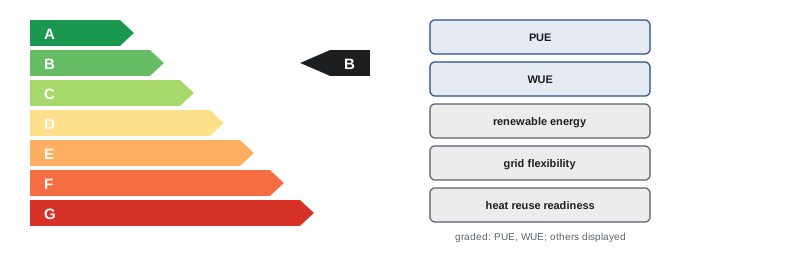
The EU has the most detailed data center rules. The recast Energy Efficiency Directive (EU) 2023/1791 requires operators of data centers with installed IT power of at least 500 kW to report annually to a European database, under Delegated Regulation (EU) 2024/1364, key information and indicators: installed power, energy consumption, PUE, water use and WUE, renewable energy share, waste heat reuse, cooling temperatures and other data, with first reports made in 2024. In September 2026, the Commission adopted a further delegated regulation establishing a mandatory A-to-G sustainability rating label for data centers of 500 kW or more, graded on PUE and WUE and also displaying energy sourcing, new clean capacity, grid flexibility and waste heat reuse readiness, with the first labels expected in 2027. Minimum energy performance standards for data centers are being prepared separately. Some member states go further: Germany's Energy Efficiency Act sets PUE limits for new and existing data centers, requires renewable electricity, and mandates a rising share of waste heat reuse for new facilities. Companies operating in the EU may also fall under the Corporate Sustainability Reporting Directive, whose scope and timing were narrowed in 2025.
Canada
In Canada, the Canadian Sustainability Standards Board published CSDS 1 and CSDS 2 (aligned with the ISSB standards) in December 2024 for voluntary use, federally regulated financial institutions disclose under OSFI Guideline B-15, and the Competition Act, as amended in 2024 and 2026, requires environmental claims to be substantiated. US operators with Canadian facilities or customers should expect requests for data consistent with these frameworks.
The United States
In the United States, the Securities and Exchange Commission adopted a climate disclosure rule in 2024, but it was stayed by litigation and the SEC stopped defending it in 2025. California's Climate Corporate Data Accountability Act (SB 253) requires US-organized companies with annual revenue over $1 billion doing business in California to report Scope 1 and 2 emissions, with the first reports due by November 10, 2026, and Scope 3 reporting beginning in 2027, with third-party assurance phased in; a companion law on climate-related financial risk (SB 261) has been stayed by the Ninth Circuit pending appeal. Large emitters report under the EPA's Greenhouse Gas Reporting Program, the Federal Trade Commission's Green Guides govern environmental marketing claims, and some states and utilities now require data centers to disclose energy and water use as a condition of large-load tariffs or incentives.
International frameworks
Beyond national rules, companies report against voluntary or market frameworks that regulators increasingly adopt: the ISSB's IFRS S1 (general sustainability) and S2 (climate) standards, which build on the earlier Task Force on Climate-related Financial Disclosures (TCFD) recommendations; CDP questionnaires, used by many customers to collect supplier data; and science-based targets validated by the Science Based Targets initiative (SBTi), which require emissions reductions consistent with limiting warming. Data center industry initiatives include the Climate Neutral Data Center Pact, a self-regulatory initiative of European operators with commitments on PUE, clean energy, water and circularity, and the Open Compute Project's sustainability work.
Certifications and management systems
Certifications provide independent verification of performance or practice:
- Building certifications such as LEED (which has a version for data centers) and BREEAM assess energy, water, materials and site impacts of the building design and construction.
- ISO 50001 (energy management systems) and ISO 14001 (environmental management systems) certify that an organization has systematic processes to measure, manage and improve energy and environmental performance.
- The EU Code of Conduct on Data Center Energy Efficiency recognizes operators that implement a defined set of best practices.
- Product-level labels and EPDs for equipment (Lesson 10).
Certifications are most valuable when they drive real improvement and are backed by measured performance, rather than serving as marketing badges.
Greenwashing
Greenwashing is making environmental claims that are misleading, exaggerated or unsupported. Common examples in the data center industry include claiming "100 % renewable" on the basis of unbundled certificates without explaining their nature (Lesson 8), quoting design PUE as if it were measured, claiming "carbon neutral" status through low-quality offsets, and highlighting a single green feature while omitting large impacts. Regulators in Canada, the United States and Europe have increased enforcement, and customers increasingly scrutinize claims. Credible claims are specific (what, where, which period), substantiated with data and methodology, consistent with recognized standards, and disclosed with their limitations.
Worked problem
Rewriting a claim
A marketing draft says: "Our data centers are 100 % green and carbon neutral." The facts are: annual consumption matched 100 % by RECs (60 % from a PPA with a new local wind farm, 40 % unbundled certificates from another region), hourly CFE 58 %, annual PUE 1.32 measured, and remaining emissions covered by forestry offsets. How should the claim be rewritten?
Show solution
- Avoid vague terms ("green", "carbon neutral") that imply no environmental impact.
- State the procurement precisely: "In 2026, we matched 100 % of our annual electricity use with renewable energy certificates, 60 % from a long-term contract with a new wind farm on our local grid."
- Add the hourly figure and efficiency: "On an hourly basis, 58 % of our consumption was matched with carbon-free energy. Our measured annual PUE was 1.32."
- Describe offsets separately and accurately, if at all, rather than presenting them as emission reductions.
Answer: The rewritten claim is specific, verifiable and honest about limitations, which protects the company legally and builds trust with customers who can see both the achievement and the work remaining.
Building a reporting system
Credible reporting depends on data systems as much as policies. A data center operator needs metering at the right points with documented accuracy; automated data collection into a central database rather than spreadsheets; documented calculation methods and emission factors with version control; clear organizational boundaries (which sites, which customers' loads); review and approval workflows; and audit trails so that third-party verifiers can trace every reported number to its source. Many regulations now require limited or reasonable assurance by independent auditors, which is far easier when systems are designed for it.
# Portfolio sustainability KPIs for an annual report: four sites
sites = [
    # name, IT MWh, facility MWh, water m3, contracted clean MWh, grid g/kWh, installed IT kW
    ("Site A", 150000, 189000, 210000, 189000, 420, 25000),
    ("Site B", 60000, 69000, 4000, 30000, 30, 9000),
    ("Site C", 2400, 3600, 0, 0, 380, 450),
    ("Site D", 90000, 117000, 95000, 60000, 300, 14000),
]
print("Site      PUE   WUE  REF   CUE loc  CUE mkt  EU reporting (>= 500 kW)")
tot = [0, 0, 0, 0, 0, 0]
for name, it, fac, water, clean, g, kw in sites:
    pue, wue, ref = fac / it, water / it, clean / fac
    loc = fac * g / 1000                               # t CO2e
    mkt = (fac - clean) * g * 1.1 / 1000               # residual mix assumed 10 % above grid average
    flag = "yes" if kw >= 500 else "no"
    print(f"{name:<8} {pue:5.2f} {wue:5.2f} {ref:4.0%} {loc / it:8.3f} {mkt / it:8.3f}  {flag}")
    for i, v in enumerate((it, fac, water, clean, loc, mkt)):
        tot[i] += v
it, fac, water, clean, loc, mkt = tot
print(f"Portfolio PUE {fac / it:.2f}, WUE {water / it:.2f} L/kWh, REF {clean / fac:.0%}")
print(f"Scope 2: location-based {loc:,.0f} t, market-based {mkt:,.0f} t")Site PUE WUE REF CUE loc CUE mkt EU reporting (>= 500 kW) Site A 1.26 1.40 100% 0.529 0.000 yes Site B 1.15 0.07 43% 0.035 0.021 yes Site C 1.50 0.00 0% 0.570 0.627 no Site D 1.30 1.06 51% 0.390 0.209 yes Portfolio PUE 1.25, WUE 1.02 L/kWh, REF 74% Scope 2: location-based 117,918 t, market-based 21,602 t
The roll-up shows why portfolio reporting needs site detail. The portfolio PUE of 1.25 hides a small site at 1.50, and the market-based Scope 2 total of about 22,000 t looks very different from the location-based 118,000 t. Site A achieves 100 % renewable matching on paper while operating on a 420 g/kWh grid, and uses the most water. Disclosing both portfolio totals and site-level indicators lets readers see where performance is strong and where improvement is needed.
Customer and supply chain data requests
In practice, much reporting effort goes into answering customers. Large technology companies and enterprises send detailed questionnaires to their colocation and cloud providers, asking for energy use, PUE, WUE, renewable energy matching (often hourly), Scope 1 and 2 emissions allocated to their footprint, refrigerant use and embodied carbon data. Some require contractual commitments, such as minimum renewable shares, efficiency targets or data delivery schedules. Providers that build standardized, auditable data products for customers, such as monthly reports of each customer's allocated energy, emissions and hourly CFE, save effort and gain a commercial advantage.
Preparing for change
Because sustainability regulation is evolving quickly in every jurisdiction, operators benefit from designing reporting systems that can produce more than current rules require: hourly energy data, site-level water and heat data, refrigerant records and embodied carbon estimates. Data that are collected well today can satisfy tomorrow's rules with little extra effort, while data that were never collected cannot be recreated. Tracking proposed rules, participating in industry consultations, and reviewing compliance obligations at least annually help avoid surprises when new requirements take effect.
Common mistakes
MistakeTreating reporting as a communications exercise.
InsteadBuild auditable data systems and documented methods.
MistakeUsing vague claims such as "green" or "carbon neutral".
InsteadMake specific, substantiated, time-bound claims with limitations.
MistakeReporting only portfolio averages.
InsteadDisclose site-level indicators alongside totals.
MistakeAssuming regulations are stable.
InsteadMonitor rule changes in each jurisdiction and update reporting.
MistakeRelying on certifications without measured performance.
InsteadBack certifications with measured PUE, WUE, CFE and emissions.
Summary and key terms
- Reporting serves customers, investors, regulators, communities and operators.
- The EU requires reporting for data centers of 500 kW or more and is introducing an A-to-G label.
- Canada uses voluntary CSSB standards, OSFI B-15 for financial institutions, and substantiation rules for green claims.
- In the US, California SB 253 requires large companies to report Scope 1 and 2 emissions from 2026.
- ISSB standards, CDP, SBTi and industry pacts shape voluntary reporting.
- Certifications such as LEED, ISO 50001 and ISO 14001 add verification.
- Avoid greenwashing with specific, substantiated claims and auditable data systems.
- Energy Efficiency Directive
- EU law including data center reporting requirements.
- Rating label
- A graded label of a data center's sustainability performance.
- ISSB
- International Sustainability Standards Board.
- CSSB
- Canadian Sustainability Standards Board.
- SB 253
- California's Climate Corporate Data Accountability Act.
- SBTi
- Science Based Targets initiative.
- ISO 50001
- The international standard for energy management systems.
- Greenwashing
- Misleading or unsupported environmental claims.
- Assurance
- Independent verification of reported information.
- Organizational boundary
- The scope of operations included in a report.
Practice problems
Work each problem on paper first, then reveal the answer to check.
Which EU data centers must report under the Energy Efficiency Directive?
Show answer
Those with installed IT power of at least 500 kW.
Which two indicators grade the EU rating label?
Show answer
PUE and WUE.
When are the first California SB 253 reports due, and for which scopes?
Show answer
By 10 November 2026, for Scope 1 and 2.
What do the CSSB's CSDS 1 and CSDS 2 align with?
Show answer
The ISSB's IFRS S1 and S2.
Name two management system standards relevant to data centers.
Show answer
ISO 50001 and ISO 14001.
Give two examples of greenwashing in data centers.
Show answer
Unexplained "100 % renewable" from unbundled RECs, design PUE presented as measured, carbon neutral via low-quality offsets.
What makes an environmental claim credible?
Show answer
Specific, substantiated, consistent with standards and disclosing limitations.
From the output, which site does not reach the EU reporting threshold?
Show answer
Site C, at 450 kW.
From the output, how do location- and market-based Scope 2 compare?
Show answer
About 118,000 t versus 22,000 t.
Name three features of an auditable reporting system.
Show answer
Metering, automated collection, documented methods, boundaries, approvals, audit trails.
Lesson quiz · 5 questions
Score 60% or more to complete this lesson.
Create a free account to save your progress, take quizzes and earn a certificate.