
DCE-460 · Lesson 8 of 12 · 24 min
Clean energy procurement and 24/7 matching
Because electricity dominates a data center's emissions (Lesson 7), the energy it buys matters more than almost any design decision. Data center operators are among the world's largest buyers of renewable energy, and their purchases have financed many gigawatts of wind and solar. But the way clean energy is matched to consumption is changing. Matching annual consumption with renewable certificates allows a facility to claim 100 % renewable energy while running on fossil power at night and in calm weather. A growing number of operators now aim for 24/7 carbon-free energy: matching consumption with clean generation in every hour, on the same grid. This lesson reviews the procurement instruments (covered in more depth in DCE-420, Lesson 5), explains additionality and deliverability, introduces hourly matching and the carbon-free energy score, and shows how portfolios of wind, solar, storage and firm clean power, together with flexible loads, achieve high hourly matching.
Procurement instruments
The main ways a data center obtains clean electricity are:
- On-site generation: rooftop or adjacent solar, rarely more than a few percent of a large facility's demand because of limited area.
- Utility green tariffs and supply programs, in which the utility procures renewable energy on the customer's behalf.
- Physical power purchase agreements (PPAs): long-term contracts to buy electricity and its attributes from a specific new project, delivered through the grid.
- Virtual (financial) PPAs: contracts for differences that pay the project a fixed price while the buyer keeps the certificates; electricity is bought separately from the local utility.
- Unbundled energy attribute certificates (RECs): certificates bought separately from any electricity, often cheap and from distant or existing projects.
Instruments differ in their real-world effect. A long-term PPA with a new project helps finance generation that would not otherwise be built; buying unbundled certificates from an old hydro dam may change nothing physically.
Additionality and deliverability
Two concepts determine whether a clean energy purchase actually reduces emissions. Additionality asks whether the purchase causes new clean generation that would not have happened anyway. Long-term contracts with new projects are generally considered additional; certificates from long-established facilities are not. Deliverability asks whether the clean energy can physically reach the load: a solar farm in a distant, congested grid region cannot supply a data center on a different grid, even if certificates can be transferred on paper. The most credible procurement combines additional projects on the same grid as the load, ideally in the same hours.
From annual to hourly matching
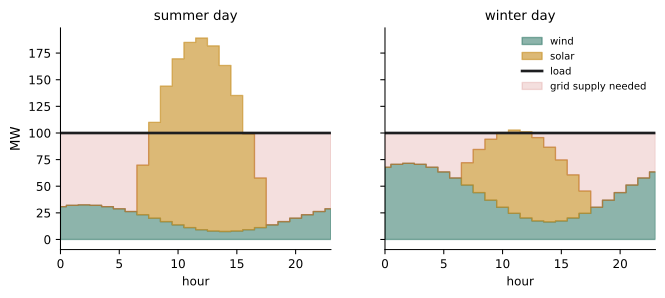
Under annual matching, a facility that consumes 876,000 MWh a year and holds certificates for 876,000 MWh of renewable generation claims 100 % renewable energy, regardless of when that generation occurred. If the certificates come from solar farms, they were all generated in daylight, while the facility also consumed at night from the grid, which may then be supplied by gas or coal. Hourly (24/7) matching compares clean supply with consumption hour by hour: in each hour, only the clean energy generated (or discharged from storage) in that hour on the same grid counts toward that hour's consumption. The carbon-free energy (CFE) score is the share of annual consumption matched this way:
Excess clean energy in one hour cannot be carried to another hour except through storage. The grid's own clean generation in each hour (for example from hydro or nuclear plants already on the system) is often counted too, in proportion to the facility's share of grid supply.
import numpy as np

# Hourly carbon-free energy (CFE) matching for a flat 100 MW load over one year
rng = np.random.default_rng(8)
h = np.arange(8760); hod = h % 24; doy = h // 24
load = np.full(8760, 100.0)

season = 0.75 + 0.25 * np.cos(2 * np.pi * (doy - 172) / 365)
solar = np.clip(np.sin(np.pi * (hod - 6) / 12), 0, None) * season * rng.uniform(0.5, 1.0, 365).repeat(24)
wind_daily = np.clip(rng.gamma(2.0, 0.18, 365), 0, 1).repeat(24)
wind = np.clip(wind_daily + rng.normal(0, 0.08, 8760), 0, 1)
solar, wind = solar / solar.mean(), wind / wind.mean()      # normalize so each profile averages 1.0

def cfe(supply, storage_MWh=0.0, eff=0.88):
    soc, matched = 0.0, 0.0
    for s, l in zip(supply, load):
        if s >= l:
            matched += l
            soc = min(storage_MWh, soc + (s - l) * eff)
        else:
            discharge = min(soc, l - s)
            soc -= discharge
            matched += s + discharge
    return matched / load.sum()

portfolios = {
    "100 % annual match, solar only": 100 * solar,
    "100 % annual match, 50/50 solar and wind": 50 * solar + 50 * wind,
    "150 % annual match, solar and wind": 75 * solar + 75 * wind,
    "Solar and wind 100 % plus 30 MW firm clean": 35 * solar + 35 * wind + 30,
}
for name, supply in portfolios.items():
    print(f"{name:<45} hourly CFE {cfe(supply):5.1%}")
s = 75 * solar + 75 * wind
label = "150 % solar and wind plus 400 MWh storage"
print(f"{label:<45} hourly CFE {cfe(s, 400):5.1%}")100 % annual match, solar only hourly CFE 43.8% 100 % annual match, 50/50 solar and wind hourly CFE 69.4% 150 % annual match, solar and wind hourly CFE 79.5% Solar and wind 100 % plus 30 MW firm clean hourly CFE 78.6% 150 % solar and wind plus 400 MWh storage hourly CFE 92.8%
Solar alone, sized to match 100 % of annual consumption, matches only about 44 % of hours' consumption, because it produces nothing at night and too much at midday. Combining solar and wind raises the score to about 70 %, because wind often blows at night and in winter. Over-procuring to 150 % of annual consumption reaches about 80 %, with large surpluses at times. Adding 400 MWh of storage to that portfolio, shifting midday surpluses into the night, lifts the score above 90 %. Replacing part of the variable portfolio with firm clean power (such as geothermal, hydro or nuclear) gives a high score with much less over-procurement. These simulated numbers are illustrative, but the pattern matches real studies: the last 10 to 20 % of hourly matching is the hardest and most expensive, and firm clean resources and storage become essential.
Firm clean power and storage
Because data centers run around the clock, their ideal clean supply is also around the clock. Resources that can provide it include hydroelectricity (in regions that have it), nuclear power (existing plants and, potentially, new small modular reactors, for which several technology companies have signed agreements), geothermal (including new enhanced geothermal systems), and fossil generation with carbon capture. Batteries shift solar and wind energy over hours, and longer-duration storage technologies are emerging. Each has different costs, timelines and risks, and many are years from large-scale availability, so most 24/7 strategies combine near-term wind, solar and batteries with longer-term firm resources.
Flexible and carbon-aware loads
Data centers can also adjust their demand to match clean supply. Much computing is time-sensitive (a web search must be answered now), but some is flexible: batch processing, data analytics, some AI training jobs, and backups. Carbon-aware computing shifts flexible work to hours when the grid is cleaner or clean supply is abundant, or to data centers in other regions with cleaner grids at that moment. Large operators have demonstrated shifting a few percent of load, enough to improve hourly matching and to reduce marginal emissions. Data centers can also provide demand response to the grid: reducing load or switching to on-site resources during peak periods, which helps integrate renewables and avoid building peaking plants. On-site batteries and UPS energy storage, with proper protection of reliability, can contribute to grid services. These capabilities are increasingly valued by utilities facing rapid load growth and may be required for new large-load interconnections.
Choosing a strategy
A clean energy strategy for a data center portfolio typically moves through stages: first, measure consumption by site and hour, and calculate location-based emissions and current hourly CFE; second, procure long-term contracts with new wind and solar projects on the same grids as the largest loads; third, add storage and firm clean resources to fill the gaps, and develop load flexibility; and finally, work with utilities and policymakers on grid-level decarbonization, including transmission. Throughout, report transparently: annual renewable match, hourly CFE score, location-based and market-based emissions (Lesson 7).
In the United States, options vary by market. In organized wholesale markets such as PJM, ERCOT and MISO, corporate buyers commonly sign virtual PPAs; in vertically integrated states, utility green tariffs and special contracts for large loads are typical. Hourly matching requirements have entered federal policy through the clean hydrogen tax credit rules, and several large technology companies have signed long-term agreements for nuclear power, including restarts of existing reactors and new small modular reactors.
Worked problem
Evaluating a procurement proposal
A data center operator on a grid with 40 % hourly clean generation is offered two options: (a) unbundled RECs from wind farms in another region covering 100 % of annual consumption, at low cost; (b) a 15-year PPA with a new solar-plus-storage project on the same grid covering 60 % of annual consumption, raising its estimated hourly CFE to 75 %. Compare them.
Show solution
- Option (a) allows an annual "100 % renewable" claim and zero market-based Scope 2 under current rules, but it is not additional to the local grid and does not change hourly matching on the operator's grid, which stays at about 40 %.
- Option (b) finances new local clean generation (additional and deliverable), raises hourly CFE to about 75 %, and reduces location-relevant emissions, but leaves 40 % of annual consumption unmatched in market-based terms.
- Under evolving accounting rules and customer expectations, which increasingly favor hourly, local and additional procurement, option (b) carries more credibility and less risk of being judged greenwashing.
Answer: Option (b) has far greater real-world impact, even though it supports a smaller annual claim. Many operators combine such projects with transparent reporting of their hourly CFE, and treat unbundled certificates as a transitional tool at most.
Whatever the instruments, procurement teams should model the hourly CFE of proposed portfolios before signing, using realistic generation profiles for each project and the facility's expected load shape, so that contracts are chosen for their contribution to round-the-clock matching rather than annual volume alone.
Common mistakes
MistakeEquating annual 100 % renewable matching with running on clean energy.
InsteadMeasure hourly CFE on the same grid.
MistakeBuying unbundled certificates from distant, existing projects.
InsteadPrioritize additional, deliverable projects on the same grid.
MistakeOver-relying on solar for a flat load.
InsteadCombine solar with wind, storage and firm clean resources.
MistakeTreating all computing as inflexible.
InsteadIdentify flexible workloads for carbon-aware scheduling and demand response.
MistakeReporting only the most favorable metric.
InsteadReport annual match, hourly CFE and both Scope 2 methods.
Summary and key terms
- Instruments include on-site generation, green tariffs, physical and virtual PPAs and unbundled certificates.
- Additionality and deliverability determine real-world impact.
- Hourly matching counts clean supply only in the hour and grid where it occurs; the CFE score measures it.
- Solar alone matches few hours; wind, over-procurement, storage and firm clean power raise CFE.
- The last 10 to 20 % of hourly matching is the hardest.
- Flexible loads, carbon-aware computing and demand response help match supply and support the grid.
- Strategies combine measurement, local additional contracts, firm resources, flexibility and transparent reporting.
- PPA
- Power purchase agreement: a long-term contract to buy electricity and attributes.
- Virtual PPA
- A financial contract for differences tied to a renewable project.
- Unbundled REC
- A certificate bought separately from electricity.
- Additionality
- Causing new clean generation that would not otherwise occur.
- Deliverability
- Physical ability of generation to reach the load on the grid.
- Hourly matching
- Matching consumption with clean supply in each hour.
- CFE score
- Share of consumption matched by carbon-free energy hour by hour.
- Firm clean power
- Carbon-free generation available on demand around the clock.
- Demand response
- Reducing or shifting load in response to grid conditions.
- Carbon-aware computing
- Shifting flexible computing to cleaner times or places.
Practice problems
Work each problem on paper first, then reveal the answer to check.
What is the difference between a physical and a virtual PPA?
Show answer
A physical PPA delivers electricity; a virtual PPA is a financial contract while power is bought locally.
What does additionality mean?
Show answer
The purchase causes new clean generation that would not otherwise happen.
Why can annual matching overstate clean energy use?
Show answer
Clean generation in some hours is counted against consumption in other hours.
In an hour with 80 MW load and 120 MW clean supply, how much is matched?
Show answer
80 MW; the surplus does not count for other hours without storage.
From the output, what CFE does solar alone achieve at 100 % annual match?
Show answer
About 44 %.
From the output, what does adding 400 MWh of storage achieve?
Show answer
Raises CFE from about 80 % to about 93 %.
Name three firm clean resources.
Show answer
Hydro, nuclear, geothermal, fossil with carbon capture.
Give two examples of flexible data center workloads.
Show answer
Batch processing, analytics, some AI training, backups.
Why is the last 10 to 20 % of hourly matching hardest?
Show answer
It covers long calm, dark periods that need storage or firm resources.
In the example, why is option (b) more credible?
Show answer
It is additional, deliverable on the same grid and raises hourly matching.
Lesson quiz · 5 questions
Score 60% or more to complete this lesson.
Create a free account to save your progress, take quizzes and earn a certificate.