
CRE-340 · Lesson 8 of 12 · 29 min
Paid amplification: whitelisting, Spark Ads and partnership ads
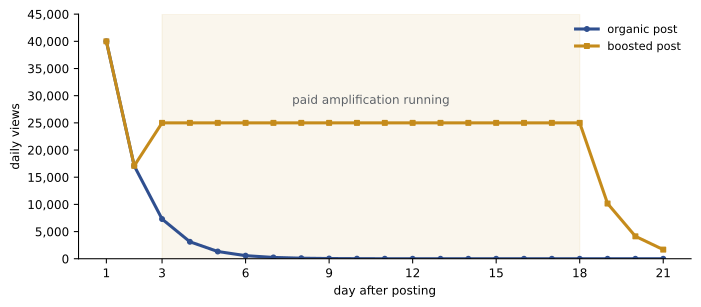
Organic creator posts reach only part of a creator's audience, and most of that reach happens in the first day or two. Paid amplification uses advertising budget to push creator content further: to more of the creator's followers, to lookalike audiences, to people who visited the brand's website, or to entirely new audiences selected by the platform's targeting. Done well, amplification turns the best creator content into some of the most efficient advertising a brand runs. Done badly, it wastes money on weak posts or runs content beyond the rights the brand paid for. This lesson explains the main amplification methods, how to choose which content to amplify, how to budget and test, and the rights and disclosure issues involved.
Why amplify creator content
Creator content often outperforms brand-produced ads because it looks native to the platform, carries a recognizable human voice and benefits from the social proof of a real person's endorsement. Many performance marketers now treat creator content as their main source of ad creative. Amplification also solves a planning problem: organic reach is unpredictable, while paid reach can be bought at a known price. By combining a creator's credibility with paid targeting and budget control, brands get the best of both.
Amplification also extends the useful life of content. An organic post may stop gaining views after 48 hours, but the same video run as an ad can deliver results for weeks, until audiences tire of it. Because the creative is already made and approved, the cost of each additional impression is only the media cost.
The main amplification methods
Platforms offer several ways for brands to run ads using creator content. The names change frequently, so check the current terms on each platform, but the underlying models are similar.
- Boosting or authorizing the creator's own post. The creator grants the brand permission to promote an existing post from the creator's account. On TikTok this is known as Spark Ads: the creator generates an authorization code for a specific video and chooses how long the authorization lasts, and the brand enters the code in its ad account. The ad appears from the creator's account, and engagement accumulates on the original post.
- Partnership or co-branded ads. Meta's partnership ads show both the creator's and the brand's names on an ad, using either an existing post or new content, and the creator approves the partnership. YouTube's creator partnership tools, renamed in 2026 from BrandConnect to YouTube Creator Partnerships, let advertisers turn creator videos into ads through Google Ads.
- Whitelisting. In the broader sense, whitelisting means the creator gives the brand access to run ads through the creator's identity, sometimes including new ads the creator did not post organically. Some agencies use the term creator licensing instead. Permissions are now usually granted through platform tools rather than by sharing passwords, which should never happen.
- Dark posts. These are ads that use a creator's identity or content but never appear on the creator's profile feed. They let brands test many variations without cluttering the creator's page.
- Brand-handle ads with creator content. The brand licenses the content and runs it from its own account. This needs only a usage license, not account access, but loses the creator's name and social proof in the ad header.
| Method | Appears from | Needs | Typical strengths |
|---|---|---|---|
| Authorized creator post (e.g. Spark Ads) | Creator account | Post-level authorization code, usage license | Native look, engagement builds on original post |
| Partnership ads | Creator and brand together | Creator approval in platform, usage license | Social proof plus brand clarity, flexible targeting |
| Whitelisting or creator licensing | Creator identity | Account-level ad permission, usage license | Many variations, new copy and audiences |
| Dark posts | Creator identity, not on feed | Ad permission, usage license | Testing without cluttering the feed |
| Brand-handle ads | Brand account | Usage license only | Simple rights, full brand control |
Rights, permissions and pricing
Every amplification method requires a usage license in the contract covering paid use, its duration, the platforms and the territories. Methods that run ads through the creator's identity also require platform permissions and, usually, an additional fee because the creator is lending their name and reputation to ads they may not see in advance. Creators commonly price paid usage and whitelisting as a percentage of their base fee per month, as Lesson 6 showed.
Brands should track authorization periods carefully. Authorization codes and partnership permissions have expiry dates, and creators can revoke them. If an ad stops delivering suddenly, an expired or revoked permission is often the cause. The contract should say what happens if a creator revokes permission early, for example a pro-rata refund of the usage fee.
Creators reasonably want control over what is said in their name. Good contracts give creators approval rights over new ad copy, headlines and calls to action, and set limits on targeting, for example excluding audiences the creator would find inappropriate. Running ads with exaggerated claims under a creator's identity can damage the creator's reputation and create legal risk for both parties.
Disclosure in paid creator ads
Ads that use a creator's identity are still endorsements, and the audience must be able to tell they are paid. Platform ad formats usually add a "sponsored" label and, for partnership ads, a "paid partnership" label, but the content itself should not contain claims that imply the creator is speaking spontaneously if they are not. If the ad uses new copy written by the brand, it must still reflect the creator's honest views; a brand cannot put words in a creator's mouth that the creator does not believe.
US advertisers should apply the same FTC Act standards and Endorsement Guides to amplified creator content as to organic posts. Ads that use a creator's name and likeness beyond the scope of consent can also raise right-of-publicity claims under state law, which several states protect by statute.
Choosing what to amplify
Not every creator post deserves paid support. The usual approach is to let posts run organically for a day or two, then amplify the ones with the strongest early signals. Useful signals include high watch time or completion rate, a strong hook rate (the share of viewers who keep watching past the first few seconds), above-median saves and shares, positive comment sentiment and, for conversion campaigns, high click-through rates. Organic performance is not a perfect predictor of paid performance, because paid audiences differ from followers, so many brands run a small test budget across the top few candidates and scale the winners.
Worked problem
Choosing posts for amplification
After 48 hours, four creator videos show these completion rates and click-through rates: A 32 % and 0.6 %; B 18 % and 1.4 %; C 41 % and 1.1 %; D 25 % and 0.5 %. The campaign's primary KPI is purchases. Which two should be tested with paid budget first?
Show solution
- For a purchase KPI, click-through rate matters most, with completion rate as a sign of engaging creative.
- C has the best completion rate and the second-best CTR.
- B has the best CTR, though completion is lower.
- A and D have the weakest CTRs.
Answer: Test C and B first; keep A as a possible awareness ad if the brand also values reach.
Budgeting amplification
Amplification budgets can be planned from impression targets or from conversion targets. For reach and awareness, divide the target impressions by 1,000 and multiply by the expected paid CPM. For conversions, divide the target number of conversions by the expected conversion rate per impression, or multiply target conversions by an expected CPA. Use the brand's own ad history where possible; creator content often achieves lower CPAs than brand-made creative, but results vary widely.
Worked problem
Budget from an impression target
A brand wants 3 million extra impressions in its target audience from amplified creator videos. Its recent paid CPM for similar audiences is $9.50. What budget is needed?
Show solution
- Thousands of impressions: 3,000,000 ÷ 1,000 = 3,000.
- Budget: 3,000 × $9.50 = $28,500.
Answer: About $28,500, plus a margin for higher CPMs at busy times such as the holiday season.
Worked problem
Comparing creator and brand creative
In a split test with equal budgets of $5,000, a brand-produced ad generated 125 purchases and an amplified creator video generated 200 purchases. What is the CPA of each, and how much would the brand save per 1,000 purchases by switching?
Show solution
- Brand ad CPA: 5,000 ÷ 125 = $40.
- Creator ad CPA: 5,000 ÷ 200 = $25.
- Saving per purchase: $15; per 1,000 purchases: $15,000, before deducting the creator's usage fee.
Answer: Brand ad $40 CPA, creator ad $25 CPA; switching saves about $15,000 per 1,000 purchases, less the usage and whitelisting fees.
Frequency, fatigue and refreshing content
Even great creative wears out. As the same people see an ad repeatedly, click-through rates fall and costs rise, a pattern called creative fatigue. Watch frequency, the average number of times each person has seen the ad, alongside performance trends. When CPA rises steadily while frequency climbs, it is time to rotate in new content. A steady supply of fresh creator content is one of the main reasons brands run always-on creator programs rather than one-off campaigns.
Testing helps too. Variations of the same creator video with different hooks, captions, lengths or calls to action can be tested against each other. With creators' agreement, brands can edit content into several versions, which is why contracts often request raw footage and permission to make edits within agreed limits.
Coordinating organic and paid teams
Amplification sits at the boundary between the creator team and the paid media team, and coordination matters. The creator team secures the right permissions and content; the paid team chooses audiences, budgets and bidding; both need the same data on which posts are performing. Agree in advance who requests authorization codes, who checks that permissions match the contract, who monitors ad comments and who reports results. Ad comments on creator posts can be numerous and sometimes negative; the creator should not be left to handle a flood of comments generated by the brand's ad spending alone.
Targeting amplified creator content
Targeting choices shape how amplified content performs. Common audiences include the creator's own followers and people who engaged with their content, which reinforces the message with warm audiences; lookalike audiences built from the brand's customers; interest and behavior targeting based on the campaign's audience description; and retargeting of people who visited the brand's site or watched part of a video. Testing two or three audience types against each other with the same creative shows where creator content works best. Exclude existing customers from acquisition campaigns where possible, or the results will flatter the ads by counting people who would have bought anyway.
Finally, report amplified and organic results separately as well as together. Combining them hides which part of the effect came from the creator's own audience and which came from paid distribution, and the two cost very different amounts per result.
Common mistakes
MistakeAmplifying every creator post equally.
InsteadAmplify posts with strong early signals and test before scaling.
MistakeRunning ads after the authorization or license has expired.
InsteadTrack expiry dates and contract terms for every amplified post.
MistakeAsking creators to share account passwords.
InsteadUse platform permission tools only.
MistakeWriting new ad copy in a creator's voice without approval.
InsteadGive creators approval rights over copy that runs under their name.
MistakeIgnoring creative fatigue.
InsteadMonitor frequency and CPA trends and refresh content.
Summary and key terms
- Amplification extends the reach and life of creator content with paid budget.
- Methods include authorized creator posts such as Spark Ads, partnership ads, whitelisting, dark posts and brand-handle ads.
- All need a paid-usage license; identity-based methods also need platform permissions and usually an extra fee.
- Disclosure and honest-opinion rules apply to amplified content as well as organic posts.
- Choose content to amplify using early signals and small tests.
- Budget = target impressions ÷ 1,000 × paid CPM, or target conversions × expected CPA.
- Watch frequency and fatigue, and coordinate creator and paid media teams.
- Paid amplification
- Using ad budget to extend the reach of creator content.
- Spark Ads
- TikTok ads that promote a creator's post with authorization.
- Partnership ads
- Ads showing both creator and brand identities.
- Whitelisting
- Permission for a brand to run ads through a creator's identity.
- Dark post
- An ad that does not appear on the account's feed.
- Authorization code
- A code a creator generates to let a brand promote a post.
- Hook rate
- Share of viewers who keep watching past the opening seconds.
- Creative fatigue
- Declining ad performance as audiences see it repeatedly.
- Frequency
- Average number of times each person sees an ad.
- Usage license
- Contractual permission to use content in stated ways.
Practice problems
Work each problem on paper first, then reveal the answer to check.
Why does creator content often perform well as ads?
Show answer
It looks native and carries a real person's endorsement.
What does a Spark Ads authorization code allow?
Show answer
A brand to promote a specific creator post for a set period.
Which method needs only a usage license, not account permissions?
Show answer
Brand-handle ads.
Target 2 million impressions at $12 CPM. Budget?
Show answer
$24,000.
$6,000 spend, 150 purchases. CPA?
Show answer
$40.
Name two early signals for choosing posts to amplify.
Show answer
Completion rate, hook rate, saves, shares, CTR, sentiment.
What is creative fatigue?
Show answer
Falling performance as audiences see an ad repeatedly.
What should happen if a creator revokes permission early?
Show answer
Follow the contract, often a pro-rata refund of usage fees.
Why give creators approval over new ad copy?
Show answer
It runs under their name and reputation.
What did YouTube rename BrandConnect in 2026?
Show answer
YouTube Creator Partnerships.
Lesson quiz · 5 questions
Score 60% or more to complete this lesson.
Create a free account to save your progress, take quizzes and earn a certificate.