
CRE-340 · Lesson 1 of 12 · 30 min
Influencer marketing in the marketing mix
Earlier courses in this stream looked at brand partnerships from the creator's chair: how to build a media kit, price a post, pitch a brand and deliver on a brief. This course turns the chair around. You are now the marketer, agency planner or brand manager who has to decide whether to use creators at all, which ones to hire, how much to spend, how to keep the work legal and how to prove it paid off. Many creators eventually do this work themselves, running campaigns for their own products or managing other creators, so seeing the buyer's side makes you a better seller as well.
The course follows a campaign from first idea to final report. This lesson places influencer marketing within the wider marketing mix. Later lessons cover objectives and KPIs, audience strategy and creator tiers, finding and vetting creators, budgets and buying models, briefs and contracts, running campaigns at scale, paid amplification, attribution, measurement, fraud and crisis management, and a capstone in which you build a complete campaign plan and a post-campaign report. CRE-320 covers advertising law in depth, so this course stays at the level a campaign manager needs and points there for detail.
What brands are buying
When a brand pays a creator, it can be buying several different things at once, and confusion about which one is the main purpose is the most common cause of disappointing campaigns. The first is attention: the creator's content reaches people the brand would otherwise have to pay a platform to reach through ads. The second is trust: a recommendation from a person the audience chose to follow carries more weight than a banner. The third is content: creators are skilled, fast and cheap producers of photos and video that feel native to each platform, and brands increasingly reuse that content in their own ads and channels. The fourth is cultural relevance: a creator can place a product inside a community, a joke format or a trend in a way a brand voice cannot. The fifth, for some campaigns, is direct sales through links and codes.
A good campaign plan says which of these is the priority. A skincare launch aimed at awareness may care most about attention and trust. A direct-to-consumer brand that runs heavy paid social may care most about content it can turn into ads. A software company may want a handful of credible experts whose explanations reduce sales friction. Each priority leads to different creators, different deliverables, different contracts and different measures of success.
Paid, owned, earned and shared media
Marketers often sort channels into paid, owned and earned media. Paid media is space the brand buys, such as search ads, social ads and television spots. Owned media is the brand's own website, email list, app and social accounts. Earned media is attention the brand did not pay for directly: press coverage, word of mouth, reviews and organic social mentions. Some planners add shared media for content that spreads on social platforms through likes, shares and comments.
Influencer marketing does not fit neatly into one box, which is part of why it is both powerful and hard to manage. A paid sponsorship is bought like media but looks like earned word of mouth. Gifting a product with no obligation to post is closer to public relations, and any posts that follow look earned even though a material connection exists. Content licensed from a creator and posted on the brand's channels becomes owned media, and the same content run as an ad becomes paid media. Because the categories blur, so do the budgets: influencer spending may sit with the public relations team, the social media team, the performance marketing team or a dedicated creator team, and turf disputes are common.
A practical consequence is that a brand needs to decide early who owns creator work, which budget pays for it and which team's metrics will judge it. A public relations team may value mentions and sentiment, a performance team may value cost per acquisition, and a brand team may value awareness lift. None of these is wrong, but a campaign cannot be optimized for all of them at once.
The marketing funnel and where creators fit
The marketing funnel describes the stages a customer passes through on the way to buying and, ideally, buying again. A simple version has five stages: awareness, consideration, conversion, loyalty and advocacy. Real customers do not move in a straight line, and many models replace the funnel with a loop or a flywheel, but the funnel remains a useful way to match tactics to goals.
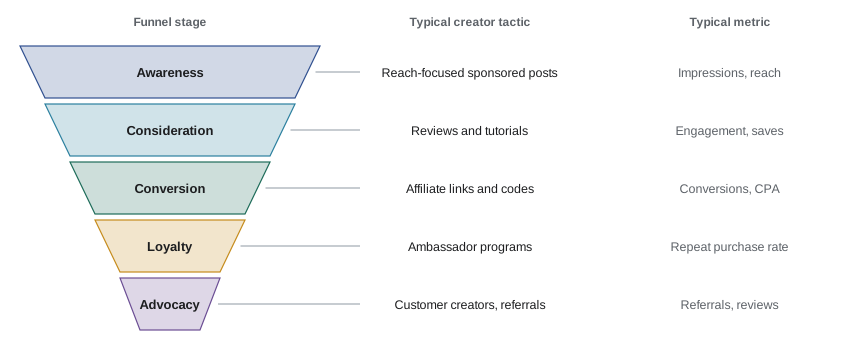
At the awareness stage, creators with large or highly relevant audiences introduce a product to people who have not heard of it. Typical measures are impressions, reach, video views and, if the brand runs a survey, ad recall or awareness lift. At the consideration stage, people compare options; reviews, tutorials, unboxings and side-by-side comparisons help, and the measures shift to engagement, saves, watch time, link clicks and site visits. At the conversion stage, affiliate links, discount codes and limited offers push people to buy, and the measures are conversions, revenue, cost per acquisition and return on ad spend. Loyalty and advocacy programs use long-term ambassadors and existing customers who create content, and their measures include repeat purchase rates, community growth and referrals.
A frequent planning error is to buy for one stage and measure another. A brand that pays for a beautiful awareness video from a lifestyle creator and then judges it on next-day sales will usually be disappointed, and a brand that chooses creators purely on affiliate sales may starve the top of the funnel and see sales shrink a few months later. Lesson 2 shows how to set objectives and KPIs that match the stage.
How big is influencer marketing?
Estimates of the size of the industry vary widely because researchers define it differently. Some count only payments to creators for sponsored content; others add agency fees, platform tools, affiliate commissions and the paid media used to amplify creator content. Influencer Marketing Hub, a trade publisher, estimated the global market at about US$24 billion in 2024 and about US$32.6 billion in 2025. Broader estimates of the whole creator economy, which includes platform ad revenue sharing, subscriptions and creator-owned products, run into the hundreds of billions. Treat any single figure as an estimate and check how it was defined before quoting it in a budget proposal.
Surveys of marketers point the same way even if the numbers differ. In Influencer Marketing Hub's 2026 benchmark survey, published in May 2026, nearly nine in ten respondents expected their influencer budgets to rise, about two-thirds ran influencer marketing entirely in-house rather than through an agency, and TikTok was the platform most often included in investment plans. The same survey found that the largest planned increases were in nano and micro creators, an important shift that Lesson 3 examines.
| Measure | Typical source | What to check before quoting it |
|---|---|---|
| Global influencer marketing spend | Trade publishers, research firms | Does it include paid amplification, agency fees and affiliates? |
| Creator economy size | Investment banks, consultancies | Usually includes platform payouts and creator products |
| Share of marketers increasing budgets | Annual marketer surveys | Sample size, who responded and how they were recruited |
| Average engagement rates | Analytics vendors | Mean or median, by followers or by reach, and which accounts |
| Average CPMs or fees | Agencies and marketplaces | Which tiers, platforms, countries and deliverables |
Why brands use creators, and why some do not
The case for influencer marketing rests on a few recurring advantages. Creator content tends to feel more authentic than brand advertising, so it can cut through ad fatigue and ad blocking. Creators reach niche communities, such as climbers, home bakers, retro gamers or new parents, more precisely than broad targeting can. Short-form video has made creator-style content the dominant format on major platforms, and brands that cannot produce it quickly fall behind. Creator content also performs well when reused as ads, often beating polished studio work on cost per click or cost per acquisition. Finally, a long-term relationship with trusted creators can build a brand's reputation in a community over years.
There are real drawbacks as well. Results vary enormously from creator to creator and post to post, so small tests can mislead. Measurement is harder than for search or display ads because much of the effect is indirect and delayed. Fraud, in the form of purchased followers and fake engagement, wastes money. Creators can damage a brand through controversies unrelated to the campaign. Legal exposure is significant, because in both Canada and the United States the brand is responsible for misleading claims and missing disclosures in content it paid for. And creator programs take a lot of people time: finding, negotiating with, briefing, approving and paying dozens of individuals is labor-intensive compared with buying a media plan from one platform.
A sensible conclusion is that influencer marketing is one tool among many. It tends to work best when the product has a story worth telling, when the target audience spends time with creators in a clear niche, and when the brand is prepared to give creators enough creative freedom to sound like themselves. It tends to work poorly for products that are hard to demonstrate, for audiences that distrust sponsored content, and for brands that insist on scripted ads read by creators.
The players in a campaign
Even a modest campaign involves several parties. On the brand side there may be a brand manager who owns the product, a social or creator lead who runs the program, a legal or compliance reviewer, a finance contact who pays invoices and, in larger firms, a performance marketing team that runs paid amplification. Agencies come in several types: full-service creative agencies, specialist influencer agencies, talent management agencies that represent creators, and media agencies that may manage the paid side. Software platforms help with discovery, outreach, contracting, content approval, payments and reporting, and the major social platforms run their own marketplaces where brands can find creators and manage branded content.
On the creator side there may be the creator alone or a team including a manager, an agent, an editor and an accountant. Understanding who you are dealing with matters: a manager will negotiate rates and usage hard, a talent agency may represent several creators and offer packages, and an individual creator may need more help with briefs, timelines and disclosure. Lesson 7 looks at how to manage these relationships at scale.
Ethics and the brand's responsibility
Because influencer content looks like a personal recommendation, the potential to mislead is built in. A brand that runs creator campaigns has an ethical responsibility, as well as a legal one, to make sure audiences can tell when content is paid, that claims are true, that creators are not pressured into false enthusiasm, and that vulnerable audiences, especially children, are treated with care. Brands that treat disclosure as a box to tick, or quietly discourage creators from labeling posts, take legal risks and erode the trust that makes creator marketing valuable in the first place.
In the United States, the Federal Trade Commission's Endorsement Guides make clear that advertisers can be liable for misleading endorsements and missing disclosures by influencers they pay, and that they should train and monitor the people who promote their products. Lesson 6 explains what this means in practice.
Fair treatment of creators is also part of ethical practice. Paying on time, paying fairly across creators of different backgrounds, respecting creative input and being clear about usage rights all build the kind of reputation that makes the best creators want to work with a brand again.
A first look at the campaign cycle
Most campaigns follow a similar cycle, whether they involve three creators or three hundred. The brand sets objectives and KPIs, defines the audience and the message, sets a budget and chooses a buying model. It then finds and vets creators, negotiates terms, issues briefs and contracts, and receives and approves content. Content goes live on the creators' channels and, if planned, is amplified with paid media. The brand tracks results during the campaign, adjusts where possible and produces a final report that feeds into the next plan. The rest of the course follows this cycle in order.
Worked problem
Matching a goal to a funnel stage
A new oat-milk brand has strong distribution in grocery stores but low awareness. Its marketing director wants creators to "drive sales". Which funnel stage should the campaign mainly target, and what should it measure?
Show solution
- Identify the real constraint: the product is already available, but few people know it exists.
- Low awareness means the main job is at the top of the funnel: awareness and early consideration.
- Store sales cannot be tracked with links, so last-click sales will undercount the effect.
- Measure reach, video views and engagement, run a brand-lift survey if budget allows, and compare store sales in test and control regions over the campaign period.
Answer: Target awareness and consideration, measuring reach, views and awareness lift, with a regional sales comparison rather than affiliate links as the sales measure.
Worked problem
Estimating effective reach of a creator post
A creator has 200,000 followers. Their recent sponsored videos reached a median of 18 % of followers, and the brand estimates that 40 % of the audience is in its target market. How many target-market people is one post likely to reach?
Show solution
- Median reach: 200,000 × 0.18 = 36,000 people.
- Target share: 36,000 × 0.40 = 14,400 people.
- Remember this is a median: some posts will reach more, some fewer.
Answer: About 14,400 target-market people per post, based on median reach.
The second example shows a habit that runs through this course: never plan from follower counts alone. Followers are a ceiling, not a forecast. Reach, audience fit and authenticity all reduce the useful audience, often by an order of magnitude.
Common mistakes
MistakeTreating influencer marketing as a single tactic with a single purpose.
InsteadDecide whether you are buying attention, trust, content, relevance or sales, and plan for that priority.
MistakeBuying for awareness and judging on next-day sales.
InsteadMatch the KPIs to the funnel stage the campaign targets.
MistakePlanning from follower counts.
InsteadEstimate reach and audience fit, then plan from the useful audience.
MistakeQuoting market-size figures without checking their definitions.
InsteadNote what each estimate includes and use ranges.
MistakeLeaving budget ownership and success measures unclear between teams.
InsteadAgree early which team owns creator work and which metrics will judge it.
Summary and key terms
- Brands buy attention, trust, content, cultural relevance and sometimes direct sales from creators; a plan must state the priority.
- Creator work spans paid, owned and earned media, which blurs budgets and measures.
- Creators can serve every funnel stage, but tactics and KPIs differ by stage.
- Market-size estimates vary with definitions; marketer surveys show rising budgets and growing interest in smaller creators.
- Advantages include authenticity, niche reach and reusable content; drawbacks include variable results, fraud, measurement difficulty and legal exposure.
- Brands are responsible for disclosure and truthful claims in content they pay for, in both Canada and the US.
- Followers are a ceiling; plan from reach and audience fit.
- Influencer marketing
- Paying or rewarding people with audiences to promote products to those audiences.
- Paid media
- Advertising space a brand buys.
- Owned media
- Channels a brand controls, such as its website and accounts.
- Earned media
- Attention a brand receives without paying for the space.
- Marketing funnel
- A model of the stages from awareness to advocacy.
- Awareness lift
- The increase in people who know a brand, measured against a control group.
- UGC
- Creator-made content a brand posts on its own channels or in ads.
- Effective reach
- The number of target-market people likely to see content.
- Material connection
- A relationship between a brand and endorser that audiences might not expect.
- Creator economy
- The wider market of creators, platforms and creator-owned businesses.
Practice problems
Work each problem on paper first, then reveal the answer to check.
Name the five things brands can buy from creators.
Show answer
Attention, trust, content, cultural relevance and direct sales.
Where does licensed creator content run as an ad sit in the paid, owned and earned model?
Show answer
Paid media (and owned, if posted on brand channels).
Which funnel stage do affiliate codes mainly serve?
Show answer
Conversion.
A creator has 80,000 followers, 25 % median reach and 50 % target fit. Effective reach?
Show answer
80,000 × 0.25 × 0.5 = 10,000.
Why do market-size estimates differ?
Show answer
They include different spending, such as amplification, fees and affiliates.
Give two drawbacks of influencer marketing.
Show answer
Variable results, fraud, measurement difficulty, legal exposure, labor intensity.
Who is responsible for disclosure in paid creator content?
Show answer
Both the creator and the brand (and its agency).
Why might a public relations team and a performance team disagree about a campaign?
Show answer
They value different metrics, such as sentiment versus CPA.
What is the first step in the campaign cycle?
Show answer
Setting objectives and KPIs.
Why is follower count a ceiling, not a forecast?
Show answer
Only a fraction see each post, and only some are in the target market.
Lesson quiz · 5 questions
Score 60% or more to complete this lesson.
Create a free account to save your progress, take quizzes and earn a certificate.