
CRE-340 · Lesson 7 of 12 · 29 min
Running campaigns at scale: workflows and approvals
Running a campaign with three creators can be done from an inbox and a spreadsheet. Running one with fifty, or an always-on program with hundreds of creators a year, needs systems. Without them, briefs go out late, products ship to the wrong addresses, drafts sit unreviewed, posts go live without disclosure and invoices go unpaid. This lesson covers campaign phases and timelines, roles and responsibilities, creator relationship management, product seeding logistics, approval workflows, live-campaign management and how to estimate the people time a program needs.
Campaign phases
Most campaigns move through six phases. In planning, the team sets objectives, audience, budget and timeline. In recruitment, it finds, vets, contacts and contracts creators. In onboarding, it sends briefs, products and guidelines and holds kickoff calls. In production, creators make content and the brand reviews and approves it. In the live phase, content is published, monitored, engaged with and, if planned, amplified. In wrap-up, the team collects analytics, pays creators, reports results and records lessons. Each phase has a natural owner and a set of deliverables, and the handover points are where things most often go wrong.
Working back from the launch date
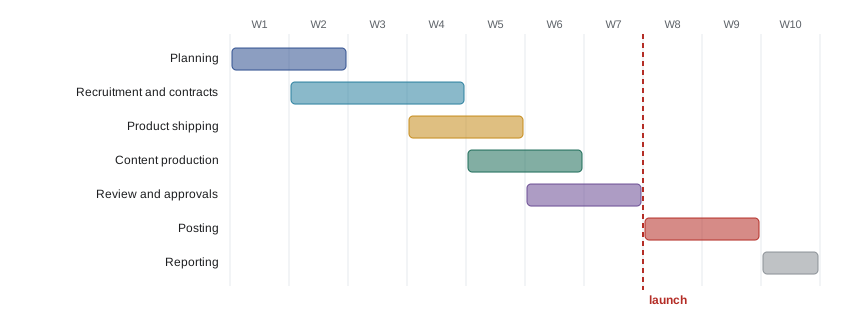
Campaign timelines are usually fixed at the end: a product launch, a holiday, an event or a season. The safest way to plan is to work backwards from the first posting date, allowing realistic time for each step and adding buffers. Creators need time to make good content, brands need time to review it, and shipping often takes longer than expected, especially across borders.
Worked problem
Building a backward schedule
A brand wants creator posts to go live on 1 November. It allows 5 working days for final approvals, 10 working days for creators to produce drafts after receiving products, 7 days for shipping and 10 working days to recruit and contract creators. Treating working days as five per week and ignoring holidays, roughly when must recruitment begin?
Show solution
- Approvals: 5 working days ≈ 1 week before 1 November, so drafts are due about 25 October.
- Production: 10 working days ≈ 2 weeks, so products must arrive about 11 October.
- Shipping: 7 calendar days, so products must ship about 4 October.
- Recruitment and contracting: 10 working days ≈ 2 weeks, so recruitment must begin about 20 September, plus a buffer.
Answer: Recruitment should start around mid-September, about six weeks before launch, and earlier if the brand wants a safety buffer or busy creators.
Timelines should also allow for creators' own schedules. Popular creators book sponsorships weeks or months ahead, especially before the end-of-year shopping season, and they rarely do their best work on a rush brief. Rush fees exist for a reason.
Roles and responsibilities
Clear ownership prevents tasks from falling between teams. A common tool is a RACI chart, which lists each task and shows who is Responsible for doing it, who is Accountable for the outcome, who must be Consulted and who must be Informed. For creator programs, legal is often consulted on contracts and claims, finance on payments, the product team on technical accuracy and the paid media team on amplification.
| Task | Creator program lead | Brand manager | Legal or compliance | Finance | Paid media |
|---|---|---|---|---|---|
| Set objectives and budget | R | A | I | C | C |
| Select creators | R | A | C | I | I |
| Approve contracts | R | I | A | C | I |
| Review drafts for claims and disclosure | R | C | A | I | I |
| Pay creators | C | I | I | A/R | I |
| Run amplification | C | I | I | I | A/R |
| Report results | R | A | I | I | C |
Creator relationship management
As programs grow, brands need a single record of every creator they have worked with or considered. Specialist influencer platforms include a creator relationship management (CRM) database, but a well-structured spreadsheet or general CRM can work for smaller programs. Useful fields include contact details and preferred contact route, manager or agency, platforms and audience data, rates and past fees, contracts and usage rights with expiry dates, exclusivity commitments, shipping address, tax forms, past campaign results, content links, compliance history and notes on working relationship.
Two fields deserve special attention. Usage-rights expiry dates must be tracked so that the brand stops running content in ads when rights end; running content beyond the license is a common and avoidable dispute. Exclusivity dates must be tracked so the brand does not accidentally ask a creator to break an exclusivity commitment to a competitor, or ask them to promote a competing product line of its own.
Creator data is personal information. US brands should protect it under applicable state privacy laws, which in several states now cover business-to-business contacts as well as consumers, collect only what they need, store it securely and keep it no longer than necessary. Tax identification numbers collected on Form W-9 require particular care.
Product seeding and logistics
Getting products to creators sounds simple and often is not. Large programs ship hundreds of packages, sometimes internationally, with tracking, customs forms and returns. Plan for shipping time, especially across the Canada–US border where duties, brokerage fees and delays can apply; for correct sizes, shades or variants, which means asking creators in advance; for packaging that makes a good unboxing without excessive waste; and for products that need instructions or safety information. Keep a log linking each shipment to the creator, the contract and the expected post, so missing deliveries are noticed quickly.
Unsolicited seeding, where products are sent without asking, can create goodwill but wastes product when creators are not interested, and some creators see it as presumptuous. Asking first, with a short note on why the product fits them, usually gets better results.
Approval workflows
Content review protects the brand but can easily become a bottleneck that frustrates creators and delays launches. A good approval workflow defines what is reviewed, by whom, within what time and against which criteria. The criteria should be objective where possible: correct product name and claims, disclosure present and prominent, no prohibited content, correct link or code and technical specifications met. Subjective preferences about style should be expressed early in the brief, not imposed after the creator has finished.
- Set service-level targets, such as feedback within two working days, and stick to them.
- Consolidate feedback from all reviewers into one message; never send creators conflicting notes from different people.
- Separate required changes, such as a wrong claim, from optional suggestions.
- Limit included revision rounds in the contract, often one or two, and treat new requests as scope changes.
- Approve concepts before full production for complex or expensive content.
- Check the live post against the approved draft, because captions and disclosures are sometimes changed at posting.
Worked problem
Approval capacity
A campaign has 40 creators, each submitting one draft. Each review takes 20 minutes, and 30 % of drafts need a second review of 10 minutes. Legal must also review the 10 drafts that mention health claims, at 15 minutes each. How many review hours are needed?
Show solution
- First reviews: 40 × 20 = 800 minutes.
- Second reviews: 0.30 × 40 = 12 drafts × 10 = 120 minutes.
- Legal reviews: 10 × 15 = 150 minutes.
- Total: 800 + 120 + 150 = 1,070 minutes ≈ 17.8 hours.
Answer: About 18 hours of review time, which must fit into the approval window; if drafts arrive in a two-day burst, more than one reviewer is needed.
Managing the live campaign
Once content goes live, the work shifts to monitoring and response. Check each post soon after publication for disclosure, correct links and approved content. Watch comments for questions the brand can help answer, complaints that need customer service and any signs of controversy. Engage authentically from the brand account where appropriate, for example thanking the creator or answering a product question, but do not flood a creator's comments with brand replies. Track early performance and share what is working with other creators in the campaign, such as hooks or formats that land well. If amplification is planned, the paid team should identify the strongest posts quickly.
Keep a simple campaign tracker that shows, for each creator, contract status, product shipped and received, draft submitted and approved, posting date, live link, disclosure check, metrics received and payment status. A glance at the tracker should show what is late and who needs a nudge.
People time and scaling
Creator programs are labor-intensive, and underestimating the people time is a common reason programs fail. Estimating hours per creator per campaign for each phase, from recruitment to payment, gives a realistic staffing plan.
Worked problem
Estimating staff time
A program lead estimates per creator: 1.5 hours to recruit and negotiate, 1 hour to onboard and ship, 1 hour to review content, 0.5 hours to monitor posts and 1 hour for analytics and payment. The brand plans 120 creator collaborations over a quarter of 13 weeks. How many hours a week does this require?
Show solution
- Hours per creator: 1.5 + 1 + 1 + 0.5 + 1 = 5 hours.
- Total: 120 × 5 = 600 hours.
- Per week: 600 ÷ 13 ≈ 46 hours.
Answer: About 46 hours a week, more than one full-time person, before planning, reporting and stakeholder meetings are counted.
Programs scale by standardizing and automating. Templates for briefs, contracts and outreach; software for discovery, contracting, content approval and payments; clear criteria that let junior staff handle routine reviews; and long-term ambassador relationships that need less onboarding each time all reduce hours per creator. Agencies offer another route to scale, with the brand paying a fee in exchange for people and systems.
The creator experience
Brands compete for the best creators, and creators talk to each other. Programs that pay promptly, respond quickly, give clear briefs, respect creative input and share results become known as good partners and attract better creators at better rates. Programs that pay late, change briefs mid-stream and ignore messages find the reverse. A short survey of creators after each campaign, asking what worked and what did not, is an easy way to improve the program and show creators their views matter.
Working with agencies and managers
Many campaigns involve intermediaries. Talent managers negotiate on behalf of creators, and influencer agencies may run the whole program for the brand. Working with intermediaries changes the workflow: briefs, contracts and feedback may pass through extra hands, and response times can lengthen. Agree at the start who the brand should contact for what, whether creators can be contacted directly about content, and how quickly each party will respond. When an agency runs the program, the brand should still own the key decisions on objectives, budgets and creator approval, and should receive access to the underlying data rather than only summary reports.
Agency fees are usually a retainer, a percentage of creator spend, a fixed project fee or a combination. Compare agency proposals on what is included, such as discovery, contracting, content review, payments, reporting and amplification management, and on who owns the creator relationships and data when the agency contract ends. A brand that outsources everything and keeps nothing can find itself starting again from zero if it changes agency.
Communication with creators during the campaign
Creators appreciate a single point of contact who answers quickly and knows the campaign. A short welcome message after contracting, confirming key dates, deliverables and contacts, prevents many misunderstandings. Reminders a few days before drafts and posts are due help busy creators stay on schedule. When problems arise, such as a delayed shipment or a change in launch date, tell creators immediately and adjust deadlines fairly rather than expecting them to absorb the delay.
Common mistakes
MistakePlanning forwards from today and hoping to hit the launch date.
InsteadWork backwards from the posting date with buffers.
MistakeSending creators conflicting feedback from several reviewers.
InsteadConsolidate feedback into one message with required and optional changes separated.
MistakeForgetting when usage rights expire.
InsteadTrack expiry dates and stop using content when rights end.
MistakeShipping products without confirming variants and addresses.
InsteadConfirm details in advance and log every shipment.
MistakeUnderestimating staff time.
InsteadEstimate hours per creator per phase and staff or automate accordingly.
Summary and key terms
- Campaigns move through planning, recruitment, onboarding, production, live and wrap-up phases.
- Work backwards from the launch date and allow buffers for shipping and approvals.
- Use a RACI chart to make ownership clear.
- A creator CRM should track contacts, rates, contracts, usage expiry, exclusivity, results and compliance.
- Approval workflows need service levels, consolidated feedback, objective criteria and limited rounds.
- Monitor live posts against approved drafts and track every creator's status.
- Estimate people time per creator and scale through templates, software and long-term relationships.
- Backward scheduling
- Planning a timeline from the end date back to the start.
- RACI chart
- A table showing who is responsible, accountable, consulted and informed.
- Creator CRM
- A database of creator relationships, contracts and results.
- Seeding
- Sending products to creators.
- Service level
- A committed response time, such as feedback within two days.
- Scope change
- A request beyond what the contract covers.
- Campaign tracker
- A status record for every creator in a campaign.
- Always-on program
- A continuous creator program rather than one-off campaigns.
- Concept approval
- Agreeing an idea before full production.
- Rush fee
- A premium for shortened timelines.
Practice problems
Work each problem on paper first, then reveal the answer to check.
Name the six campaign phases.
Show answer
Planning, recruitment, onboarding, production, live, wrap-up.
Why work backwards from the launch date?
Show answer
The end date is fixed, and it shows when each step must start.
What do R and A stand for in RACI?
Show answer
Responsible and accountable.
Which two CRM dates matter most to avoid disputes?
Show answer
Usage-rights expiry and exclusivity dates.
50 drafts × 15 minutes plus 20 % rework at 10 minutes. Total minutes?
Show answer
750 + 100 = 850.
Give two rules for good feedback.
Show answer
Consolidate it and separate required from optional changes.
Why check the live post against the draft?
Show answer
Captions or disclosures may change at posting.
80 creators × 4.5 hours over 10 weeks. Hours per week?
Show answer
36.
Name two ways to scale a program.
Show answer
Templates, software, clear criteria, ambassadors, agencies.
Why does creator experience matter?
Show answer
Good partners attract better creators at better rates.
Lesson quiz · 5 questions
Score 60% or more to complete this lesson.
Create a free account to save your progress, take quizzes and earn a certificate.