
CRE-340 · Lesson 3 of 12 · 26 min
Audience strategy and creator tiers
With objectives agreed, the next decision is who the campaign is for and which kinds of creators can reach them. Many brands skip straight to a list of popular names. A better approach starts with the audience, works out which creator communities that audience trusts, and then chooses a mix of creator sizes that delivers the objective within the budget. This lesson covers audience definition, the creator tier system, the trade-offs between tiers and some simple mathematics for building a tier mix.
Defining the target audience
A target audience description should go beyond demographics. Age, gender, location and income help with targeting and with checking creators' audience data, but they rarely explain why someone buys. Psychographics, such as values, interests and attitudes, and behaviors, such as where people shop, which platforms they use and how they research purchases, are usually more useful for choosing creators. A brand of trail-running shoes might describe its audience as adults who run off-road at least twice a month, care about performance more than fashion, research gear through reviews and video, and follow athletes and outdoor creators rather than celebrities.
Good audience descriptions also say what the audience does not want. Many audiences are skeptical of heavy-handed sponsorship, dislike scripted ads and will scroll past content that feels inauthentic. Knowing this shapes the creative brief as much as the creator list.
Most brands have more than one audience. A baby-products brand may want first-time parents, grandparents buying gifts and childcare professionals. Each may follow different creators on different platforms, so the campaign may need separate creator groups and messages. Trying to reach everyone with one set of creators usually reaches no one well.
Communities, niches and platforms
Creators matter because they sit at the center of communities. The useful question is not which creators are most popular, but which communities your audience belongs to and who those communities trust. Communities form around interests such as cooking, fitness, finance, gaming, fashion, parenting, cars or specific hobbies; around identities and cultures; around places; and around professions. Within each there are layers, from broad creators who introduce the topic to specialists whose recommendations carry weight with enthusiasts.
Platform choice follows the audience. Short-form vertical video dominates discovery for many age groups. Long-form video suits detailed reviews, tutorials and explanations, and tends to have a longer shelf life because it is found through search. Image-led platforms remain strong for fashion, beauty, food and home. Podcasts and newsletters reach engaged niche audiences who trust hosts deeply. Professional networks suit business-to-business products. Platform audiences shift quickly, so check current usage data for your market rather than relying on assumptions from a few years ago.
US campaigns often need to plan for Spanish-language and bilingual creators, since tens of millions of Americans speak Spanish at home. The US is also large and regionally varied, so a creator's audience may be concentrated in particular states or cities; check location data against where your product is sold.
The creator tier system
The industry sorts creators into tiers by follower count. Definitions vary between agencies and platforms, but a common scheme is shown below. The tiers are a rough guide only; a 40,000-follower creator in a valuable niche may command higher fees than a 300,000-follower creator in a crowded general category.
| Tier | Typical followers | Typical strengths | Typical weaknesses |
|---|---|---|---|
| Nano | 1,000 – 10,000 | Close community, high engagement, low cost, often happy with gifting | Small reach each, more admin per impression, variable quality |
| Micro | 10,000 – 100,000 | Niche authority, good engagement, affordable, reliable content | Need many creators for scale |
| Mid-tier | 100,000 – 500,000 | Balance of reach and relevance, professional production | Higher fees, more management layers |
| Macro | 500,000 – 1,000,000 | Large reach, strong production, often agency represented | Lower engagement rates, higher cost, less niche trust |
| Mega and celebrity | Over 1,000,000 | Mass awareness, news value, cultural reach | Expensive, harder to control, audience fit may be loose |
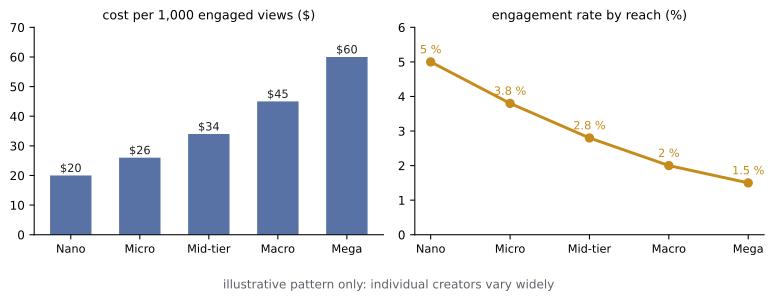
Two patterns hold across most published studies. Engagement rates tend to fall as follower counts rise, because larger audiences contain more casual followers. And fees rise with followers, though not always in proportion, because demand for well-known creators is high. Whether smaller creators are cheaper per useful result depends on the campaign. Smaller creators often deliver lower cost per engagement, but they require more creators, more briefs, more contracts and more approvals to achieve the same reach, and that management cost is real.
Matching tiers to objectives
Tier choice should follow the objective. For broad awareness on a tight timeline, a few macro or mega creators can deliver reach quickly, especially for a launch with news value. For consideration in a niche, micro and mid-tier specialists are often the most persuasive. For content production, nano and micro creators can supply large volumes of authentic assets at low cost. For conversion, results depend more on audience fit and the creator's history of driving sales than on size, and affiliate or hybrid deals with micro creators are common. For community building and advocacy, many nano creators and existing customers create a sense that everyone is talking about the product.
Many campaigns use a pyramid: one or two larger creators for reach and credibility at the top, a layer of mid-tier and micro creators for depth, and a broad base of nano creators and customers for volume and social proof. The pyramid also spreads risk: if one creator underperforms or causes a problem, the campaign does not collapse.
Reach, overlap and frequency
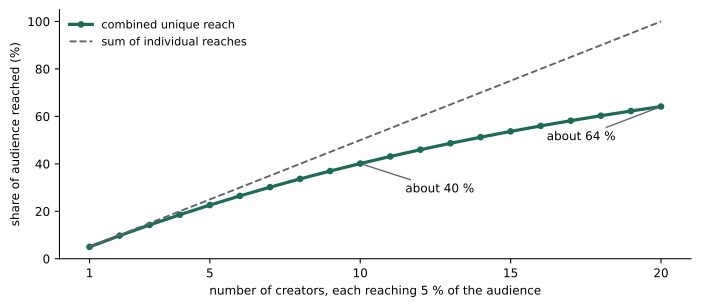
When several creators post about the same product, their audiences overlap. Fans of one fitness creator often follow others. Overlap means total unique reach is less than the sum of each creator's reach, but it also means some people see the message several times, which can help memory and persuasion. Planners talk about frequency: the average number of times each reached person sees the message.
A simple way to estimate combined reach when overlap is unknown is to assume people see each creator's post independently. If one creator's post reaches 10 % of a target audience and another reaches 15 %, the chance a person sees neither is 0.90 × 0.85 = 0.765, so combined reach is about 23.5 %, not 25 %. Real overlap is often higher than this independence assumption suggests, because creators in the same niche share fans, so treat the result as an upper estimate.
Building a tier mix within a budget
Tier mix decisions balance cost, reach, engagement and management effort. A simple spreadsheet model, shown in the worked example below, compares options by cost per thousand people reached and cost per engagement, and adds an estimate of management hours. More sophisticated planners use historical results by tier for their category and treat the mix as a portfolio, as Lesson 5 explains.
Worked problem
Comparing two tier mixes
A brand has $30,000. Option A: two macro creators at $12,000 each, expected reach 180,000 each, engagement rate by reach 2 %, plus $6,000 for production of ad cut-downs. Option B: 20 micro creators at $1,500 each, expected reach 15,000 each, engagement rate by reach 5 %. Assume no overlap within each option. Compare reach, engagements and cost per engagement.
Show solution
- Option A reach: 2 × 180,000 = 360,000. Engagements: 360,000 × 0.02 = 7,200. Cost per engagement: 30,000 ÷ 7,200 ≈ $4.17.
- Option B reach: 20 × 15,000 = 300,000. Engagements: 300,000 × 0.05 = 15,000. Cost per engagement: 30,000 ÷ 15,000 = $2.00.
- Option A reaches more people; Option B delivers twice the engagement per dollar but needs 20 contracts, briefs and approvals instead of 2.
Answer: Option A wins on reach and simplicity; Option B wins on engagement and content volume. The objective decides, and many brands would split the budget.
Worked problem
Estimating combined reach with overlap
Three creators are expected to reach 8 %, 6 % and 5 % of a target audience of 500,000 people. Estimate combined reach assuming independence.
Show solution
- Probability of seeing none: 0.92 × 0.94 × 0.95 ≈ 0.8215.
- Combined reach share: 1 − 0.8215 = 0.1785, or about 17.9 %.
- People reached: 500,000 × 0.1785 ≈ 89,250, compared with 95,000 if reaches were simply added.
Answer: About 89,000 people, an upper estimate because creators in the same niche usually share more fans than independence assumes.
Diversity, representation and fairness
Audience strategy is also about who is represented. Audiences notice when campaigns feature a narrow range of people, and diverse creator line-ups usually reach more communities. Research and creator advocacy groups have documented pay gaps in the industry, with creators from some racial and ethnic groups, and creators with disabilities, reporting lower rates for similar work. Brands can address this by setting fee ranges based on deliverables and performance rather than negotiation alone, reviewing pay across their roster and including diverse creators in briefs from the start rather than as an afterthought. These practices are both fair and good for results.
Long-term versus one-off creators
A final strategic choice is between one-off posts and longer relationships. One-off posts are flexible and good for testing. Repeated posts from the same creator usually perform better per post over time, because audiences need several exposures and because a creator who genuinely uses a product over months is more believable. Many brands test widely with one-off deals, then convert the best performers into multi-month ambassadors. Lesson 12's capstone uses this test-then-scale approach.
Audience research methods
Brands can learn about their audiences in several inexpensive ways before choosing creators. Customer surveys can ask which creators, podcasts and channels people follow and trust. Social listening tools show which accounts are mentioned alongside the brand or category. The brand's own social analytics reveal the interests and other accounts followed by its audience. Interviews with a handful of loyal customers often uncover communities the marketing team did not know existed, such as a running club that has adopted a product or a hobby forum that recommends it. Sales data by region shows where awareness is strong and where it is weak, which helps decide where creators should be based.
The aim is to build a short list of communities and the kinds of voices they trust before opening any discovery tool. A team that starts with research is less likely to be dazzled by large follower counts and more likely to find creators whose audiences actually match the customer.
Cross-border audiences
Canadian and US audiences overlap heavily online, and many creators have followers in both countries. For a brand selling in only one country, followers in the other are wasted reach, and the fee should reflect the share of the audience that can actually buy. For a brand selling in both, cross-border creators can be efficient, but disclosure rules, product claims, prices and promotions may differ between the countries, so content and links may need versions for each market. Check also that any discount code or offer works for every audience the creator will reach, or state clearly where it applies.
Common mistakes
MistakeDescribing the audience only by age and gender.
InsteadAdd interests, values, behaviors and platform habits.
MistakeChoosing creators by popularity rather than community fit.
InsteadStart from the communities your audience trusts.
MistakeAssuming smaller creators are always cheaper per result.
InsteadInclude management effort and compare cost per useful result.
MistakeAdding up individual reach to forecast campaign reach.
InsteadAllow for audience overlap; combined reach is less than the sum.
MistakeIgnoring where a creator's audience actually lives.
InsteadCheck location and language data against your market.
Summary and key terms
- Define audiences by demographics, psychographics and behaviors, and expect more than one audience.
- Choose communities and platforms first, then creators within them.
- Tiers run roughly from nano (1,000–10,000) to mega (over 1 million), but definitions vary.
- Engagement rates tend to fall and fees rise with tier; management effort rises with creator count.
- Match tiers to objectives and consider a pyramid that spreads risk.
- Combined reach ≈ 1 − Π(1 − rᵢ) under independence, an upper estimate.
- Fair pay and diverse rosters improve reach and trust.
- Psychographics
- Audience values, interests and attitudes.
- Nano creator
- A creator with roughly 1,000 to 10,000 followers.
- Micro creator
- A creator with roughly 10,000 to 100,000 followers.
- Macro creator
- A creator with roughly 500,000 to 1 million followers.
- Audience overlap
- People who follow more than one creator in a campaign.
- Frequency
- Average number of times each reached person sees the message.
- Creator pyramid
- A tier mix with few large creators and many smaller ones.
- Ambassador
- A creator in a longer-term relationship with a brand.
- Audience fit
- How closely a creator's audience matches the target.
- Social proof
- The persuasive effect of seeing many others use a product.
Practice problems
Work each problem on paper first, then reveal the answer to check.
Name three kinds of information in a good audience description.
Show answer
Demographics, psychographics, behaviors.
Typical follower range for a micro creator?
Show answer
10,000 to 100,000.
Impressions 600,000, reach 240,000. Frequency?
Show answer
2.5.
Two creators reach 20 % and 10 % independently. Combined reach?
Show answer
1 − 0.8 × 0.9 = 28 %.
Why might nano creators cost more per result than expected?
Show answer
Management time for many contracts and approvals.
$12,000 buys 8,000 engagements. CPE?
Show answer
$1.50.
Give one advantage of a creator pyramid.
Show answer
It spreads risk and combines reach with depth.
Why check a Canadian creator's audience location?
Show answer
Many have large audiences outside Canada.
What usually happens to engagement rate as follower count grows?
Show answer
It tends to fall.
Why do repeated posts by one creator often work better?
Show answer
Repeated exposure and growing credibility.
Lesson quiz · 5 questions
Score 60% or more to complete this lesson.
Create a free account to save your progress, take quizzes and earn a certificate.