
CRE-250 · Lesson 12 of 12 · 29 min
Law, ethics and a capstone test stream
Streaming live means publishing in real time, without an edit to remove a mistake. Everything shown and said on stream is subject to the same laws as any other publication: advertising and disclosure rules, contest and lottery law, gambling regulation, privacy and children's privacy law, copyright, defamation and the rights of people who appear on camera. Platform rules add another layer and often go further than the law. This lesson surveys the legal and ethical issues streamers meet most often, with the differences between Canada and the United States where they matter, and finishes with a capstone: planning, running and reviewing a complete test stream that uses the skills from the whole course.
Sponsorship and endorsement disclosure
In the United States, the Federal Trade Commission Act prohibits deceptive practices, and the FTC's Endorsement Guides (revised in 2023) and its guidance for influencers, "Disclosures 101 for Social Media Influencers", say that any material connection with a brand, including payment, free products, affiliate commissions, employment or a family relationship, must be disclosed clearly and conspicuously. The FTC has specifically said that disclosures in live streams should be repeated periodically so viewers who join partway through see them.
For live streams, good disclosure is both spoken and shown: say "this stream is sponsored by…" at the start and repeat it at intervals, keep a visible on-screen label such as "Sponsored" or "Paid partnership" while the sponsor is featured, use the platform's branded-content or paid-promotion setting where one exists, and label affiliate links in panels and chat commands. Disclosure belongs where viewers will notice it, not hidden in a description panel or a hashtag among many. Gifted products and game keys count as material connections even if no money changes hands.
Gambling content
Gambling streams, particularly online casino and slot streams, became a major category and a major controversy. Concerns include audiences that include minors, undisclosed deals in which casinos pay streamers or give them house money to play with, and the normalization of heavy gambling. Platforms have responded with their own rules: at the time of writing, Twitch prohibits streaming slots, roulette and dice games from sites that are not licensed in the United States or another jurisdiction with sufficient consumer protection, a ban introduced in October 2022, while some newer platforms permit gambling content more broadly. Streamers must follow both platform rules and the law where they and their audiences are.
In the United States, gambling is regulated mainly by the states. Online casino gaming is legal only in a minority of states, sports betting is legal in many but not all, and rules on advertising, age (often 21) and responsible-gambling messages vary by state. Promoting unlicensed offshore casinos to US viewers carries legal and reputational risk, and sweepstakes-model casinos are under increasing state scrutiny. Gambling advertising codes adopted by operators and industry groups restrict marketing that appeals to people under 21.
Ethically, gambling streams should be clearly labeled, restricted to adult audiences using platform age gates, disclose any relationship with operators including the source of the money being gambled, include responsible-gambling information, and never present gambling as a way to make money. Many streamers choose not to stream gambling at all because of its effects on young and vulnerable viewers.
Giveaways, contests and prizes
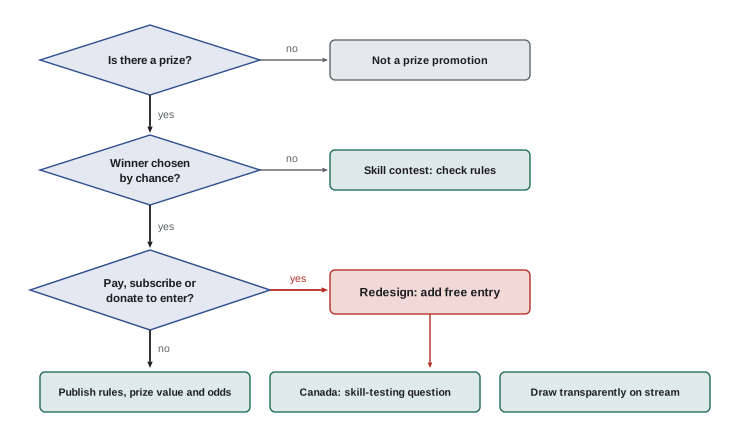
Giveaways are popular on streams, but prize promotions are regulated. The key legal distinction is between a lottery or illegal gambling, which combines a prize, chance and consideration (something of value paid to enter), and a lawful promotional contest, which removes at least one of those elements or follows specific rules.
In the United States, contest and sweepstakes law is mainly at the state level. A sweepstakes, where winners are chosen by chance, must not require consideration, so a free alternative method of entry ("no purchase necessary") with equal odds is standard. Skill contests may require payment in many states but not all. Official rules should state eligibility, entry methods, dates, prizes and approximate retail values, odds and how winners are chosen. Some states require registration and bonding for large prize promotions (New York and Florida for prizes over certain values, for example), and winners of prizes above set values receive tax forms.
Platform rules apply too: many platforms prohibit giveaways that require subscribing, cheering or donating to enter, and require the streamer to be responsible for the giveaway and its rules. Practical rules for streamers: publish written rules before starting, offer free entry, set eligibility (age, region), choose winners transparently with a random tool shown on stream, confirm winners privately, and never collect more personal information than needed to send the prize.
Worked problem
Checking a giveaway against the rules
A streamer plans to give away a $400 graphics card: "Every gifted subscription is an entry; winner drawn at 1,000 subs." The audience is in Canada and the United States. What needs to change?
Show solution
- Identify the elements: prize (graphics card), chance (random draw), consideration (gifted subscriptions). All three are present, which risks an illegal lottery.
- Remove consideration: add a free entry method, such as a chat command or form with one entry per person, with equal odds per entry.
- Check platform rules: many forbid tying entries to paid support at all, so the safer design is free entry only.
- For Canadian winners, add a skill-testing question; for Quebec residents, check Régie requirements or exclude Quebec.
- Publish rules: eligibility, dates, how and when the winner is drawn, approximate value ($400), odds depending on entries, and how the prize is delivered.
- Remove the "at 1,000 subs" condition, which ties the draw to paid support and could leave entrants with no prize.
Answer: Make entry free, publish rules with prize value and draw details, add a skill-testing question for Canadian winners, and decouple the draw from paid support.
| Element | Lottery (risky) | Lawful promotion |
|---|---|---|
| Prize | Yes | Yes |
| Chance | Winner drawn at random | Random draw allowed, with skill question in Canada |
| Consideration | Pay, subscribe or donate to enter | Free entry available with equal odds |
| Rules | Unclear or unpublished | Published before entry |
| Disclosure | Value and odds hidden | Prize value, number and odds disclosed |
Minors and children's privacy
Children watch streams and sometimes appear in them, and laws treat children's personal information and advertising to children with extra care. Most major platforms set minimum ages: users must generally be at least 13 to have an account, and many require users to be 18 to stream, receive money or use certain features such as LIVE on TikTok, while streams by minors may require adult supervision under platform rules.
In the United States, the Children's Online Privacy Protection Act (COPPA) restricts collecting personal information from children under 13 without verifiable parental consent, and applies to channels and websites that are directed at children or that knowingly collect children's information. Following a 2019 settlement with the FTC, YouTube requires creators to mark content that is made for kids, which disables features such as live chat and personalized ads on that content. Amended COPPA rules took effect in 2025, and several states have passed additional laws on minors' online safety and on child influencers' earnings.
Practical steps include not collecting personal information such as names, ages, schools or locations from viewers who may be children; not encouraging young viewers to spend money; avoiding giveaways that require personal details from minors; using platform age restrictions for mature content; moderating chat to protect young viewers from adults seeking contact; and, if your own children appear on stream, protecting their privacy and considering their long-term interests and consent. Several jurisdictions now require that a share of earnings from content featuring child performers be set aside for them.
Copyright on stream
Copyright issues on live streams include music (Lesson 6), video games, film and television, and other creators' videos. Most game publishers permit streaming their games under published policies, sometimes with restrictions on monetization, spoilers or pre-release footage; check each publisher's policy. Watch-alongs and reaction streams, in which streamers show films, television or other creators' videos, are a frequent source of copyright strikes and disputes.
In the United States, fair use allows limited use of copyright material without permission, assessed on four factors: the purpose and character of the use, including whether it is transformative; the nature of the work; the amount used; and the effect on the market. Courts have found some commentary-heavy reaction videos transformative and others not; showing an entire work with little commentary is unlikely to be fair use. Platforms process DMCA takedown notices, and repeat strikes can lead to channel termination.
Safer practices include streaming games under their publishers' policies, using licensed or platform-safe music, using official watch-party features where platforms offer them under license, showing only short clips with substantial commentary when reacting, asking creators for permission, and respecting takedown requests. Fair dealing and fair use are defenses assessed case by case, not automatic permissions.
Privacy, consent and IRL streaming
IRL ("in real life") streaming outdoors and in public places raises privacy and safety issues. In both Canada and the United States, filming in public places is generally lawful, but laws on recording audio, voyeurism, harassment and trespass apply, private property owners can set their own rules, and some places such as schools, hospitals, courts and changing rooms restrict filming. Quebec's Civil Code protects a person's right to their image, so publishing an identifiable image of a person in Quebec without consent can be actionable even in a public place in some circumstances. Ethical IRL streaming involves not targeting or harassing bystanders, not filming people in vulnerable situations, respecting requests to stop filming, blurring or avoiding faces where appropriate, and never staging pranks that frighten, endanger or humiliate members of the public. Streams that involve harassment, dangerous stunts or illegal activity violate platform rules and can lead to criminal charges.
Guests and co-streamers should consent to appearing and understand how recordings will be used. Calls and voice chats with viewers should only be broadcast with their knowledge. Recording private conversations without consent can be unlawful depending on the jurisdiction.
Defamation, impersonation and platform rules
Live commentary about real people can be defamatory if it states false facts that harm their reputation. Opinion and fair comment on matters of public interest are generally protected, but accusing someone of a crime or misconduct without evidence is risky. Streamers should avoid presenting rumors as facts, correct errors on stream and in VOD descriptions, and moderate chat that spreads allegations. Impersonating others, misleading viewers about who is streaming, using AI-generated voices or likenesses of real people without permission, and faking emergencies all breach platform rules and may breach laws. Platform community guidelines cover harassment, hateful conduct, sexual content, violence, dangerous activities, misinformation and more, and they apply to streamers' conduct on and sometimes off platform. Read the guidelines of every platform you use and review them periodically, since they change.
Capstone: plan, run and review a test stream
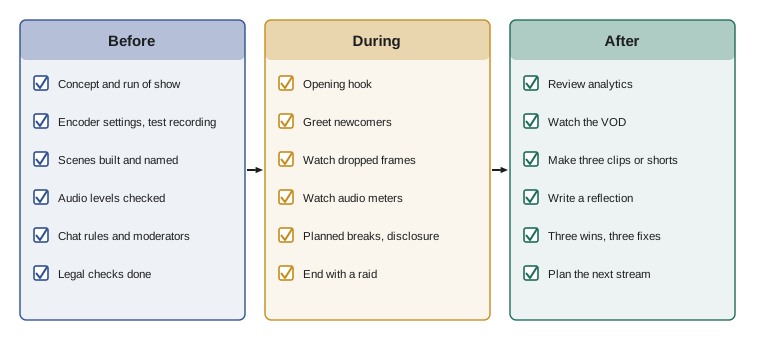
The capstone brings the course together in a complete stream of 60 to 90 minutes, either public or unlisted. The steps follow the order of the course.
- Concept and format (Lessons 1–2): choose a platform, a category, a format and a run of show with segments, an opening hook, planned breaks and an ending with a raid target.
- Technical setup (Lessons 3–5): set up camera, lighting, capture and microphone; choose encoder settings based on a measured upload speed; build scenes for starting soon, main, break and ending; run a private test recording.
- Audio (Lesson 6): set levels, noise suppression and compression; check music licensing.
- Audience and moderation (Lessons 7 and 9): write chat rules, set up automated filters and chat commands, recruit at least one moderator or plan for shields-up settings, and prepare engagement prompts for a quiet chat.
- Collaboration and monetization (Lessons 8 and 10): optionally invite a guest or plan a raid; disclose any sponsored or gifted items.
- Law and ethics (Lesson 12): check any giveaway against contest rules, music and footage against copyright policies, and the stream content against platform guidelines.
- Review (Lesson 11): afterwards, review analytics, the VOD, dropped frames and audio; create at least three clips or shorts; write a short reflection with three things that worked and three improvements.
Worked problem
Capstone pre-flight calculation
A student measures a reliable upload of 12 Mbps and plans a 1080p30 stream with 160 kbps audio on a platform that recommends up to 6,000 kbps for H.264. The stream will run 75 minutes. Choose the video bitrate, check the upload headroom, set the keyframe interval, and estimate the size of a local backup recording at the same bitrate.
Show solution
- Upload budget: \(0.75 \times 12{,}000 = 9{,}000\) kbps available.
- Platform limit: video 6,000 kbps; total \(6{,}000 + 160 = 6{,}160\) kbps, well under 9,000 kbps.
- Keyframe interval 2 s: at 30 fps, \(N = 30 \times 2 = 60\) frames between keyframes.
- Backup size: \(6{,}160 \text{ kbps} \times 4{,}500 \text{ s} = 27{,}720{,}000 \text{ kb} \approx 3.47 \text{ GB}\) (dividing by 8,000,000 to convert kilobits to gigabytes).
- Plan for about 4 GB of free disk space per 75 minutes of backup recording, plus headroom.
Answer: Video at 6,000 kbps with 160 kbps audio (6,160 kbps total, under the 9,000 kbps budget), a 2-second keyframe interval of 60 frames, and about 3.5 GB of disk for the backup recording.
| Capstone criterion | Evidence | Weight |
|---|---|---|
| Planning | Run of show, segment plan, raid target | 15 % |
| Technical quality | Encoder settings justified; few dropped frames; clean scenes | 25 % |
| Audio | Clear voice, balanced levels, licensed music | 15 % |
| Engagement and moderation | Chat rules, greetings, interaction, moderation plan | 20 % |
| Legal and ethical compliance | Disclosure, contest and copyright checks | 10 % |
| Review and repurposing | Analytics review, three clips, reflection | 15 % |
Where to go next
Streaming connects to many other skills. CRE-210 and CRE-211 cover short-form and long-form video for repurposing; CRE-202 covers analytics; CRE-310 and CRE-330 cover brand partnerships, contracts and creator business; and CRE-401 covers building teams and larger creator businesses. Whatever direction you take, the core of live streaming stays the same: reliable technology, a clear format, a welcoming community, honest monetization and respect for the law and for the people watching.
Common mistakes
MistakeDisclosing a sponsor only in a panel.
InsteadSay it, show it and repeat it during the stream.
MistakeMaking paid support an entry to a giveaway.
InsteadOffer free entry and publish rules.
MistakePromoting unlicensed gambling sites to a general audience.
InsteadFollow platform and local law, age-gate and disclose, or avoid gambling content.
MistakeAssuming fair use or fair dealing covers whole films.
InsteadUse short clips with commentary, licenses or watch-party features.
MistakeCollecting personal details from young viewers.
InsteadCollect nothing beyond what is needed and protect minors.
Summary and key terms
- Live streams are publications; laws and platform rules apply in real time.
- Disclose material connections clearly, verbally and visually, and repeat.
- Gambling content is restricted by platforms and regulators; protect minors.
- Prize, chance and consideration together make a risky lottery; offer free entry and publish rules.
- Children's privacy laws limit collecting information from young viewers.
- Fair dealing and fair use are case-by-case defenses, not permissions.
- The capstone stream applies planning, technology, engagement, ethics and review.
- Material connection
- Relationship with a brand that viewers might not expect.
- Endorsement Guides
- FTC guidance on endorsements and disclosure.
- Consideration
- Something of value given to enter a contest.
- Skill-testing question
- Question Canadian contest winners must answer.
- No purchase necessary
- Free method of entry to a prize promotion.
- COPPA
- US law on collecting children's information.
- PIPEDA
- Canadian federal private-sector privacy law.
- Fair dealing
- Canadian copyright exception for listed purposes.
- Fair use
- US copyright defense assessed on four factors.
- IRL stream
- Stream filmed out in the real world.
Practice problems
Work each problem on paper first, then reveal the answer to check.
Name three material connections that require disclosure.
Show answer
Payment, free products, affiliate commissions, employment, family ties.
Why repeat disclosure in a live stream?
Show answer
Viewers join partway through.
What three elements make a lottery?
Show answer
Prize, chance and consideration.
How do Canadian contests avoid being lotteries?
Show answer
Free entry and a skill-testing question.
What must Canadian contests disclose under the Competition Act?
Show answer
Number and value of prizes, regions, odds factors, distribution.
What age threshold does COPPA use?
Show answer
Under 13.
What did Twitch ban in October 2022?
Show answer
Streaming slots, roulette and dice from unlicensed sites.
Is showing a full film with light commentary likely fair use or fair dealing?
Show answer
Unlikely.
Video bitrate budget with 10 Mbps reliable upload and 160 kbps audio?
Show answer
About 7,340 kbps (7,500 total minus audio), capped by the platform limit.
Backup size of a 60-minute stream at 6,000 kbps?
Show answer
About 2.7 GB.
Lesson quiz · 5 questions
Score 60% or more to complete this lesson.
Create a free account to save your progress, take quizzes and earn a certificate.