
CRE-250 · Lesson 10 of 12 · 29 min
Live monetization: subscriptions, tips, gifts, ads and sponsors
Live streaming offers more direct ways for audiences to support creators than almost any other format: monthly subscriptions, one-off tips and donations, virtual currencies such as Bits and gifts, paid chat messages, advertising, sponsorships, affiliate links, merchandise and memberships. Most streamers combine several of these. Live monetization also raises ethical issues, because the visibility of support and the emotional connection of live interaction can pressure viewers to spend. This lesson covers the main income streams, how revenue shares and fees work, estimating income, advertising on live streams, sponsorships and live integrations, merchandise and affiliate income, ethical monetization, and taxes and records. Figures are approximate and stated at the time of writing; check current platform terms.
Subscriptions and memberships
Subscriptions are recurring monthly payments that give viewers benefits such as custom emotes, badges, ad-free viewing on some platforms, subscriber-only chat or streams, and recognition. On Twitch, subscriptions come in tiers, viewers can gift subscriptions to others, and Amazon Prime members can use a free monthly Prime subscription on one channel. YouTube offers channel memberships with creator-defined tiers and perks. Kick offers subscriptions with a creator-favorable split. TikTok offers LIVE subscriptions in some regions. Subscription revenue is the most stable form of live income because it recurs, though many subscribers cancel after a month or two, so retention matters.
| Platform | Subscription or membership share to creator (approximate, at the time of writing) | Notes |
|---|---|---|
| Twitch | 50 % by default; 70 % on a portion for eligible Partner Plus members | Program criteria and caps change; check current terms |
| YouTube | 70 % of net revenue for memberships | After taxes and app-store fees |
| Kick | About 95 % | Promoted as creator-favorable |
| TikTok LIVE | Varies by region and feature | LIVE subscriptions not available everywhere |
Tips, Bits, gifts and paid messages
Viewers can support streamers with one-off payments:
- Direct tips or donations through services such as PayPal, Streamlabs or StreamElements, which go to the streamer minus payment processing fees, without a platform cut, but with risks of chargebacks and fraud.
- Twitch Bits, a virtual currency viewers buy and "cheer" in chat; streamers receive about one US cent per Bit at the time of writing.
- YouTube Super Chat, Super Stickers and Super Thanks, paid messages that are highlighted in chat, with creators receiving 70 % of revenue after taxes and fees.
- TikTok LIVE gifts, bought by viewers with coins and converted into diamonds for creators, which can be exchanged for money at rates set by the platform; the effective share to creators is reported to be well below half of what viewers spend.
Paid messages and alerts make support visible, which motivates viewers but can also encourage escalating, impulsive spending. Lesson 12 covers ethical and legal concerns.
Advertising on live streams
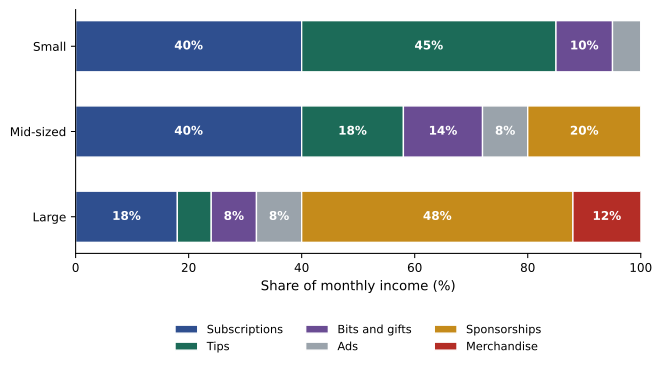
Platforms show pre-roll and mid-roll ads on live streams and share revenue with eligible creators. Streamers can schedule ad breaks during natural pauses, and some platforms reward regular ad breaks by reducing pre-rolls for new viewers. Ad income depends on the number of viewers, the length and frequency of ads, viewers' locations and the time of year; it is usually measured as revenue per thousand impressions. For many small and mid-sized streamers, ads are a minor income source compared with subscriptions and sponsorships. Long ad breaks can drive viewers away, so many streamers balance ad income with viewer experience, running short breaks during planned pauses and offering ad-free viewing to subscribers.
Estimating income
Estimating live income helps set realistic goals. A simple monthly model adds subscription, Bit or gift, tip, ad and sponsorship income:
Here \(S\) is paying subscribers, \(P\) the price, \(r_s\) the creator share, \(B\) Bits or equivalent, \(v_b\) their value, \(H\) hours streamed, \(\bar{V}\) average concurrent viewers, \(a\) ad impressions per viewer per hour, and \(R\) revenue per thousand impressions. Real income is reduced by taxes, payment fees, currency conversion and equipment costs.
Worked problem
Estimating monthly income for a mid-sized streamer
A streamer averages 60 concurrent viewers over 80 hours a month. They have 150 paying subscribers at $5.99 with a 50 % share, receive 20,000 Bits at $0.01 each, $300 in direct tips, and run ads with about 3 impressions per viewer per hour at $3 per thousand impressions. Estimate monthly income before taxes and expenses.
Show solution
- Subscriptions: 150 × $5.99 × 0.50 ≈ $449.
- Bits: 20,000 × $0.01 = $200.
- Tips: $300 (less roughly 3 % processing, about $291).
- Ads: impressions = 80 × 60 × 3 = 14,400; income = 14,400 / 1000 × $3 ≈ $43.
- Total: about $449 + $200 + $291 + $43 ≈ $983.
- Per hour streamed: $983 / 80 ≈ $12.30, before taxes, equipment and preparation time.
Answer: About $980 a month, roughly $12 per hour streamed before taxes and costs, showing why many streamers add sponsorships and other income.
Sponsorships and live integrations
Sponsorships often provide the largest share of income for established streamers. Live sponsorships take forms such as sponsored streams of a new game, product placement on the desk, read-outs at set intervals, branded overlays and chat commands with links, giveaways run with the sponsor, and appearances at brand events. Brands evaluate streamers by average concurrent viewers, hours watched, audience demographics, engagement, brand safety and fit. Pricing is often based on hours or average viewers, flat fees for campaigns, or performance such as sign-ups through a link. Contracts should specify deliverables (hours, mentions, overlays), disclosure requirements, exclusivity, content rules, approvals, usage rights for clips and VODs, payment terms and what happens if a stream is canceled (CRE-310, CRE-330). Disclosure of sponsored content is legally required (Lesson 12): live sponsorships need clear verbal and visual disclosure, repeated during long streams because viewers arrive throughout.
Merchandise, affiliate links and other income
Other income sources include merchandise, often produced through print-on-demand services so there is no inventory risk; affiliate links for equipment, games and services, which pay commissions on purchases; game publisher programs and creator codes; paid communities such as Discord servers with subscriber roles or membership platforms such as Patreon; coaching, consulting and teaching; and recorded content on YouTube and short-form platforms that earns ads and brings new viewers to the stream (Lesson 11). Diversifying income reduces dependence on any single platform or sponsor.
Ethical monetization
Live monetization can pressure viewers, including young and vulnerable viewers, to spend more than they can afford, because support is visible, celebrated and sometimes competitive. Ethical practices include thanking supporters without making non-paying viewers feel unwelcome; not tying basic participation or attention to payment; avoiding manipulative tactics such as guilt, fake urgency or encouraging competitive spending between viewers; refusing large donations that seem out of character or from viewers who appear young or distressed, and refunding where possible; never encouraging viewers to spend money they do not have; being transparent about sponsorships and affiliate links; and keeping gambling content away from audiences who could be harmed (Lesson 12). Platforms have their own rules; for example, some prohibit offering rewards for donations that resemble gambling, or require viewers to be adults to send gifts.
Taxes, records and business basics
Streaming income is generally taxable income. Streamers should keep records of all income, including subscriptions, tips, Bits, gifts, sponsorships, affiliate commissions and the fair market value of gifted products, as well as expenses such as equipment, software, internet and a portion of home costs where rules allow. Platforms provide payout reports and, in some cases, tax forms. Requirements differ by country: in Canada, self-employment income is reported on a personal tax return, sales taxes such as GST/HST may apply once revenue passes a threshold, and foreign platforms may withhold US tax unless forms are completed; in the United States, self-employment tax and income tax apply, and platforms issue forms such as 1099s. CRE-330 covers creator business, contracts and taxes in depth, and streamers with significant income should consult an accountant.
Pricing a sponsored stream
Sponsors and streamers often start pricing discussions from expected viewing. One common method multiplies the expected hours watched by a rate per viewer-hour, or prices per average concurrent viewer per hour of the integration. Rates vary widely by category, audience, region and season, so these numbers are only illustrations.
Worked problem
Pricing a two-hour sponsored stream
A streamer averages 250 concurrent viewers. A game publisher wants a two-hour sponsored stream of a new release, with a verbal mention every 30 minutes, an overlay and a chat command. If the agreed rate is $0.80 per viewer-hour, what is the fee, and what is the effective cost per thousand viewer-hours?
Show solution
- Expected viewer-hours: 250 x 2 = 500.
- Fee: 500 x $0.80 = $400.
- Cost per thousand viewer-hours: $400 / 500 x 1,000 = $800.
- Add charges for extra rights, such as the sponsor reusing clips in adverts, or exclusivity that prevents working with competitors.
Answer: About $400 for the stream, equal to $800 per thousand viewer-hours, plus any agreed fees for usage rights or exclusivity.
Comparing revenue splits
Revenue splits make a large difference over time. The same viewer support produces different income depending on the platform share.
| Viewer spend per month | Creator share 50 % | Creator share 70 % | Creator share 95 % |
|---|---|---|---|
| $500 | $250 | $350 | $475 |
| $2,000 | $1,000 | $1,400 | $1,900 |
| $10,000 | $5,000 | $7,000 | $9,500 |
Higher shares are attractive, but streamers also weigh audience size, discovery, advertiser demand, payout reliability and community fit. A platform with a higher share but far fewer viewers can produce less total income.
Gift economies and conversion
On platforms that use virtual gifts, viewers buy coins with real money, send gifts worth a number of coins, and creators receive diamonds or points that convert back to money. The creator share depends on the coin price, the conversion rate and fees, and it is often much lower than the share of a subscription.
Worked problem
Estimating income from virtual gifts
Viewers spend about $300 a month on coins that they send as gifts during a streamer LIVE sessions. If the creator effectively receives about 40 % of what viewers spend after platform fees and conversion, and the streamer goes live 20 times for 90 minutes, what is the income per hour live?
Show solution
- Creator income: $300 x 0.40 = $120.
- Hours live: 20 x 1.5 = 30 hours.
- Income per hour live: $120 / 30 = $4.
Answer: About $120 a month, or $4 per hour live, before taxes.
Payouts, thresholds and currency
Platforms pay out monthly or on request once balances pass a minimum threshold, often in US dollars. Canadian streamers may lose a few percent to currency conversion and bank fees, and should complete the platform tax forms that apply to foreign creators so that withholding is applied correctly. Keep a record of the exchange rate used for each payout for accounting.
Negotiating with sponsors
Negotiation is normal in sponsorships. Before agreeing, ask what the sponsor wants to achieve, such as awareness, sign-ups or sales, because that shapes the right deliverables and the right price. Share accurate statistics, including average concurrent viewers, hours watched and audience regions, and never inflate numbers, since sponsors can usually check them. Ask about usage rights, exclusivity, approval processes and payment terms, which are often 30 to 60 days after the campaign. It is reasonable to propose a different package, to ask for a higher fee for exclusivity or for the sponsor to reuse clips in advertising, and to decline sponsors whose products do not fit the community. Many streamers keep a simple rate card and a media kit with their audience statistics, examples of past integrations and contact details, updated every few months. Saying no to poorly fitting sponsors protects the trust that makes future sponsorships valuable.
Income stability and planning
Live income fluctuates from month to month. Subscriptions drop after breaks, sponsorships arrive unevenly, ad rates rise late in the year and fall in January, and platform policy changes can alter income overnight. Streamers who rely on streaming income often keep a buffer of several months of expenses, set aside a share of each payout for taxes, and track income by source so they can see which streams of revenue are growing and which are shrinking. Treating streaming income as variable, rather than as a salary, makes it easier to plan purchases and to take breaks without financial stress.
Common mistakes
MistakeRelying on one income source.
InsteadCombine subscriptions, tips, sponsors, merch and recorded content.
MistakeLong, frequent ad breaks.
InsteadRun short breaks during natural pauses.
MistakeDisclosing a sponsor only once in a long stream.
InsteadDisclose clearly and repeat for new arrivals.
MistakeEncouraging competitive spending.
InsteadThank supporters without pressuring viewers.
MistakeKeeping no records.
InsteadTrack income and expenses for taxes.
Summary and key terms
- Subscriptions are the most stable live income; shares vary by platform.
- Tips, Bits, gifts and paid messages are visible, one-off support.
- Ads usually contribute modestly; balance with viewer experience.
- Estimate income realistically, including per-hour earnings.
- Sponsorships need contracts and repeated disclosure.
- Merchandise, affiliates and recorded content diversify income.
- Monetize ethically and keep records for taxes.
- Subscription
- Recurring monthly support with benefits.
- Gift subscription
- Subscription bought for another viewer.
- Bits
- Twitch virtual currency used to cheer.
- Super Chat
- Paid highlighted message on YouTube.
- LIVE gift
- Virtual gift sent to TikTok creators.
- Mid-roll
- Ad shown during a stream.
- RPM
- Revenue per thousand impressions.
- Sponsorship
- Paid promotion for a brand.
- Affiliate link
- Link that earns a commission on purchases.
- Chargeback
- Reversal of a payment by the payer's bank.
Practice problems
Work each problem on paper first, then reveal the answer to check.
Why are subscriptions the most stable live income?
Show answer
They recur monthly.
What does a streamer receive per Bit at the time of writing?
Show answer
About one US cent.
Creator share of YouTube Super Chat?
Show answer
70 % after taxes and fees.
Income from 100 subs at $5 with a 70 % share?
Show answer
$350.
Ad impressions for 40 viewers, 50 hours, 2 per viewer-hour?
Show answer
4,000.
Ad income from 4,000 impressions at $4 RPM?
Show answer
$16.
Name three sponsorship deliverables.
Show answer
Hours, mentions, overlays, links, giveaways, appearances.
Why repeat sponsor disclosure on stream?
Show answer
Viewers arrive throughout.
Name two ethical monetization practices.
Show answer
No pressure, refund suspicious donations, transparency.
What records should streamers keep?
Show answer
All income and expenses, including gifted products.
Lesson quiz · 5 questions
Score 60% or more to complete this lesson.
Create a free account to save your progress, take quizzes and earn a certificate.