
CRE-250 · Lesson 1 of 12 · 28 min
The live landscape and platforms
Livestreaming is the most immediate form of content creation. Instead of planning, filming, editing and publishing, a streamer goes live and creates the show in real time with the audience, who can talk back through chat, send gifts and subscriptions, and shape what happens next. Streams range from a single person playing a game for six hours to a multi-camera talk show, a cooking class, a charity marathon, a product launch, a music performance or a quiet study session with thousands of people working alongside. This course covers how to plan, produce, run and grow live shows: platforms, formats, hardware, encoding, production software, audio, audience engagement, collaborations, moderation and safety, monetization, the business and wellbeing of streaming, and the law and ethics of going live. This first lesson surveys the landscape: what makes live different, a short history, the main platforms and their economics, how live discovery works, and how to choose where to stream. Platform features, revenue shares and requirements change frequently; figures in this course are stated at the time of writing (October 2026) and should be checked against each platform's current help pages.
What makes live different
Live content differs from recorded content in several ways that shape everything a streamer does:
- Interaction: viewers respond in real time, and the streamer responds back. The audience is part of the show, not just watching it.
- Duration: streams often last hours, so they are built from segments, routines and recurring moments rather than a single tight script.
- Imperfection: there is no edit. Mistakes, technical problems and surprises happen in front of the audience, and how a streamer handles them becomes part of their persona.
- Community: regular viewers return for the people, the chat culture and in-jokes as much as for the content, forming communities with their own norms.
- Scheduling: live content is appointment viewing. Consistent schedules help audiences know when to show up.
- Monetization: viewers pay directly through subscriptions, tips and gifts, often more than they would for recorded content, because support is visible and acknowledged in the moment.
- Risk: anything said or shown is broadcast immediately, so safety, privacy and moderation demand constant attention.
Recorded content and live content also feed each other: streams produce highlights, clips and long-form edits for other platforms (Lesson 11), and recorded content brings new viewers to live shows.
A short history of livestreaming
Live video on the internet began in the 1990s with webcams and experimental broadcasts. Justin.tv, launched in 2007 by Justin Kan broadcasting his life continuously, grew into a platform where anyone could stream; its gaming section became Twitch in 2011, and Amazon acquired Twitch in 2014. YouTube introduced live streaming broadly in 2011 and expanded it over the following years, and Facebook Live launched in 2016. Mobile streaming spread through apps such as Periscope (launched 2015, shut down in 2021) and Instagram Live (2016). Live streaming became central to esports, game culture and music during the late 2010s, and the COVID-19 pandemic in 2020 brought a surge of live classes, concerts, events and talk shows. TikTok LIVE grew rapidly in the early 2020s, with gift-based economics particularly strong in mobile-first audiences. Kick, launched in 2022 and associated with the gambling company Stake, attracted attention with high revenue shares and deals with prominent streamers. By the mid-2020s, livestreaming spanned gaming, "just chatting", music, sports, education, shopping and events across many platforms.
The main platforms
Each platform has its own audience, culture, discovery system and economics. At the time of writing, the major platforms include:
| Platform | Strengths | Typical content | Notes |
|---|---|---|---|
| Twitch | Mature live culture, chat tools, raids, extensions, community features | Gaming, just chatting, esports, creative, music | Discovery historically weak for new streamers; owned by Amazon |
| YouTube Live | Search and recommendations, VODs stay discoverable, high bitrates and 4K | Gaming, talk shows, news, events, education | Live content becomes part of the channel library |
| TikTok LIVE | Huge mobile audience, strong discovery from the For You feed, gifts | Mobile chats, music, battles, shopping, gaming | Age and follower requirements; gift-driven |
| Kick | High subscription revenue share for creators | Gaming, just chatting, gambling-adjacent content | Owned by people associated with Stake; policies differ |
| Instagram and Facebook Live | Existing follower base, mobile, collaborations | Q&As, interviews, behind the scenes, launches | Fewer long-form streaming tools |
| LinkedIn Live, X, others | Professional or niche audiences | Webinars, panels, business events | Often streamed through third-party tools |
Smaller and regional platforms also matter in some markets, and shopping-focused live streams on platforms such as TikTok Shop, Amazon Live and others combine entertainment with commerce. Some streamers use multistreaming tools to broadcast to several platforms at once (Lesson 4), although some platforms restrict this for partners.
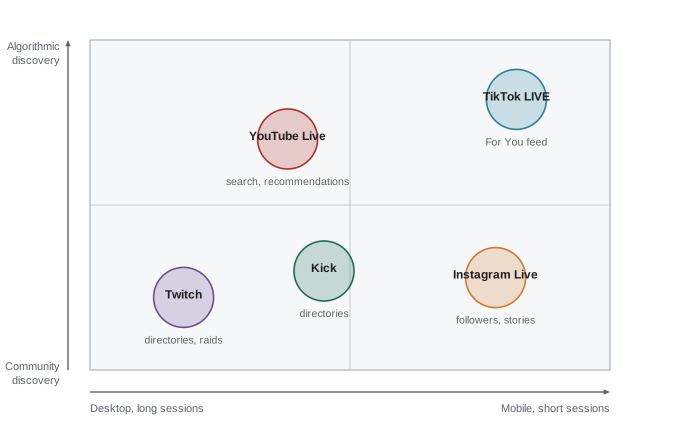
How live discovery works
Finding new viewers is the central challenge for new streamers. Discovery differs by platform:
- Directory browsing: Twitch and Kick list live channels by category, usually sorted by current viewers, which favors channels that are already large. Small channels appear far down the list in popular categories.
- Recommendations: YouTube and TikTok recommend live streams in feeds alongside recorded content, using signals such as watch time, engagement and viewer interests (CRE-201). A TikTok LIVE can reach new viewers quickly if early viewers engage.
- Social graph: followers are notified when a streamer goes live, and Instagram and Facebook Live rely heavily on existing followers.
- Off-platform promotion: clips, short videos, social posts, communities and collaborations drive viewers to streams.
- Raids, hosts and co-streams: streamers send their audiences to each other at the end of a stream or stream together (Lesson 8).
Because of these differences, a common strategy is to use short-form clips and recorded videos for discovery and live streams for community and income.
The economics of live
Live platforms share revenue with streamers through several mechanisms, covered in Lesson 10. At the time of writing, reported terms include Twitch subscriptions splitting 50/50 by default, with eligible partners able to reach 70/30 on a portion of their subscription revenue through the Partner Plus program; Bits worth about one US cent each to the streamer; YouTube channel memberships and Super Chat paying creators 70 % of revenue after certain deductions; Kick advertising a 95/5 subscription split in the creator's favor; and TikTok LIVE gifts converting to diamonds that creators can exchange for money at rates the platform sets. These terms change regularly and vary by program and country, so always check current terms before planning income. Most streamers earn little or nothing; a small minority earn a full-time living, usually combining platform income with sponsorships, merchandise, affiliate links and recorded content.
Worked problem
Comparing subscription income across platforms
A streamer has 200 paying monthly subscribers at a price of $5.99 (US). Estimate monthly subscription income at a 50/50 split, a 70/30 split and a 95/5 split, ignoring taxes and fees.
Show solution
- Gross subscription revenue: 200 × $5.99 = $1,198.
- At 50/50: 0.50 × $1,198 = $599.
- At 70/30: 0.70 × $1,198 ≈ $839.
- At 95/5: 0.95 × $1,198 ≈ $1,138.
Answer: About $599, $839 and $1,138 per month respectively, before taxes, app-store fees, regional pricing and currency conversion, which reduce actual payouts.
Revenue share is only one factor. Audience size and behavior, discovery, community features, sponsorship opportunities and the platform's policies all matter, and a streamer with a large audience on a lower-share platform may earn more than one with a small audience on a higher-share platform.
Choosing where to stream
Choosing a primary platform involves several questions:
- Where is your audience already? A creator with a large TikTok following may do well on TikTok LIVE; a YouTuber may start with YouTube Live.
- What content will you stream? Long gaming sessions suit Twitch, YouTube and Kick; short mobile chats suit TikTok and Instagram; webinars suit LinkedIn or YouTube.
- How will people discover you? Consider which platform's discovery fits your growth strategy.
- What tools do you need? Chat moderation, extensions, channel points, clips, VOD storage and analytics differ.
- What are the policies? Content rules (for example on gambling, mature content and music), exclusivity terms for partners, and enforcement history matter.
- How do you want to earn? Subscriptions, gifts, ads and sponsorships work differently on each platform.
Many streamers focus on one main platform to build a concentrated community, use short-form platforms for discovery, and consider multistreaming or simulcasting where rules allow. Diversifying reduces the risk of depending on a single platform whose policies or economics may change.
Live categories and formats
Live content falls into recognizable categories: gaming (from casual play to competitive esports), just chatting and talk shows, creative streams (art, music production, crafts, cooking), IRL streams from the real world, music performances and DJ sets, education and tutorials, co-working and study streams, sports watch-alongs and reactions (with rights limits, Lesson 12), events and conferences, charity marathons, and live shopping. Lesson 2 covers designing a show within these categories. Choosing a category also means choosing a culture: viewers of speedrunning streams expect different things from viewers of cozy art streams or high-energy reaction shows.
Who watches and why
Viewers watch live streams for entertainment, companionship, learning, skill observation (watching experts play or work), participation in community, and the chance to interact with the streamer. Research on parasocial relationships (CRE-220) shows that regular viewers can feel a sense of friendship with streamers, which brings loyalty but also responsibilities: streamers should be honest, avoid exploiting viewers' feelings for money, and take care with vulnerable or young viewers. Understanding why your viewers watch, through chat, surveys and analytics, helps shape the show.
Live and recorded content compared
Many creators work in both live and recorded formats, and it helps to understand how they differ before committing time and money to streaming. Recorded video rewards editing, pacing and searchable topics, and a good video can keep earning views for years. Live content rewards presence, consistency and community, and most of its value happens in the moment, although VODs and clips extend its life. The table compares the two.
| Feature | Live stream | Recorded video |
|---|---|---|
| Editing | None during the broadcast | Full control before publishing |
| Audience interaction | Real time, through chat and alerts | Delayed, through comments |
| Typical length | One to several hours | Seconds to under an hour |
| Discovery | Directories, raids, notifications, recommendations | Search, recommendations, shares |
| Lifespan | Mostly during the broadcast, then clips and VODs | Months or years |
| Main income | Subscriptions, tips, gifts, sponsors | Ads, sponsors, affiliate links |
Measuring an audience in hours watched
Live platforms and sponsors often describe channels by hours watched rather than views, because a viewer who stays for two hours is worth more to the community, the platform and advertisers than one who leaves after ten seconds. Hours watched is the average number of concurrent viewers multiplied by the hours streamed.
Worked problem
Comparing two schedules by hours watched
Streamer A streams 4 hours, 5 days a week, with 25 average viewers. Streamer B streams 8 hours, 2 days a week, with 40 average viewers. Which produces more hours watched per week?
Show solution
- A: 25 viewers x 20 hours = 500 hours watched per week.
- B: 40 viewers x 16 hours = 640 hours watched per week.
- B produces about 28 % more hours watched, but A appears on more days, which may help habit and discovery.
Answer: Streamer B, with 640 hours watched against 500, although the more frequent schedule has its own benefits.
Mobile-first and vertical live
A growing share of live viewing happens on phones, and some platforms are designed for vertical live from the start. TikTok LIVE, Instagram Live and YouTube Live from a phone favor short, personal, chat-driven sessions, often between 20 minutes and two hours, with gifts as the main form of support. Discovery on these platforms leans on recommendation feeds rather than directories, so a stream can briefly reach many viewers who have never seen the creator before, and then vanish from their feeds just as quickly. Streamers who work on both horizontal and vertical platforms often run separate shows, or produce a dual-format output so that one broadcast fits both screens (Lesson 5).
Reading the terms of service
Before investing in a platform, read its creator terms, community guidelines and monetization policies. Pay attention to exclusivity clauses that limit streaming elsewhere, rules for multistreaming, payout thresholds and schedules, minimum ages, rules about gambling and sponsored content, and how the platform handles copyright claims. At the time of writing, several platforms have changed exclusivity and multistreaming rules more than once in a few years, so check the current version rather than relying on older advice from other streamers.
Common mistakes
MistakeChoosing a platform only by revenue share.
InsteadWeigh audience, discovery, tools and policies too.
MistakeAssuming viewers will find a new stream in the directory.
InsteadPlan off-platform promotion and clips for discovery.
MistakeTreating figures from blogs as permanent.
InsteadCheck current platform terms at the time of planning.
MistakeExpecting quick full-time income.
InsteadPlan realistically; most streamers earn little.
MistakeDepending entirely on one platform.
InsteadDiversify discovery and income where possible.
Summary and key terms
- Live content is interactive, long, unedited, community-driven and scheduled.
- Livestreaming grew from Justin.tv and Twitch to YouTube, TikTok, Kick and others.
- Platforms differ in audience, discovery, tools, culture and economics.
- Discovery comes from directories, recommendations, followers, clips and raids.
- Revenue shares vary and change; most streamers earn little.
- Choose platforms by audience, content, discovery, tools, policies and income.
- Categories carry cultures; understand why your viewers watch.
- Livestream
- Video broadcast in real time to an online audience.
- Just chatting
- Category for conversation-led streams.
- IRL stream
- Stream from the real world outside a studio.
- Directory
- List of live channels by category.
- Raid
- Sending your viewers to another live channel.
- Multistreaming
- Broadcasting to several platforms at once.
- VOD
- Recording of a past stream available on demand.
- Revenue share
- Split of income between platform and creator.
- Appointment viewing
- Content watched at a scheduled time.
- Parasocial relationship
- One-sided sense of connection with a media figure.
Practice problems
Work each problem on paper first, then reveal the answer to check.
Name three ways live differs from recorded content.
Show answer
Interaction, duration, imperfection, community, scheduling, monetization, risk.
What did Justin.tv's gaming section become?
Show answer
Twitch, in 2011.
Which platform keeps live VODs discoverable through search?
Show answer
YouTube.
Why is directory discovery hard for small channels?
Show answer
Channels are usually sorted by current viewers.
Monthly income from 100 subs at $5 with a 50/50 split?
Show answer
$250.
Name two non-financial factors in choosing a platform.
Show answer
Audience, discovery, tools, policies, culture.
What is a common discovery strategy for streamers?
Show answer
Short-form clips for discovery, live for community.
Name four live categories.
Show answer
Gaming, just chatting, creative, IRL, music, education, co-working, events.
Why are parasocial relationships a responsibility?
Show answer
Viewers feel close; streamers must not exploit that.
Why diversify platforms?
Show answer
To reduce dependence on one platform's policies and economics.
Lesson quiz · 5 questions
Score 60% or more to complete this lesson.
Create a free account to save your progress, take quizzes and earn a certificate.