
CRE-120 · Lesson 9 of 12 · 27 min
Voice, style and editing
Two creators can share the same information and get completely different results because of how they write. Voice is what makes writing recognizable as yours: the attitude, word choices, rhythm and personality that run through every caption, script and newsletter. Editing is what turns a rough draft into writing that is clear, tight and effective. Most writing improves dramatically in editing, and professional writers spend as much time revising as drafting. This lesson covers developing and documenting a voice, adjusting tone for context, plain language principles, a practical editing process, readability measures, grammar and style choices, and working with editors, feedback and tools.
Voice and tone
Voice is consistent personality; tone is how that personality adapts to the situation. A creator's voice might be warm, witty and direct across everything they publish, while the tone shifts: lighter in a humorous short video, more serious when addressing a mistake, more precise in a tutorial, more emotional in a personal story. CRE-110 covered defining a brand voice; this lesson focuses on expressing it in writing. Voice shows up in:
- Word choice: plain or technical, formal or casual, slang or standard, British or North American spelling.
- Sentence rhythm: short and punchy, or flowing and reflective.
- Point of view: first person ("I"), second person ("you"), or collective ("we").
- Humor: none, dry, playful, self-deprecating.
- Attitude: encouraging, skeptical, rebellious, calm, enthusiastic.
- Recurring phrases, sign-offs and formats that audiences come to recognize.
Authentic voice usually comes from writing the way you speak to a friend who is interested in the topic, then refining. Imitating another creator's voice rarely works for long.
Documenting your voice
As a creator's team grows, or simply to stay consistent, a short voice and style guide helps. It might describe the voice in three to five adjectives with "this, not that" clarifications ("confident, not arrogant; playful, not silly"), list words and phrases to use and avoid, set rules for spelling, capitalization, numbers, emoji and hashtags, and give examples of good and bad copy. Editors, assistants and AI tools can then produce drafts closer to the creator's voice.
| Voice trait | This | Not that | Example |
|---|---|---|---|
| Confident | Clear recommendations | Arrogant or dismissive | "Use the 50/30/20 rule. Here is why." |
| Warm | Encouraging and human | Gushing or fake | "Everyone starts somewhere. My first loaf was a brick." |
| Playful | Light humor | Silly or off-topic | "Your plants are not dramatic. They are thirsty." |
| Direct | Short, plain sentences | Blunt or rude | "Skip the expensive kit. Start with your phone." |
Plain language
Plain language means writing that the intended audience can find, understand and use the first time they read it. Governments and organizations around the world, including Canada and the United States, have adopted plain language principles for public communication, and the ISO 24495-1 standard sets out plain language guidelines. Core principles:
- Know your audience and purpose before writing.
- Put the most important information first.
- Use short sentences, averaging around 15 to 20 words, with one main idea each.
- Choose common words: "use" not "utilize", "help" not "facilitate", "about" not "approximately".
- Prefer active voice: "We changed the settings" rather than "The settings were changed".
- Explain or avoid jargon and acronyms.
- Use headings, lists and white space to organize information.
Plain language is not simplistic: it allows complex ideas to be understood quickly. It is especially important for health, finance, legal and safety topics, where misunderstanding causes harm.
A practical editing process
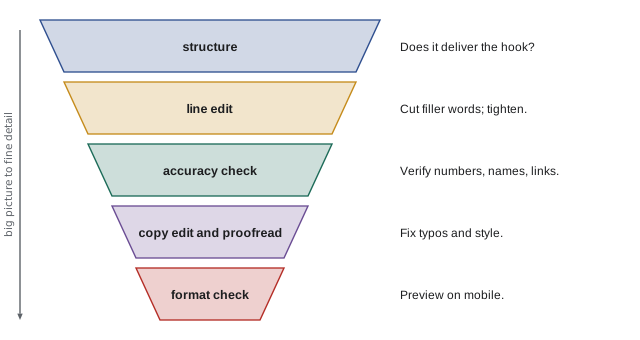
Editing works best in passes, each focused on one level:
- Structural edit: Does the piece deliver on its hook? Is the most important point first? Is anything missing, repeated or out of order? Cut sections that do not serve the purpose.
- Line edit: tighten sentences, replace weak verbs and vague words, remove filler ("really", "very", "just", "actually", "in order to"), vary rhythm, and check that every sentence sounds like you.
- Accuracy check: verify facts, numbers, names, links and claims, especially anything that could mislead.
- Copy edit and proofread: grammar, spelling, punctuation, consistency of style, and typos. Reading aloud and changing the font or device help catch errors the eye skips.
- Format check: preview on mobile, check line breaks, alt text, captions and links.
Letting a draft rest, even for an hour, before editing helps you see it with fresh eyes. For important pieces, a second reader catches what you cannot.
Worked problem
Line-editing a caption
Edit this sentence: "In order to really make sure that your houseplants are actually getting the amount of light that they need, it is very important that you try to place them in close proximity to a window that faces south."
Show solution
- Remove filler: "really", "actually", "very", "try to".
- Replace wordy phrases: "in order to" → "to"; "in close proximity to" → "near"; "the amount of light that they need" → "enough light".
- Use active, direct phrasing addressed to the reader.
- Result: "To give your houseplants enough light, place them near a south-facing window."
- The sentence drops from 38 words to 12 without losing meaning.
Answer: "To give your houseplants enough light, place them near a south-facing window." (12 words instead of 38).
Measuring readability
Readability formulas estimate how hard text is to read. The Flesch Reading Ease score (introduced in Lesson 1) rates text from 0 to 100, with higher scores easier; scores of 60 to 70 correspond roughly to plain English for a general audience. The Flesch–Kincaid Grade Level estimates the school grade needed to understand the text:
Worked problem
Calculating a grade level
A 120-word caption has 8 sentences and 168 syllables. Calculate its Flesch–Kincaid grade level.
Show solution
- Words per sentence: 120 / 8 = 15.
- Syllables per word: 168 / 120 = 1.4.
- FK grade = 0.39 × 15 + 11.8 × 1.4 − 15.59.
- = 5.85 + 16.52 − 15.59 = 6.78.
- About grade 7: accessible to a broad audience.
Answer: About grade 6.8, roughly grade 7.
Formulas measure only sentence length and word length, not clarity of ideas, structure or tone, so they are diagnostic tools rather than targets. Tools such as the Hemingway Editor and the readability checks in word processors highlight long sentences, passive voice and complex words for review.
Grammar, style and consistency
Social writing allows informality, such as sentence fragments, starting sentences with "and" or "but", and conversational punctuation, but errors still cost credibility, especially for educational and professional creators. Choose a style and apply it consistently: spelling conventions (Canadian, American or British), capitalization of titles, number formats (numerals are often clearer than words online), use of the serial comma, and how to write dates, times and units. Creators writing for both Canadian and American audiences should be aware of spelling differences, such as words ending in -our or -or, -re or -er, and -ise or -ize, and choose deliberately. Many organizations follow a published style guide, such as The Canadian Press Stylebook or the Associated Press Stylebook, and creators can adopt one as a reference.
Feedback, editors and tools
Feedback accelerates improvement. Sources include trusted peers who represent the audience, editors (freelance editors are common for newsletters and scripts as creators grow), comments and replies from the audience, and analytics showing which pieces perform. Grammar and style tools catch many errors, and AI assistants can suggest tighter phrasings or alternative hooks, but they can also flatten voice, introduce errors and miss context, so the creator should review every suggestion. Keeping a list of your own recurring mistakes, such as overused words or common typos, helps target future edits.
Sentence-level techniques
Good line editing relies on a handful of techniques that apply to almost any draft:
- Put the subject and verb near the start of the sentence, so readers know quickly who does what.
- Replace nominalizations, nouns made from verbs, with the verbs themselves: "make a decision" becomes "decide", "conduct an analysis" becomes "analyze".
- Cut redundant pairs and phrases: "each and every", "end result", "past history", "free gift".
- Replace vague words such as "things", "stuff" and "aspects" with specific nouns.
- Break long sentences at natural joints, often where "and", "but" or "which" appears.
- Vary sentence length, mixing short punchy sentences with longer ones, so the rhythm does not become monotonous.
- Put the most important word or idea at the end of the sentence or paragraph, where it lands with emphasis.
Applying these techniques consistently makes writing tighter without making it sound robotic.
Editing for social formats
Each social format adds specific editing checks. For captions, confirm the hook works before the truncation point and the call to action is single and clear. For scripts, read aloud and time the delivery, cutting lines that duplicate what the visuals show. For threads and carousels, check that each post or slide carries one idea and that the sequence flows. For newsletters, review the subject line, preview text and links, and send a test email to yourself on both a phone and a computer. For titles and descriptions, check keywords and truncation. Using a checklist for each format prevents recurring errors and speeds up editing as it becomes habit.
Self-editing versus being edited
Self-editing is difficult because writers know what they meant, so their minds fill in gaps that readers will notice. Distance helps: leaving a draft overnight, changing the font or reading on a different device makes familiar text look new. Reading aloud slows the eye and reveals awkward rhythm. Text-to-speech tools can read the draft back. Even with these techniques, a second reader is valuable for important pieces. When receiving feedback, writers should listen for the problem the reader experienced rather than arguing about the suggested fix: if a reader is confused, something needs to change, even if the writer chooses a different solution.
Keeping voice through editing
Heavy editing can strip personality from writing, leaving it correct but flat. The goal is to remove what obscures the voice, such as filler, repetition and confusion, while keeping what expresses it, such as characteristic phrases, humor, rhythm and opinions. Comparing an edited draft with a few of the creator's best-performing pieces helps check that it still sounds like them. Some apparent errors are deliberate voice choices, such as fragments, casual punctuation or repeated words for emphasis, and a good editor learns the difference. A style guide that records these choices helps editors and collaborators respect them.
Editing with AI tools
AI writing assistants can speed up editing by suggesting shorter phrasings, flagging passive voice, generating alternative hooks and summarizing long drafts. They are most useful when given clear instructions, such as "tighten this caption to under 80 words without changing the tone" or "suggest five alternative first lines", and examples of the creator's voice. They are least reliable at judging accuracy, context and audience fit: they can introduce factual errors, change meaning subtly, and produce generic phrasing that many other creators are also publishing. Every AI suggestion should be reviewed, and the creator remains responsible for what is published. Lesson 12 discusses responsible use of AI tools further.
Building an editing habit
Editing becomes faster and more effective with practice and routine. Useful habits include scheduling editing as a separate task from drafting; keeping a personal list of recurring problems to check, such as overused words or a tendency toward long introductions; reviewing published pieces after a week to see what could be better; and studying edited versions of your work when an editor or collaborator makes changes. Over time, many edits move upstream into drafting, as writers internalize the patterns and produce cleaner first drafts.
An editing checklist
A short checklist turns the editing process into a habit. Before publishing, ask: Does the opening line work on its own? Is the most important point first? Is every paragraph about one idea? Have filler words and repeated points been cut? Are facts, names, numbers and links correct? Is the spelling consistent with my style guide? Does it sound like me when read aloud? Is there one clear call to action? Have I added alt text, captions or other accessibility features? Does it look right on a phone? Keeping the checklist beside the drafting space, or saving it as a template, takes only a minute per piece and catches most of the errors that slip through.
Common mistakes
MistakePublishing first drafts.
InsteadEdit in passes and let drafts rest.
MistakeImitating another creator's voice.
InsteadWrite as you speak and refine your own voice.
MistakeUsing jargon without explanation.
InsteadUse plain language or define terms.
MistakeTreating readability scores as goals.
InsteadUse them to flag problems, then judge clarity.
MistakeAccepting all tool suggestions.
InsteadReview suggestions for accuracy and voice.
Summary and key terms
- Voice is consistent personality; tone adapts to context.
- Voice shows in word choice, rhythm, point of view, humor and attitude.
- A voice and style guide keeps writing consistent across a team.
- Plain language makes writing understandable the first time.
- Edit in passes: structure, line, accuracy, copy and format.
- Readability formulas flag long sentences and words.
- Use consistent style and review feedback and tool suggestions critically.
- Voice
- Consistent personality in writing.
- Tone
- Adjustment of voice to a situation.
- Style guide
- Rules for spelling, usage and formatting.
- Plain language
- Writing understood the first time it is read.
- Active voice
- Sentences where the subject performs the action.
- Structural edit
- Editing organization and content.
- Line edit
- Editing sentences for clarity and style.
- Proofreading
- Final check for errors.
- Flesch–Kincaid grade
- Readability measure as a school grade.
- Filler words
- Words that add length but not meaning.
Practice problems
Work each problem on paper first, then reveal the answer to check.
Distinguish voice and tone.
Show answer
Voice is consistent personality; tone adapts to context.
Name three ways voice shows up.
Show answer
Word choice, rhythm, point of view, humor, attitude.
What does a "this, not that" chart clarify?
Show answer
How a trait should and should not sound.
Replace "utilize" and "facilitate".
Show answer
Use and help.
Rewrite in active voice: "The video was edited by Sam."
Show answer
"Sam edited the video."
List the editing passes.
Show answer
Structure, line, accuracy, copy/proofread, format.
Why let drafts rest?
Show answer
To see them with fresh eyes.
FK grade for 10 words/sentence and 1.3 syllables/word?
Show answer
3.9 + 15.34 − 15.59 ≈ 3.65.
What do readability formulas not measure?
Show answer
Clarity of ideas, structure, tone.
Name two style guides.
Show answer
Canadian Press Stylebook, AP Stylebook.
Lesson quiz · 5 questions
Score 60% or more to complete this lesson.
Create a free account to save your progress, take quizzes and earn a certificate.