
CRE-120 · Lesson 5 of 12 · 25 min
Scripting long-form video and podcasts
Long-form content, such as YouTube videos of eight to forty minutes, video essays, tutorials, documentaries and podcasts, gives creators room to go deep, build relationships with audiences and earn more per viewer through watch time and sponsorships. It also gives viewers more opportunities to leave. Writing is what holds long-form content together: a clear promise, a structure that builds, transitions that carry viewers from one section to the next, and moments that renew interest. This lesson covers planning and research, structures for long-form video, writing intros that hold, maintaining retention through the middle, scripting versus outlining, writing for podcasts and interviews, and integrating sponsorships smoothly.
Start with the promise and the audience
Every long-form piece should be built around a clear promise that the title and thumbnail make and the content keeps: "how to build a gaming PC for under $1,000", "why the 2008 financial crisis happened, explained simply", "what I learned living without a car for a year". Before writing, answer: Who is this for? What will they know, feel or be able to do by the end? Why should they watch this instead of the alternatives? What is the one thing they must remember? These answers guide every structural decision and every cut. Research comes next: gather facts from reliable sources, note examples and stories, collect visuals or B-roll ideas, and check what existing videos on the topic cover and miss, so yours adds something.
Structures for long-form video
Common structures include:
- Problem–solution: present a problem the audience cares about, explore why it happens, then deliver solutions.
- Step-by-step tutorial: overview, then steps in order, with checkpoints and a recap.
- Listicle: a set of items, often ordered to build toward the strongest or most surprising, with a reason to stay for each.
- Narrative or documentary: a story with a beginning, rising tension, climax and resolution, often following a person, project or mystery.
- Argument or video essay: a thesis, evidence and counterarguments, and a conclusion.
- Challenge or experiment: a premise, attempts, setbacks and outcome.
Most successful long-form videos combine structure with story. Even a tutorial benefits from a narrative thread, such as the creator's own project from start to finish, because stories create the question "what happens next?" that keeps viewers watching.
The intro
The first 30 seconds of a long-form video often lose the largest share of viewers, so the intro is scripted with particular care. A strong intro: confirms the promise of the title and thumbnail quickly, so viewers know they are in the right place; shows a glimpse of the payoff, such as the finished result or the most surprising finding; establishes stakes or curiosity; establishes the creator's credibility briefly, if needed; and moves into the content within about 15 to 45 seconds. Weak intros start with long greetings, channel branding, requests to subscribe, sponsor messages before any value, or a lengthy explanation of what the video will cover. A common pattern is cold open (a striking moment or question), promise, brief preview of what is coming, then straight into the first section.
Worked problem
Rewriting a long-form intro
A creator's intro reads: "Hey guys, welcome back to the channel! If you are new here, I make videos about personal finance, so make sure to subscribe and hit the bell. Today we are going to talk about index funds, which is something a lot of you have asked about..." Rewrite it.
Show solution
- Cut the greeting, channel description and subscribe request.
- Open with a striking, specific fact or question.
- Confirm the promise of the video.
- Preview briefly what the viewer will learn.
- Rewrite: "If you had invested $10,000 in a simple index fund in 2010 and done nothing else, you would have far more today than most professional fund managers delivered. In the next 12 minutes I will show you how index funds work, the three mistakes beginners make, and exactly how to buy your first one."
Answer: Lead with a striking fact, confirm the promise and preview the payoff, without greetings or subscribe requests.
Holding attention through the middle
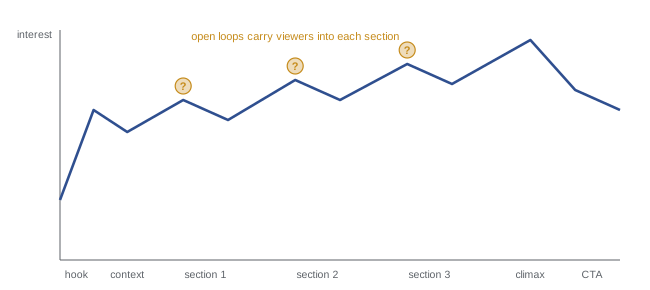
Retention typically declines slowly through the middle of long videos, with sharp drops at slow or confusing moments. Writing techniques that hold attention include:
- Open loops: raise a question early and answer it later ("I will show you the mistake that cost me $2,000 in a moment, but first..."), used honestly and paid off.
- Sections with mini-payoffs: each section delivers something valuable and ends by setting up the next.
- Re-hooks: brief statements every few minutes that remind viewers why the next part matters.
- Variety: alternating explanation with examples, stories, visuals, demonstrations and humor.
- Momentum: cutting tangents, repetition and anything that does not serve the promise.
- Transitions: phrases that connect sections logically ("Now that you know why it happens, here is how to fix it").
Retention graphs from previous videos show exactly where viewers leave, which guides future scripts.
Full scripts versus outlines
Creators differ on whether to write word-for-word scripts. Full scripts produce tight, well-structured content, precise explanations and fewer retakes, and they are valuable for complex or factual topics, video essays and voiceovers. Their risk is a stiff, read-aloud delivery, which can be overcome with conversational writing, practice and a teleprompter. Outlines, with key points, examples and transitions but not every word, produce more natural delivery and suit personalities who speak well off the cuff, at the cost of more rambling and longer editing. Many creators use a hybrid: script the intro, key explanations, transitions and the ending word for word, and outline the rest. Whatever the approach, a written plan keeps the video focused on its promise.
| Approach | Strengths | Risks | Best for |
|---|---|---|---|
| Full script | Tight structure, precise, fewer retakes | Stiff delivery if not conversational | Essays, explainers, voiceovers |
| Detailed outline | Natural delivery, flexibility | Rambling, more editing | Vlogs, reviews, experienced presenters |
| Hybrid | Strong intros and transitions with natural middle | Requires discipline | Most tutorials and educational content |
| Interview guide | Prepared questions with flexibility | Losing focus | Podcasts and interviews |
Writing for podcasts
Podcasts are listened to, often while doing something else, so audio scripts must be even more listener-friendly than video: no visual aids, more signposting, more repetition of key points, and descriptions of anything listeners cannot see. Solo podcasts may be fully scripted or outlined. Interview podcasts rely on research and an interview guide: background on the guest, a clear angle for the episode, opening questions that relax the guest, open-ended questions that invite stories ("Tell me about the moment you decided..."), follow-ups that dig deeper, and a closing question. Good interviewers listen more than they talk and are willing to abandon their plan when a better story appears. Episode titles and descriptions should state what the listener will gain, and show notes can summarize key points with timestamps and links.
Writing sponsor segments
Long-form videos and podcasts often include sponsored segments. Well-written integrations are clearly disclosed (legally required and important for trust), relevant to the audience, placed where they least disrupt the flow, often after the first section has delivered value, and written in the creator's own voice with honest experience of the product. Transitions into and out of the segment should be smooth and honest rather than disguised. Sponsors provide talking points and requirements, but scripts that sound like the creator perform better for both sides. CRE-310 and CRE-320 cover sponsorships and disclosure rules in detail.
Endings and calls to action
Endings should deliver the final payoff, summarize the key takeaway in a sentence or two, and point to a next step: a related video ("If you want to see how I built the shelves, watch this next"), a resource, or a question for the comments. Because many viewers leave as soon as they sense the end, long outros reduce the chance they will watch another of the creator's videos; end screens and verbal recommendations work best when they come promptly and are specific.
Research before scripting
Long-form content earns attention through depth, so it depends on solid research. Before outlining, creators gather facts, examples, data and expert views; note sources for every claim that might be challenged; watch or listen to existing content on the topic to find what is missing or poorly explained; and collect audience questions from comments and messages. A research document with links and notes makes scripting faster and makes it easier to add sources to the description or show notes. For interviews, research covers the guest's background, previous interviews and the topics they are known for, so the host can ask questions that go beyond what the guest has said many times before.
Outlines, beat sheets and full scripts
Long-form scripts can take several forms. An outline lists the main sections and key points under each. A beat sheet goes further, listing every moment, or beat, in order: the hook, the promise, each point, each example, each transition and the ending, often with an estimated time. A full script writes every word. Educational and documentary creators often fully script for accuracy and tight pacing, while conversational creators, vloggers and many podcasters work from outlines or beat sheets so their delivery stays natural. Whatever the format, planning the structure before recording prevents rambling, repetition and missing points, which are the main reasons long videos lose viewers in the middle.
Retention in the middle
Retention graphs for long videos typically show a drop in the first 30 seconds, then a gradual decline, with dips where viewers lose interest. Common causes of mid-video drop-off include long tangents, slow sections without visual change, repeated points, and sections that do not obviously serve the promise in the title. Techniques to hold attention include re-hooking at the start of each section ("but this next mistake is the one that cost me the most"), previewing what is coming, varying visuals and pace, telling short stories and examples, and keeping each section focused. Reviewing the retention graph after publishing shows exactly where viewers left and teaches what to change in future scripts.
Writing for podcasts
Podcasts are listened to, often while people drive, exercise or work, so audio scripts must carry everything without visuals. Listeners cannot see a chart, so numbers should be few and rounded, explained in words, and repeated when important. Signposting matters more than in video: "there are three reasons; the first is..." helps listeners follow. Interview episodes benefit from a prepared question list grouped into themes, with follow-up prompts, but the host should listen and follow interesting answers rather than reading questions in order. Solo episodes often use a detailed outline with key phrases written out. Many podcasts open with a cold open, a short compelling clip from later in the episode, before the theme music and introduction.
Sponsorship reads and segments
Long-form content often includes sponsored segments. Effective sponsor reads are written in the creator's voice, explain honestly why the product is relevant to the audience, include any required disclosure clearly at the start of the segment ("This video is sponsored by..."), and are placed where they disrupt the content least, often after the hook and first section rather than at the very start. Sponsors usually provide talking points, and the creator adapts them; contracts may require approval of the script. Lesson 12 and CRE-320 cover disclosure and the ethics of sponsored writing in more detail.
Endings and end screens
Long-form endings should resolve the promise of the title, summarize the key takeaway briefly, and then point viewers to a next step, such as a related video, a playlist, a newsletter or a community. On YouTube, end screens and cards can link to other videos; scripting a natural verbal lead-in ("if you want to see how I set up the whole system, watch this one next") makes viewers more likely to click. Long, slow outros, extended thank-you lists and repeated requests to subscribe cause viewers to leave before the end screen appears. Keeping the ending short and purposeful respects viewers and supports the channel.
Common mistakes
MistakeStarting with a long greeting and channel introduction.
InsteadOpen with a striking moment and confirm the promise.
MistakeOpening loops that are never closed.
InsteadPay off every promise and question.
MistakeReading a formal script in a stiff voice.
InsteadWrite conversationally and practice delivery.
MistakePlacing sponsor reads before any value.
InsteadPlace them after the first payoff, clearly disclosed.
MistakeLong outros.
InsteadSummarize briefly and recommend a specific next video.
Summary and key terms
- Long-form content is built around a clear promise and audience.
- Structures include problem–solution, tutorial, listicle, narrative, essay and experiment.
- Intros confirm the promise and move into content within 15–45 seconds.
- Open loops, mini-payoffs, re-hooks and variety hold attention.
- Choose full scripts, outlines or hybrids to fit the content and presenter.
- Podcast scripts need more signposting; interviews need prepared guides.
- Sponsor segments should be disclosed, relevant and well placed.
- Long-form content
- Videos or audio of several minutes or more.
- Promise
- What the content commits to deliver.
- Cold open
- Starting directly with a striking moment.
- Open loop
- A question raised early and answered later.
- Re-hook
- A reminder of why the next part matters.
- B-roll
- Supplementary footage illustrating narration.
- Video essay
- An argument-driven explanatory video.
- Interview guide
- Prepared questions and angle for an interview.
- Show notes
- Written summary and links for a podcast episode.
- Sponsor integration
- Paid segment within content.
Practice problems
Work each problem on paper first, then reveal the answer to check.
What four questions guide long-form planning?
Show answer
Who is it for, what will they gain, why this one, what must they remember.
Why combine structure with story?
Show answer
Stories create the question of what happens next.
When should an intro move into content?
Show answer
Within about 15 to 45 seconds.
What is an open loop?
Show answer
A question raised early and answered later.
Name two ways to hold attention mid-video.
Show answer
Re-hooks, mini-payoffs, variety, transitions.
What is the main risk of full scripts?
Show answer
Stiff delivery.
How does podcast writing differ from video?
Show answer
More signposting and description; no visuals.
Give an open-ended interview question.
Show answer
For example, "Tell me about the moment you decided..."
Where should sponsor segments go?
Show answer
After early value, clearly disclosed.
Why avoid long outros?
Show answer
Viewers leave before the next recommendation.
Lesson quiz · 5 questions
Score 60% or more to complete this lesson.
Create a free account to save your progress, take quizzes and earn a certificate.