
CRE-120 · Lesson 8 of 12 · 25 min
Storytelling in social writing
Facts inform, but stories move people. A statistic about debt is easily forgotten; the story of one person opening a stack of unpaid bills at 2 a.m. is not. Stories hold attention because they create questions (what happens next?), engage emotion, and help people remember and share information. Creators use stories everywhere: in captions, threads, hooks, scripts, newsletters and even product descriptions. This lesson covers why stories work, the core elements of a story, story structures that fit short and long formats, techniques that make writing vivid, using your own experience ethically, and how to weave stories into educational and promotional content.
Why stories work
Psychological research suggests several reasons stories are effective. Narrative transportation, the experience of being absorbed in a story, reduces counterarguing and increases attitude change, which is why stories persuade more than arguments for many audiences. Stories organize information in a sequence of cause and effect that is easier to remember than lists of facts. Emotional engagement makes experiences memorable. And stories about specific people trigger more empathy and action than statistics about many, an effect sometimes called the identifiable victim effect. For creators, stories also build connection: sharing experiences, failures and lessons lets audiences know the person behind the content.
The core elements of a story
Almost every story, however short, has a few elements:
- A character the audience can relate to or care about, often the creator, a client or the audience member themselves.
- A desire or goal: what the character wants.
- An obstacle or conflict: what stands in the way, creating tension.
- Stakes: what happens if the character fails.
- A turning point: a decision, discovery or event that changes the situation.
- A resolution and meaning: how it ends and what it teaches.
Without conflict, there is no story, only a description of events. "I went to Japan and it was amazing" is an anecdote; "I landed in Tokyo with no phone signal, no cash and a hotel booking for the wrong city" is the start of a story.
Story structures
Structures help shape raw experience into stories:
- Situation, complication, resolution: the simplest arc, ideal for captions and short videos.
- The hero's journey, simplified: ordinary world, call to change, struggle, transformation, return with a lesson. Useful for longer personal stories and brand stories.
- Before, during, after: showing a transformation, common in fitness, design, renovation and business content.
- In medias res: starting in the middle of the action, then filling in background, which makes a strong hook.
- The failure story: what went wrong, why, and what was learned, often more relatable and trusted than success stories.
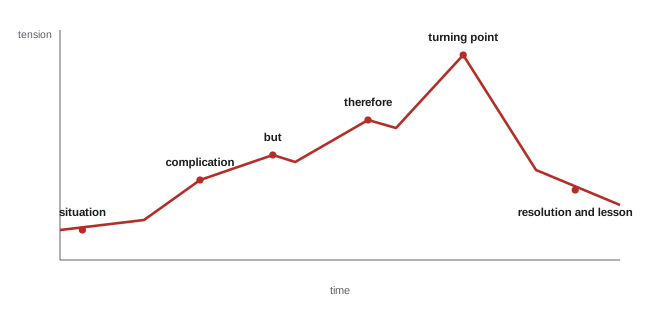
- The "but, therefore" chain: the creators of South Park famously advised connecting story beats with "but" and "therefore" rather than "and then", so that each event causes or complicates the next, creating momentum.
Worked problem
Turning an anecdote into a story
A freelance designer wants to post about the value of contracts. Draft: "Always use contracts with clients. They protect you. I learned this the hard way." Rewrite it as a short story caption.
Show solution
- Character and goal: the designer wanted to land a dream client.
- Obstacle: they skipped the contract to seem easygoing.
- Stakes and complication: after three weeks of work, the client changed the scope and refused to pay.
- Turning point: they lost $3,200 and decided never again.
- Rewrite: "My dream client emailed on a Friday. I was so excited I skipped the contract. Three weeks and 40 hours later, they changed the brief and refused to pay. I lost $3,200. Now every project starts with a one-page agreement, even for friends. Here is what mine includes..."
Answer: Add a character, goal, obstacle, stakes and turning point, then the lesson.
Making writing vivid
Vivid writing lets readers see and feel what happened:
- Specific details: "a cracked phone screen and 3 % battery" rather than "technical problems".
- Sensory language: sounds, smells, textures and images.
- Dialogue and direct quotes: "Are you sure that is the right city?" brings a moment to life.
- Show, do not tell: describe actions and reactions rather than naming emotions ("my hands were shaking as I hit send" rather than "I was nervous").
- Strong verbs and concrete nouns rather than adjectives and adverbs.
- Pacing: short sentences for tension and action; longer ones for reflection.
Too much detail slows a story, so choose the few details that matter most, especially those that reveal character or raise stakes.
Stories in educational content
Educational creators often think stories are a distraction from teaching, but stories make lessons stick. Techniques include opening a tutorial with a short story of a problem the audience recognizes; using case studies of real clients or students (with permission); telling the history behind a concept; and framing the whole lesson as a journey from confusion to understanding. A story can carry the main teaching point, with the explanation following, or a lesson can be punctuated with brief examples that keep it grounded. The key is relevance: every story should illuminate the point, not wander away from it.
Stories in promotional content
Stories also make promotion more effective and less intrusive. Instead of listing features, creators describe how a product solved a real problem in their life or work, what it was like before, and what changed. Customer stories and testimonials, used with permission and accurately, show results more convincingly than claims. Founding stories explain why a creator made a product. Promotional stories must still be truthful and, when sponsored, clearly disclosed; inventing or exaggerating experiences with a product is deceptive and can breach advertising law (CRE-320).
| Content type | Story approach | Example |
|---|---|---|
| Tutorial | Open with a relatable problem | The night my code deleted a client database |
| Thought leadership | Failure story and lesson | Why my first startup failed in 9 months |
| Product promotion | Before and after experience | How this planner got me out of 80-hour weeks |
| Community post | Shared experience | The first time a stranger recognized my work |
| Newsletter | Personal moment leading to an insight | What my grandmother's recipe box taught me about systems |
Using personal and other people's stories ethically
Personal stories create connection, but creators should think about what they share. Questions to ask include: Am I comfortable with this being public permanently? Does it involve other people, such as family, friends, clients or partners, who have not agreed to be part of my content? Could it identify or harm someone? Am I sharing to help the audience or only for attention? Stories involving children, health, relationships and workplaces require particular care (CRE-450). When telling others' stories, get consent, change identifying details where appropriate, and represent people fairly. Creators should also avoid inventing or embellishing stories presented as true; audiences increasingly detect fabricated "storytime" content, and discovery damages credibility severely.
Practicing storytelling
Storytelling improves with practice. Useful exercises include keeping a story bank, a running list of experiences, mistakes, conversations and observations that might become stories; rewriting the same story at different lengths (one sentence, a caption, a thread, a script); telling stories aloud to friends and noticing where they lean in or lose interest; and studying how skilled storytellers in podcasts, stand-up comedy, journalism and fiction open, build tension and land endings.
Micro-stories in short formats
Stories do not need to be long. A micro-story can be told in a single caption, a 20-second video or three lines of a post. The trick is compression: start as close to the conflict as possible, include one vivid detail, reach the turning point quickly, and end with a single line of meaning. For example: "Day one of my bakery: the oven died at 5 a.m. I sold cold sandwiches and gave away free coffee. Eighty people came back the next week to see if the oven worked. Sometimes the disaster is the marketing." Micro-stories are powerful hooks because they create curiosity in very few words, and they can lead into longer content that tells the full story.
Serial stories and series
Some creators build stories across many posts or videos, inviting audiences to follow a journey: renovating a house, training for a marathon, building a business, learning a language. Serial storytelling builds anticipation and loyalty because viewers want to know what happens next. Effective series have a clear goal and stakes from the start, regular episodes, recaps for new viewers, and honest reporting of setbacks as well as progress. Setbacks are often the most engaging episodes, because they create tension and show authenticity. Creators should be careful not to manufacture drama for engagement, which audiences tend to detect and resent.
The role of the audience in stories
Some of the most effective stories make the audience the hero. Instead of telling stories only about themselves, creators tell stories in which the audience recognizes their own situation and sees a path forward, with the creator as a guide who offers tools and advice. This approach, popularized in marketing by frameworks such as Donald Miller's StoryBrand, keeps content focused on the audience's needs. Questions such as "What does my audience want? What is stopping them? What would success look like for them?" help shape stories that resonate. Sharing audience stories, with permission, also builds community and shows real results.
Endings that land
Endings determine what readers remember. A strong story ending resolves the central question, delivers the lesson or meaning clearly without lecturing, and often echoes the opening, bringing the story full circle. Weak endings trail off, add a moral that feels forced, or introduce new ideas the story did not prepare for. In social content, the ending often leads into a call to action, and the transition should feel natural: after a story about learning from a mistake, inviting readers to share their own mistake fits; abruptly asking them to buy a course may not. Writing the ending first, or at least knowing it before drafting, helps keep the whole story focused.
Common storytelling pitfalls
Several pitfalls weaken stories. Too much setup delays the conflict and loses readers. Too many characters or details confuse short stories. A creator who is always the hero, never making mistakes, seems less relatable and less believable. Stories without a clear point leave readers asking "so what?". Vague generalizations, such as "it was a tough time", lack the specificity that makes stories vivid. And stories that exploit other people's pain, trauma or misfortune for engagement raise serious ethical concerns. Reviewing drafts with these pitfalls in mind, and asking a trusted reader for feedback, steadily improves storytelling.
Practicing with prompts
Prompts help writers find stories in their own experience. Useful prompts include: the first time you tried the skill your content teaches; a mistake that cost you money, time or pride; a moment you nearly gave up; advice you ignored and later wished you had followed; a stranger who changed your mind; and the day you realized something had worked. Writing a short paragraph for each prompt and storing the results in a story bank provides a supply of material for hooks, captions, scripts and newsletters for months.
Story length and platform
The same story can be told at very different lengths, and choosing the right length for the platform matters. On a short video platform, a story might be compressed into 30 seconds, with one detail and one twist. In a caption, it might run to six short paragraphs. In a long-form video or podcast, it can unfold over several minutes, with dialogue, setbacks and reflection. In a newsletter, it might be the opening of an essay that leads into practical advice. Writing the story first at its fullest length, then cutting it down for shorter formats, ensures that the essential elements of character, conflict and resolution survive the compression. The details that remain in the shortest version are usually the strongest ones.
Common mistakes
MistakeDescribing events without conflict.
InsteadInclude a goal, obstacle and stakes.
MistakeNaming emotions instead of showing them.
InsteadDescribe actions, reactions and details.
MistakeTelling stories that wander from the point.
InsteadChoose stories that illuminate the lesson.
MistakeSharing other people's stories without consent.
InsteadAsk permission and protect identities.
MistakeEmbellishing or inventing "true" stories.
InsteadTell the truth; fabrication destroys trust.
Summary and key terms
- Stories hold attention, persuade, aid memory and build connection.
- Core elements: character, goal, obstacle, stakes, turning point, resolution.
- Structures include situation–complication–resolution, before–after, in medias res and failure stories.
- Connect beats with "but" and "therefore" for momentum.
- Vivid writing uses specific details, dialogue and showing.
- Stories strengthen both educational and promotional content.
- Share personal and others' stories ethically, truthfully and with consent.
- Narrative transportation
- Absorption in a story that reduces counterarguing.
- Identifiable victim effect
- Greater empathy for one specific person than many.
- Conflict
- The obstacle that creates tension in a story.
- Stakes
- What the character stands to lose.
- Turning point
- The moment that changes the situation.
- In medias res
- Starting a story in the middle of the action.
- Show, do not tell
- Conveying emotion through actions and details.
- Case study
- Story of a real example used to teach.
- Testimonial
- A customer's account of their experience.
- Story bank
- A collection of potential stories.
Practice problems
Work each problem on paper first, then reveal the answer to check.
Give two reasons stories are effective.
Show answer
They hold attention, persuade, aid memory, build connection.
List the core story elements.
Show answer
Character, goal, obstacle, stakes, turning point, resolution.
What turns an anecdote into a story?
Show answer
Conflict and stakes.
What does in medias res mean?
Show answer
Starting in the middle of the action.
Why use "but" and "therefore"?
Show answer
Each beat causes or complicates the next.
Rewrite "I was nervous" to show it.
Show answer
For example, "My hands shook as I hit send."
How can a tutorial use story?
Show answer
Open with a relatable problem or case study.
What must promotional stories be?
Show answer
Truthful and disclosed if sponsored.
What should you ask before sharing someone else's story?
Show answer
Their consent; consider identifying details.
What is a story bank?
Show answer
A running list of possible stories.
Lesson quiz · 5 questions
Score 60% or more to complete this lesson.
Create a free account to save your progress, take quizzes and earn a certificate.