
CON-300 · Lesson 8 of 12 · 27 min
General conditions, indirect costs and markups
Direct costs build the walls, floors, roofs and systems of a building. They do not, by themselves, run a construction site or a construction company. Someone must manage the project, supervise the trades, keep the site safe, provide offices, power, water, toilets and fencing, haul away waste, clean up, test, insure and bond the work, and pay for the head office that supports all of this. Then the contractor needs a profit. This lesson covers these costs: general conditions (the project's indirect costs), the contractor's home office overhead, and the markups that turn a cost into a price. It also untangles the most common arithmetic error in contracting: confusing markup with margin.
Terms that are often confused
Different firms and regions use the words differently, so it is worth fixing them for this course. General conditions (often called general requirements costs, site overhead or job overhead) are the project-specific indirect costs of running the site: site staff, temporary facilities and services, safety, cleaning and so on. Many of them correspond to the requirements of Division 01 of the specifications, but some do not appear in the specifications at all. General and administrative overhead (G&A, home office overhead or company overhead) is the cost of running the company: executives, estimating, accounting, offices, insurance not charged to projects and so on, which must be recovered from all projects. Profit is what remains after all costs and is the reward for risk and capital. Fee usually means overhead and profit together, particularly on cost-plus and construction management contracts.
| Category | Examples | How it is usually priced |
|---|---|---|
| Direct cost | Concrete, steel, drywall, mechanical subcontract | Quantities and unit prices; trade quotes |
| General conditions (time-related) | Superintendent, project manager, site office, temporary toilets, equipment rental, site security | Rate per week or month times duration |
| General conditions (fixed) | Mobilization, signage, site office setup and removal, final cleaning, permits, as-built documents | Lump sum per item |
| General conditions (quantity-related) | Waste bins, temporary protection of finishes, cleaning during construction | Per unit of floor area, per load, or percentage of related cost |
| Home office overhead (G&A) | Executive, estimating, accounting, IT, head office rent | Percentage based on annual overhead and annual volume |
| Profit | Return for risk and capital | Percentage, adjusted for risk and competition |
| Bonds and insurance | Performance and payment bonds, builder's risk, liability | Rates applied to contract value or payroll |
Building the general conditions estimate
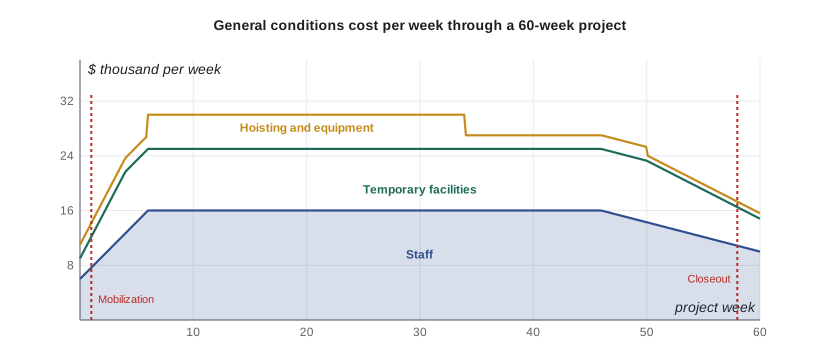
General conditions are priced from the schedule. The estimator first establishes the expected duration of the project and of its major phases, then lists every indirect item, decides whether it is time-related, fixed or quantity-related, and prices it accordingly. Staff time is the largest single item on most projects: a project manager, superintendent, assistant superintendent, project coordinator, field engineer and safety coordinator, each for the part of the schedule when they are needed, at their loaded cost including salary, benefits, vehicle and phone allowances.
A checklist is essential, because general conditions are where items are most easily forgotten. Typical headings include staff, site offices and storage, temporary utilities (power, water, heat, telecommunications), temporary facilities (fencing, hoarding, signage, roads, parking), safety (guardrails, fall protection, first aid, safety staff), hoisting (cranes and hoists if not priced elsewhere, Lesson 3), protection and winter work, cleaning and waste, surveying and layout, testing and inspection not paid by the owner, permits and fees the contractor must pay, schedule and document control, photographs, commissioning support, closeout documents and warranty.
# Time-related and fixed general conditions for a 60-week project (illustrative rates)
weeks = 60
staff = {  # role: (weekly loaded cost, weeks on site)
    "Project manager (70 % time)": (4_600 * 0.7, 66),
    "Superintendent":              (4_300, 62),
    "Assistant superintendent":    (3_300, 40),
    "Project coordinator":         (2_300, 64),
    "Field engineer":              (2_800, 50),
    "Safety coordinator (50 %)":   (3_000 * 0.5, 60),
}
time_items = {"Site office and storage": 1_150, "Temporary power and water": 900,
              "Toilets and wash stations": 420, "Fencing and security": 650,
              "Waste bins": 1_100, "Telehandler": 2_300, "Small tools and consumables": 600}
fixed = {"Mobilization and demobilization": 38_000, "Layout and surveying": 46_000,
         "Final cleaning": 29_000, "Closeout and as-builts": 14_000, "Winter protection": 85_000}
s = sum(r * w for r, w in staff.values())
t = sum(v * weeks for v in time_items.values())
f = sum(fixed.values())
print(f"Staff ${s:,.0f}  Time-related ${t:,.0f}  Fixed ${f:,.0f}")
print(f"Total general conditions ${s + t + f:,.0f}  "
f"(${(s + t) / weeks:,.0f} per week time-related)")Staff $988,320 Time-related $427,200 Fixed $212,000 Total general conditions $1,627,520 ($23,592 per week time-related)
The output shows that time-related costs dominate. The weekly figure is especially useful: it is the cost of each week of delay, which matters when evaluating schedule risk, liquidated damages and claims for extension of time. As a rough check, general conditions on commercial buildings are often in the range of 6 to 12 % of the cost of the work, higher on small, long or complex projects and lower on large, fast ones. A figure far outside the usual range for the firm deserves a second look.
Who pays for what
The contract and Division 01 decide which indirect costs belong to the contractor. Building permits are frequently the contractor's responsibility in the United States but sometimes the owner's; impact fees and utility connection fees are usually the owner's, but the bid documents should be checked. Testing is commonly split: the owner pays an independent testing agency for quality assurance and special inspections, and the contractor pays for its own quality control and for retesting failed work. Standard forms such as AIA A201 and ConsensusDocs 200 allocate many of these items, and supplementary conditions frequently change the defaults.
Home office overhead
Home office overhead is not caused by any one project, so it must be spread over all of them. The usual approach is to divide expected annual overhead by expected annual revenue (or annual direct cost, if markups are applied to cost) to get an overhead percentage. A firm with $2.4 million of annual overhead and $60 million of annual cost of work needs to recover 4.0 % on every project, on average, to cover its overhead before any profit. If the firm wins less work than expected, the percentage required rises, which is one reason contractors in a slow market face a painful choice between raising markups (and winning less) and cutting them (and not covering overhead).
Worked problem
Overhead recovery when volume falls
Northline expects $2.4 million of home office overhead and $60 million of cost of work this year, so it prices overhead at 4.0 %. Halfway through the year, it forecasts only $48 million of cost of work. What overhead rate is now needed on the remaining work to recover the full year's overhead, assuming $28 million of cost of work was completed in the first half at 4.0 %?
Show solution
- Overhead recovered in the first half = 0.04 × 28 = $1.12 million.
- Remaining overhead to recover = 2.4 − 1.12 = $1.28 million.
- Remaining forecast cost of work = 48 − 28 = $20 million.
- Required rate = 1.28 ÷ 20 = 6.4 %.
Answer: To recover its overhead, Northline would need 6.4 % on the rest of the year's work, which is likely uncompetitive. In practice the firm would cut overhead, accept lower profit, or both.
Markup versus margin
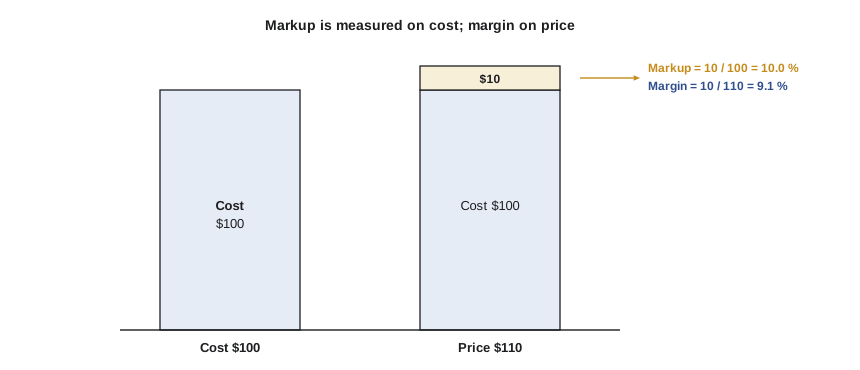
Markup is expressed as a percentage of cost; margin is expressed as a percentage of price. They describe the same dollars but give different percentages, and confusing them is one of the most common and costly mistakes in contracting. If a cost of $100 is marked up by 10 %, the price is $110 and the margin is 10 ÷ 110, about 9.1 %. If a manager wants a 10 % margin and the estimator adds a 10 % markup, the firm falls short of its target on every bid.
| Markup on cost | Margin on price |
|---|---|
| 5 % | 4.76 % |
| 8 % | 7.41 % |
| 10 % | 9.09 % |
| 12 % | 10.71 % |
| 15 % | 13.04 % |
| 20 % | 16.67 % |
| 25 % | 20.00 % |
Worked problem
Pricing to a target margin
Company policy requires a gross margin of 8 % (overhead plus profit as a share of price) on a project whose cost of work, including general conditions and contingency, is $14.2 million. What price is required, and what markup does that represent?
Show solution
- Price = cost ÷ (1 − margin) = 14.2 ÷ 0.92 ≈ $15.435 million.
- Markup = margin ÷ (1 − margin) = 0.08 ÷ 0.92 ≈ 8.70 %.
- Check: 14.2 × 1.087 ≈ 15.435.
Answer: The price must be about $15.43 million. Adding only 8 % to cost would give $15.34 million, about $100,000 short of the target.
Profit
Profit compensates the contractor for taking risk and committing capital, and it funds growth. The profit percentage in a bid is a business decision, not a calculation. It depends on the risk of the project (contract terms, design completeness, site conditions, schedule), the competition and how badly the firm needs work, the firm's capacity, the owner relationship and the opportunity cost of the people and bonding capacity the project will use. Lesson 11 shows how bid strategy models can inform the choice, but the decision rests with senior management.
A common practice is to set a target profit by project type and size and then adjust it on bid day based on the competition and the risk profile. Large projects with tight competition may carry 2 to 4 % profit on cost, while small, complex or high-risk projects may carry much more. Public bids generally carry lower margins than negotiated private work. Whatever the number, it should be applied to a clearly defined base and documented.
Bonds, insurance and the order of markups
Bond premiums and some insurance premiums are priced as a percentage of the final contract value, so they are applied last, after overhead and profit. Performance and labor and material payment bonds (CON-350) are typically priced on a sliding scale: a higher rate on the first portion of the contract value and lower rates on larger amounts, with the actual rate depending on the contractor's financial strength and experience. Builder's risk insurance may be provided by the owner or the contractor; liability insurance may be charged on revenue or payroll. Whatever the structure, the estimator must apply each premium to the right base and in the right order.
# Sliding-scale performance bond premium (illustrative rates)
contract = 11_600_000
bands = [(500_000, 0.0150), (2_000_000, 0.0100), (2_500_000, 0.0075),
         (2_500_000, 0.0070), (float("inf"), 0.0065)]   # (band width, rate)
remaining, premium = contract, 0.0
for width, rate in bands:
    amount = min(remaining, width)
    premium += amount * rate
    remaining -= amount
    if remaining <= 0:
        break
print(f"Bond premium on ${contract:,}: ${premium:,.0f} ({premium / contract:.2%})")Bond premium on $11,600,000: $90,400 (0.78%)
Because the bond premium depends on the final price, which itself includes the premium, estimators usually calculate it on the price before bonds and accept the small circularity, or iterate once. The difference is negligible compared with the uncertainty in the rest of the estimate.
Fees on changes
The contract usually specifies the markup that applies to changes after award, often different for work performed by the contractor's own forces and for subcontracted work, and sometimes limited for large changes. Standard forms set default rules that supplementary conditions often change. Estimators should note these rates during the bid, because a contract that allows only a small markup on changes, or forbids markup on subcontract changes, shifts risk to the contractor and may justify a higher base markup.
Common mistakes
MistakeUsing markup and margin interchangeably.
InsteadConvert explicitly: margin = markup ÷ (1 + markup); markup = margin ÷ (1 − margin).
MistakePricing general conditions as a flat percentage without reference to the schedule.
InsteadBuild general conditions from the schedule with time-related, fixed and quantity-related items.
MistakeForgetting that general conditions continue through delays.
InsteadCalculate the weekly time-related cost and use it when assessing schedule risk.
MistakeAssuming permits and testing are always the owner's cost.
InsteadRead the contract and Division 01; allocations vary and are often changed by supplementary conditions.
MistakeUsing last year's overhead rate when volume has dropped.
InsteadRecalculate the overhead rate from current overhead and realistic volume.
MistakeApplying bond rates to the price before overhead and profit.
InsteadApply bond and insurance premiums to the final contract value.
Summary and key terms
- General conditions are project indirect costs; home office overhead is company cost recovered across projects; profit rewards risk and capital.
- General conditions are built from the schedule as time-related, fixed and quantity-related items, with staff usually the largest cost.
- The weekly time-related cost measures the cost of delay.
- The contract and Division 01 allocate permits, testing and other indirect costs.
- The overhead rate is annual overhead divided by annual volume and rises when volume falls.
- Markup is on cost and margin is on price; they are related by margin = markup ÷ (1 + markup).
- Profit is a business decision based on risk, competition and capacity.
- Bonds and some insurance are applied last on the contract value, often on a sliding scale.
- General conditions
- Project-specific indirect costs of running the site.
- Time-related cost
- A cost that varies with project duration, such as staff and rentals.
- Fixed indirect cost
- A one-time cost such as mobilization or final cleaning.
- Home office overhead (G&A)
- Company costs not attributable to a single project.
- Overhead rate
- Annual overhead divided by annual volume, used to recover overhead.
- Markup
- An amount added to cost, expressed as a percentage of cost.
- Margin
- The difference between price and cost, expressed as a percentage of price.
- Fee
- Overhead and profit together, especially on cost-plus contracts.
- Sliding-scale premium
- A bond premium with decreasing rates on successive bands of contract value.
- Weekly burn rate
- The time-related general conditions cost per week.
Practice problems
Work each problem on paper first, then reveal the answer to check.
Classify as time-related, fixed or quantity-related: superintendent, final cleaning, waste bins.
Show answer
Time-related, fixed, quantity-related (or time-related).
Name six headings in a general conditions checklist.
Show answer
Staff, offices, temporary utilities, temporary facilities, safety, hoisting, protection, cleaning and waste, layout, testing, permits, closeout (any six).
Time-related general conditions are $24,000 per week. What does a 5-week delay cost?
Show answer
$120,000.
Annual overhead $1.8M, annual cost of work $45M. Overhead rate?
Show answer
4.0 %.
Convert a 12 % markup to margin.
Show answer
0.12 ÷ 1.12 ≈ 10.7 %.
Convert a 15 % margin to markup.
Show answer
0.15 ÷ 0.85 ≈ 17.6 %.
Cost $5.0M, target margin 6 %. Price?
Show answer
5.0 ÷ 0.94 ≈ $5.32M.
Why are bond premiums applied last?
Show answer
They are calculated on the final contract value, which includes overhead and profit.
Name four factors that influence the profit percentage.
Show answer
Risk, competition, need for work, capacity, owner relationship, opportunity cost.
Why note the contract's markup on changes during the bid?
Show answer
Low allowed markups on changes shift risk to the contractor and may justify a higher base markup.
Lesson quiz · 5 questions
Score 60% or more to complete this lesson.
Create a free account to save your progress, take quizzes and earn a certificate.