
CON-300 · Lesson 6 of 12 · 28 min
Electrical estimating
Electrical work powers, lights, connects and protects a building. It typically accounts for 10 to 20 % of the construction cost of a commercial building and more in data centers, hospitals and laboratories. Like mechanical work, it is almost always subcontracted by the general contractor, and like mechanical work it is full of interfaces where scope can fall between trades. This lesson explains how electrical contractors build their estimates, how to check them and what the general contractor must look for on bid day. Labor units and prices in the examples are illustrative.
What electrical work includes
In MasterFormat, electrical work falls under Division 26 (electrical), Division 27 (communications) and Division 28 (electronic safety and security), with utility work in Division 33. In the United States, installations must meet the National Electrical Code (NFPA 70) as adopted, sometimes with amendments, by the state or local jurisdiction, and are inspected by the local authority. Electricians and electrical contractors are licensed by states or localities.
| System | Main components | Typical pricing basis |
|---|---|---|
| Service and distribution | Utility service, switchgear, transformers, panelboards, feeders | Equipment quotes; feeders by length and size |
| Branch power | Receptacles, boxes, conduit or cable, wire, equipment connections | Device counts; conduit and wire by length |
| Lighting | Luminaires, lighting controls, emergency and exit lighting | Fixture schedule counts; supplier quotes |
| Standby power | Generator, transfer switches, fuel system | Equipment quote; installation labor |
| Fire alarm | Control panel, initiating devices, notification appliances, wiring | Device counts; subcontract or supplier quote |
| Communications | Structured cabling, pathways, telecom rooms, racks | Drops (outlets); cable length |
| Security | Access control, intrusion detection, video surveillance | Device counts; subcontract quote |
| Other | Electric vehicle charging, solar photovoltaic, lightning protection | Unit counts and quotes |
How an electrical contractor builds an estimate
An electrical estimate starts with a count of every device and fixture on the drawings and a measurement of every conduit and cable run. Lighting fixtures come from the fixture schedule; receptacles, switches, data outlets, fire alarm devices and equipment connections are counted from the plans; switchgear and panels come from the single-line diagram and panel schedules. Conduit and wire are measured for feeders (from the service to distribution panels) and for branch circuits (from panels to devices).
Material is priced from distributor quotes, often with large items such as switchgear, lighting packages and generators quoted separately and late in the bid. Labor is priced with labor units per item, such as hours per hundred meters or feet of conduit by size, per device, per fixture, per termination, adjusted for conditions such as working height, concealed versus exposed work, existing buildings and congestion. Many electrical contractors use estimating software with labor-unit libraries based on industry manuals and their own history.
Conduit and wire
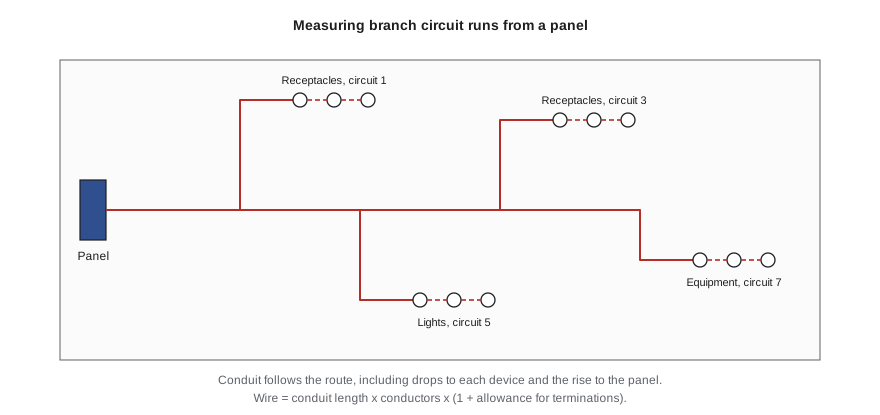
Branch circuit conduit is measured along the actual route, including vertical drops to devices and rises to panels, not as straight lines across the plan. Wire is then calculated from the conduit length times the number of conductors in the run, plus an allowance for terminations and slack at panels and boxes. Many jurisdictions and specifications permit armored or metal-clad cable instead of conduit and wire in some locations, which changes both material and labor. The specification's wiring method section is therefore one of the first things an electrical estimator reads.
# Branch circuit conduit, wire and labor for one floor (illustrative labor units)
runs = [  # description, conduit length ft, conductors per run, count of runs
    ("Office receptacle circuits", 125, 3, 24),
    ("Lighting circuits",          145, 3, 18),
    ("Dedicated equipment",         98, 4, 8),
]
allow = 0.10                    # terminations, makeup and slack
cond_ft = wire_ft = 0.0
for name, L, n, k in runs:
    cond_ft += L * k
    wire_ft += L * n * k * (1 + allow)
lab_conduit = 0.037             # hours per foot of 3/4 in EMT installed
lab_wire = 0.0037               # hours per foot of conductor pulled
hours = cond_ft * lab_conduit + wire_ft * lab_wire
print(f"Conduit {cond_ft:,.0f} ft, wire {wire_ft:,.0f} ft")
print(f"Labor {hours:,.0f} h; at $96/h = ${hours * 96:,.0f}")Conduit 6,394 ft, wire 21,963 ft Labor 318 h; at $96/h = $30,513
Conduit labor is much larger than wire-pulling labor, which is why wiring methods that avoid conduit can save significant cost where they are allowed. The estimate would then add boxes, devices, cover plates, supports, fittings and terminations, each with its own material and labor.
Devices, fixtures and connections
Devices (receptacles, switches, occupancy sensors), fixtures and equipment connections are priced per unit. Each unit carries material, labor to mount and terminate, and its share of boxes and supports. Lighting is often a large part of the electrical price; the fixture package may be quoted by a lighting distributor as a single lot, with substitutions allowed or forbidden by the specification. Lighting controls (networked control systems, daylight sensors, occupancy sensors) have grown in cost and complexity with energy codes and must be read carefully in the specifications.
| Item | Count | Illustrative labor hours each | Hours |
|---|---|---|---|
| Duplex receptacle including box and plate | 320 | 0.65 | 208.0 |
| Switch or occupancy sensor | 140 | 0.55 | 77.0 |
| Recessed LED troffer | 410 | 1.10 | 451.0 |
| Linear pendant (per fixture) | 60 | 1.60 | 96.0 |
| Exit sign or emergency unit | 45 | 1.20 | 54.0 |
| Mechanical equipment connection | 36 | 3.50 | 126.0 |
| Total | 1,012.0 |
Service, distribution and utility work
Service and distribution equipment, such as switchgear, transformers and panelboards, is priced from manufacturer or distributor quotes, which may be among the last prices received on bid day and can change sharply with market conditions. Lead times for switchgear and transformers have been long in recent years, which affects schedule risk as well as price (CON-330). Installation labor covers setting, anchoring, terminating feeders and testing.
Utility work needs special attention. The serving electric utility decides how the building is served and charges for the connection, which may include transformers, primary cables and metering. The electrical contractor's price often excludes these utility charges, which can be large; the bid documents should say who pays. Similar questions arise for temporary power during construction.
Worked problem
Feeder cost
A feeder from the main switchboard to a distribution panel runs 215 ft in 3 in conduit with four 250 kcmil copper conductors plus a ground. Illustrative costs: conduit installed $36 per ft; conductors $14 per ft each installed; ground $4.30 per ft; terminations $1,450. Add 8 % to wire length for terminations and slack. What is the feeder cost?
Show solution
- Conduit = 215 × 36 = $7,740.
- Conductors = 4 × 215 × 1.08 × 14 ≈ $13,003; ground = 215 × 1.08 × 4.30 ≈ $998.
- Total = 7,740 + 13,003 + 998 + 1,450 ≈ $23,190.
Answer: About $23,000 for a single feeder. Large feeders are worth measuring individually because a small length error is expensive.
Fire alarm, communications and security
Fire alarm systems are designed and certified to their own standards and are commonly supplied by a fire alarm manufacturer or its distributor, with the electrical contractor installing conduit and wire and the supplier verifying and programming the system. Prices are checked per device: smoke and heat detectors, pull stations, horns and strobes, duct detectors, monitoring and control modules, and the panel and annunciators.
In the United States, fire alarm systems are designed and installed to NFPA 72, and the estimate must allow for acceptance testing and any inspection required before occupancy. Communications cabling is priced per drop (outlet) and by cable length to the telecom rooms, with racks, patch panels and testing; the owner's IT department often supplies network equipment.
Worked problem
Checking a fire alarm price
A three-story office has 210 smoke detectors, 40 heat detectors, 24 pull stations, 160 horn-strobes, 18 duct detectors and 30 modules. A rough installed price per device, including wire and conduit, is $520 for detectors and pull stations, $610 for horn-strobes, $780 for duct detectors and $450 for modules; the panel, annunciator and programming cost $38,000. The fire alarm portion of the electrical quote is $285,000. Is it plausible?
Show solution
- Detectors and pull stations = (210 + 40 + 24) × 520 = $142,480.
- Horn-strobes = 160 × 610 = $97,600. Duct detectors = 18 × 780 = $14,040. Modules = 30 × 450 = $13,500.
- Total = 142,480 + 97,600 + 14,040 + 13,500 + 38,000 = $305,620.
Answer: The quote is about 7 % below the rough check, which is within the range of normal variation; the estimator should confirm it includes verification and the duct detector installation.
Where the gaps are
Electrical scope gaps tend to appear at the same interfaces as mechanical ones, viewed from the other side.
| Interface | Typical question |
|---|---|
| Electrical and mechanical | Who supplies motor starters, variable frequency drives and disconnects? Who wires them? |
| Electrical and controls | Who supplies and wires low-voltage control circuits, and who provides power to control panels? |
| Electrical and communications | Is structured cabling in the electrical contract or a separate contract? Who provides pathways? |
| Electrical and owner | Who supplies network equipment, audio-visual equipment, security cameras or kitchen equipment, and who connects it? |
| Electrical and utility | Who pays utility connection charges, transformers and metering? |
| Electrical and general trades | Who cuts and patches, firestops penetrations, provides backboards and blocking for panels? |
| Temporary power | Who provides and pays for temporary service, distribution and lighting during construction? |
Checking electrical prices on bid day
The checks are similar to those for mechanical work: cost per unit of floor area against comparable projects, electrical as a share of total cost, unit prices per device, fixture and drop, implied labor hours and crew size against the schedule, and confirmation that major equipment and the lighting package are included at current prices. Because switchgear and lighting quotes often arrive late, electrical contractors sometimes carry allowances for them; the general contractor should know which parts of the price are firm and which are allowances or budgets.
Worked problem
Electrical cost per unit area
A new 80,700 ft² office building has three electrical quotes: $2.31 million, $2.46 million and $1.79 million. Recent similar projects, adjusted to current prices and this location, averaged $28.40 per ft² for electrical work. What do the quotes imply?
Show solution
- Unit costs: 2.31M ÷ 80,700 ≈ $28.62 per ft²; 2.46M ÷ 80,700 ≈ $30.48 per ft²; 1.79M ÷ 80,700 ≈ $22.18 per ft².
- The first two are close to history; the third is about 22 % below.
Answer: The low quote needs a scope review before it is carried: fire alarm, structured cabling, lighting controls, generator or utility charges may be excluded. If it is complete, it is a real advantage; if not, carrying it could cost the job.
Common mistakes
MistakeMeasuring conduit as straight lines on the plan.
InsteadMeasure along the route, including vertical drops and rises.
MistakeCalculating wire as equal to conduit length.
InsteadMultiply by the number of conductors and add an allowance for terminations and slack.
MistakeAssuming utility connection charges are in the electrical price.
InsteadConfirm who pays utility charges, transformers and metering, and price them if they are the contractor's.
MistakeIgnoring wiring-method rules in the specifications.
InsteadRead the wiring-method section first; whether cable is permitted instead of conduit changes cost significantly.
MistakeTreating the lighting package as fixed when it is an allowance.
InsteadIdentify which parts of the electrical quote are firm, budget or allowance.
MistakeAccepting an outlier low quote without review.
InsteadCompare unit costs and check scope inclusions before carrying it.
Summary and key terms
- Electrical work covers service and distribution, branch power, lighting, standby power, fire alarm, communications and security.
- Estimates are built from device and fixture counts and measured conduit and wire runs, priced with material quotes and labor units.
- Wire length is conduit length times conductors plus an allowance; conduit labor usually dominates.
- Switchgear, transformers, lighting and generators are quoted separately and can change late in the bid.
- Utility charges and temporary power must be assigned explicitly.
- Scope gaps arise at interfaces with mechanical, controls, communications, owner, utility and general trades.
- Unit costs, shares of total cost and implied labor hours provide quick checks of electrical quotes.
- Feeder
- A circuit from service equipment to a distribution panel or large load.
- Branch circuit
- A circuit from a panel to devices, fixtures or equipment.
- Single-line diagram
- A drawing showing the electrical distribution system in simplified form.
- Panel schedule
- A table listing the circuits in a panelboard and their loads.
- Device
- A receptacle, switch, sensor or similar unit installed at an outlet box.
- Drop
- A single communications outlet with its cable back to the telecom room.
- Wiring method
- The permitted way of installing conductors, such as conduit and wire or armored cable.
- Utility connection charge
- The utility's charge for providing service to the building.
- Lighting package
- The group of luminaires and controls quoted together by a supplier.
- Verification
- Testing that confirms a fire alarm system is installed and operates correctly.
Practice problems
Work each problem on paper first, then reveal the answer to check.
Name five electrical systems and a pricing basis for each.
Show answer
Distribution (quotes, feeders by length), branch power (devices, conduit), lighting (fixture counts), fire alarm (devices), communications (drops), security (devices).
Why measure conduit along the route?
Show answer
Vertical drops and offsets add significant length that straight-line measurement misses.
A run of 130 ft has 3 conductors; allowance 10 %. Wire length?
Show answer
429 ft.
Why can armored cable be cheaper than conduit and wire?
Show answer
It avoids much of the conduit installation labor, where permitted.
What usually dominates branch circuit labor?
Show answer
Conduit installation.
Name three electrical items often quoted separately and late.
Show answer
Switchgear, transformers, lighting package, generator.
Who decides how the building is served and charges for the connection?
Show answer
The utility.
Give three electrical scope interfaces.
Show answer
Motor starters and drives, control wiring, structured cabling, owner equipment, utility charges, firestopping, temporary power.
Electrical quote $1.5M on 64,600 ft². Unit cost?
Show answer
About $23.22 per ft².
A quote includes a $180,000 lighting allowance. What does that mean for the general contractor?
Show answer
That part of the price is not firm; the final cost may differ and the allowance terms must be understood.
Lesson quiz · 5 questions
Score 60% or more to complete this lesson.
Create a free account to save your progress, take quizzes and earn a certificate.