
CON-300 · Lesson 2 of 12 · 29 min
Organizing a complete estimate
A complete bid estimate for a building can contain thousands of line items, quotes from forty or fifty trades and suppliers, several layers of indirect costs and markups, and a trail of addenda and clarifications. Without a clear structure, items are counted twice, others are missed entirely, and no one can check the number in the few hours before it is submitted. This lesson is about building that structure: reviewing the documents, dividing the work into packages, deciding what to self-perform, setting up the estimate summary and protecting the estimate against the most common errors.
CON-200 introduced MasterFormat, UniFormat, measurement rules and cost codes for organizing quantities. Here the focus moves up a level, from organizing a takeoff to organizing an entire bid that a team can build in parallel and a senior estimator can review in an afternoon.
Reading the bid documents as a whole
Before measuring anything, the estimating team should read the bid documents as a whole. A bid package normally includes the invitation or instructions to bidders, the bid form, the contract form and its supplementary conditions, the general requirements (Division 01), the technical specifications, the drawings, reports such as the geotechnical investigation, and any addenda. Each part affects price.
| Document | What the estimator looks for | Typical price impact |
|---|---|---|
| Instructions to bidders | Closing time and place, bid security, required forms, alternates, separate prices, questions deadline | Disqualification if missed; cost of bid security |
| Bid form | Format of the price: lump sum, unit prices, alternates, separate prices, list of subcontractors | Determines how the estimate must be summarized |
| Contract and supplementary conditions | Payment terms, holdback or retainage, liquidated damages, insurance, warranties, changes clause, risk allocation | Financing cost, risk premium, insurance and bond cost |
| General requirements (Division 01) | Temporary facilities, site offices, testing, cleaning, closeout, scheduling and reporting requirements | General conditions costs (Lesson 8) |
| Specifications | Products, standards, execution requirements, submittals, mock-ups | Material and labor cost; often hidden scope |
| Drawings | Quantities and configuration | Direct cost |
| Reports | Soils, hazardous materials, existing conditions | Excavation, dewatering, abatement, foundation risk |
| Addenda | Changes to any of the above | Can add or remove significant scope late in the bid |
A disciplined estimator keeps a running list of questions, conflicts and assumptions while reading. Questions go to the consultant before the deadline for questions; the answers usually come back as addenda that apply to every bidder. Assumptions that cannot be resolved become clarifications or exclusions, although many public tenders forbid qualified bids, so the estimator must price the most reasonable interpretation instead of qualifying the bid (Lesson 10).
Dividing the work into packages
A building estimate is built from work packages, each of which will be priced either by the general contractor's own forces or by a subcontractor. The packages should match the way the work is normally bought in the local market: a drywall subcontractor in one city may also supply and install ceilings and insulation, while in another those are separate trades. Packages that do not match local trade practice produce quotes that overlap or leave gaps.
Each package needs a scope sheet (also called a bid package description or trade scope) that tells subcontractors exactly what to include. A good scope sheet lists the specification sections, the drawings, specific inclusions and exclusions, and interfaces with other trades such as who supplies blocking, who cores floor penetrations, who supplies access doors and who provides temporary heat. Lesson 7 covers scope sheets and the leveling of subcontractor quotes in detail.
Self-perform or subcontract?
Most general contractors self-perform only a few trades, typically concrete, carpentry, general labor and sometimes structural steel erection or masonry, and subcontract the rest. The decision for each project depends on several factors.
- Capability and capacity: whether the firm has foremen, crews and equipment available for the duration of the work.
- Control of the schedule: self-performing critical-path work such as foundations and structure gives the contractor more control.
- Price and risk: self-performed work carries productivity risk but no subcontractor markup; subcontracting transfers productivity risk but adds the subcontractor's overhead and profit and the risk of subcontractor default.
- Bonding and cash: subcontractors may be asked for bonds; self-performed work ties up the contractor's own working capital.
- Competitive position: if the firm's self-performed concrete is cheaper than the market, it gains an advantage on concrete-heavy projects.
Many contractors price their own forces and also solicit subcontract quotes for the same work, then decide on bid day which is lower once risk is considered. When comparing, the estimator must add the costs that a self-performed price carries but a subcontract price includes: supervision, small tools, equipment, safety, and the contractor's share of insurance and overhead.
Worked problem
Comparing self-performed and subcontracted concrete
Northline's own estimate for the cast-in-place concrete on a project is: labor $412,000, materials $386,000, equipment $58,000 and a foreman for 16 weeks at $3,100 per week. Small tools and consumables are 3 % of labor. The best concrete subcontractor quotes $1,010,000 including all of these. Which is cheaper before risk, and by how much?
Show solution
- Foreman = 16 × $3,100 = $49,600.
- Small tools = 0.03 × $412,000 = $12,360.
- Self-perform total = 412,000 + 386,000 + 58,000 + 49,600 + 12,360 = $917,960.
- Difference = 1,010,000 − 917,960 = $92,040, about 9 % of the subcontract price.
Answer: Self-performing is about $92,000 cheaper before risk. Northline must judge whether its productivity assumptions are reliable enough to accept that risk, and whether its crews are available.
The estimate summary
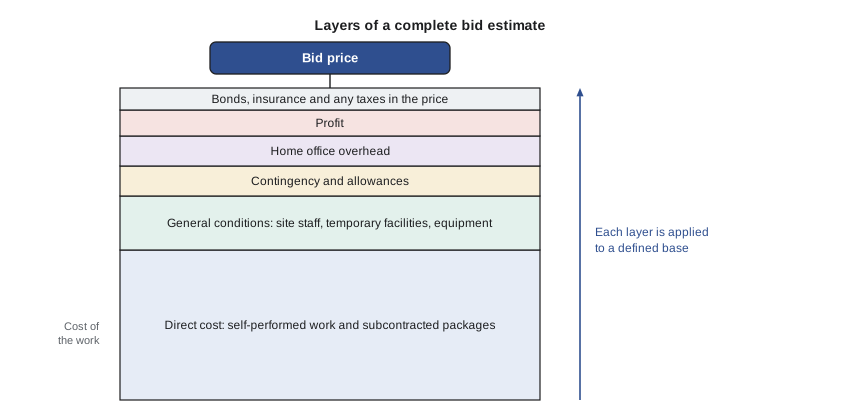
The estimate summary, sometimes called the recap or bid summary sheet, is the single page that rolls all the work up to the bid price. It should be set up at the start of the bid, not on bid day. A typical summary lists each package with its source (self-performed or subcontract), the amount carried, the bidder carried, and a status (quote received, plug, allowance). Below the direct costs come general conditions, contingency, overhead, profit, bonds, insurance and taxes, each calculated on a clearly defined base.
Order matters. Markups are usually applied in a set sequence: for example, overhead on the subtotal of direct costs and general conditions, profit on the subtotal including overhead, and bond and insurance premiums on the total including profit. Sales tax on materials is normally built into the direct cost of each item because in most states the contractor pays it as the consumer of the materials; Lesson 9 explains the exceptions.
| Line | Basis | Example amount ($) |
|---|---|---|
| Self-performed direct work | Detailed estimate | 1,920,000 |
| Subcontracted packages | Leveled quotes and plugs | 6,480,000 |
| Subtotal: direct cost | 8,400,000 | |
| General conditions | Time-related and fixed site costs | 690,000 |
| Subtotal: cost of work | 9,090,000 | |
| Contingency (2 %) | Of cost of work | 181,800 |
| Overhead (4 %) | Of cost of work plus contingency | 370,872 |
| Profit (3.5 %) | Of all of the above | 337,494 |
| Bond and insurance (1.4 %) | Of all of the above | 139,722 |
| Bid price | Rounded | 10,120,000 |
# Roll up an estimate summary, applying each markup to a defined base
direct = {"Self-performed": 1_920_000, "Subcontracts": 6_480_000}
general_conditions = 690_000
rates = [("Contingency", 0.02), ("Overhead", 0.04), ("Profit", 0.035), ("Bond and insurance", 0.014)]

running = sum(direct.values()) + general_conditions
print(f"Cost of work            {running:>12,.0f}")
for name, r in rates:
    add = running * r
    running += add
    print(f"{name:22s}  {add:>12,.0f}   running total {running:>12,.0f}")
bid = round(running, -4)
print(f"Bid price (rounded to $10,000): {bid:,.0f}")
print(f"Total markup on cost of work: {bid / (sum(direct.values()) + general_conditions) - 1:.2%}")Cost of work 9,090,000 Contingency 181,800 running total 9,271,800 Overhead 370,872 running total 9,642,672 Profit 337,494 running total 9,980,166 Bond and insurance 139,722 running total 10,119,888 Bid price (rounded to $10,000): 10,120,000 Total markup on cost of work: 11.33%
Because each markup is applied to a running total, the combined effect of four modest percentages is about 11.3 %, more than their simple sum of 10.9 %. Whatever method a firm uses, it must be applied consistently and understood by everyone who touches the number, because bid-day adjustments are made on the summary sheet under time pressure.
Alternates, separate prices and unit prices
Many bid forms ask for more than a single lump sum. Alternates (also called alternative prices) ask how much the price would change if a defined change were made, such as substituting a different roofing system or deleting a canopy. Separate prices ask for the cost of a defined portion of the work, such as a parking lot that may or may not be built. Unit prices ask for rates to add or delete quantities, such as the cost per cubic meter of rock excavation if more rock is found than expected.
Each must be priced with the same care as the base bid, because owners often accept alternates and unit prices become contract rates. An alternate that deletes work should credit the full cost including its share of general conditions and markups only if those costs really go away; an alternate that adds work must include the added markups and any extra time. Unit prices for additional quantities should reflect the cost of small extra quantities, which is usually higher per unit than the average cost of the base work, while unit prices for deletions may be lower. Some owners evaluate bids on the base price plus selected alternates, so a poorly priced alternate can change who wins.
Worked problem
Pricing a deductive alternate
Alternate 2 asks for the credit if the entrance canopy is deleted. The canopy's direct cost is $84,000 (steel $46,000, roofing $12,000, soffit and lighting $26,000). It adds no time to the schedule. Northline's overhead is 4 %, profit 3.5 % and bond and insurance 1.4 %, applied in sequence. What credit should be offered?
Show solution
- General conditions do not change because the schedule does not change.
- Apply markups: 84,000 × 1.04 × 1.035 × 1.014 ≈ $91,700.
- Some contractors credit only direct cost plus a reduced markup to protect their overhead recovery; this is a business decision.
Answer: A credit of about $91,700 is consistent with the base bid. Offering only $84,000 is common practice but should be a deliberate choice, not an accident.
Estimating software and spreadsheets
Estimating platforms range from spreadsheets to dedicated software with digital takeoff, assemblies, cost databases, bid-day leveling and integration with accounting and scheduling. CON-200 introduced the categories; for a complete bid the important questions are whether the tool supports the firm's cost code structure, whether several estimators can work on the same estimate at once, whether trade quotes can be leveled inside it, and whether the final estimate can be exported cleanly to the project budget.
Whatever the tool, the same disciplines apply: one source of truth for each number, no hard-typed values hidden in formulas, consistent units, a change log for addenda, and a summary that ties every line back to its detail. Many bid-day disasters come from spreadsheet errors: a range that stops one row short of the last line, a markup applied twice, a quote entered in the wrong package. Simple controls catch most of them.
| Check | What it catches |
|---|---|
| Totals cross-footed (rows and columns sum to the same total) | Formulas that miss rows or columns |
| Cost per unit area by package compared with history | Order-of-magnitude errors, missing or doubled scope |
| Labor hours and crew-weeks compared with the schedule | Unrealistic productivity or durations |
| Every specification section mapped to a package | Scope gaps between packages |
| Every addendum logged with its impact | Late changes not priced |
| Independent review of the summary by someone who did not build it | Markup errors and wrong bases |
Managing addenda
Addenda are formal changes to the bid documents issued before closing. Late addenda are a fact of bid life, and they cause many pricing errors. Each addendum must be logged, read by every estimator whose packages it affects, forwarded to the relevant subcontractors and suppliers, and its cost impact tracked. Most bid forms require the bidder to acknowledge every addendum by number; failing to acknowledge one can make the bid non-compliant. On bid day, the estimator should confirm that every trade quote received acknowledges the latest addendum, or adjust the quote for any addendum it does not include.
Common mistakes
MistakeStarting takeoff before reading the contract and Division 01.
InsteadRead the bid documents as a whole first; contract terms and general requirements carry significant cost.
MistakeDefining packages in a way that suits the estimator but not local trade practice.
InsteadMatch packages to how the work is bought locally, and write clear scope sheets for each.
MistakeComparing a self-performed direct cost with an all-in subcontract quote.
InsteadAdd supervision, small tools, equipment and other costs the self-performed price carries before comparing.
MistakeBuilding the summary sheet on bid day.
InsteadSet up the summary, markup bases and checks at the start of the bid.
MistakePricing alternates as an afterthought.
InsteadPrice alternates, separate prices and unit prices with the same care as the base bid; they may become contract prices or decide the winner.
MistakeAccepting a trade quote without checking which addenda it includes.
InsteadConfirm every quote acknowledges the latest addendum, or adjust it.
Summary and key terms
- Read the whole bid package first; contract terms, Division 01 and reports all affect price.
- Divide the work into packages that match local trade practice, each with a clear scope sheet.
- Self-perform decisions weigh capability, schedule control, price, risk and cash.
- The estimate summary rolls packages up to the bid price, applying each markup to a defined base in a set order.
- Alternates, separate prices and unit prices must be priced as carefully as the base bid.
- Spreadsheet and software discipline (single source, cross-footing, history checks, independent review) prevents bid-day errors.
- Every addendum must be logged, priced, passed to trades and acknowledged on the bid form.
- Bid documents
- The instructions, forms, contract, specifications, drawings, reports and addenda that define a bid.
- Work package
- A portion of the work priced and bought as a unit, by own forces or a subcontractor.
- Scope sheet
- A document defining exactly what a trade package includes and excludes.
- Estimate summary
- The sheet that rolls up all packages, indirect costs and markups to the bid price.
- Alternate
- A price for a defined change to the base scope.
- Separate price
- A price for a defined portion of the work that may be awarded or not.
- Unit price
- A rate for adding or deleting a unit of work.
- Addendum
- A formal change to the bid documents issued before closing.
- Cross-footing
- Checking that row totals and column totals sum to the same grand total.
- Plug number
- A placeholder amount carried for a package without an acceptable quote.
Practice problems
Work each problem on paper first, then reveal the answer to check.
Name four parts of a bid package and one price impact of each.
Show answer
Instructions (bid security), contract (holdback, liquidated damages), Division 01 (temporary facilities), specifications (products), drawings (quantities), reports (excavation risk); any four.
What should a scope sheet include?
Show answer
Specification sections, drawings, inclusions, exclusions and interfaces with other trades.
Give three reasons a general contractor might self-perform concrete.
Show answer
Capability, schedule control on the critical path, lower price than the market, no subcontractor markup.
Own-forces drywall: labor $120,000, materials $90,000, supervision $14,000, tools 3 % of labor. What is the total?
Show answer
$227,600.
Cost of work is $5,000,000. Apply overhead 5 % then profit 4 %. What is the total?
Show answer
5,000,000 × 1.05 × 1.04 = $5,460,000.
What is the difference between an alternate and a separate price?
Show answer
An alternate changes the base scope; a separate price is for a defined portion that may or may not be awarded.
Why might a unit price for added rock excavation exceed the average base rate?
Show answer
Small extra quantities cost more per unit to mobilize and handle.
Name three checks that catch spreadsheet errors.
Show answer
Cross-footing, cost per unit area versus history, hours versus schedule, spec-to-package map, addenda log, independent review.
What must happen to every addendum?
Show answer
Logged, read, forwarded to trades, priced and acknowledged on the bid form.
A quote acknowledges addenda 1 to 3, but addendum 4 added work in that trade. What should the estimator do?
Show answer
Confirm with the trade or add the cost of addendum 4 to the quote before carrying it.
Lesson quiz · 5 questions
Score 60% or more to complete this lesson.
Create a free account to save your progress, take quizzes and earn a certificate.