
CON-200 · Lesson 6 of 12 · 28 min
Material pricing: quotes, waste, escalation and taxes
Materials are often the largest single cost in the work a contractor performs itself. Unlike labor, material prices can usually be fixed before the bid, through supplier quotations. But a quotation is only the start: the estimator must convert net quantities to purchase quantities, allow for waste, add delivery and handling, account for price changes between bid and purchase, and include the sales taxes that are a real cost to the contractor. This lesson works through each step.
Getting prices
Material prices come from several sources, each suited to a different stage and size of purchase.
- Supplier quotations: written prices from suppliers for the specific materials, quantities and delivery terms of the project. These are the basis of bid prices for significant materials.
- Price lists and recent invoices: suitable for small, common items such as fasteners and lumber, adjusted for current market conditions.
- Published cost data: useful for unfamiliar items and for checking quotations.
- Historical unit costs: used in early estimates but rarely for bids, because material prices move quickly.
A good quotation request gives suppliers the specification sections, drawings or a bill of materials, the required delivery schedule and location, and the date by which prices must be received. It asks suppliers to state what is included and excluded, how long the price is valid, payment terms and any escalation clauses. Requesting quotes from at least two or three suppliers for each major material gives a check on price and protects against a supplier withdrawing.
Reading and comparing quotations
Quotations rarely arrive on a common basis. One supplier quotes delivered to site, another free on board (FOB) at its plant; one includes accessories, another quotes them separately; one covers the full quantity, another only the items it stocks. Before choosing a supplier, the estimator levels the quotes: adjusts each to the same scope, quantity, delivery and terms so that they can be compared fairly. Bid-day leveling of material and subcontractor quotes is one of the estimator's most important tasks.
| Check | Questions to ask |
|---|---|
| Scope | Does the quote cover every item in the specification section, including accessories, fasteners and trim? |
| Quantity | Is the quote for the full quantity, or a quantity the supplier measured? Whose takeoff governs? |
| Delivery | Is it delivered to site, FOB plant, or picked up? Are there minimum load or small-order charges? |
| Validity and escalation | How long is the price firm? Does it include a price adjustment clause? |
| Taxes | Are taxes included or extra? Which taxes apply? |
| Terms | What are the payment terms and any discounts for prompt payment? |
| Compliance | Does the product meet the specification, or is it a substitution needing approval? |
Worked problem
Leveling two supplier quotes
Supplier A quotes $18,400 for a package of masonry accessories, FOB its warehouse, with delivery quoted separately at $1,150. Supplier B quotes $19,300 delivered, but its quote covers only 95 % of the required quantity because it does not stock one item. Which quote is lower on a like-for-like basis?
Show solution
- Supplier A delivered: $18,400 + $1,150 = $19,550 for the full quantity.
- Supplier B covers 95 % of the scope for $19,300. If the missing 5 % costs about the same per unit, the full-scope equivalent is $19,300 ÷ 0.95 = $20,316.
- Supplier B also leaves a gap the contractor must buy elsewhere, possibly at a higher price and with a separate delivery.
- Supplier A is lower by about $766 and covers the full scope.
Answer: Supplier A, at $19,550 delivered for the full scope against about $20,316 for B.
From net quantity to purchase quantity
Takeoff measures the work net, as it appears in place. Materials are bought in standard units and sizes, and some material is always lost to cutting, breakage, spillage, overlap and theft. The purchase quantity therefore differs from the net quantity in three ways.
- Waste and loss: a percentage added for cutting, breakage, spillage and theft. Typical starting values are 2 to 5 % for concrete, 3 to 5 % for masonry units, 5 to 10 % for lumber and sheathing, 10 to 15 % for gypsum board and 5 to 10 % for flooring, adjusted for the design. Cut-up layouts and patterned materials waste more.
- Laps and overlaps: material that overlaps itself in place, such as reinforcing bar laps, membrane and vapor retarder laps, and roofing overlaps, added from the specification or standard details.
- Packaging and rounding: materials sold in whole units, such as sheets, boxes, bundles, pallets or ready-mix truckloads, rounded up to the next purchase unit.
Waste allowances should come from the firm's records, not from habit. An allowance that is too high makes the bid uncompetitive; one that is too low guarantees a shortfall. When records show actual waste much higher than estimated, the cause is often poor material handling on site, which is a management problem, not an estimating one.
Delivery, handling and small-order charges
The price of material at the supplier's door is not its cost in place. Estimators add the costs of getting it to the work.
- Freight: delivery charges, minimum load charges and fuel surcharges. Ready-mix concrete suppliers charge for short loads below a minimum, for waiting time beyond an allowance, and for winter additives or heated water.
- Hoisting and distribution: crane or forklift time, material hoists, and labor to move material to the floor where it will be used.
- Storage and protection: laydown areas, containers, tarps and heated storage for temperature-sensitive materials.
- Restocking and returns: charges for returning surplus material, which can make over-ordering expensive.
Taxes on materials
Sales taxes on materials are a real cost in many jurisdictions, and getting them wrong is a common and expensive mistake. Whether a tax is a cost to the contractor depends on how the jurisdiction treats construction contracts and whether the tax can be recovered.
In the United States, there is no national sales tax, and each state, and often each county and city, sets its own sales and use tax rates and rules for construction. In many states, a contractor performing a lump-sum contract to improve real property is treated as the consumer of the materials it installs, so it pays sales tax when it buys them, or use tax if it buys them out of state without paying the local tax, and that tax is a cost to include in the bid. Other states treat contractors as retailers who charge tax to the owner, or tax the whole contract price. Exemptions for purchases by tax-exempt owners such as governments and charities vary: in some states the contractor can buy tax-free on the owner's behalf, in others it cannot. The estimator checks the rules of the state and locality where the project is built.
Worked problem
Building up the cost of concrete supply
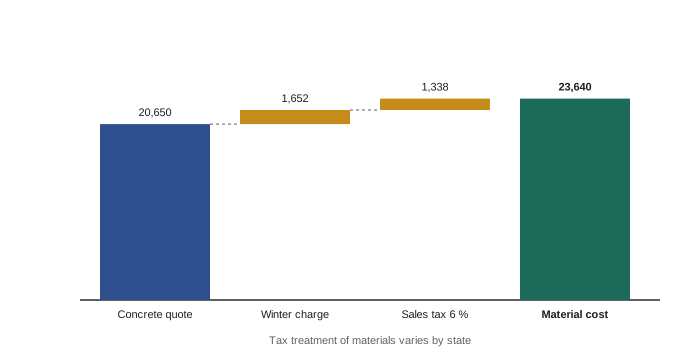
A foundation needs 112 yd³ of concrete net. Allow 5 % waste and order in whole cubic yards. The quote is $175 per cubic yard delivered, with a winter charge of $14 per cubic yard for heated water and accelerator. The project is in a state where the contractor pays 6 % sales tax on materials as the consumer. Calculate the material cost to carry in the estimate.
Show solution
- Purchase quantity: 112 × 1.05 = 117.6 yd³, rounded up to 118 yd³.
- Concrete: 118 × $175 = $20,650.00.
- Winter charge: 118 × $14 = $1,652.00. Subtotal $22,302.00.
- Sales tax: 6 % × $22,302.00 = $1,338.12.
- Material cost: $22,302.00 + $1,338.12 = $23,640.12.
Answer: About $23,640, or $211 per net cubic yard, including sales tax.
Escalation and price risk
Material prices change between the bid and the purchase, sometimes sharply. Steel, copper, lumber, fuel-dependent products and anything subject to tariffs or supply disruptions can move by double-digit percentages in a few months. A supplier's quote is usually firm for 30 to 90 days; if the contractor will not buy until later, it carries the risk of price increases unless the contract provides relief.
Here r is the expected escalation rate per period and n is the number of periods until purchase. Estimators forecast r from producer price indexes, supplier advice and market commentary, and they apply escalation to the expected purchase date of each major material, not to the whole estimate at once.
Worked problem
Escalating a steel price
A fabricator quotes $96,000 for structural steel, firm for 30 days. The steel will be purchased in about 8 months, and the estimator forecasts escalation of 0.5 % per month. What should be carried in the bid?
Show solution
- Number of months to purchase: 8. Monthly rate: 0.005.
- Factor: (1.005)^8 = 1.0407.
- Escalated price: $96,000 × 1.0407 = $99,907.
- Alternatively, the contractor can ask the fabricator to hold its price longer, buy the steel early and store it, or negotiate a price adjustment clause with the owner.
Answer: About $99,900, an escalation allowance of roughly $3,900.
Contractors manage material price risk in several ways: placing purchase orders soon after award to lock in prices, buying and storing critical materials early, asking for longer price holds, including escalation allowances, and negotiating price adjustment clauses that share the risk of large changes in identified materials with the owner. Owners increasingly accept such clauses for volatile materials, because the alternative is bids padded with large contingencies.
Owner-supplied materials and allowances
Some materials are not priced by the contractor at all. Owner-furnished items, such as equipment the owner buys directly, may need only installation pricing, plus receiving, storage and handling. Cash allowances, written into the specifications as a stated sum for items not yet selected, such as hardware or finishes, are carried in the bid at the stated amount, with installation and markup priced according to the contract. The estimator must read the allowance clause carefully: in some contracts the allowance covers material only, in others material and installation, and in Canadian standard contracts such as CCDC 2 the treatment of overhead and profit on allowances is specified in the contract documents.
Common mistakes
MistakeComparing supplier quotes without leveling scope, quantity and delivery.
InsteadAdjust each quote to the same scope, quantity, delivery and terms before choosing.
MistakePricing net quantities without waste or laps.
InsteadConvert net quantities to purchase quantities with documented waste, lap and rounding allowances.
MistakeAssuming every state taxes construction materials the same way.
InsteadCheck the state and local rules for contractors; include tax where the contractor is the consumer.
MistakeCarrying a 30-day quote for a purchase months away.
InsteadEscalate to the expected purchase date or obtain a longer price hold.
MistakeIgnoring delivery minimums and short-load charges.
InsteadAdd freight, minimum load, waiting time and winter charges.
Summary and key terms
- Significant material prices come from written supplier quotations, requested with clear scope and terms.
- Quotes must be leveled to the same scope, quantity, delivery and terms before comparison.
- Purchase quantity = net quantity plus waste and laps, rounded up to purchase units.
- Freight, hoisting, storage and small-order charges belong in the cost of material in place.
- Sales and use tax rules vary by state; where the contractor is the consumer, tax is a cost in the bid.
- Escalate volatile materials to the expected purchase date.
- Price holds, early buying, allowances and adjustment clauses manage material price risk.
- Quotation
- A supplier's written price for specified materials, quantities and terms.
- Leveling
- Adjusting quotes to a common basis of scope, quantity, delivery and terms for comparison.
- FOB
- Free on board; a price that applies at the stated point, with freight beyond it extra.
- Waste allowance
- A percentage added to net quantities for cutting, breakage and loss.
- Purchase quantity
- The quantity actually ordered, after waste, laps and rounding to purchase units.
- Short-load charge
- An extra charge for ready-mix deliveries below a minimum quantity.
- Input tax credit
- A credit that lets a registered business recover GST or HST paid on purchases.
- Use tax
- A tax on materials bought without paying local sales tax, owed by the purchaser.
- Escalation
- An increase in price over time, forecast to the expected purchase date.
- Cash allowance
- A stated sum in the bid documents for work or materials not yet selected.
Practice problems
Work each problem on paper first, then reveal the answer to check.
Name three sources of material prices.
Show answer
Supplier quotations, price lists or invoices, published cost data, historical unit costs.
What does FOB plant mean for a quote?
Show answer
The price applies at the plant; delivery is extra.
A net quantity is 400 units and waste is 8 %. What is the purchase quantity before rounding?
Show answer
432 units.
Why should waste allowances come from records?
Show answer
So bids are neither uncompetitive nor short of material.
Name two charges a ready-mix supplier may add.
Show answer
Short-load, waiting time, winter heating or additives, fuel surcharge.
When is sales tax on materials a cost to the contractor?
Show answer
When state law treats the contractor as the consumer of materials installed in real property.
A $50,000 quote escalates at 0.4 % per month for 10 months. What is the escalated price?
Show answer
$50,000 × 1.004^10 = about $52,036.
Name two ways to manage material price risk.
Show answer
Early purchase, longer price holds, escalation allowances, price adjustment clauses.
What must be checked in a cash allowance clause?
Show answer
Whether it covers material only or material and installation, and how overhead and profit apply.
Why can over-ordering be costly?
Show answer
Restocking and return charges, storage and handling of surplus.
Lesson quiz · 5 questions
Score 60% or more to complete this lesson.
Create a free account to save your progress, take quizzes and earn a certificate.