
CON-200 · Lesson 4 of 12 · 28 min
Labor pricing: crews, productivity and labor burden
Labor is the most variable cost in construction. Material prices can be locked in with a quote, and equipment rates are published, but how many hours a crew needs to place a wall or hang a ceiling depends on the crew, the design, the site, the weather and the management. A self-performing contractor's profit often depends more on labor pricing than on anything else. This lesson shows how estimators price labor: the loaded hourly cost of each worker, the crew, the productivity rate, and the adjustments that turn historical productivity into a price for this job.
The labor pricing equation
Labor cost for any item is the quantity of work multiplied by the hours needed per unit, multiplied by the cost of an hour. Estimators express the middle term in one of two equivalent ways.
The first form, labor-hours per unit, also called the unit labor rate or productivity factor, is convenient for single trades and is how most historical data is stored. The second, crew output, is convenient when a mixed crew works together, such as a forming crew of carpenters and laborers with a foreman. Both give the same answer when the data agree, and estimators convert between them freely.
From base wage to loaded rate
The wage on a worker's pay stub is only part of what an hour costs the contractor. The loaded or burdened rate adds every cost that follows from employing that worker for an hour. Estimators build it up in layers.
- Base wage: the hourly rate from the collective agreement, the firm's pay scale or the applicable wage schedule.
- Vacation and statutory holiday pay: in construction often paid as a percentage added to each hour rather than as paid time off.
- Statutory payroll costs: employer contributions required by law, such as pension plan, employment or unemployment insurance and workers' compensation premiums.
- Benefits and fringes: health and welfare, pension, training and other contributions required by collective agreements or company policy.
- Other costs some firms include: small tools, safety equipment, travel and living allowances, and overtime premium where overtime is planned.
In the United States, the employer's statutory costs in 2026 include Social Security tax of 6.2 % of wages up to $184,500 and Medicare tax of 1.45 % on all wages, together called FICA; federal unemployment tax (FUTA) of 0.6 % on the first $7,000 of wages after the usual state credit; state unemployment tax (SUTA), whose rate and wage base vary by state and by the employer's claims history; and workers' compensation insurance, priced per $100 of payroll by job classification and state, which can range from a few percent for clerical classes to over 20 % for roofing and steel erection. Union contracts add fringe benefit contributions for health and welfare, pension, annuity and apprenticeship funds, which are often a large share of the total package.
Because some statutory contributions stop once a worker's annual earnings reach the yearly maximum, the burden on an hour worked in November can be lower than on an hour worked in March. Estimators usually use an average annual burden percentage calculated by the firm's payroll department, rather than recalculating each contribution, and update it every year when rates change.
Worked problem
Building up a loaded hourly rate
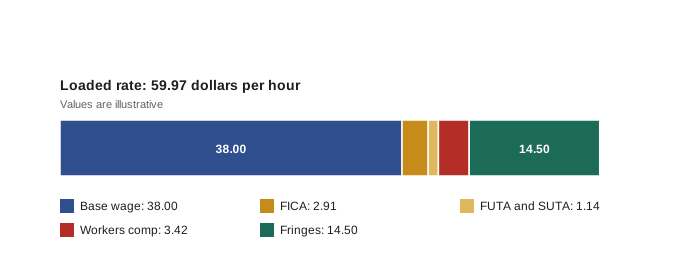
A union carpenter earns a base wage of $38.00 per hour with fringe contributions of $14.50 per hour for health and welfare, pension and training. Use FICA of 7.65 %, combined FUTA and SUTA of 3.0 % (an illustrative average) and workers' compensation of 9.0 % of wages (illustrative). Calculate the loaded hourly rate, ignoring wage-base limits.
Show solution
- FICA: $38.00 × 7.65 % = $2.91.
- Unemployment taxes: $38.00 × 3.0 % = $1.14.
- Workers' compensation: $38.00 × 9.0 % = $3.42.
- Fringes: $14.50.
- Loaded rate: $38.00 + $2.91 + $1.14 + $3.42 + $14.50 = $59.97 per hour, about 58 % above the base wage.
Answer: About $59.97 per hour; the burden adds more than half again to the base wage.
Wage rules on public work
Wage rates on public construction can be set by law. The federal Davis-Bacon Act requires contractors and subcontractors on federally funded or assisted construction contracts over $2,000 to pay at least the locally prevailing wages and fringe benefits published by the US Department of Labor in wage determinations for each county and type of construction. The Department updated its regulations in a 2023 final rule. Many states have their own prevailing wage laws, often called little Davis-Bacon acts, for state and local public works, with their own thresholds and rate schedules, and some require certified payroll reports every week. An estimator bidding public work must find the applicable wage determination and price at least those rates.
Crews and crew rates
Most work is done by crews rather than individuals. A crew is a defined mix of trades and skill levels that works efficiently on a task, such as a forming crew of one foreman, three carpenters and one laborer, or a masonry crew of two masons and one tender. The crew hourly cost is the sum of the loaded rates of its members, plus any equipment that travels with the crew. The crew's output per hour, measured in units of work, comes from historical records.
Worked problem
Pricing wall forms with a crew rate
A wall-forming crew consists of a foreman at $64.00 per hour loaded, three carpenters at $59.97 and one laborer at $46.00. Historical records show the crew forms 100 ft² of wall contact area per crew-hour on similar walls. Calculate the crew hourly cost, the labor-hours per square foot and the labor cost per square foot.
Show solution
- Crew hourly cost: $64.00 + 3 × $59.97 + $46.00 = $289.91.
- Labor-hours per crew-hour: 5 workers × 1 hour = 5 labor-hours.
- Labor-hours per square foot: 5 ÷ 100 = 0.050 h/ft².
- Labor cost per square foot: $289.91 ÷ 100 = $2.90/ft².
Answer: $289.91 per crew-hour, 0.050 labor-hours and $2.90 per square foot of contact area.
Crew composition matters. A crew with too few laborers wastes skilled hours carrying material; a crew with too many stands around. Estimators use the crews the firm actually runs, and they price the work with the crew that suits the job: a small crew on a small, cut-up wall and a larger crew with a crane on long, repetitive walls.
Productivity data
Productivity rates come from three sources. The best is the firm's own historical cost data, collected by cost code from completed projects, because it reflects the firm's crews, methods and management. The second is published cost data, which gives national average productivity for many tasks and is useful for unfamiliar work. The third is the judgment of experienced superintendents and foremen, who can estimate how long work will take from first principles, by thinking through each step. Good estimators use all three and compare them.
| Task (illustrative) | Metric productivity | Imperial productivity | Notes |
|---|---|---|---|
| Form footings, hand-set | 0.40 to 0.60 h/m² | 0.04 to 0.06 h/ft² | Contact area; strip and clean included |
| Form walls, gang forms | 0.30 to 0.50 h/m² | 0.03 to 0.05 h/ft² | Repetitive walls with crane |
| Place concrete, pumped walls | 0.6 to 1.2 h/m³ | 0.5 to 0.9 h/yd³ | Depends on pour size and access |
| Lay 200 mm (8 in) concrete block | 0.8 to 1.2 h/m² | 0.08 to 0.11 h/ft² | Mason and tender hours combined |
| Hang gypsum board, walls | 0.10 to 0.16 h/m² | 0.010 to 0.015 h/ft² | Board only, no taping |
Historical data must be read with care. Recorded hours include whatever happened on the job: bad weather, design changes, rework and slow deliveries. Before reusing a rate, the estimator asks what conditions produced it and whether this job will be similar. Data recorded under vague cost codes, such as a single code for all concrete labor, cannot be reused for individual items.
Adjusting productivity for the job
No two jobs are identical, so historical productivity is adjusted for the conditions of the new job. Common factors include the following.
- Size and repetition: large quantities of repetitive work go faster per unit than small, cut-up work, because crews learn the task and set-up time is spread over more units.
- Access and height: work at height, in confined spaces or far from the hoist takes longer.
- Weather: cold, heat, rain and short winter days reduce productivity, and winter work may require heating and hoarding.
- Overtime and shift work: extended hours raise output per day but lower output per hour, as fatigue builds over weeks.
- Crew experience and labor market: a tight labor market can mean less experienced workers.
- Site congestion and trade stacking: many trades working in the same area slow each other down.
Worked problem
Adjusting productivity for winter work
A firm's historical rate for setting anchor bolts is 0.25 labor-hours each. A new job has 1,200 anchor bolts, to be set in winter under hoarding. The superintendent expects winter conditions to reduce productivity by 15 %. How many labor-hours should be estimated, and what is the labor cost at $58.00 per hour?
Show solution
- A 15 % loss in productivity means the crew achieves 85 % of its normal output.
- Adjusted rate: 0.25 ÷ 0.85 = 0.294 labor-hours per bolt. Note that dividing by 0.85 is not the same as multiplying by 1.15.
- Hours: 1,200 × 0.294 = 353 labor-hours.
- Cost: 353 × $58.00 = $20,474. Compare with 1,200 × 0.25 × 58 = $17,400 without adjustment.
Answer: About 353 labor-hours and $20,500, roughly $3,100 more than the unadjusted price.
Productivity factors should be applied once and documented. Stacking several pessimistic factors, each reasonable on its own, can produce an uncompetitive price; ignoring them produces a loss. The estimator's notes should state which factors were applied and why, so the project team understands the labor budget it inherits.
Common mistakes
MistakePricing labor at the base wage.
InsteadUse the loaded rate including vacation, statutory costs, workers' compensation and fringes.
MistakeMultiplying by 1.15 for a 15 % productivity loss.
InsteadDivide the rate by 0.85; a 15 % loss of output raises hours by about 17.6 %.
MistakeReusing historical rates without knowing the conditions behind them.
InsteadCheck what the source job was like and adjust for differences.
MistakeIgnoring prevailing or fair wage requirements on public work.
InsteadRead the contract labor clauses and price the required wage schedules.
MistakeUsing one crew size for every job.
InsteadChoose the crew that suits the quantity, access and repetition of the work.
Summary and key terms
- Labor cost = quantity × labor-hours per unit × loaded rate, or quantity ÷ crew output × crew cost.
- The loaded rate adds vacation and holiday pay, statutory payroll costs, workers' compensation and benefits to the base wage.
- US statutory costs include FICA, FUTA, SUTA and workers' compensation insurance.
- Federal Davis-Bacon and state prevailing wage laws set minimum wages on public work.
- Crew cost is the sum of members' loaded rates; output per crew-hour comes from records.
- Productivity data come from company history, published data and field judgment.
- Adjust productivity for size, access, weather, overtime, crew and congestion, and document the factors.
- Loaded rate
- The full hourly cost of a worker, including wage, burden and benefits.
- Labor burden
- Costs added to wages, such as statutory contributions and benefits, often expressed as a percentage.
- Labor-hour
- One worker working for one hour; also called a person-hour.
- Productivity rate
- The labor-hours needed per unit of work, or the output per crew-hour.
- Crew
- A defined group of workers of different trades and skills who work together on a task.
- Crew-hour
- One hour of work by a whole crew.
- Workers' compensation
- Insurance or premiums paid by employers to cover workplace injuries, priced by industry classification.
- Prevailing wage
- A minimum wage and fringe rate set by government for public construction in an area.
- Fringe benefits
- Employer contributions for health, pension, training and similar plans.
- Productivity factor
- An adjustment applied to historical productivity for the conditions of a specific job.
Practice problems
Work each problem on paper first, then reveal the answer to check.
Write the labor cost equation using labor-hours per unit.
Show answer
Labor cost = quantity × labor-hours per unit × loaded hourly rate.
A crew of 4 produces 20 units per crew-hour. What are the labor-hours per unit?
Show answer
4 ÷ 20 = 0.20.
Name three components of labor burden.
Show answer
Any three of: vacation and holiday pay, pension contributions, employment or unemployment insurance, workers' compensation, benefits.
A worker's base wage is $40 and the burden is 45 %. What is the loaded rate?
Show answer
$58.00.
A crew costs $250 per hour and places 25 m² (or 250 ft²) per hour. What is the labor cost per unit?
Show answer
$10/m² (or $1/ft²).
Why might burden be lower late in the year?
Show answer
Some statutory contributions stop once annual maximum earnings are reached.
What is the best source of productivity data?
Show answer
The firm's own historical cost data from similar work.
Historical rate 0.5 h/unit; expected productivity loss 20 %. What rate should be used?
Show answer
0.5 ÷ 0.80 = 0.625 h/unit.
Why can overtime reduce productivity?
Show answer
Fatigue over long hours and weeks lowers output per hour.
Why should productivity factors be documented?
Show answer
So the project team understands the labor budget and the assumptions behind it.
Lesson quiz · 5 questions
Score 60% or more to complete this lesson.
Create a free account to save your progress, take quizzes and earn a certificate.