
CIV-390 · Lesson 7 of 12 · 19 min
Unsignalized intersections and roundabouts
Most intersections have no signal. They are controlled by stop or yield signs, or by the simple rule that drivers yield to the right, and they work well as long as traffic on the minor road can find gaps in the major-road stream. The new operations site access on Ridgeway Road is a test of that idea. In the afternoon, staff and fleet vehicles leaving the site must turn left across two lanes of busy traffic. Should the access be stop-controlled, signalized, or built as a roundabout? This lesson develops the gap acceptance theory behind unsignalized intersection analysis, introduces modern roundabouts, and compares the options for the operations site.
Types of intersection control
The least restrictive control is none at all, appropriate only where volumes are very low and sight lines are good. Yield control requires drivers on the minor approach to slow and give way, stopping only if needed. Two-way stop control (TWSC) stops the minor-road approaches while major-road traffic flows freely; it is by far the most common form of control at urban and rural intersections. All-way stop control (AWSC) stops every approach and gives right of way in order of arrival; it suits intersections with roughly balanced volumes where neither road should have priority, but it adds delay and is not recommended as a speed-control device. Roundabouts and signals handle higher volumes.
The choice of control is guided by warrants in the MUTCD, which lists nine warrants for traffic signals, including the eight-hour and four-hour vehicular volume warrants, the peak hour warrant, pedestrian volume, school crossing, coordinated signal system, crash experience, roadway network and intersections near a grade crossing. Meeting a warrant does not by itself require a signal; the MUTCD asks for an engineering study that considers alternatives. A signal that is not warranted can increase delay and rear-end crashes without improving safety, so the warrant analysis is the first step, not an afterthought.
Gap acceptance
A driver waiting at a stop sign to turn left from the minor road watches the stream of major-road vehicles and waits for a gap long enough to complete the turn. The critical headway \(t_c\) is the minimum headway that a typical driver will accept; gaps shorter than \(t_c\) are rejected and longer ones accepted. When a long gap appears and several drivers are waiting, they enter one after another at a follow-up headway \(t_f\), shorter than the critical headway. Both values depend on the movement: a minor-street left turn, which must cross or join traffic from both directions, needs the longest headway, while a major-street left turn, which crosses only the opposing through traffic, needs the shortest.
| Movement | Critical headway \(t_c\) (s) | Follow-up headway \(t_f\) (s) |
|---|---|---|
| Left turn from the major street | 4.1 | 2.2 |
| Right turn from the minor street | 6.2 (two-lane major) to 6.9 (four-lane) | 3.3 |
| Through movement from the minor street | 6.5 | 4.0 |
| Left turn from the minor street | 7.1 (two-lane major) to 7.5 (four-lane) | 3.5 |
If major-street vehicles arrive at random, their headways follow a negative exponential distribution: the probability that a headway exceeds \(t\) seconds is \(e^{-qt}\), where \(q\) is the flow in vehicles per second. Combining this with the critical and follow-up headways gives the potential capacity of a minor-street movement facing a conflicting flow \(v_c\):
Capacity falls steeply as the conflicting flow rises. A minor-street left turn across a light stream of 300 veh/h has a potential capacity of several hundred vehicles per hour; across 1,200 veh/h, it may be under 150. The HCM adjusts the potential capacity for the impedance of higher-priority movements, for shared lanes, for two-stage crossings through a wide median and for the effects of upstream signals.
Delay and queues at stop control
The HCM estimates average control delay for a minor-street movement with volume \(v\) and capacity \(c\) as
where \(T\) is the analysis period in hours and the final 5 seconds accounts for deceleration and acceleration. LOS thresholds for unsignalized intersections are lower than for signals, because drivers expect less delay at a stop sign: LOS A is up to 10 s, B up to 15, C up to 25, D up to 35, E up to 50, and F above 50 s or whenever demand exceeds capacity. The 95th percentile queue, used to check storage space, has a similar form. Delay at a two-way stop is reported for each minor movement; the major-street through movements are assumed to have no control delay.
Modern roundabouts
A modern roundabout is a circular intersection in which entering traffic yields to traffic already circulating, counter-clockwise around a central island. It differs from older traffic circles and rotaries in three ways: entering traffic yields rather than circulating traffic; the entries are deflected by splitter islands, so vehicles slow to about 25 to 40 km/h (15 to 25 mph) before entering; and the diameter is compact, typically 30 to 45 m (100 to 150 ft) for a single-lane urban roundabout. A truck apron, a mountable ring around the central island, lets large vehicles track over it while keeping the circulating lane narrow for cars.
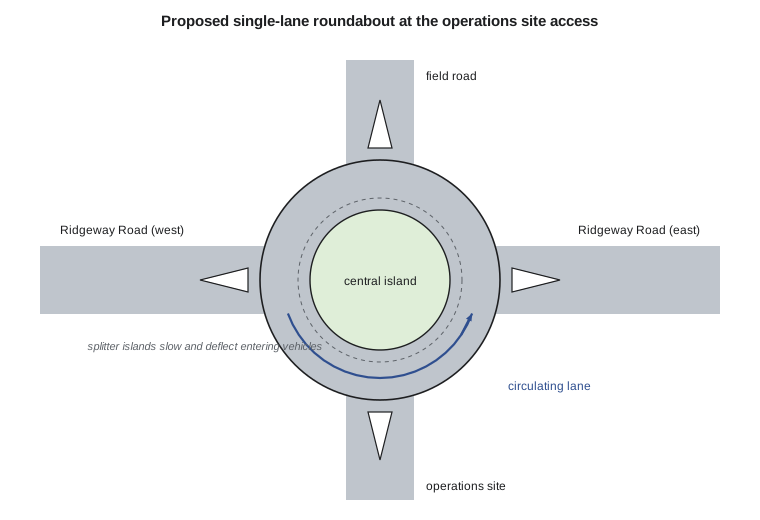
Roundabouts are widely associated with large reductions in serious crashes compared with stop-controlled and signalized intersections, because they eliminate the high-angle conflicts that cause the most severe crashes and force all drivers to slow. Studies in North America and abroad have reported reductions in injury crashes on the order of 70 % or more after conversion from stop or signal control, although results vary with the site and design. Multi-lane roundabouts have more conflicts than single-lane ones, and their safety depends heavily on good entry and exit design and clear lane markings. Roundabouts also tend to cut delay and emissions where volumes are balanced, because traffic keeps moving instead of waiting through red time.
Roundabouts are not always the right answer. They need more land at the corners than a stop-controlled intersection; they cannot give priority to one approach the way a coordinated signal can; and they can be harder for pedestrians with visual impairments to cross, because drivers do not stop on a predictable cycle. Raised crossings and pedestrian-activated beacons at the entries help. In cold climates they work well in winter, and the city's plows can clear them, but the truck apron and splitter islands must be designed for snow storage and plow blades.
Roundabout capacity
The capacity of a roundabout entry depends mainly on the circulating flow in front of it. The HCM's model for a single-lane entry facing a single circulating lane is an exponential function of the conflicting flow in passenger cars per hour:
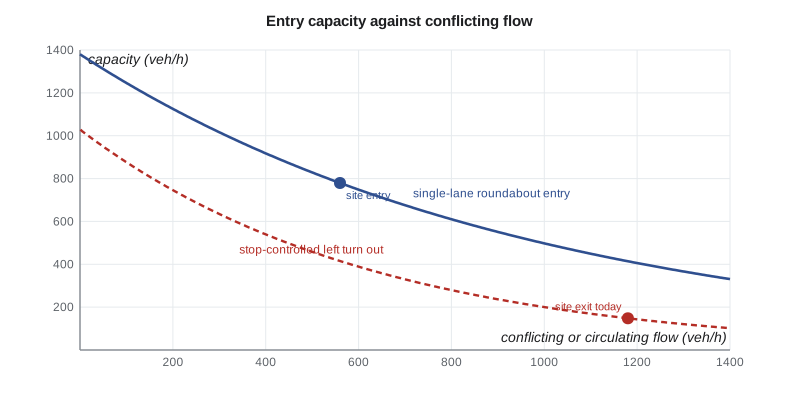
Entry capacity is 1,380 pc/h when nothing circulates and falls to about 500 pc/h when the circulating flow reaches 1,000 pc/h. Multilane entries have their own equations. Delay is computed with the same form as for stop control, and the same LOS thresholds apply, with LOS F whenever the volume-to-capacity ratio exceeds 1.
Intersection sight distance
Drivers stopped on a minor approach need to see far enough along the major road to judge gaps. Intersection sight distance (ISD) is the length of the major road that must be visible, and it is computed from the time gap a driver needs to complete the maneuver: \(ISD = 0.278\,V_{major}\,t_g\) in meters (or \(1.47\,V_{major}\,t_g\) in feet), where \(t_g\) is about 7.5 seconds for a passenger car turning left from a stop, longer for trucks and for wider major roads. The sight triangle formed by the driver's eye and the approaching vehicle must be kept clear of buildings, signs, parked vehicles and, in northern cities, snowbanks. At 60 km/h (40 mph), a 7.5-second gap needs about 125 m (440 ft) of sight distance along Ridgeway Road.
Choosing control for the operations site access
Owen's design-year PM peak forecast for the access has 1,150 veh/h of through traffic on Ridgeway (both directions combined) and 190 veh/h turning left out of the operations site. Ridgeway is four lanes wide at the access, so the minor-street left turn uses a critical headway of 7.5 s and a follow-up headway of 3.5 s. The script analyzes two-way stop control and then a single-lane roundabout, using conflicting circulating flows from a turning movement balance.
# Operations site access: two-way stop control versus a single-lane roundabout
import math
UNITS = "US"
SI = UNITS == "SI"
# design-year PM peak hour, veh/h
major_through = 1150     # Ridgeway Road, both directions combined, conflicting with the exiting left turn
major_right = 60
minor_left = 190          # vehicles leaving the operations site and turning left
tc, tf = 7.5, 3.5         # critical headway and follow-up time, minor-street left turn across a four-lane road, s
vc = major_through + major_right / 2
cp = vc * math.exp(-vc * tc / 3600) / (1 - math.exp(-vc * tf / 3600))
def delay(v, c, T=0.25):
    x = v / c
    return 3600 / c + 900 * T * ((x - 1) + math.sqrt((x - 1) ** 2 + (3600 / c) * x / (450 * T))) + 5
def los(d):
    for lim, l in ((10, 'A'), (15, 'B'), (25, 'C'), (35, 'D'), (50, 'E')):
        if d <= lim: return l
    return 'F'
d = delay(minor_left, cp)
print(f"two-way stop: conflicting flow {vc:.0f} veh/h, potential capacity {cp:.0f} veh/h")
print(f"  exiting left turn v/c = {minor_left/cp:.2f}, delay = {d:.0f} s/veh, LOS {los(d)}")
q95 = 900 * 0.25 * ((minor_left/cp - 1) + math.sqrt((minor_left/cp - 1) ** 2 + (3600/cp) * (minor_left/cp) / (150 * 0.25))) * cp / 3600
print(f"  95th-percentile queue = {q95:.1f} vehicles")
# single-lane roundabout: each entry against its circulating flow (pc/h)
entries = {"Ridgeway east": (640, 210), "Ridgeway west": (610, 330), "Operations site": (260, 560), "Field road": (40, 720)}
for name, (ve, vcirc) in entries.items():
    ce = 1380 * math.exp(-1.02e-3 * vcirc)
    x = ve / ce
    dd = delay(ve, ce)
print(f"roundabout {name:15s} entry {ve:4d} circulating {vcirc:4d} capacity {ce:5.0f} v/c {x:.2f} delay {dd:4.1f} s LOS {los(dd)}")two-way stop: conflicting flow 1180 veh/h, potential capacity 148 veh/h exiting left turn v/c = 1.28, delay = 228 s/veh, LOS F 95th-percentile queue = 11.5 vehicles roundabout Ridgeway east entry 640 circulating 210 capacity 1114 v/c 0.57 delay 12.5 s LOS B roundabout Ridgeway west entry 610 circulating 330 capacity 986 v/c 0.62 delay 14.4 s LOS B roundabout Operations site entry 260 circulating 560 capacity 779 v/c 0.33 delay 11.9 s LOS B roundabout Field road entry 40 circulating 720 capacity 662 v/c 0.06 delay 10.8 s LOS B
With two-way stop control, the left turn out of the site faces a conflicting flow of about 1,180 veh/h and has a potential capacity of only about 150 veh/h. Demand exceeds capacity (v/c about 1.3), delay is several minutes per vehicle and the movement is at LOS F, with queues of a dozen vehicles backing into the site. That is not acceptable, and drivers facing such delays accept dangerously short gaps. A single-lane roundabout serves every approach at LOS B, with volume-to-capacity ratios no higher than about 0.62 and average delays of about 11 to 14 seconds. The roundabout also slows eastbound traffic as it enters the rural section, which helps with the curve and crest examined in lessons 8 and 9.
A signal would also serve the left turn, but the access does not meet the volume justification in all hours, a signal would add delay to Ridgeway traffic outside the peak, and signals at rural-urban transitions have a poor rear-end crash record. The team recommends the roundabout, designed for a WB-20 (WB-62) salt truck with a truck apron, raised pedestrian crossings on the Ridgeway legs, and a snow storage plan agreed with the city's operations staff.
Worked problem
Potential capacity across a lighter stream
Before the operations site opened, the conflicting flow at the access in the PM peak was 700 veh/h. Find the potential capacity of the minor-street left turn with \(t_c\) = 7.5 s and \(t_f\) = 3.5 s.
Show solution
- \[c_p = 700\,\frac{e^{-700(7.5)/3600}}{1 - e^{-700(3.5)/3600}} = 700\,\frac{0.233}{1 - 0.506} = 700 \times 0.471 = 330\ \text{veh/h}\]
Answer: About 330 veh/h. Growth in Ridgeway traffic from 700 to 1,180 veh/h cuts the left-turn capacity by more than half, which is why a stop sign that works today will fail in the design year.
Common mistakes
MistakeUsing a two-lane major-road critical headway for a four-lane road.
InsteadMinor-street left and right turns need longer critical headways when the major road has more lanes.
MistakeReporting an average delay for the whole stop-controlled intersection.
InsteadReport delay for each minor movement; the worst movement usually governs.
MistakeInstalling all-way stops to slow traffic.
InsteadAll-way stop control is for balanced volumes; it adds delay and is not a speed-control device.
MistakeDesigning a roundabout without the design vehicle and winter in mind.
InsteadCheck swept paths with a truck apron and plan snow storage and plowing.
Summary and key terms
- Control options range from none and yield through two-way and all-way stop to roundabouts and signals, chosen with warrants or justifications.
- Gap acceptance uses critical and follow-up headways; random arrivals give \(c_p = v_c e^{-v_c t_c/3600}/(1 - e^{-v_c t_f/3600})\).
- Stop-control delay and LOS are reported per minor movement, with thresholds of 10, 15, 25, 35 and 50 s.
- Modern roundabouts slow entering vehicles with deflection and have a strong safety record; single-lane entry capacity is \(1380 e^{-0.00102 v_c}\).
- Intersection sight distance and the sight triangle must be kept clear, including of snow.
- Two-way stop control
- Control that stops the minor-road approaches while the major road flows freely.
- All-way stop control
- Control that stops every approach and assigns right of way in order of arrival.
- Critical headway
- The minimum major-stream headway a typical minor-street driver will accept.
- Follow-up headway
- The time between successive minor-street vehicles entering the same gap.
- Modern roundabout
- A circular intersection with yield-at-entry, deflected entries and a compact diameter.
- Truck apron
- A mountable ring around a roundabout's central island for large vehicles.
- Sight triangle
- The area at an intersection that must be clear for drivers to see approaching traffic.
Practice problems
Work each problem on paper first, then reveal the answer to check.
Find the potential capacity of a minor-street right turn (\(t_c\) = 6.2 s, \(t_f\) = 3.3 s) facing 500 veh/h.
Show answer
\(500 e^{-0.861}/(1 - e^{-0.458}) = 500(0.423)/0.368 = 575\) veh/h.
A roundabout entry faces 600 pc/h circulating. Find the entry capacity.
Show answer
\(1380 e^{-0.612} = 748\) pc/h.
A movement has v = 200 veh/h and c = 400 veh/h; with T = 0.25 h, estimate the delay and LOS.
Show answer
\(d = 9 + 225[-0.5 + \sqrt{0.25 + 0.04}] + 5 = 9 + 225(0.0385) + 5 = 22.7\) s: LOS C.
Find the intersection sight distance along a 45 mph road for a 7.5 s gap.
Show answer
\(1.47 \times 45 \times 7.5 = 496\) ft.
Lesson quiz · 5 questions
Score 60% or more to complete this lesson.
Create a free account to save your progress, take quizzes and earn a certificate.