
CIV-370 · Lesson 6 of 12 · 20 min
Weirs, flumes, gates and spillways
Every pond, dam and canal needs structures that control how much water passes and that measure it. Weirs, flumes, orifices, gates and spillways do both jobs. Each is a control in the sense of lesson 1: it fixes a definite relation between the upstream water level and the discharge. That relation, the rating curve, is what a designer needs to route a flood through a pond and what an operator needs to know how much water is being released. This lesson develops the ratings of the common structures and builds the outlet structure for the Kestrel Bay stormwater pond.
Sharp-crested weirs
A sharp-crested weir is a thin plate with a beveled edge set across a channel. Water springs clear of the crest, and the nappe, the falling sheet, is ventilated underneath so that atmospheric pressure acts on both sides. Integrating the velocity over the depth above the crest, assuming the velocity at each level is \(\sqrt{2gh}\), gives the classic weir equation for a rectangular opening of width \(b\) under a head \(H\) measured upstream of the drawdown:
The discharge coefficient \(C_d\) accounts for the contraction of the nappe and the approach velocity. For a full-width weir it is about 0.62, slightly increasing with the ratio of head to weir height \(P\); the Rehbock formula, \(C_d \approx 0.611 + 0.075 H/P\), is a common expression. With \(C_d = 0.62\), the combined coefficient \(C_w\) is about 1.84 in SI units and 3.33 in US units. When the weir is narrower than the channel, the nappe contracts at the ends as well; the Francis correction reduces the effective width by \(0.1H\) for each end contraction.
For measuring small flows accurately, the V-notch, or triangular, weir is better, because the head changes rapidly with discharge. For a notch of angle \(\theta\),
For a 90° notch with \(C_d \approx 0.58\), this gives \(Q \approx 1.38H^{2.5}\) in SI units and \(2.49H^{2.5}\) in US units. Standards for the installation of measuring weirs, from ISO and ASTM, specify the plate, the approach channel, the ventilation and where to measure the head.
Broad-crested weirs and flumes
A broad-crested weir is a flat-topped sill long enough in the direction of flow for the streamlines to become parallel over it. If the downstream level is low enough, the flow passes through critical depth on the crest. Lesson 2 then gives the discharge directly: in a rectangular section, \(y_c = \tfrac23 E\), and
with a coefficient slightly below 1 to allow for losses. Road embankments that are overtopped act as broad-crested weirs, and emergency spillways cut into pond berms are designed the same way.
A flume measures flow by forcing it through critical depth in a constricted throat. The Parshall flume, developed in Colorado in the 1920s, is the best known. Because the flow accelerates through the throat without a pool behind a sill, a flume passes sediment and debris that would fill the pool of a weir, and it causes little head loss. Flumes are standard at the inlets of wastewater treatment plants and in irrigation canals. Each size has an empirical rating published by the developer and in standards.
Orifices
An orifice is an opening, usually circular, through which water flows under a head. When the opening is submerged on the upstream side and discharges freely, the jet contracts to a vena contracta, and
where \(A\) is the area of the opening, \(h\) is the head on its center and \(C_d\) is about 0.6 for a sharp-edged opening. If the outlet is submerged, \(h\) becomes the difference between the upstream and downstream levels. When the upstream water is below the top of the opening, the orifice flows like a weir, and a transition between the two equations is needed at shallow heads. Orifices are the workhorses of stormwater outlets because their discharge rises only with the square root of the head: small flows pass easily while large flows are held back.
Sluice gates
A vertical sluice gate raised an opening \(a\) above the floor releases a jet that contracts to a depth \(y_2 = C_c a\), with a contraction coefficient \(C_c\) of about 0.61. Applying the energy equation from the upstream pool, at depth \(y_1\), to the vena contracta, with continuity, gives the discharge per unit width for free flow:
The jet below a gate is supercritical, and lesson 5 shows that it ends in a hydraulic jump. If the tailwater is deeper than the sequent depth of the jet, the jump moves upstream and drowns the gate, and the discharge for a given opening falls. Gate ratings must therefore be checked for submergence.
Spillways
Dams and large ponds have spillways to pass floods without overtopping the embankment. The ogee spillway of a concrete dam is shaped to follow the underside of the nappe of a sharp-crested weir, so that the water clings to the concrete without separating. Its rating, \(Q = C L H_e^{3/2}\), uses a coefficient of about 2.1 in SI units (3.9 in US units) at the design head, varying with the head, the approach depth and the piers. Small embankment ponds usually have an emergency spillway, a broad grassed or armored channel cut through natural ground beside the embankment or a concrete chute over it, rated as a broad-crested weir. Dam safety guidelines, provincial in Canada and state in the United States, set the flood that a spillway must pass, depending on the consequences of failure.
Combining structures: a stage-discharge curve
A stormwater pond outlet usually combines several openings at different levels, so that the release can be controlled for more than one storm. A small orifice near the bottom releases the frequent storms slowly, which also gives treatment time for settling of sediment. An overflow weir at a higher level comes into play for larger storms, and an emergency spillway near the top of the berm passes extreme floods or the full inflow if the outlet is blocked. The total rating at any stage is the sum of the flows through each opening that is active at that stage.
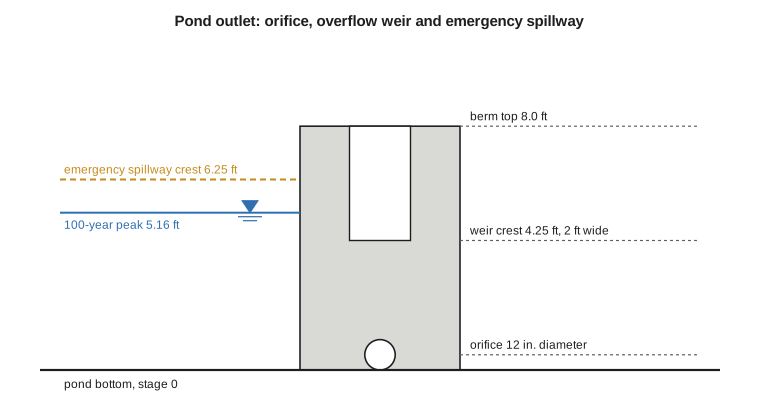
For the Kestrel Bay pond, the city's requirement is to hold the post-development peak flow to the pre-development peak for storms up to the 100-year event; lesson 9 estimates that pre-development 100-year peak at 15.1 cfs. Anika's outlet design, refined by the routing in lesson 10, has a 12 in. orifice with its invert at the pond bottom, an overflow weir 2 ft wide with its crest at a stage of 4.25 ft, and an emergency spillway 20 ft wide at 6.25 ft, with the top of the berm at 8.0 ft. A 90° V-notch weir plate in the outlet manhole lets the operator measure low flows, and a small sluice gate on a drawdown channel allows the pond to be emptied for maintenance.
Worked problem
Outlet flow at a stage just above the weir crest
Find the total outflow when the pond stands at 5.25 ft above the orifice invert.
Show solution
- Orifice, head on the center \(5.25 - 0.50 = 4.75\) ft, area \(\pi(1.0)^2/4 = 0.785\) ft²:
- \[Q_o = 0.62(0.785)\sqrt{2(32.2)(4.75)} = 8.52\ \text{cfs}\]
- Weir, head \(5.25 - 4.25 = 1.00\) ft:
- \[Q_w = 3.33(2.0)(1.00)^{3/2} = 6.66\ \text{cfs}\]
- \[Q = 8.52 + 6.66 = 15.2\ \text{cfs}\]
Answer: At 5.25 ft the outlet releases about 15.2 cfs, right at the 15.1 cfs allowed, so the 100-year peak stage should lie at or just below this level. Lesson 10 confirms it at 5.16 ft.
Sofia's script tabulates the full stage-discharge curve, the V-notch rating and the free-flow discharge of the drawdown gate.
# Control structures: the pond outlet rating, a V-notch weir for monitoring and a sluice gate
from math import sqrt, pi, tan, radians
UNITS = "US"
SI = UNITS == "SI"
g = 9.81 if SI else 32.2
L, uq = ("m", "m3/s") if SI else ("ft", "cfs")
# pond outlet: orifice (diameter d, invert at stage 0), rectangular weir (crest, width), emergency spillway
d, crest, bw, sp, bsp = (0.30, 1.30, 0.6, 1.90, 6.0) if SI else (1.0, 4.25, 2.0, 6.25, 20.0)
Cw = 1.84 if SI else 3.33               # sharp-crested weir coefficient in Q = Cw b H^1.5
Cb = 1.70 if SI else 3.09               # broad-crested (critical flow) coefficient
def orifice(h):
    if h <= 0: return 0.0
    if h < d: return 0.0 if h < 0.02 * d else None                # partly full: weir-like flow, see text
    return 0.62 * pi * d * d / 4 * sqrt(2 * g * (h - d / 2))
def rating(h):
    qo = orifice(h)
    if qo is None: qo = Cw * 0.6 * d * h ** 1.5                     # rough weir flow through the opening
    qw = Cw * bw * (h - crest) ** 1.5 if h > crest else 0.0
    qs = Cb * bsp * (h - sp) ** 1.5 if h > sp else 0.0
    return qo, qw, qs
print(f"Pond outlet rating (stage above the orifice invert, {L}; flows in {uq})")
print(f"{'h':>5} {'orifice':>8} {'weir':>7} {'spillway':>9} {'total':>7}")
stages = [0.2, 0.5, 0.8, 1.0, 1.3, 1.5, 1.6, 1.9, 2.1, 2.3] if SI else [0.6, 1.5, 2.5, 3.5, 4.25, 4.75, 5.25, 6.25, 7.0, 7.5]
for h in stages:
    qo, qw, qs = rating(h)
    print(f"{h:5.2f} {qo:8.3f} {qw:7.3f} {qs:9.3f} {qo + qw + qs:7.3f}")
# 90-degree V-notch weir for low-flow monitoring of the pond release
Cv = 1.38 if SI else 2.49               # Q = Cv H^2.5 for a 90-degree notch
for H in ((0.05, 0.10, 0.20) if SI else (0.15, 0.33, 0.65)):
    print(f"V-notch head {H:.2f} {L}: Q = {Cv * H ** 2.5:.4f} {uq}")
# vertical sluice gate on the pond drawdown channel, opening a, width w, upstream depth y1
a, w, y1 = (0.20, 1.0, 1.50) if SI else (0.66, 3.3, 4.9)
Cc = 0.61
# free flow: energy from the upstream pool to the vena contracta, depth Cc a
q = Cc * a * sqrt(2 * g * y1) / sqrt(1 + Cc * a / y1)
y2 = Cc * a; V2 = q / y2
F2 = V2 / sqrt(g * y2)
y3 = y2 / 2 * (sqrt(1 + 8 * F2 ** 2) - 1)
print(f"\nSluice gate: q = {q:.3f} {'m2/s' if SI else 'ft2/s'}, Q = {q * w:.3f} {uq}; vena contracta {y2:.3f} {L}, Fr = {F2:.2f}")
print(f"Free flow needs tailwater below the sequent depth {y3:.3f} {L}; above it the gate is submerged")Pond outlet rating (stage above the orifice invert, ft; flows in cfs)
h orifice weir spillway total
0.60 0.929 0.000 0.000 0.929
1.50 3.908 0.000 0.000 3.908
2.50 5.526 0.000 0.000 5.526
3.50 6.768 0.000 0.000 6.768
4.25 7.567 0.000 0.000 7.567
4.75 8.056 2.355 0.000 10.411
5.25 8.517 6.660 0.000 15.177
6.25 9.370 18.837 0.000 28.208
7.00 9.963 30.372 40.140 80.475
7.50 10.339 39.021 86.368 135.728
V-notch head 0.15 ft: Q = 0.0217 cfs
V-notch head 0.33 ft: Q = 0.1558 cfs
V-notch head 0.65 ft: Q = 0.8482 cfs
Sluice gate: q = 6.875 ft2/s, Q = 22.687 cfs; vena contracta 0.403 ft, Fr = 4.74
Free flow needs tailwater below the sequent depth 2.507 ft; above it the gate is submergedReading the results
The rating shows the purpose of each opening. Up to the weir crest at 4.25 ft, only the orifice flows, and the release grows slowly, reaching 7.6 cfs at the crest. Above it, the weir adds flow rapidly, and by 6.25 ft the outlet passes 28 cfs. Above the emergency spillway crest the flow increases steeply again: at 7.0 ft the spillway alone carries 40 cfs, and at 7.5 ft the total is about 136 cfs, more than twice the 100-year inflow. The spillway can therefore pass the whole 100-year inflow of 64 cfs with the outlet blocked, at a stage of about 7.3 ft, leaving about 0.7 ft of freeboard to the top of the berm. Anika accepts the small margin for this extreme case, in which the outlet is assumed blocked; with the outlet working, the 100-year stage is 5.16 ft.
The V-notch rating shows its sensitivity at low flow: doubling the head from 0.33 to 0.65 ft multiplies the flow by more than five. The drawdown gate, opened 0.66 ft with 4.9 ft of water behind it, releases about 6.9 cfs per foot of width as a supercritical jet with a Froude number of 4.7. It flows freely only while the water downstream stays below the sequent depth of 2.5 ft.
Practical details of outlet structures
Small orifices clog with debris and ice, so they are protected by trash racks or perforated risers, and some municipalities set a minimum orifice size, often around 75 to 100 mm or 3 to 4 in., for that reason. In northern climates, the outlet must keep working in winter: the orifice is often placed in a submerged or insulated chamber, and the emergency spillway is sized on the assumption that the outlet may be frozen during spring rain-on-snow events. The weir and spillway crests must be built level and to the specified elevations, because errors of a few centimeters change the ratings noticeably, and inspection after construction should confirm them. Finally, the outlet pipe beyond the structure must have enough capacity that it does not drown the orifice, and lesson 4 showed that a high lake level partly submerges the outfall at Kestrel Bay, which lesson 12 considers.
Practical points
- Rate each opening separately and add the flows active at each stage.
- Use orifices for low flows and weirs for larger ones; size the emergency spillway for the full inflow with the outlet blocked.
- Check for submergence of orifices, weirs and gates by the tailwater.
- Protect small openings from debris and ice.
- Survey the crests after construction; ratings are sensitive to elevation errors.
Common mistakes
MistakeMeasuring the head on a weir right at the crest.
InsteadMeasure upstream, beyond the drawdown, typically three to four times the maximum head.
MistakeUsing the orifice equation when the water is below the top of the opening.
InsteadAt shallow heads the opening acts as a weir.
MistakeIgnoring end contractions on a weir narrower than the channel.
InsteadReduce the effective width by 0.1H per contraction.
MistakeDesigning the emergency spillway only for the excess above the outlet capacity.
InsteadAssume the outlet may be blocked and pass the full inflow.
Summary and key terms
- Rectangular sharp-crested weir: \(Q = C_w b H^{3/2}\), \(C_w \approx 1.84\) (SI) or 3.33 (US).
- 90° V-notch: \(Q \approx 1.38 H^{5/2}\) (SI) or \(2.49 H^{5/2}\) (US), good for small flows.
- Broad-crested weir and flumes force critical depth: \(Q \approx 1.705 bH^{3/2}\) (SI) or \(3.09 bH^{3/2}\) (US).
- Orifice: \(Q = C_d A\sqrt{2gh}\), \(C_d \approx 0.6\); sluice gate jets end in a jump and can be drowned.
- A stage-discharge curve adds the flows of all active openings.
- Pond outlet: 12 in. orifice, 2 ft weir at 4.25 ft, 20 ft spillway at 6.25 ft; 15.2 cfs at 5.25 ft.
- Weir
- A barrier over which water flows, used to control or measure discharge.
- Nappe
- The sheet of water falling over a weir.
- Rating curve
- The relation between the upstream water level and the discharge at a control.
- Orifice
- An opening through which water flows under a head.
- Flume
- A constricted channel that forces critical depth for flow measurement.
- Sluice gate
- A gate that releases water through an opening at its base.
- Ogee spillway
- A spillway crest shaped to the lower surface of a free nappe.
- Emergency spillway
- A spillway that passes extreme floods or the full inflow when the main outlet is blocked.
Practice problems
Work each problem on paper first, then reveal the answer to check.
A full-width rectangular weir 6 ft long carries a head of 0.8 ft. Estimate the discharge.
Show answer
\(Q = 3.33(6)(0.8)^{1.5} = 14.3\) cfs.
What head on a 90° V-notch weir gives 0.35 cfs?
Show answer
\(H = (0.35/2.49)^{0.4} = 0.456\) ft.
An 8 in. orifice discharges freely under a head of 4 ft on its center. Find the flow.
Show answer
\(Q = 0.62(0.349)\sqrt{2 \times 32.2 \times 4} = 3.47\) cfs.
Why are pond outlets usually designed with a small orifice below a larger weir?
Show answer
The orifice releases frequent small storms slowly, giving storage and settling time, while the weir passes larger storms without excessive rise.
Lesson quiz · 5 questions
Score 60% or more to complete this lesson.
Create a free account to save your progress, take quizzes and earn a certificate.