
CIV-370 · Lesson 2 of 12 · 19 min
Specific energy and critical flow
Lesson 1 showed that the same discharge can flow at two quite different depths, one subcritical and one supercritical. This lesson explains why, using a simple but powerful idea introduced by Boris Bakhmeteff in 1912: the specific energy. It leads to critical depth, the most useful single number in open-channel hydraulics, and to an explanation of what happens when a channel narrows or its bed rises, which is exactly the situation at the Kestrel Creek culvert.
Specific energy
The total head of lesson 1 is measured from a fixed datum. If we measure it instead from the channel bed at the section, we get the specific energy:
Specific energy is not conserved along a channel. It increases where the bed drops and decreases where the bed rises or friction removes energy. But at any one section, for a given discharge, it depends only on the depth, and plotting it against depth reveals the structure of open-channel flow.
For a rectangular channel of width \(b\), it is convenient to use the discharge per unit width \(q = Q/b\), so that \(V = q/y\) and
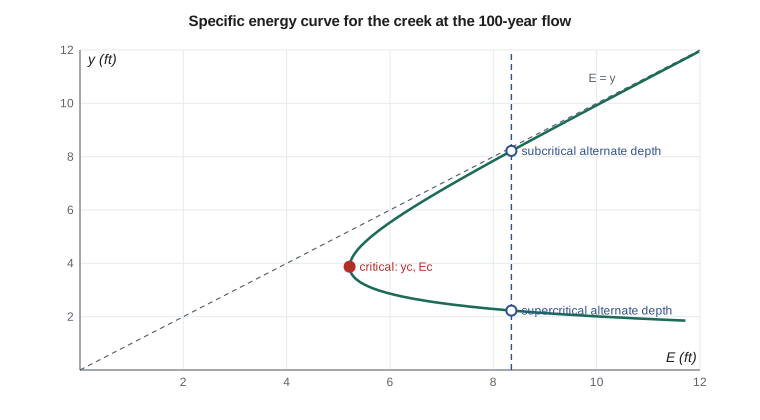
As the depth becomes large, the velocity head becomes negligible and \(E\) approaches \(y\): the curve approaches the 45° line. As the depth becomes small, the velocity head grows without limit. Between these extremes the curve has a minimum. For every value of \(E\) greater than the minimum there are two possible depths, called alternate depths: a large, subcritical one and a small, supercritical one.
Critical depth
The minimum point of the curve is the critical state. Differentiating the specific energy with respect to depth, using \(dA/dy = T\),
The minimum, where \(dE/dy = 0\), occurs where the Froude number equals 1. So critical flow, defined in lesson 1 by the Froude number, is also the state of minimum specific energy for a given discharge. The general condition for critical flow in any channel is
which must usually be solved by trial or numerically. For a rectangular channel it gives a closed form:
In a rectangular channel at critical flow, the velocity head is exactly half the depth. For a triangular channel, \(E_c = \tfrac{5}{4} y_c\); trapezoids lie between the two.
The same analysis can be turned around. For a fixed specific energy, the discharge is a maximum at critical depth. A channel section with a given energy available can pass no more than the critical discharge, a fact that becomes important when the section is constricted.
Why critical depth matters
Critical depth is used in four ways. It classifies the flow: a depth greater than \(y_c\) is subcritical, a smaller one supercritical. It classifies channel slopes: in lesson 4, a channel whose normal depth exceeds the critical depth has a mild slope, and one whose normal depth is less than the critical depth has a steep slope. It locates controls: wherever the flow passes from subcritical to supercritical, such as at the brink of a free overfall, the crest of a broad weir or the entrance of a steep culvert, it passes through critical depth, giving a known relation between depth and discharge. And it is the basis of flow measurement in flumes and weirs, the subject of lesson 6.
Critical flow itself is unstable and undesirable as a design condition in a long channel. Near critical depth, a small change in specific energy produces a large change in depth, and the water surface becomes wavy and unpredictable. Designers avoid channels whose normal flow has a Froude number between about 0.8 and 1.2.
Transitions: humps and contractions
Consider subcritical flow approaching a smooth rise in the channel bed of height \(\Delta z\), short enough that friction can be neglected. Over the hump, the specific energy decreases by \(\Delta z\). On the specific energy curve, the point representing the flow moves to the left along the upper, subcritical limb: the depth decreases, and the water surface dips over the hump. In supercritical flow, the point moves along the lower limb, and the depth increases.
If the hump is high enough to reduce the specific energy to the critical value, the flow over its crest is critical. If it is higher still, the available energy is less than the minimum needed to pass the discharge, and the flow cannot continue as before. The flow is choked. The water upstream must rise until it has enough energy to pass the discharge over the hump at critical depth. The upstream depth increases, and the effect, called a backwater effect, extends upstream.
A contraction in width works the same way. Narrowing a rectangular channel increases the unit discharge \(q\), which raises the critical depth and the minimum specific energy. If the minimum specific energy in the narrow section exceeds the energy available in the approach flow, the contraction chokes the flow, and the upstream water level rises. This is precisely what happens at a culvert that is too small: the water ponds at the entrance until its head is enough to drive the flow through.
A culvert entrance is more complicated than a frictionless contraction, because there are entrance losses and the barrel may flow full. Lesson 12 develops the culvert check properly. But the specific energy argument explains the first-order behavior and gives a quick screening test.
The crossing at the design flow
Anika starts the crossing study with a preliminary 100-year design flow of 640 cfs, which lessons 10 and 11 will confirm by two independent methods. The existing culvert is a concrete box 8 ft wide and 6 ft high. The creek just upstream flows at its normal depth of 5.29 ft, a value lesson 3 computes from Manning's equation.
Worked problem
Will the box culvert choke the flow?
Compare the specific energy of the approach flow in the creek with the minimum specific energy needed to pass 640 cfs through the 8 ft wide box, ignoring losses.
Show solution
- Approach flow at normal depth, with \(A = (10 + 2 \times 5.286)(5.286) = 108.7\) ft²:
- \[E_1 = 5.286 + \frac{640^2}{2(32.2)(108.7)^2} = 5.286 + 0.538 = 5.824\ \text{ft}\]
- Critical flow in the barrel:
- \[q = \frac{640}{8} = 80.0\ \text{ft}^2/\text{s} \qquad y_c = \Big(\frac{80.0^2}{32.2}\Big)^{1/3} = 5.836\ \text{ft} \qquad E_c = 1.5(5.836) = 8.754\ \text{ft}\]
- Since \(E_c > E_1\), the contraction chokes the flow.
Answer: The box cannot pass the 100-year flow at the natural creek level. Water will pond upstream until the headwater has at least 8.75 ft of specific energy above the culvert invert, plus whatever is lost at the entrance. With the road low point only 10.5 ft above the invert, the margin is already thin, and lesson 12 shows that entrance losses use it up.
Sofia's script solves the general critical-flow condition for the trapezoidal creek by Newton's method, finds the alternate depths for a chosen energy, tabulates the specific energy curve and repeats the culvert check.
# Specific energy, critical depth and alternate depths in the creek at the crossing
from math import sqrt
UNITS = "US"
if UNITS == "SI":
    g, b, z, Q, L, uq = 9.81, 3.0, 2.0, 18.0, "m", "m3/s"
    bc = 2.4                         # width of the box culvert barrel at the crossing
else:
    g, b, z, Q, L, uq = 32.2, 10.0, 2.0, 640.0, "ft", "cfs"
    bc = 8.0
def A(y, b=b, z=z): return (b + z * y) * y
def T(y, b=b, z=z): return b + 2 * z * y
def E(y, b=b, z=z): return y + Q * Q / (2 * g * A(y, b, z) ** 2)
def crit(b, z):
    y = 1.0                          # Newton iteration on Q^2 T / (g A^3) = 1
    for _ in range(60):
        f = Q * Q * T(y, b, z) / (g * A(y, b, z) ** 3) - 1
        h = 1e-6
        df = (Q * Q * T(y + h, b, z) / (g * A(y + h, b, z) ** 3) - 1 - f) / h
        y -= f / df
    return y
def alt(Et, lo, hi, b=b, z=z):
    for _ in range(200):             # bisection for a depth with E(y) = Et
        m = (lo + hi) / 2
        if (E(lo, b, z) - Et) * (E(m, b, z) - Et) <= 0: hi = m
        else: lo = m
    return (lo + hi) / 2
yc = crit(b, z); Ec = E(yc)
print(f"Creek, Q = {Q} {uq}: critical depth yc = {yc:.3f} {L}, minimum specific energy Ec = {Ec:.3f} {L}")
Et = 1.6 * Ec
print(f"Alternate depths for E = {Et:.3f} {L}: subcritical {alt(Et, yc, 20 * yc):.3f} {L}, supercritical {alt(Et, 0.01 * yc, yc):.3f} {L}")
print("\nSpecific energy curve (y, E):")
for k in (0.5, 0.7, 1.0, 1.4, 2.0, 3.0):
    y = k * yc
    print(f"  y = {y:6.3f}  E = {E(y):6.3f}")
# rectangular culvert barrel: critical depth from the unit discharge
q = Q / bc
ycr = (q * q / g) ** (1 / 3)
print(f"\nRectangular barrel {bc} {L} wide: q = {q:.2f}, yc = {ycr:.3f} {L}, Ec = 1.5 yc = {1.5 * ycr:.3f} {L}")
yn_up = 1.615 if UNITS == "SI" else 5.286   # normal depth upstream (from lesson 3)
E_up = E(yn_up)
print(f"Approach flow: normal depth {yn_up} {L}, E = {E_up:.3f} {L}")
print("Contraction chokes the flow" if 1.5 * ycr > E_up else "Contraction passes the flow without choking")Creek, Q = 640.0 cfs: critical depth yc = 3.872 ft, minimum specific energy Ec = 5.219 ft Alternate depths for E = 8.351 ft: subcritical 8.216 ft, supercritical 2.229 ft Specific energy curve (y, E): y = 1.936 E = 10.756 y = 2.710 E = 6.352 y = 3.872 E = 5.219 y = 5.420 E = 5.919 y = 7.743 E = 7.907 y = 11.615 E = 11.658 Rectangular barrel 8.0 ft wide: q = 80.00, yc = 5.836 ft, Ec = 1.5 yc = 8.754 ft Approach flow: normal depth 5.286 ft, E = 5.824 ft Contraction chokes the flow
Reading the results
In the creek itself, the critical depth at 640 cfs is 3.87 ft, and the normal depth of 5.29 ft is well above it: the approach flow is subcritical with a margin. For a specific energy of 8.35 ft, the two alternate depths are 8.22 ft and 2.23 ft; the same discharge could flow either deep and slow or shallow and fast. The tabulated curve shows how sharply the energy rises below the critical depth: halving the depth to 1.94 ft needs more than twice the minimum energy.
At the culvert, the minimum energy needed in the barrel is 8.75 ft, against 5.82 ft available in the approach flow. The difference, about 2.9 ft, is the least amount by which the water must rise at the entrance before the box can pass the flow, even before entrance losses are added.
Critical depth as a control
Because flow passing from subcritical to supercritical must pass through critical depth, critical depth acts as a control. At the brink of a free overfall, such as the end of a channel discharging over a drop, the depth falls to about 0.715 \(y_c\) at the brink itself, because the streamlines curve and the pressure is no longer hydrostatic, and reaches critical depth a short distance upstream, about three to four times \(y_c\). Measuring the brink depth therefore gives the discharge, a method sometimes used for rough field estimates.
At the entrance of a culvert on a steep slope, flow passes through critical depth near the inlet, and the inlet geometry, not the barrel, controls the headwater. This is called inlet control, and the analysis in this lesson is the basis of it.
Momentum and specific force
Specific energy cannot handle a hydraulic jump, where energy is lost in turbulence at an unknown rate. For that, the momentum equation is used. For a horizontal channel with negligible friction over a short distance, the specific force
is conserved, where \(\bar{z}\) is the depth of the centroid of the flow area below the surface. The specific force also has a minimum at critical depth, and two depths with the same specific force, called sequent or conjugate depths, are linked by a jump. Lesson 5 uses this idea to design the stilling basin below the pond spillway.
Practical points
- Compute the critical depth at the design discharge before anything else; it tells you whether the flow is subcritical or supercritical and where the controls are.
- Avoid designing channels with Froude numbers near 1.
- Use the specific energy curve to judge transitions: humps and contractions lower the depth in subcritical flow and raise it in supercritical flow.
- A contraction chokes the flow when the minimum energy it needs exceeds the energy available; the water then rises upstream.
- Use specific force, not specific energy, across a hydraulic jump.
Common mistakes
MistakeUsing \(E_c = 1.5 y_c\) for a trapezoidal or natural channel.
InsteadThat relation holds only for a rectangle; solve \(Q^2T/(gA^3) = 1\) in general.
MistakeAssuming the depth over a hump in subcritical flow rises.
InsteadIn subcritical flow the depth falls over a hump; it rises only in supercritical flow.
MistakeApplying the energy equation across a hydraulic jump without a loss term.
InsteadUse momentum across the jump, then compute the energy loss.
MistakeTaking the brink depth of an overfall as critical depth.
InsteadThe brink depth is about 0.715 \(y_c\); critical depth occurs a little upstream.
Summary and key terms
- Specific energy \(E = y + V^2/2g\) is the head measured from the channel bed.
- For each energy above the minimum there are two alternate depths, subcritical and supercritical.
- The minimum specific energy occurs at critical depth, where \(Fr = 1\) and \(Q^2T/(gA^3) = 1\).
- Rectangular channel: \(y_c = (q^2/g)^{1/3}\), \(E_c = 1.5 y_c\).
- A hump or contraction chokes the flow when the available energy is less than the minimum required; the water rises upstream.
- The 8 ft box needs 8.75 ft of energy at 640 cfs against 5.82 ft in the creek: it chokes the flow.
- Specific energy
- The sum of the depth and the velocity head, measured from the channel bed.
- Alternate depths
- The subcritical and supercritical depths that have the same specific energy for a given discharge.
- Critical depth
- The depth at which the specific energy is a minimum for a given discharge and the Froude number equals 1.
- Choked flow
- A condition in which a transition cannot pass the discharge with the energy available, forcing the upstream level to rise.
- Unit discharge
- The discharge per unit width of a rectangular channel.
- Specific force
- The sum of the momentum flux and the hydrostatic force per unit weight, conserved across a hydraulic jump.
- Free overfall
- The end of a channel where the flow drops freely, passing through critical depth just upstream of the brink.
Practice problems
Work each problem on paper first, then reveal the answer to check.
A rectangular channel 12 ft wide carries 350 cfs. Find \(y_c\), \(V_c\) and \(E_c\).
Show answer
\(q = 29.2\) ft²/s, \(y_c = 2.98\) ft, \(V_c = 9.79\) ft/s, \(E_c = 4.47\) ft.
In the same channel the flow is 5.0 ft deep. How high a smooth hump would make the flow critical over its crest?
Show answer
\(E_1 = 5.0 + 29.2^2/(64.4 \times 25) = 5.53\) ft; \(\Delta z = 5.53 - 4.47 = 1.06\) ft.
The same 350 cfs, 5.0 ft deep flow approaches a contraction to 7 ft width. Does it choke?
Show answer
\(q = 50\) ft²/s, \(y_c = 4.27\) ft, \(E_c = 6.40\) ft > 5.53 ft: yes, it chokes.
Why are channels designed to avoid flow near critical depth?
Show answer
Near critical depth a small change in energy causes a large change in depth, making the surface wavy and unstable.
Lesson quiz · 5 questions
Score 60% or more to complete this lesson.
Create a free account to save your progress, take quizzes and earn a certificate.