
CIV-370 · Lesson 5 of 12 · 20 min
Hydraulic jumps and energy dissipation
Water racing down a spillway, out of a steep culvert or under a gate is supercritical: shallow, fast and capable of scouring away the channel below it. Somewhere downstream it must return to the deep, slow subcritical flow of the receiving channel. It cannot do so smoothly, because the energy equation would require it to pass through critical depth on the wrong side of the specific energy curve. Instead it does so abruptly, in a turbulent roller called a hydraulic jump. A jump is violent, noisy and destructive if left to form wherever it likes. Harnessed in a concrete stilling basin, it is the engineer's most effective tool for dissipating energy safely. This lesson analyses the jump and designs the basin below the emergency spillway of the Kestrel Bay pond.
What happens in a jump
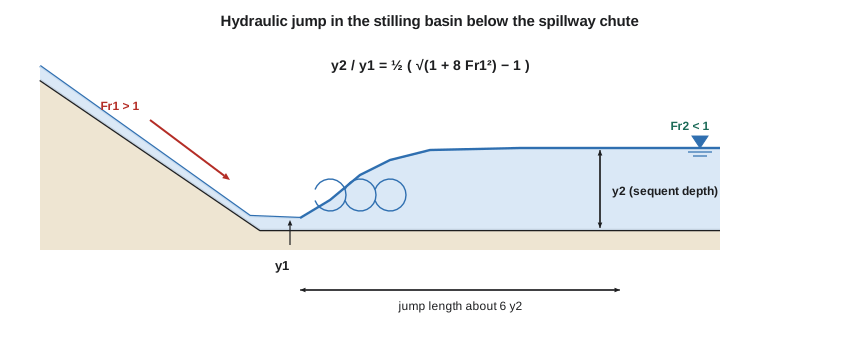
At a hydraulic jump, the depth rises suddenly from a supercritical depth \(y_1\) to a subcritical depth \(y_2\) over a short distance. The surface rolls back on itself, entraining air, and the flow below is intensely turbulent. Large eddies convert mean kinetic energy into turbulence and, ultimately, heat. Because the energy loss in the jump is unknown in advance, the energy equation cannot be used to find \(y_2\). The momentum equation can, because over the short length of a jump the friction force on the bed is small compared with the hydrostatic forces at each end.
The momentum equation and the Bélanger equation
For a horizontal rectangular channel, the momentum equation between the sections before and after the jump, per unit width, is
Substituting \(V = q/y\) and dividing through gives a quadratic in \(y_2/y_1\) whose positive root is the Bélanger equation, first published by Jean-Baptiste Bélanger in 1828:
The two depths are called sequent (or conjugate) depths. They have the same specific force, the quantity introduced at the end of lesson 2. The same equation works in reverse, with \(Fr_2\) in place of \(Fr_1\), to find the upstream depth from a known downstream depth. For non-rectangular channels, the specific force \(Q^2/(gA) + \bar{z}A\) is equated at the two sections and solved numerically.
The head loss in the jump follows from the energy equation once both depths are known. For a rectangular channel it reduces to a neat expression:
Types of jump
The character of a jump depends almost entirely on the upstream Froude number. Studies by the US Bureau of Reclamation in the 1950s classified jumps as follows.
| Fr₁ | Type | Behavior |
|---|---|---|
| 1.0 to 1.7 | Undular | A train of standing waves; little energy loss |
| 1.7 to 2.5 | Weak | Small rollers; smooth surface downstream; loss under 20 % |
| 2.5 to 4.5 | Oscillating | An unstable jet oscillates between bed and surface, sending waves far downstream |
| 4.5 to 9 | Steady | A stable, well-balanced jump; loss of 45 to 70 %; the best range for basins |
| Above 9 | Strong | A rough, violent jump with high efficiency but severe surface waves |
The oscillating range is the most troublesome. Its waves travel downstream and erode banks, and they are hard to damp. Designers avoid it by changing the basin floor level or the width, or by using special basins with baffles. The steady range gives the most reliable performance.
The length of a jump on a horizontal floor, from the toe to the end of the roller, is about six times the sequent depth for Froude numbers above about 4.5. Downstream of the roller, the flow remains turbulent for some distance, and the channel must be protected beyond the end of the basin, typically with riprap.
Tailwater and the position of the jump
A jump forms where the depth of the incoming supercritical flow and the tailwater depth in the receiving channel are sequent. In a basin, the supercritical depth at the toe of the chute is fixed by the spillway, so the Bélanger equation gives the required sequent depth \(y_2\). The actual tailwater depth \(y_t\) is set by the channel downstream, usually its normal depth or a backwater from a lower control. Three cases are possible.
- If \(y_t = y_2\), the jump forms at the toe of the chute, the ideal position.
- If \(y_t < y_2\), the tailwater cannot hold the jump. It is swept downstream, and the supercritical flow travels along the channel, gaining depth in an M3 profile, until its sequent depth falls to match the tailwater. The jump may then form well beyond the basin, on an unprotected channel, with serious scour.
- If \(y_t > y_2\), the jump is pushed upstream onto the chute and becomes drowned or submerged. A drowned jump is stable but dissipates less energy, and a high-velocity jet can persist along the floor beneath the surface roller.
The usual design approach is to set the basin floor low enough that the tailwater exceeds the sequent depth by a margin, often about 10 %, at all flows. Lowering the floor increases the available tailwater and slightly increases the incoming velocity, so the calculation is repeated until it closes.
Stilling basins
A stilling basin is a short, paved channel designed to contain the jump. The simplest is a horizontal apron long enough to hold the full jump length with an end sill to stabilize it. Standard basins add chute blocks at the entrance, baffle blocks on the floor and a dentated end sill, which together shorten the jump and make it less sensitive to tailwater. The US Bureau of Reclamation basins, numbered by type, and the St. Anthony Falls basin, developed at the University of Minnesota for small structures, are the most widely used families. Agency design manuals give their proportions as functions of the Froude number and the sequent depth.
Not every outlet needs a jump. At the outlet of a small pipe or culvert, energy is often dissipated by an impact basin, in which the jet strikes a vertical baffle, or by a riprap apron sized for the outlet velocity. Lesson 12 returns to outlets at the creek crossing.
The pond's emergency spillway
The stormwater pond designed in lessons 6 and 10 has an emergency spillway in its berm, a broad crest 20 ft wide at a stage of 6.25 ft. Its purpose is to pass the full inflow safely if the outlet structure is blocked by ice or debris during a major storm. Below the crest, a concrete chute 10 ft wide drops 8 ft down the berm to a basin beside the creek. Anika asks Owen to design the basin for a flow of 64 cfs, the 100-year peak inflow to the pond.
Worked problem
Sequent depth at the toe of the spillway chute
The unit discharge is \(q = 64/10 = 6.4\) ft²/s. With about 10 % of the energy lost on the chute, the flow at the toe has a depth of 0.275 ft. Find the velocity, the Froude number, the sequent depth, the head loss and the length of the jump.
Show solution
- Incoming flow:
- \[V_1 = \frac{6.4}{0.275} = 23.2\ \text{ft/s} \qquad Fr_1 = \frac{23.2}{\sqrt{32.2 \times 0.275}} = 7.8\]
- Sequent depth:
- \[y_2 = \frac{0.275}{2}\Big(\sqrt{1 + 8(7.8)^2} - 1\Big) = 2.91\ \text{ft}\]
- Head loss and jump length:
- \[\Delta E = \frac{(2.91 - 0.275)^3}{4(0.275)(2.91)} = 5.7\ \text{ft} \qquad L_j \approx 6 y_2 = 17\ \text{ft}\]
Answer: The jump is in the steady range and would dissipate about two-thirds of the energy at the toe. It needs a tailwater of about the sequent depth to stay in place.
Sofia's script computes the toe conditions from the energy available, the sequent depth and loss, classifies the jump, tests three tailwater depths and estimates how far the basin floor must be lowered to hold the jump when the creek is low.
# Hydraulic jump at the toe of the pond's emergency spillway chute
from math import sqrt
UNITS = "US"
SI = UNITS == "SI"
g = 9.81 if SI else 32.2
L = "m" if SI else "ft"
Q, bw, drop = (1.8, 3.0, 2.4) if SI else (64.0, 10.0, 8.0)   # flow, chute width, fall from crest to basin floor
q = Q / bw
yc = (q * q / g) ** (1 / 3)
E0 = drop + 1.5 * yc                    # energy above the basin floor at the crest (critical flow on the crest)
E1 = 0.9 * E0                           # allow about 10 % loss on the chute
lo, hi = 1e-4, yc                       # supercritical depth with y + q^2/(2 g y^2) = E1
for _ in range(100):
    m = (lo + hi) / 2
    if m + q * q / (2 * g * m * m) > E1: lo = m
    else: hi = m
y1 = m; V1 = q / y1; F1 = V1 / sqrt(g * y1)
y2 = y1 / 2 * (sqrt(1 + 8 * F1 ** 2) - 1)      # Belanger equation
dE = (y2 - y1) ** 3 / (4 * y1 * y2)
print(f"q = {q:.3f} {'m2/s' if SI else 'ft2/s'}, yc = {yc:.3f} {L}")
print(f"Toe of chute: y1 = {y1:.3f} {L}, V1 = {V1:.2f} {L}/s, Fr1 = {F1:.2f}")
print(f"Sequent depth y2 = {y2:.3f} {L}; head loss {dE:.3f} {L} ({dE / E1 * 100:.0f} % of the energy)")
kind = ("undular" if F1 < 1.7 else "weak" if F1 < 2.5 else "oscillating" if F1 < 4.5 else "steady" if F1 < 9 else "strong")
print(f"Jump type: {kind}; length about 6 y2 = {6 * y2:.2f} {L}")
for tw in ((0.30, 0.60, 0.90) if SI else (1.0, 2.0, 3.0)):
    state = "jump swept downstream" if tw < 0.95 * y2 else ("jump at the toe" if tw < 1.1 * y2 else "drowned jump")
    print(f"  tailwater {tw:.2f} {L}: {state}")
# lowering the basin floor so the jump forms at the toe with a 10 % margin
tw_low = 0.30 if SI else 1.0
print(f"With low creek tailwater {tw_low} {L}, sink the basin floor about {1.1 * y2 - tw_low:.2f} {L} below the creek bed")q = 6.400 ft2/s, yc = 1.084 ft Toe of chute: y1 = 0.275 ft, V1 = 23.24 ft/s, Fr1 = 7.80 Sequent depth y2 = 2.905 ft; head loss 5.682 ft (66 % of the energy) Jump type: steady; length about 6 y2 = 17.43 ft tailwater 1.00 ft: jump swept downstream tailwater 2.00 ft: jump swept downstream tailwater 3.00 ft: jump at the toe With low creek tailwater 1.0 ft, sink the basin floor about 2.20 ft below the creek bed
Reading the results
The jump is steady, with a Froude number of 7.8, and dissipates 66 % of the energy, 5.7 ft of head. The critical question is the tailwater. The emergency spillway operates during a major storm, when the creek itself is high, but it could also operate if the outlet freezes during a spring rain-on-snow event while the creek is still low. With a creek depth of only 1 ft, the jump would be swept downstream into the creek. With 3 ft it would form at the toe. To be safe in both cases, Owen sinks the basin floor about 2.2 ft below the creek bed, so that even the low tailwater exceeds the sequent depth by about 10 %, and adds an end sill and riprap beyond it. A short St. Anthony Falls basin with chute blocks and baffles would allow a shorter apron than the 17 ft of a plain floor; Anika asks him to compare the two on cost.
Lowering the floor changes the drop and therefore the toe velocity slightly, so the final design repeats the calculation with the new floor level. Dr. Kowalczyk also reminds the team that the basin sits on the sand over the varved clay of CIV-340, and that uplift under an empty basin from the high groundwater must be checked, exactly as it was for the pump station in CIV-341.
Jumps elsewhere
Hydraulic jumps appear wherever supercritical flow meets subcritical flow: below sluice gates, at the outlets of steep culverts and storm sewers, at the foot of road gutters on steep streets, and in mixing basins at water treatment plants, where the intense turbulence of a jump is used to disperse coagulant chemicals rapidly. CIV-380 returns to that application. In each case the same Bélanger equation gives the sequent depth.
Practical points
- Use momentum, not energy, across a jump; then compute the energy loss.
- Design for a steady jump; avoid Froude numbers between 2.5 and 4.5 or use a basin designed for them.
- Check the tailwater at the full range of flows and creek levels, not only the design flood.
- Set the basin floor so the tailwater exceeds the sequent depth with a margin.
- Protect the channel downstream of the basin, and check uplift and frost on the basin slab.
Common mistakes
MistakeApplying the energy equation across a jump with no loss term.
InsteadUse the Bélanger equation (momentum), then find the loss.
MistakeChecking tailwater only at the design flood.
InsteadA jump can be swept out at lower flows when the tailwater is low.
MistakeEnding the riprap at the end of the jump roller.
InsteadTurbulence persists downstream; extend the protection.
MistakeUsing the Bélanger equation for a trapezoidal channel.
InsteadIt applies to rectangles; equate the specific force for other shapes.
Summary and key terms
- A hydraulic jump is an abrupt transition from supercritical to subcritical flow.
- Bélanger: \(y_2/y_1 = \tfrac12(\sqrt{1 + 8Fr_1^2} - 1)\); loss \((y_2 - y_1)^3/(4y_1y_2)\).
- Jumps are classified by \(Fr_1\); the steady range 4.5 to 9 suits stilling basins.
- The jump forms where the tailwater equals the sequent depth; low tailwater sweeps it downstream.
- Stilling basins hold the jump with a sunken floor, blocks and an end sill.
- Spillway basin: \(Fr_1 = 7.8\), \(y_2 = 2.91\) ft, loss 5.7 ft; floor lowered about 2.2 ft below the creek bed.
- Hydraulic jump
- An abrupt rise in depth where supercritical flow becomes subcritical, with a large energy loss.
- Sequent depths
- The depths before and after a hydraulic jump, which have equal specific force.
- Bélanger equation
- The momentum relation between the sequent depths of a jump in a rectangular channel.
- Stilling basin
- A paved structure that contains a hydraulic jump to dissipate energy.
- Tailwater
- The depth of flow in the channel downstream of a structure.
- Drowned jump
- A jump pushed upstream by tailwater higher than the sequent depth.
- End sill
- A low wall at the end of a stilling basin that helps hold the jump in place.
Practice problems
Work each problem on paper first, then reveal the answer to check.
Water flows at 1.0 ft depth and 20 ft/s in a rectangular channel. Find the sequent depth and the head loss.
Show answer
\(Fr_1 = 3.52\), \(y_2 = 4.51\) ft, \(\Delta E = 2.4\) ft.
What type of jump is that, and what problem might it cause?
Show answer
An oscillating jump; its waves can travel downstream and erode the banks.
A basin needs a sequent depth of 4 ft, but the channel downstream flows only 3 ft deep. What happens, and how can the basin be fixed?
Show answer
The jump is swept downstream; lower the basin floor by about 1.4 ft (to give about 10 % margin) or add blocks and a sill.
Why is the momentum equation, not the energy equation, used to find the sequent depth?
Show answer
The energy loss in the jump is unknown, while the forces over the short jump length are known.
Lesson quiz · 5 questions
Score 60% or more to complete this lesson.
Create a free account to save your progress, take quizzes and earn a certificate.