
CIV-370 · Lesson 1 of 12 · 22 min
Open-channel flow: classification and basic principles
Water that flows with a free surface open to the atmosphere is in open-channel flow. Rivers, creeks, roadside ditches, irrigation canals, storm sewers flowing part full and the spillways of dams all behave this way. Your fluid mechanics course dealt mostly with pipes, where the fluid fills the conduit and the pressure can take any value. In an open channel the pressure at the surface is atmospheric, the depth is free to change, and gravity, not a pump, drives the flow. The depth itself becomes one of the unknowns, and that makes open-channel hydraulics both richer and more practical than pipe flow.
This course has two halves. Lessons 1 to 6 cover hydraulics: how water moves in channels and through the structures that control it. Lessons 7 to 11 cover hydrology: how rain becomes runoff, how large a flood should be designed for, and how floods change as they move through ponds and streams. Lesson 12 brings both halves together in a design check.
The Kestrel Bay drainage study
The running case continues the Kestrel Bay operations center on the Lake Superior shore near Duluth, the project you followed through structural design and through CIV-340 and CIV-341. The geotechnical work is done; the drainage design now moves to the front. Anika Rao, P.E., the water resources engineer on the team, leads the study. Owen Lachance, EI, carries out the calculations, and Sofia Martel, the co-op student, writes the Python scripts that check them. Dr. Lena Kowalczyk joins when the drainage work touches the foundations, as it does at the pump station and the pond berm.
Three questions drive the study. First, Kestrel Creek crosses the access road through an old concrete box culvert about 3,940 ft upstream of its mouth: will that culvert pass the design flood without overtopping the road, which is the only route in and out of the center for snowplows and emergency vehicles? Second, the new buildings and yard will turn 18.5 acres of grass and bush into roofs and pavement: how much more runoff will that create, and how large must the ditches and the stormwater pond be to hold the peak flow leaving the site to its value before development? Third, the creek mouth and the pond outfall sit beside Lake Superior: how far up the creek does a high lake level raise the water surface?
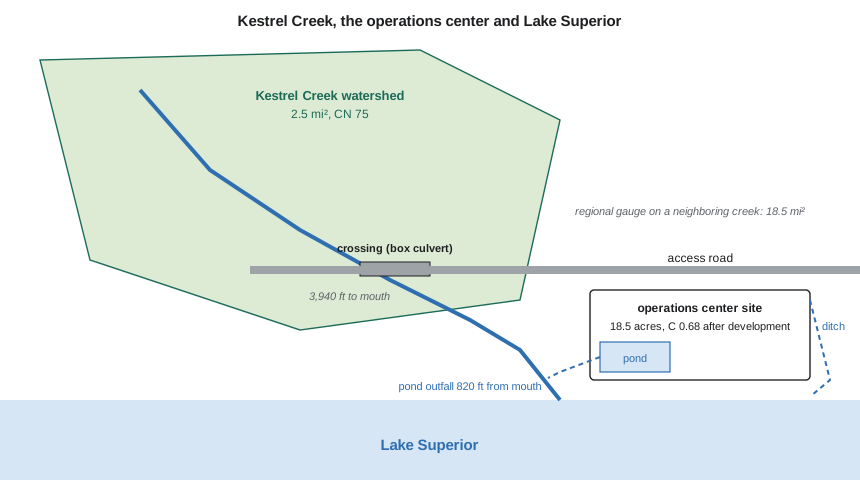
The approvals frame the work. The City of Duluth sets the site's stormwater requirements, the Minnesota Stormwater Manual published by the Minnesota Pollution Control Agency gives the methods and design criteria most reviewers expect, and the Flood Insurance Rate Map published by FEMA shows the regulated floodplain of the creek and the lakeshore. Because the crossing is on a public road, its design follows the drainage guidance of the road authority. Anika keeps a list of these documents on the first page of the design basis, because each one specifies return periods, rainfall data and allowable flows.
Classifying open-channel flow
Engineers classify open-channel flow in three ways: by how it changes with time, by how it changes along the channel and by its regime.
Steady flow does not change with time at a given point; unsteady flow does. A flood wave passing down the creek is unsteady, but over the few minutes it takes water to pass the culvert, the flow can be treated as steady at the peak discharge. Most design calculations in this course assume steady flow at a design discharge. Lesson 10 deals with unsteady flow through routing.
Uniform flow has the same depth, velocity and cross section along the channel: the water surface, the energy grade line and the channel bed are all parallel. It occurs only in long, straight, prismatic channels well away from any control, and is the subject of lesson 3. Varied flow changes depth along the channel. If the change is gradual over long distances, as upstream of a dam or a lake, the flow is gradually varied (lesson 4). If the depth changes abruptly over a short distance, as in a hydraulic jump or at a weir, the flow is rapidly varied (lessons 5 and 6).
The regime of the flow is set by two dimensionless numbers: the Reynolds number, which tells whether the flow is laminar or turbulent, and the Froude number, which tells whether it is subcritical or supercritical. The Froude number is far more important in open-channel hydraulics, because it determines how disturbances travel and where the flow is controlled.
Section geometry
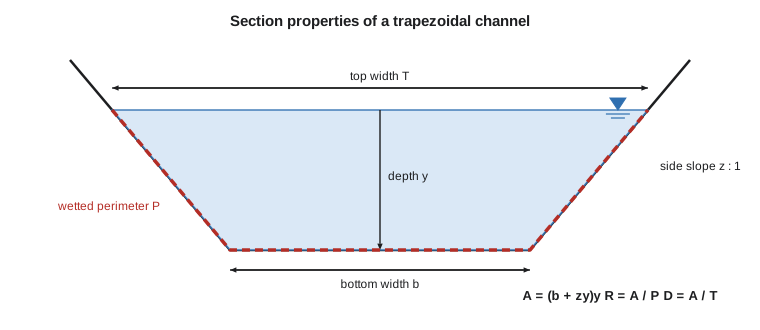
Because the depth is free to change, every quantity that describes the flow area changes with it. For any cross section the following properties are used constantly:
- The flow area \(A\), the area of the cross section below the water surface.
- The wetted perimeter \(P\), the length of the channel boundary in contact with the water. The free surface is not part of it, because air exerts negligible shear.
- The hydraulic radius \(R = A/P\), the ratio that measures how much area each meter of boundary must drag along. Friction formulas use it.
- The top width \(T\), the width of the free surface.
- The hydraulic depth \(D = A/T\), the mean depth of the section. The Froude number uses it.
For a trapezoidal channel with bottom width \(b\) and side slopes of \(z\) horizontal to 1 vertical, which approximates most natural creeks and many excavated ditches,
A rectangle is the special case \(z = 0\), and a triangle the case \(b = 0\). For a wide, shallow channel, the hydraulic radius and the hydraulic depth are both nearly equal to the depth \(y\), a simplification used often in rough calculations.
Continuity and energy
Two principles from fluid mechanics carry over directly. The continuity equation for steady flow of an incompressible fluid says that the discharge is the same at every section between inflows and outflows:
where \(V\) is the mean velocity over the section. The energy equation, written per unit weight of water, says that the total head at a section is the sum of the elevation of the channel bed \(z\), the depth \(y\), which is the pressure head at the bed for hydrostatic pressure, and the velocity head:
Between an upstream section 1 and a downstream section 2, \(H_1 = H_2 + h_L\), where \(h_L\) is the head lost to friction and turbulence. The kinetic energy coefficient \(\alpha\) corrects for the uneven distribution of velocity across the section; it is about 1.05 to 1.15 in straight channels and higher in natural streams with overbank flow, but it is usually taken as 1 in design calculations, as it will be in this course.
The assumption that pressure is hydrostatic, increasing linearly with depth below the surface, holds whenever the streamlines are nearly straight and parallel. It fails where the streamlines curve sharply, such as over the crest of a weir or at the brink of a free overfall, and those places need special treatment.
Laminar or turbulent?
For open channels, the Reynolds number is defined with the hydraulic radius as the length scale:
where \(\nu\) is the kinematic viscosity of water, about 1.41 × 10⁻⁵ ft²/s at 50 °F. Flow is laminar below about 500 and fully turbulent above about 2,000 to 12,500, depending on the roughness. Because the length scale is the hydraulic radius rather than the diameter, these limits are about a quarter of the familiar pipe values. Almost all flows of engineering interest in creeks and ditches are fully turbulent; the exceptions are thin sheets of water running off pavements and roofs at the very start of a storm, which is why lesson 9 treats sheet flow with its own formula.
The Froude number and critical flow
The Froude number compares the mean velocity of the flow with the speed at which a small surface wave travels in still water of the same hydraulic depth:
A small disturbance on the surface of still water, such as a pebble dropped into a pond, travels outward at the wave celerity \(c = \sqrt{gD}\). In moving water, the wave travels at \(V + c\) downstream and \(V - c\) upstream. When the flow is slower than the wave celerity, \(Fr < 1\), waves can travel upstream, and conditions downstream can influence the flow upstream. This is subcritical flow: deep, slow and tranquil, typical of most creeks and rivers. When the flow is faster than the wave celerity, \(Fr > 1\), no disturbance can travel upstream, and the flow is controlled entirely from upstream. This is supercritical flow: shallow, fast and rapid, typical of steep chutes, spillways and the outlets of some culverts. At \(Fr = 1\) the flow is critical, and lesson 2 shows that this state has special properties that engineers use for flow measurement and control.
The distinction matters in every calculation that follows. In subcritical flow, a calculation of the water surface starts at a downstream control, such as a lake level or a weir, and proceeds upstream. In supercritical flow, it starts at an upstream control, such as a sluice gate, and proceeds downstream. Getting the direction wrong gives answers that are not merely inaccurate but meaningless.
Classifying the creek flow
Worked problem
Regime of the spring flow in Kestrel Creek
Near the crossing, Kestrel Creek can be represented by a trapezoid with a bottom width of 10 ft and side slopes of 2H:1V. During a typical spring freshet it carries 210 cfs at a depth of 3.0 ft. Find the hydraulic radius, the velocity, the Reynolds number and the Froude number.
Show solution
- Section properties:
- \[A = (10 + 2 \times 3.0)(3.0) = 48.0\ \text{ft}^2 \qquad P = 10 + 2(3.0)\sqrt{5} = 23.4\ \text{ft}\]
- \[R = 48.0/23.4 = 2.05\ \text{ft} \qquad T = 10 + 4(3.0) = 22.0\ \text{ft} \qquad D = 2.18\ \text{ft}\]
- Velocity and dimensionless numbers:
- \[V = 210/48.0 = 4.38\ \text{ft/s} \qquad Re = \frac{4.38 \times 2.05}{1.41 \times 10^{-5}} = 6.4 \times 10^5\]
- \[Fr = \frac{4.38}{\sqrt{32.2 \times 2.18}} = 0.52\]
Answer: The flow is fully turbulent and subcritical, as expected in a creek of moderate slope. Disturbances, including the effect of the culvert and of the lake, can travel upstream.
Sofia's script repeats the calculation for a range of depths at the same discharge, to show how the regime changes, and compares the creek with a thin sheet of runoff on the paved yard.
# Open-channel flow at Kestrel Creek: geometry, velocity, Reynolds and Froude numbers
from math import sqrt
UNITS = "US"
if UNITS == "SI":
    g, nu = 9.81, 1.31e-6            # m/s2; kinematic viscosity of water at 10 C, m2/s
    b, z, L, Q, u = 3.0, 2.0, "m", 6.0, ("m", "m2", "m/s", "m3/s")
    depths = [0.3, 0.6, 0.9, 1.2, 1.5]
else:
    g, nu = 32.2, 1.41e-5            # ft/s2; ft2/s at 50 F
    b, z, L, Q, u = 10.0, 2.0, "ft", 210.0, ("ft", "ft2", "ft/s", "cfs")
    depths = [1.0, 2.0, 3.0, 4.0, 5.0]
def section(y):
    A = (b + z * y) * y              # flow area of a trapezoid
    P = b + 2 * y * sqrt(1 + z * z)  # wetted perimeter
    T = b + 2 * z * y                # top width
    return A, P, A / P, T, A / T     # area, perimeter, hydraulic radius, top width, hydraulic depth
print(f"Creek section: bottom width {b} {L}, side slopes {z}H:1V, flow {Q} {u[3]}")
print(f"{'y':>5} {'A':>7} {'R':>6} {'V':>6} {'Re':>9} {'Fr':>5}  regime")
for y in depths:
    A, P, R, T, D = section(y)
    V = Q / A
    Re = V * R / nu                  # Reynolds number based on hydraulic radius
    Fr = V / sqrt(g * D)             # Froude number based on hydraulic depth
    reg = "subcritical" if Fr < 1 else "supercritical"
    print(f"{y:5.2f} {A:7.2f} {R:6.3f} {V:6.2f} {Re:9.2e} {Fr:5.2f}  {reg}")
# a shallow sheet of runoff on the paved yard, for comparison
y_sheet = 0.005 if UNITS == "SI" else 0.016
V_sheet = 0.15 if UNITS == "SI" else 0.5
print(f"\nSheet flow on pavement, depth {y_sheet} {L}, velocity {V_sheet} {u[2]}: Re = {V_sheet * y_sheet / nu:.0f}")Creek section: bottom width 10.0 ft, side slopes 2.0H:1V, flow 210.0 cfs
y A R V Re Fr regime
1.00 12.00 0.829 17.50 1.03e+06 3.33 supercritical
2.00 28.00 1.478 7.50 7.86e+05 1.06 supercritical
3.00 48.00 2.050 4.38 6.36e+05 0.52 subcritical
4.00 72.00 2.582 2.92 5.34e+05 0.31 subcritical
5.00 100.00 3.090 2.10 4.60e+05 0.20 subcritical
Sheet flow on pavement, depth 0.016 ft, velocity 0.5 ft/s: Re = 567Reading the results
At the same discharge of 210 cfs, the flow could exist at a depth of 2.0 ft with a velocity of 7.5 ft/s and a Froude number of 1.06, which is supercritical, or at 3.0 ft with 4.4 ft/s and a Froude number of 0.52, which is subcritical. Which depth actually occurs depends on the slope and roughness of the channel and on the controls upstream and downstream, as the next three lessons explain. The Reynolds numbers are all several hundred thousand: the creek is fully turbulent at any depth. The sheet of runoff on the pavement, only about 0.2 in. deep, has a Reynolds number of about 570, in the laminar range, and its behavior is quite different.
Controls
A control is any feature that fixes a definite relation between depth and discharge at a section. Weirs, sluice gates, culvert entrances, abrupt drops, lakes and reservoirs are all controls. So is a long uniform reach, where friction fixes the depth for each discharge. Controls are where hydraulic calculations begin, and finding them is the first step in any open-channel problem. At Kestrel Bay, Anika marks three on the plan before any calculation is made: the lake at the creek mouth, the culvert entrance at the access road and the outlet structure of the pond. Each will be studied in turn.
Practical points
- Sketch the channel, mark the controls and decide whether the flow is subcritical or supercritical before calculating anything.
- Use the hydraulic radius for friction and the hydraulic depth for the Froude number.
- Treat the flow as steady at the design peak unless storage or routing matters.
- Check that pressure is hydrostatic; it is not over weir crests, at brinks or in sharp bends.
- Remember that natural channels are irregular: the trapezoid is an idealization that must be checked against surveyed sections.
Common mistakes
MistakeIncluding the free surface in the wetted perimeter.
InsteadOnly the boundary in contact with the water counts.
MistakeUsing the depth instead of the hydraulic depth in the Froude number of a trapezoid.
InsteadUse \(D = A/T\); for a wide channel the two are close, but not for a narrow trapezoid.
MistakeStarting a subcritical water surface calculation at an upstream section.
InsteadSubcritical flow is controlled from downstream; start there.
MistakeApplying pipe-flow Reynolds number limits to open channels.
InsteadWith \(R\) as the length scale, the limits are about a quarter of the pipe values.
Summary and key terms
- Open-channel flow has a free surface at atmospheric pressure, and the depth is one of the unknowns.
- Flow is steady or unsteady, uniform or varied (gradually or rapidly).
- Section properties: \(A\), \(P\), \(R = A/P\), \(T\) and \(D = A/T\).
- Continuity \(Q = VA\) and energy \(H = z + y + V^2/2g\) apply between sections.
- \(Re = VR/\nu\); creek and ditch flows are fully turbulent.
- \(Fr = V/\sqrt{gD}\): subcritical below 1 (controlled from downstream), supercritical above 1 (controlled from upstream).
- Controls fix the relation between depth and discharge and are the starting points of calculations.
- Open-channel flow
- Flow of a liquid with a free surface exposed to the atmosphere.
- Hydraulic radius
- The flow area divided by the wetted perimeter.
- Hydraulic depth
- The flow area divided by the top width; the mean depth of the section.
- Froude number
- The ratio of the mean velocity to the celerity of a small surface wave.
- Subcritical flow
- Flow with a Froude number below 1, in which surface waves can travel upstream.
- Supercritical flow
- Flow with a Froude number above 1, in which disturbances cannot travel upstream.
- Uniform flow
- Flow with constant depth and velocity along the channel.
- Control
- A section where a definite relation between depth and discharge is fixed.
Practice problems
Work each problem on paper first, then reveal the answer to check.
A rectangular channel 8 ft wide carries 140 cfs at a depth of 2.6 ft. Find \(R\) and \(Fr\).
Show answer
\(A = 20.8\) ft², \(P = 13.2\) ft, \(R = 1.58\) ft, \(V = 6.73\) ft/s, \(Fr = 0.74\).
A triangular roadside gutter with side slopes of 3H:1V carries water 0.5 ft deep. Find \(A\), \(P\) and \(R\).
Show answer
\(A = 3(0.5)^2 = 0.75\) ft², \(P = 2(0.5)\sqrt{10} = 3.16\) ft, \(R = 0.24\) ft.
A stone thrown into a stream creates ripples that move upstream as well as downstream. What does this tell you about the flow?
Show answer
The flow is subcritical: the wave celerity exceeds the velocity.
Why does the Reynolds number for open channels use the hydraulic radius rather than the depth?
Show answer
The hydraulic radius measures the area per unit of boundary that causes friction; with it, results from channels of different shapes, and from pipes with \(D = 4R\), can be compared.
Lesson quiz · 5 questions
Score 60% or more to complete this lesson.
Create a free account to save your progress, take quizzes and earn a certificate.