
CIV-321 · Lesson 1 of 12 · 23 min
Indeterminate structures and how to analyze them
In CIV-224 the Kestrel Bay Engineering team analyzed the determinate parts of a municipal operations center: simple trusses, three-hinged frames, cables, arches and simply supported girders. Those structures could be solved by equilibrium alone. Most of the rest of the building cannot. The office wing has continuous floor beams and rigid two-story frames, the garage portal frames have moment connections at the eaves, the wall bracing has more diagonals than it strictly needs, and the access road bridge is being considered as a two-span continuous girder. Every one of these is statically indeterminate. This course gives you the tools to analyze them: the force method, the slope-deflection and moment distribution methods, approximate methods for preliminary design, and the matrix stiffness method that sits inside every structural analysis program.
Priya Raman, the project engineer, has asked Owen Lachance (EIT/EI) to take on the indeterminate analysis this term, with Sofia Martel, the co-op student, writing Python checks for each method. Throughout the course we will return to the same structures so that you can see each method give the same answer, which is the best evidence that you have applied it correctly.
What makes a structure indeterminate
A plane structure has three independent equilibrium equations for the structure as a whole, and three for every free body you cut from it. A structure is statically determinate when equilibrium alone fixes every reaction and internal force. It is statically indeterminate when there are more unknown forces than independent equilibrium equations. The surplus is the degree of static indeterminacy, n, and each surplus force is called a redundant. The word does not mean the force is unnecessary; it means equilibrium would still be possible without it.
For beams and frames the count can be written as a formula. With m members, j joints, r reaction components and c internal releases (hinges count as one release each where two members meet), the degree of indeterminacy of a rigid-jointed plane frame is
For a plane truss, where every member carries axial force only and every joint has two equilibrium equations,
where b is the number of bars. A negative result means the structure is a mechanism and cannot carry general loads. A result of zero or more is necessary but not sufficient for stability: as CIV-224 showed, a structure can have enough members and supports and still be geometrically unstable, for example if all reactions are parallel or concurrent, or if a panel has no diagonal.
For continuous beams the frame formula reduces to a simple rule: the degree of indeterminacy equals the number of reaction components minus three. A beam continuous over four supports, with a pin and three rollers, has five reactions and is indeterminate to the second degree.
Worked problem
Counting redundants in the operations center
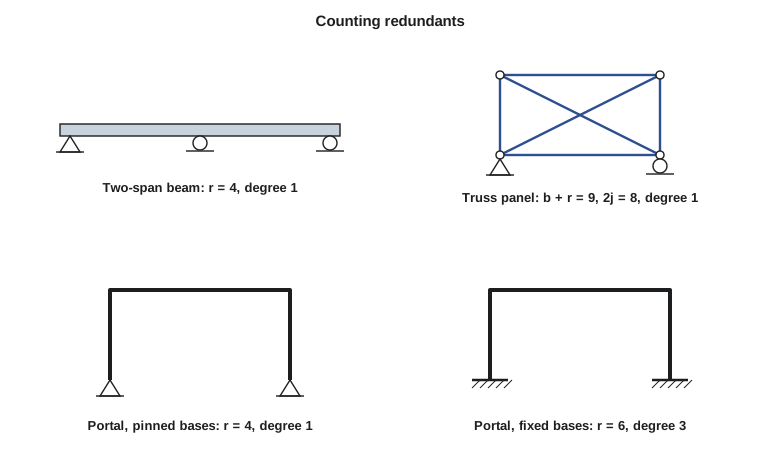
Find the degree of static indeterminacy of (a) a floor beam continuous over three supports (pin, roller, roller); (b) a garage portal frame with pinned bases; (c) the same portal with fixed bases; (d) the two-story, two-bay office frame with fixed bases; and (e) a 60 ft Pratt roof truss with 6 panels, 14 joints and 25 bars, to which the fabricator proposes adding crossed diagonals in both end panels.
Show solution
- (a) Reactions \(r = 2 + 1 + 1 = 4\), so \(n = 4 - 3 = 1\).
- (b) Three members, four joints, two pins: \(n = 3(3) + 4 - 3(4) = 1\).
- (c) Fixed bases give \(r = 6\): \(n = 9 + 6 - 12 = 3\).
- (d) Three column lines and three levels give \(j = 9\); six columns and four beams give \(m = 10\); three fixed bases give \(r = 9\):
- \[n = 3(10) + 9 - 3(9) = 12\]
- (e) The original truss: \(n = 25 + 3 - 2(14) = 0\), determinate. Two extra diagonals make \(b = 27\), so \(n = 2\).
Answer: The degrees are 1, 1, 3, 12 and 2. A dozen redundants in a modest two-story frame explains why building frames are analyzed by computer, and why hand methods that work with joint rotations rather than redundant forces were invented.
Static and kinematic indeterminacy
There is a second way to count. Instead of asking how many extra forces there are, ask how many independent joint displacements are needed to describe the deformed shape. This number is the degree of kinematic indeterminacy, or the number of degrees of freedom. A fixed end has none; a pin support in a beam has one (rotation); a free rigid joint in a plane frame has three (two translations and a rotation). If axial deformation of beams and columns is ignored, as is usual in hand analysis of frames, the translations are linked and the count drops sharply.
The two counts can be very different. The two-span beam above has one static redundant but three rotational degrees of freedom (at the pin, the middle roller and the end roller). The fixed-base office frame has twelve static redundants but, ignoring axial deformation, only eight kinematic unknowns: six joint rotations and one sway at each floor. A fixed-fixed beam is indeterminate to the second degree statically (for vertical loads) but has no free displacements at all, which is why its end moments can be tabulated once as fixed-end moments and reused.
| Structure | Static degree n | Kinematic degree (no axial deformation) |
|---|---|---|
| Propped cantilever | 1 | 1 (rotation at the prop) |
| Two-span beam, pin and two rollers | 1 | 3 (rotations) |
| Fixed-fixed beam | 3 (2 for vertical load) | 0 |
| Portal, pinned bases | 1 | 5 (2 base rotations, 2 knee rotations, 1 sway) |
| Portal, fixed bases | 3 | 3 (2 knee rotations, 1 sway) |
| Two-story, two-bay frame, fixed bases | 12 | 8 (6 rotations, 2 sways) |
Two families of methods
Every exact method of analyzing indeterminate structures uses the same three ingredients: equilibrium, compatibility (the deformed members fit together and respect the supports) and the force-displacement relations of the members (for linear elastic members, Hooke's law expressed through \(EI\), \(EA\) and length). The methods differ in which quantities they choose as the unknowns.
- Force methods take redundant forces as the unknowns. You release the redundants to obtain a determinate primary structure, compute its deflections with the virtual work and moment-area tools of CIV-224, and write one compatibility equation per redundant. The force method is natural when n is small, and it remains the clearest way to see why settlement and temperature cause forces.
- Displacement methods take joint displacements as the unknowns. You lock every joint, compute fixed-end forces in each member, then release the joints by amounts that restore equilibrium. Slope-deflection, moment distribution and the matrix stiffness method all belong to this family. Because the procedure is the same for every structure, it is the basis of all general-purpose structural software.
Lessons 2 to 4 develop the force method; lessons 5 to 7 the classical displacement methods; lesson 8 approximate methods and influence lines; and lessons 9 to 12 the matrix stiffness method and how to use and check analysis software.
Why engineers choose indeterminate structures
Continuity and redundancy pay for their extra analysis effort. A continuous beam is stiffer and usually lighter than a series of simple spans: under uniform load on all spans, the end-span moments drop to about 80 percent of the simple-span value and the interior spans to about 20 percent, while deflections fall even more. Rigid frames resist lateral load without bracing, which keeps the garage doors and office windows clear. And redundant structures have alternative load paths. If a column is struck by a snowplough or a diagonal is damaged by corrosion, an indeterminate structure can often redistribute the load instead of collapsing. Building codes increasingly ask designers to think about this property, called robustness or structural integrity.
Indeterminacy also has costs that a designer must manage. Internal forces depend on relative stiffness, so changing a member size changes the forces everywhere and the analysis must be repeated. Support settlement, temperature change, creep, shrinkage and fabrication misfit all cause stresses in indeterminate structures but not in determinate ones. That is why the salt shed, with its heavy, corrosive loads on uncertain fill, uses three-hinged frames, while the office wing on bedrock uses continuous construction.
A review: the propped cantilever
CIV-224 ended with the force method applied to the simplest indeterminate beam. It is worth repeating, because every method in this course will be checked against it.
Worked problem
Propped cantilever under uniform load
A canopy beam of span 20 ft is fixed to a column at A and rests on a roller at B. It carries a factored uniform load of 0.8 kip/ft. Find the prop reaction and the fixed-end moment.
Show solution
- Release the roller reaction \(R_B\). The primary structure is a cantilever.
- Tip deflection due to the load: \(\Delta_{B0} = wL^4/(8EI)\), downward. Tip deflection due to a unit upward force: \(f_{BB} = L^3/(3EI)\).
- Compatibility: \(R_B L^3/(3EI) = wL^4/(8EI)\), so \(R_B = 3wL/8\).
- \[R_B = \frac{3(0.8)(20)}{8} = 6.0\ \text{kips} \qquad M_A = \frac{wL^2}{8} = \frac{0.8(20)^2}{8} = 40\ \text{kip·ft (hogging)}\]
Answer: The prop carries 6.0 kips and the fixed end 10.0 kips with a hogging moment of 40 kip·ft. Here \(EI\) canceled: for a single member with constant \(EI\), the forces do not depend on the member size, only on the geometry and loads.
When members of different stiffness meet, \(EI\) no longer cancels. Making one span of a continuous beam deeper attracts moment to it, just as a stiffer spring attracts load in a parallel system. This is the central idea of indeterminate behavior: load follows stiffness.
Checking the count with code
Sofia wrote a short program that applies both counting formulas to the structures in this lesson, so that the team can check a new layout before analyzing it. It also flags results that indicate a mechanism.
# Degree of static indeterminacy for plane frames and trusses
def frame_degree(m, j, r, c=0):
    return 3 * m + r - 3 * j - c

def truss_degree(b, j, r):
    return b + r - 2 * j

cases = [
    ("two-span beam (pin, roller, roller)", frame_degree(2, 3, 4)),
    ("portal, pinned bases",                frame_degree(3, 4, 4)),
    ("portal, fixed bases",                 frame_degree(3, 4, 6)),
    ("three-hinged portal",                 frame_degree(4, 5, 4, c=1)),
    ("office frame, 2 levels x 2 bays",      frame_degree(10, 9, 9)),
    ("Pratt truss, 6 panels",               truss_degree(25, 14, 3)),
    ("Pratt truss + 2 extra diagonals",     truss_degree(27, 14, 3)),
    ("square panel, both diagonals",        truss_degree(6, 4, 3)),
    ("square panel, no diagonal",           truss_degree(4, 4, 3)),
]
for name, n in cases:
    status = "mechanism" if n < 0 else ("determinate" if n == 0 else f"indeterminate to degree {n}")
print(f"{name:38s} n = {n:3d} {status}")two-span beam (pin, roller, roller) n = 1 indeterminate to degree 1 portal, pinned bases n = 1 indeterminate to degree 1 portal, fixed bases n = 3 indeterminate to degree 3 three-hinged portal n = 0 determinate office frame, 2 levels x 2 bays n = 12 indeterminate to degree 12 Pratt truss, 6 panels n = 0 determinate Pratt truss + 2 extra diagonals n = 2 indeterminate to degree 2 square panel, both diagonals n = 1 indeterminate to degree 1 square panel, no diagonal n = -1 mechanism
The three-hinged portal is modeled as four members (the rafter split at the crown hinge) with one internal release, and comes out determinate, as CIV-224 found. The square panel without a diagonal comes out as a mechanism. Remember that a count of zero or more is only a necessary condition; the program cannot detect geometric instability such as a row of parallel rollers.
Common mistakes
MistakeTreating a redundant as an unnecessary member that can be removed in the field.
InsteadRedundants carry real load; removing one changes every other force and may overload members designed with it in place.
MistakeCounting a fixed base as two reactions.
InsteadA fixed support in a plane frame provides two forces and a moment: three reactions.
MistakeConcluding that a structure is stable because \(n \ge 0\).
InsteadCheck the arrangement of supports and members for geometric instability as well.
MistakeAssuming the force distribution in an indeterminate structure is independent of member sizes.
InsteadIt depends on relative stiffness; change the sizes and the forces change.
Summary and key terms
- A structure is indeterminate when it has more unknown forces than independent equilibrium equations; the surplus forces are redundants.
- Plane frames: \(n = 3m + r - 3j - c\). Plane trusses: \(n = b + r - 2j\). Continuous beams: reactions minus three.
- Kinematic indeterminacy counts the unknown joint displacements; it is usually smaller than n for frames when axial deformation is ignored.
- Force methods solve for redundant forces from compatibility; displacement methods solve for joint displacements from equilibrium.
- Indeterminate structures are stiffer and more robust, but are sensitive to settlement, temperature and misfit, and their forces depend on relative stiffness.
- Statically indeterminate
- Having more unknown forces than independent equilibrium equations.
- Redundant
- A reaction or internal force in excess of those needed for equilibrium.
- Degree of indeterminacy
- The number of redundants.
- Kinematic indeterminacy
- The number of independent joint displacements needed to describe the deformed shape.
- Compatibility
- The condition that deformed members fit together and respect the supports.
- Force method
- An analysis method with redundant forces as unknowns.
- Displacement method
- An analysis method with joint displacements as unknowns.
- Robustness
- The ability to withstand local damage without disproportionate collapse.
Practice problems
Work each problem on paper first, then reveal the answer to check.
A beam is fixed at one end and continuous over three rollers. What is its degree of indeterminacy?
Show answer
\(r = 3 + 3 = 6\), so \(n = 3\).
A single-story, three-bay frame has four columns with pinned bases. Find n.
Show answer
\(m = 7\), \(j = 8\), \(r = 8\): \(n = 21 + 8 - 24 = 5\).
A truss has 9 joints, 16 bars and a pin and a roller. Is it determinate?
Show answer
\(n = 16 + 3 - 18 = 1\): indeterminate to the first degree, if it is stable.
How many kinematic unknowns does a fixed-base portal frame have if axial deformations are ignored?
Show answer
Three: the two knee rotations and one sway.
Why does \(EI\) cancel in the propped cantilever?
Show answer
Both the load deflection and the flexibility coefficient are divided by the same \(EI\), so their ratio, the redundant, does not depend on it.
Give two effects that cause forces in an indeterminate structure but not in a determinate one.
Show answer
Support settlement and temperature change (also shrinkage, creep and fabrication misfit).
Lesson quiz · 5 questions
Score 60% or more to complete this lesson.
Create a free account to save your progress, take quizzes and earn a certificate.