
CIV-230 · Lesson 9 of 12 · 21 min
Asphalt binders and performance grading
Asphalt binder (called asphalt cement in Canada and often simply asphalt or bitumen elsewhere) is the black, sticky glue that holds the aggregate of an asphalt pavement together. Although it is only about 5 to 6 percent of the mix by mass, it controls how the pavement behaves across the whole range of temperatures and loading times it will see: whether it ruts on a hot summer afternoon under slow trucks, cracks on a January night at minus 35, or becomes brittle and ravels after years of oxidation. Selecting the right binder for the climate and traffic is one of the most important decisions in pavement engineering.
For the interchange approaches and ramps, the state specification calls for a performance-graded binder suited to Fargo's hot summers and very cold winters, with a polymer-modified grade on the ramps where slow, heavy trucks brake and turn. Tamarack samples binder from the contractor's supply tanks and sends it to an accredited binder laboratory for verification testing.
What asphalt binder is
Almost all paving binder comes from refining crude oil: it is the heaviest fraction left after the lighter fuels are distilled off, sometimes further processed by air blowing or blending. Natural asphalt deposits, such as lake asphalt and rock asphalt, are used only in small amounts. Chemically, binder is a complex mixture of hydrocarbons with small amounts of sulfur, nitrogen, oxygen and metals. It is often described by its fractions: asphaltenes, large polar molecules that give stiffness, dispersed in maltenes (resins, aromatics and saturates) that give fluidity. The balance of these fractions, which depends on the crude source and the refining, controls how the binder behaves.
Binder is a thermoplastic, viscoelastic material. Heated to around 150 °C (300 °F) it is a liquid that can coat aggregate and be pumped; at summer pavement temperatures it is a soft viscoelastic solid; in deep winter it is stiff, nearly elastic and can crack. Its response also depends on loading time: a fast-moving truck tire loads the pavement for a small fraction of a second, a parked or slow truck for much longer. High temperature and long loading time have a similar softening effect, and low temperature and short loading time a similar stiffening effect. This time–temperature equivalence is the basis of how binders are tested.
Aging
Binder hardens over time, mainly by oxidation and loss of light fractions. The largest single change happens in a few minutes during hot mixing and placing, when thin films of hot binder are exposed to air; this is short-term aging. Long-term aging continues slowly over years in service, fastest at the surface and in hot, sunny climates. Aged binder is stiffer and more brittle, which increases the risk of cracking and ravelling. Binder tests therefore examine the binder in three states: unaged (as supplied), after simulated short-term aging in the rolling thin-film oven (RTFO), and after simulated long-term aging in the pressure aging vessel (PAV).
Older grading systems
Before the 1990s, US binders were graded mainly by viscosity at 60 °C (140 °F) into AC grades such as AC-10 and AC-20, or by penetration: the depth, in tenths of a millimeter, that a standard needle penetrates the binder at 25 °C (77 °F) in five seconds. Both measure properties at only one or two temperatures, so two binders with the same grade could behave very differently in cold weather. Viscosity and penetration grades still appear in older records and some specifications for surface treatments.
Superpave performance grading
The performance grading (PG) system, developed in the Strategic Highway Research Program of the early 1990s and published as AASHTO M 320, grades binders by the range of pavement temperatures over which they perform. A grade such as PG 58-28 means the binder has adequate stiffness to resist rutting at a high pavement design temperature of 58 °C and adequate flexibility to resist thermal cracking at a low pavement design temperature of −28 °C. Grades step in 6 °C increments: high temperatures of 46, 52, 58, 64, 70, 76 and 82, and low temperatures of −10, −16, −22, −28, −34, −40 and −46.
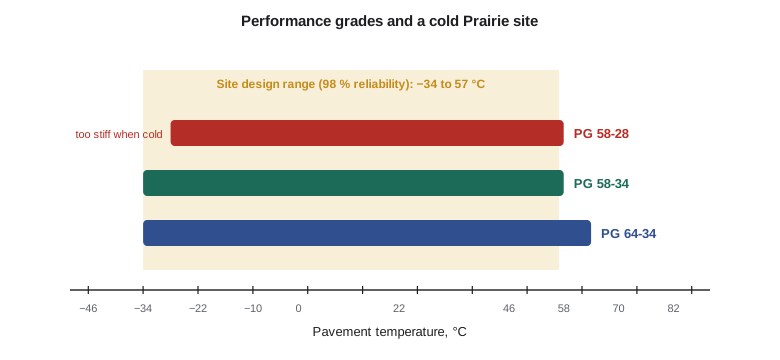
The tests in the PG system address the three main binder-related distresses:
- Rutting (permanent deformation) at high temperatures: the dynamic shear rheometer (DSR) oscillates a thin binder disc between parallel plates and measures the complex shear modulus \(G^*\) and phase angle \(\delta\). The rutting parameter \(G^*/\sin\delta\) must be at least 1.00 kPa for unaged binder and 2.20 kPa after RTFO aging at the high grade temperature.
- Fatigue cracking at intermediate temperatures: the DSR is run on PAV-aged binder, and \(G^*\sin\delta\) must not exceed 5000 kPa at a specified intermediate temperature.
- Thermal cracking at low temperatures: the bending beam rheometer (BBR) loads a small beam of PAV-aged binder at a temperature 10 °C above the low grade and measures its creep stiffness \(S\) and the slope \(m\) of the stiffness curve at 60 seconds. \(S\) must not exceed 300 MPa and \(m\) must be at least 0.300. The 10 °C shift uses time–temperature equivalence to shorten the test. A direct tension test is used when stiffness is slightly high but the binder is still ductile.
A low phase angle means the binder responds more elastically and recovers more of its deformation, which is good for rutting resistance. Polymer modification lowers the phase angle at high temperatures.
Multiple stress creep and recovery
The \(G^*/\sin\delta\) parameter does not capture the benefits of polymer modification well. Many agencies now grade binders under AASHTO M 332 using the multiple stress creep and recovery (MSCR) test, which loads the binder in creep for one second and lets it recover for nine, at two stress levels, and reports the non-recoverable creep compliance \(J_{nr}\). Lower \(J_{nr}\) means better rutting resistance. Under M 332, the high-temperature grade is set by the climate, and a traffic letter is added: S (standard), H (heavy), V (very heavy) or E (extremely heavy), so a binder might be specified as PG 58S-34 for ordinary roads and PG 58V-34 or 58E-34 for intersections and truck ramps instead of bumping to a higher temperature grade.
Selecting a grade for a site
The design high pavement temperature is the seven-day average maximum pavement temperature at a depth of 20 mm, and the design low temperature is the minimum pavement temperature at the surface. Both are estimated from air temperature records with models developed from the Long-Term Pavement Performance program (the LTPPBind software). Because temperatures vary from year to year, a reliability level, usually 98 percent, is chosen: the design value is set about two standard deviations beyond the mean, so the binder grade will be adequate in 98 of 100 years.
The design values are rounded outward to the next standard grade. For slow-moving or standing traffic and very high truck volumes, agencies traditionally bump the high-temperature grade by one or two grades (6 or 12 °C), or, under M 332, specify a higher traffic letter.
Worked problem
Choosing a binder grade
Weather records for the Fargo site give a mean seven-day maximum pavement temperature at 20 mm depth of 53.4 °C with a standard deviation of 1.7 °C, and a mean minimum pavement temperature of −28.6 °C with a standard deviation of 2.4 °C. Choose the PG grade at 98 percent reliability, and the grade for the slow-moving ramp traffic.
Show solution
- \[T_{\text{high},98} = 53.4 + 2.055 \times 1.7 = 56.9\ ^\circ\text{C} \to \text{PG } 58\]
- \[T_{\text{low},98} = -28.6 - 2.055 \times 2.4 = -33.5\ ^\circ\text{C} \to -34\]
- For slow ramp traffic, bump the high grade one step to 64, or under M 332 specify a V or E traffic level with the 58 climate grade.
Answer: PG 58-34 for the mainline approaches and PG 64-34 (or PG 58V-34 under the MSCR system) for the ramps. Both low-temperature grades need polymer or carefully selected soft crude to achieve a usable temperature range of 92 to 98 °C; as a rule of thumb, ranges above about 90 °C usually require modification.
from statistics import mean, stdev
HIGH = [46, 52, 58, 64, 70, 76, 82]
LOW = [-10, -16, -22, -28, -34, -40, -46]
Z98 = 2.055

def pg_grade(t_high_years, t_low_years, bump=0):
    th = mean(t_high_years) + Z98 * stdev(t_high_years)
    tl = mean(t_low_years) - Z98 * stdev(t_low_years)
    hi = next(g for g in HIGH if g >= th)
    hi = HIGH[min(HIGH.index(hi) + bump, len(HIGH) - 1)]
    lo = next(g for g in LOW if g <= tl)
    return th, tl, f"PG {hi}{lo}"

# Yearly 7-day max pavement temperature at 20 mm and yearly minimum surface temperature (deg C)
highs = [52.1, 54.0, 51.8, 55.6, 53.0, 52.7, 54.9, 53.8, 51.5, 54.6]
lows  = [-27.0, -31.4, -25.9, -29.8, -32.0, -26.5, -28.1, -30.6, -24.8, -29.9]
for bump, use in [(0, "mainline"), (1, "slow ramp traffic")]:
    th, tl, g = pg_grade(highs, lows, bump)
print(f"{use:18s}: T98 high {th:4.1f} C, T98 low {tl:5.1f} C -> {g}")mainline : T98 high 56.3 C, T98 low -33.7 C -> PG 58-34 slow ramp traffic : T98 high 56.3 C, T98 low -33.7 C -> PG 64-34
Modified binders
When the required temperature range is too wide for a straight-run binder, or extra rutting resistance is needed, binders are modified. Styrene-butadiene-styrene (SBS) block copolymer is the most common modifier: it forms an elastic network in the binder, raising its high-temperature stiffness and elastic recovery while keeping it flexible at low temperatures. Other modifiers include elastomers such as crumb rubber from recycled tires, plastomers, polyphosphoric acid, and various waxes and oils. Modified binders are tested with the same PG tests, plus tests such as elastic recovery or MSCR percentage recovery that confirm the polymer is present.
Emulsions, cutbacks and warm mix
Not all asphalt is applied hot. Asphalt emulsions are tiny droplets of binder suspended in water with an emulsifying agent; they are applied at ambient temperature for tack coats between layers, chip seals, slurry seals, microsurfacing and cold mixes, and they set as the water evaporates or the emulsion breaks on contact with aggregate. Emulsions are classed by their charge (anionic or cationic) and setting speed (rapid, medium or slow). Cutbacks, binder thinned with petroleum solvents, are now rare because the solvents evaporate into the air.
Warm-mix asphalt technologies, using additives, foaming or chemical packages, let the mix be produced and compacted 20 to 40 °C cooler than conventional hot mix. Lower temperatures reduce fuel use and fumes, reduce short-term aging of the binder, extend the paving season into cooler weather and allow longer haul distances. Warm mix is now used routinely in many agencies.
Recycled binder
Reclaimed asphalt pavement (RAP), milled from old roads, and recycled asphalt shingles contain aged, stiff binder that contributes to the new mix. Using RAP saves virgin binder and aggregate, but its stiff binder makes the blend more prone to cracking, so mixes with high RAP contents may need a softer virgin binder grade or rejuvenating agents. Blending charts based on the PG temperatures of the virgin and recovered binders are used to choose the virgin grade.
Common mistakes
MistakeChoosing the binder grade from air temperatures directly.
InsteadUse pavement temperatures at the correct depths, estimated with an LTPP-based model, at the chosen reliability.
MistakeRounding the design temperatures to the nearest grade.
InsteadAlways round outward: up for the high grade and down (more negative) for the low grade.
MistakeTesting only unaged binder.
InsteadShort-term and long-term aging change binder properties; the PG system tests RTFO and PAV residues.
MistakeAssuming more polymer is always better.
InsteadOver-modification can cause handling, storage and compaction problems; specify the performance needed.
Summary and key terms
- Asphalt binder is a viscoelastic, thermoplastic residue of crude oil refining whose behavior depends on temperature and loading time.
- Binder ages during mixing (short-term) and in service (long-term), becoming stiffer and more brittle.
- Performance grades such as PG 58-34 give the high and low pavement temperatures the binder can handle.
- The DSR controls rutting and fatigue; the BBR controls low-temperature cracking; MSCR better captures polymer benefits.
- Site grades are chosen from pavement temperatures at 98 percent reliability, with grade bumps or traffic letters for slow, heavy traffic.
- Polymer modification, emulsions, warm mix and recycled binders extend what asphalt can do.
- Performance grade
- A binder classification giving the high and low pavement temperatures at which it meets performance criteria.
- Dynamic shear rheometer
- An instrument that measures the complex shear modulus and phase angle of binder under oscillating shear.
- Bending beam rheometer
- An instrument that measures the low-temperature creep stiffness and m-value of binder.
- Rolling thin-film oven
- A test that simulates short-term aging during mixing and placement.
- Pressure aging vessel
- A test that simulates long-term aging in service.
- Phase angle
- The lag between applied stress and resulting strain; zero for elastic and 90 degrees for viscous behavior.
- MSCR
- Multiple stress creep and recovery, a test reporting non-recoverable creep compliance of binder.
- Asphalt emulsion
- Binder dispersed as droplets in water, used at ambient temperatures.
Practice problems
Work each problem on paper first, then reveal the answer to check.
What do the two numbers in PG 64-28 mean?
Show answer
The binder performs adequately up to a high pavement design temperature of 64 °C and down to a low of −28 °C.
A site has a 98 percent high pavement temperature of 59.2 °C. What high grade is needed?
Show answer
PG 64, because grades step in 6 °C and the design value is rounded up.
Why is the BBR test run 10 °C above the low grade temperature?
Show answer
Time–temperature equivalence lets a 60-second test at a warmer temperature represent much longer loading at the grade temperature.
What does a low phase angle indicate?
Show answer
More elastic response, which helps resist rutting.
Why might a high-RAP mix need a softer virgin binder?
Show answer
The aged RAP binder is stiff; a softer virgin binder keeps the blended binder from becoming too brittle.
Name two benefits of warm-mix asphalt.
Show answer
Lower fuel use and emissions, less binder aging, longer paving season, longer haul distances.
Lesson quiz · 5 questions
Score 60% or more to complete this lesson.
Create a free account to save your progress, take quizzes and earn a certificate.