
CIV-230 · Lesson 11 of 12 · 21 min
Wood and engineered wood
Wood is the oldest structural material in this course and, in mass timber, one of the newest. It is renewable, light for its strength, easy to work and stores carbon absorbed by the growing tree. It is also a natural, biological material: anisotropic, variable from piece to piece, affected by moisture and by how long loads act, and vulnerable to decay and fire if not designed and detailed with care. Engineered wood products overcome many of those limitations by breaking wood into smaller pieces and reassembling them with adhesives into larger, stronger and more uniform members.
The new public library is a mass timber building: glued-laminated (glulam) columns and beams supporting cross-laminated timber (CLT) floor and roof panels, on a concrete podium. Tamarack's role is to check moisture content on delivery and during construction, review the manufacturers' quality documentation for the glulam and CLT, and monitor the panels during the wet spring months before the building is closed in.
The structure of wood
Trees are divided into softwoods (conifers such as spruce, pine, fir, larch and hemlock) and hardwoods (broadleaf trees such as oak, maple and poplar). The terms describe botany, not hardness. Almost all structural lumber in North America is softwood. Softwood consists mainly of long, hollow cells called tracheids, aligned along the trunk, which carry water and give strength. Each growing season adds a ring: light, thin-walled earlywood in spring and denser, thick-walled latewood in summer. The cell walls are made of cellulose fibers in a matrix of hemicellulose and lignin, much like a fiber-reinforced composite.
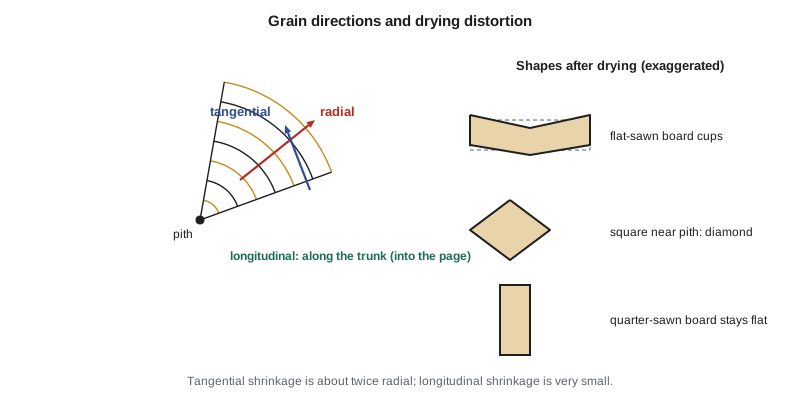
Because the cells are aligned along the trunk, wood properties depend strongly on direction. Three directions are defined: longitudinal (parallel to the grain), radial (across the rings, toward the pith) and tangential (along the rings). Wood is many times stronger and stiffer parallel to the grain than perpendicular to it: a softwood might have a compressive strength of 40 MPa parallel to the grain but only 4 to 6 MPa perpendicular, and a tensile strength perpendicular to the grain that is lower still. Structural design keeps stresses parallel to the grain wherever possible and checks bearing perpendicular to the grain at supports.
Moisture in wood
Living trees are full of water, often more than their own oven-dry mass. Moisture content (MC) is defined as the mass of water divided by the oven-dry mass of wood, so it can exceed 100 percent.
Water is held in two ways: free water in the cell cavities and bound water within the cell walls. As wood dries, free water leaves first; the point at which the cavities are empty but the walls are still saturated is the fiber saturation point, about 25 to 30 percent MC. Above it, drying changes nothing but mass. Below it, the cell walls lose water and the wood shrinks, gets stronger and stiffer, and becomes more resistant to decay.
Wood exchanges moisture with the surrounding air until it reaches its equilibrium moisture content (EMC), which depends on relative humidity and temperature. In heated buildings in cold climates, wood can dry to 6 to 10 percent MC in winter; outdoors under cover it may stay around 12 to 18 percent. Structural lumber is sold dry (surfaced dry, S-Dry, at 19 percent MC or less) or green (S-Grn); kiln drying to lower moisture contents is common for engineered products, and glulam and CLT are manufactured at roughly 12 percent plus or minus a few percent.
Shrinkage below the fiber saturation point is roughly proportional to the moisture lost. From green to oven-dry, typical softwoods shrink about 0.1 to 0.2 percent longitudinally, 3 to 5 percent radially and 6 to 8 percent tangentially. That difference is why boards cup and twist as they dry, why bolted connections in drying wood can split, and why multi-story wood frame buildings need details that allow for vertical shrinkage of plates and joists, which can accumulate to tens of millimeters over several stories.
Worked problem
Shrinkage of a floor assembly
A four-story wood-frame wing has, at each floor, a sill plate, a double top plate and 11.25 in deep solid sawn joists: a total of about 4 × (3 × 1.5 + 11.25) = 63 in of wood loaded across the grain. The lumber was installed at 19 percent MC and will reach 10 percent in service. Using a shrinkage coefficient of 0.25 percent per 1 percent change in MC across the grain (an average of radial and tangential values), estimate the total shrinkage.
Show solution
- \[\Delta MC = 19 - 10 = 9\ \%\]
- \[\Delta = 63 \times 0.0025 \times 9 = 1.42\ \text{in}\]
Answer: About 1.4 in of shortening at the roof relative to the foundation: enough to crack finishes, bind windows, and pull plumbing and stairs out of alignment unless details allow for it. Engineered floor joists and rim boards, which shrink much less, cut this substantially.
def moisture_content(wet_g, dry_g):
    return 100 * (wet_g - dry_g) / dry_g

def shrinkage(dim, mc_start, mc_end, coef_per_pct, fsp=28.0):
    """Shrinkage for moisture change below the saturation point fsp."""
    a, b = min(mc_start, fsp), min(mc_end, fsp)
    return dim * coef_per_pct / 100 * max(a - b, 0)

# Oven-dry check of CLT lamination samples (g)
samples = [(412.6, 368.9), (398.1, 352.0), (420.3, 371.5)]
for wet, dry in samples:
    print(f"MC = {moisture_content(wet, dry):4.1f} %")

# A 175 mm (5-ply) CLT panel: change in thickness from 16 % to 9 % MC
print(f"Panel thickness change: {shrinkage(175, 16, 9, 0.25):.1f} mm")
# A 6 m glulam beam along the grain from 15 % to 9 % (coefficient about 0.005 % per %)
print(f"Beam length change: {shrinkage(6000, 15, 9, 0.005):.1f} mm")MC = 11.8 % MC = 13.1 % MC = 13.1 % Panel thickness change: 3.1 mm Beam length change: 1.8 mm
The lamination samples are all near 12 to 13 percent, comfortably within the CLT manufacturing range. The panel's thickness will change by about 3 mm as it dries in service, while the 6 m glulam beam will shorten by only about 2 mm along its length, illustrating how small longitudinal movement is.
Strength and the factors that affect it
Clear, straight-grained wood is strong, but structural lumber contains natural characteristics that reduce strength: knots, which disturb the grain and act like holes; slope of grain, where fibers are not parallel to the edges; checks and splits from drying; wane, missing wood at the edges; and juvenile wood near the pith. Strength also depends on:
- Moisture content: below the fiber saturation point, drier wood is stronger and stiffer, so design values are adjusted for wet service.
- Duration of load: wood carries a short load, such as wind, much better than a permanent one, because it creeps and slowly accumulates damage under sustained stress. Design values are based on a standard term of load and multiplied by load-duration factors.
- Size: larger members are statistically more likely to contain a severe defect in a highly stressed zone, so strength per unit area falls with size.
- Temperature, chemical exposure and preservative or fire-retardant treatment can also require adjustments.
Grading lumber
In the United States, lumber is graded under rules published by agencies such as the West Coast Lumber Inspection Bureau, the Western Wood Products Association and the Southern Pine Inspection Bureau, all certified by the American Lumber Standard Committee, and each piece carries a stamp identifying the agency, the mill, the species, the grade and the moisture condition. Visually graded dimension lumber comes in grades such as Select Structural, No. 1, No. 2 and No. 3. Common species groups include Douglas Fir-Larch, Hem-Fir, Spruce-Pine-Fir and Southern Pine. Machine stress rated (MSR) and machine evaluated lumber is graded by bending each piece in a machine to measure its stiffness. Reference design values are tabulated in the supplement to the National Design Specification (NDS) and multiplied by adjustment factors for load duration, wet service, size, temperature and repetitive member use.
Engineered wood products
Engineered wood products are made by cutting wood into pieces (veneers, strands, laminations) and bonding them with structural adhesives. Defects are dispersed or removed, so properties are more uniform and higher on average; products can be made larger and longer than trees allow; and smaller, faster-growing trees can be used.
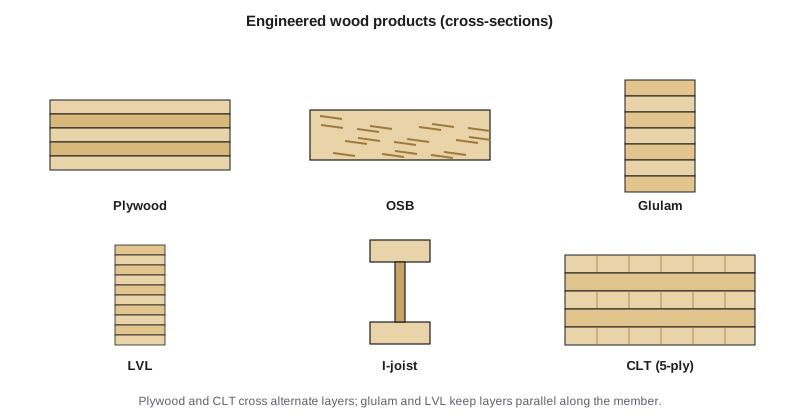
- Plywood and oriented strand board (OSB) are panels made of cross-laminated veneers or of oriented wood strands. They sheathe walls, floors and roofs and act as shear walls and diaphragms.
- Glued-laminated timber (glulam) is made by bonding layers of dimension lumber, typically 1-3/8 or 1-1/2 in thick, with their grain parallel. Lower-grade laminations go near the neutral axis and the best in the outer tension zone. Glulam can be made in large sizes, long lengths and curved shapes. It is manufactured to ANSI A190.1 with combinations such as 24F-V4 for simple-span beams and 24F-V8 for continuous or cantilevered beams.
- Structural composite lumber includes laminated veneer lumber (LVL), made of thin veneers with parallel grain; parallel strand lumber (PSL), made of long veneer strands; and laminated strand lumber (LSL), made of shorter strands. They are used for headers, beams, rim boards and I-joist flanges.
- Wood I-joists combine lumber or LVL flanges with an OSB or plywood web. They are light, straight, long-spanning and shrink very little.
- Cross-laminated timber (CLT) consists of three, five, seven or more layers of lumber boards glued with each layer at right angles to the next, forming large solid panels for floors, roofs and walls. Crossing the layers gives two-way strength and excellent dimensional stability in the plane of the panel. CLT is manufactured to ANSI/APA PRG 320, which is referenced in both Canadian and US codes. Mass timber buildings using CLT and glulam now reach heights that were impossible for wood a generation ago, under code provisions for encapsulated mass timber construction.
Durability: decay, insects and fire
Wood decays when fungi grow in it, which requires moisture content above about 20 percent, oxygen and moderate temperatures. Keeping wood dry is the first and best defense: protect it from rain during construction, separate it from concrete and soil with membranes or gaps, flash and drain all joints, and ventilate. Where wood must be wet, such as in decks, poles, piles and bridges, it is pressure-treated with preservatives (copper-based waterborne systems for most uses, creosote or pentachlorophenol alternatives for heavy timbers and piles), with retention levels matched to the use category. Termites and other insects are a concern in some regions; northern Prairie and Great Plains climates have fewer termite problems but serious decay risks from trapped moisture.
Large timber members perform well in fire because they char at a fairly predictable rate, about 0.65 mm per minute (roughly 1.5 inches per hour) for the nominal design rate in solid wood, and the char layer insulates the core, which keeps most of its strength. Codes allow fire resistance of mass timber to be calculated from the remaining section after charring for the required time, with adjustments for corners and for CLT layers that may fall off once their glue line is reached. Light-frame wood relies on gypsum board and sprinklers instead.
Common mistakes
MistakeInstalling wet lumber and closing it in.
InsteadSpecify dry lumber, protect it on site, and let it dry before enclosing; check MC with a meter.
MistakeLoading wood heavily perpendicular to the grain at supports without checking bearing.
InsteadCheck compression perpendicular to grain and provide adequate bearing length or plates.
MistakeIgnoring vertical shrinkage in multi-story wood frame buildings.
InsteadEstimate cumulative shrinkage and detail plumbing, stairs, elevators and finishes to accommodate it.
MistakeUsing untreated wood in ground contact or continually damp locations.
InsteadUse preservative-treated wood rated for the use category, or keep the wood dry by design.
Summary and key terms
- Wood is anisotropic: much stronger and stiffer parallel to the grain than perpendicular to it.
- Moisture content below the fiber saturation point controls shrinkage, strength and decay risk.
- Tangential shrinkage is about twice radial shrinkage; longitudinal shrinkage is very small.
- Knots, slope of grain, load duration and member size reduce strength; grading and adjustment factors account for them.
- Engineered products (plywood, OSB, glulam, LVL, I-joists, CLT) are more uniform, larger and more stable than sawn lumber.
- Keep wood dry to prevent decay, treat it where it must be wet, and rely on predictable charring for mass timber fire resistance.
- Anisotropic
- Having different properties in different directions.
- Moisture content
- Mass of water in wood as a percentage of its oven-dry mass.
- Fiber saturation point
- The moisture content at which cell walls are saturated and cell cavities empty, about 25 to 30 percent.
- Equilibrium moisture content
- The moisture content at which wood neither gains nor loses moisture in its environment.
- Duration of load
- The effect of how long a load acts on the strength of wood.
- Glulam
- Glued-laminated timber made of parallel lumber laminations bonded with adhesive.
- CLT
- Cross-laminated timber: panels of lumber layers glued at right angles to each other.
- Char rate
- The rate at which a wood surface converts to char in a standard fire exposure.
Practice problems
Work each problem on paper first, then reveal the answer to check.
A sample weighs 52.4 g wet and 44.0 g oven-dry. What is its moisture content?
Show answer
\(100(52.4 - 44.0)/44.0 = 19.1\) percent.
Why does a flat-sawn board cup as it dries?
Show answer
Tangential shrinkage is greater than radial, and the faces of the board are oriented differently relative to the rings.
Why are wood design values adjusted for duration of load?
Show answer
Wood carries short-term loads better than long-term ones because it creeps and accumulates damage under sustained stress.
Name two advantages of CLT over sawn timber decking.
Show answer
Two-way spanning strength and dimensional stability, large prefabricated panels, predictable fire performance.
What conditions does decay need?
Show answer
Moisture content above about 20 percent, oxygen, moderate temperatures and a food source (the wood).
Approximately how much char forms on a glulam beam in a 60-minute standard fire on each exposed face?
Show answer
About \(0.65 \times 60 = 39\ \text{mm}\) (roughly 1.5 in), before corner and other adjustments.
Lesson quiz · 5 questions
Score 60% or more to complete this lesson.
Create a free account to save your progress, take quizzes and earn a certificate.