
CIV-230 · Lesson 2 of 12 · 23 min
Aggregates: sources, gradation and properties
Aggregates are the sand, gravel and crushed stone that make up most of the volume of concrete and asphalt and all of a granular road base. In normal concrete they fill roughly 60 to 75 percent of the volume; in asphalt concrete, more than 90 percent of the mass. Because there is so much of them, aggregates control the cost, the unit weight, much of the stiffness and a good deal of the durability of the finished material. A bad aggregate can ruin a perfect mix design, and understanding aggregates is the natural starting point for the rest of the course.
On the interchange project, the concrete supplier draws coarse aggregate from a glacial gravel pit northwest of Fargo and blends in crushed granite trucked from Minnesota, because the local gravel contains soft shale particles. The asphalt contractor uses crushed gravel from a different pit. Tamarack tests both sources before the work starts and at regular intervals during production.
Sources and types of aggregate
Natural aggregates come from sand and gravel deposits left by glaciers and rivers, or from quarried bedrock that is crushed and screened. Gravel particles are rounded and smooth, which makes fresh concrete easy to place but bonds less strongly to cement paste and gives less interlock in asphalt and base courses. Crushed stone is angular and rough, which interlocks well and bonds well but needs more paste or binder to coat and lubricate. Manufactured sand is crushed rock screened to sand sizes; it is increasingly used where natural sand is scarce.
Rock type matters. Granites, basalts and many limestones and dolostones make sound aggregate. Some rocks cause trouble: shale and clay ironstone particles soften and expand when wet and freeze, causing pop-outs on concrete surfaces; chert and some siliceous rocks can react with alkalis in cement; some argillaceous dolostones expand through alkali–carbonate reaction. Recycled concrete aggregate, made by crushing old pavements and buildings, and blast-furnace slag aggregate are also used, with extra testing.
Aggregates are divided by size. Coarse aggregate is retained on the 4.75 mm (No. 4) sieve; fine aggregate (sand) passes it. The nominal maximum size of a coarse aggregate, such as 20 mm or 28 mm (3/4 in or 1 in), is the smallest sieve on which some material is retained, by the usual definition, and it limits how thin a section or how closely spaced the reinforcement can be.
Gradation and the sieve analysis
Gradation is the distribution of particle sizes. It is measured by a sieve analysis: a dried sample is shaken through a nest of sieves with progressively smaller openings, the mass retained on each sieve is weighed, and the results are reported as cumulative percentage passing each sieve. Plotting percentage passing against sieve size on a logarithmic scale gives the gradation curve.
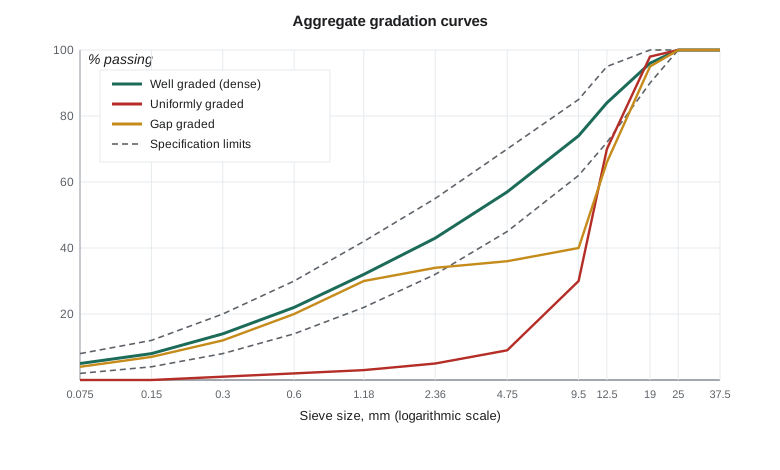
A well-graded (dense-graded) aggregate contains a smooth range of sizes, so smaller particles fill the voids between larger ones. This gives a dense packing that needs less cement paste in concrete or less binder in asphalt. A uniformly graded aggregate has most particles of similar size and leaves many voids; it is used deliberately in drainage layers and open-graded friction courses. A gap-graded aggregate is missing some intermediate sizes; it is used in stone matrix asphalt to produce stone-on-stone contact, but in concrete it can segregate.
A useful idealization is the maximum density gradation proposed by Fuller and Thompson and adapted for asphalt by the Federal Highway Administration's 0.45 power chart.
where \(P\) is the percentage passing sieve size \(d\) and \(D\) is the maximum size. A gradation close to this line packs densely; Superpave asphalt mixes are designed to pass near but not exactly on it, so that enough voids remain for binder and air (lesson 10).
Fineness modulus
For fine aggregate, gradation is summarized by the fineness modulus (FM): the sum of the cumulative percentages retained on the standard sieves 0.15, 0.3, 0.6, 1.18, 2.36 and 4.75 mm (No. 100, 50, 30, 16, 8 and 4), divided by 100. Sands for concrete usually have an FM between about 2.3 and 3.1. A higher FM means a coarser sand, which needs less water for the same workability but may make a harsh mix. Mix design methods use the FM to choose the volume of coarse aggregate (lesson 4).
Worked problem
Sieve analysis of a concrete sand
Jonah sieves 500.0 g of oven-dry sand. The masses retained are: 4.75 mm, 10 g; 2.36 mm, 60 g; 1.18 mm, 95 g; 0.6 mm, 110 g; 0.3 mm, 120 g; 0.15 mm, 80 g; pan, 25 g. Find the percentage passing each sieve and the fineness modulus.
Show solution
- Cumulative retained: 10, 70, 165, 275, 395, 475 g, with 25 g in the pan for a total of 500 g, so no material was lost.
- Cumulative percentage retained: 2, 14, 33, 55, 79, 95 percent; percentage passing: 98, 86, 67, 45, 21, 5 percent.
- \[\text{FM} = \frac{2 + 14 + 33 + 55 + 79 + 95}{100} = 2.78\]
Answer: The sand has an FM of 2.78, in the middle of the usual range for concrete sand. Its percentage passing falls within a typical concrete sand band (for example 95 to 100 percent passing 4.75 mm and 2 to 10 percent passing 0.15 mm).
Lucie automates the calculation so the lab can process a day's samples quickly and flag any that fall outside the specification band.
sieves = [4.75, 2.36, 1.18, 0.60, 0.30, 0.15]          # mm
retained = [10, 60, 95, 110, 120, 80]                    # g on each sieve
pan, total = 25, 500.0
lower = [95, 80, 50, 25, 5, 0]                          # a typical sand band (% passing)
upper = [100, 100, 85, 60, 30, 10]

assert abs(sum(retained) + pan - total) < 0.5, "mass not conserved"
cum, passing = 0, []
for m in retained:
    cum += m
    passing.append(100 * (1 - cum / total))
fm = sum(100 - p for p in passing) / 100
for d, p, lo, hi in zip(sieves, passing, lower, upper):
    flag = "" if lo <= p <= hi else "  <-- outside band"
    print(f"{d:5.2f} mm  passing {p:5.1f} %  (band {lo}-{hi}){flag}")
print(f"Fineness modulus = {fm:.2f}")4.75 mm passing 98.0 % (band 95-100) 2.36 mm passing 86.0 % (band 80-100) 1.18 mm passing 67.0 % (band 50-85) 0.60 mm passing 45.0 % (band 25-60) 0.30 mm passing 21.0 % (band 5-30) 0.15 mm passing 5.0 % (band 0-10) Fineness modulus = 2.78
Material finer than 75 µm
The fraction passing the 75 µm (No. 200) sieve is found by washing the sample over that sieve. In concrete aggregate, too much fine dust or clay coats particles, raises the water demand and weakens the bond, so specifications limit it to a few percent. In asphalt mixes the same fraction, called filler or dust, stiffens the binder and is controlled by a dust-to-binder ratio. In granular base, some fines help compaction but too many hold water and lose strength when wet or frozen.
Specific gravity, absorption and moisture states
To design a mix by volume, you need to know how much space each kilogram of aggregate occupies. Aggregate particles contain pores, some of which absorb water. The relative density (specific gravity) is therefore defined in several ways, depending on which pores are counted.
- Bulk relative density, oven-dry (\(G_{sb}\) or OD): the oven-dry mass divided by the mass of water occupying the particle volume including permeable pores.
- Bulk relative density, saturated surface-dry (SSD): uses the SSD mass, with the permeable pores filled with water but no water on the surface. Concrete mix designs are usually done on an SSD basis.
- Apparent relative density: counts only the solid material and impermeable pores.
- Absorption: the mass of water in the permeable pores at SSD, as a percentage of the oven-dry mass. Typical values are 0.5 to 2 percent for sound gravel and stone, higher for some limestones and much higher for lightweight and recycled aggregates.
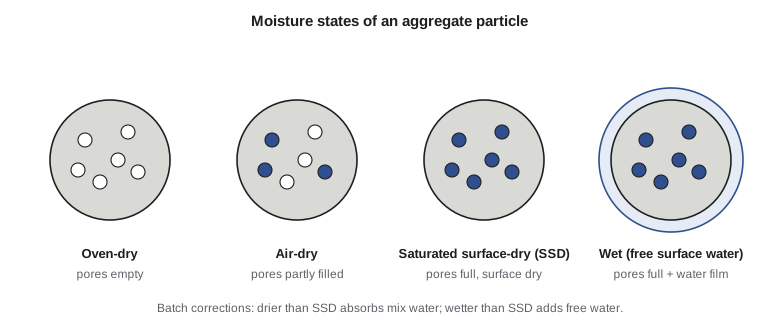
Stockpiled aggregate is rarely at SSD. If it is drier than SSD, it will absorb some of the mixing water, stiffening the mix; if it is wetter, its surface water adds to the mixing water, raising the water–cement ratio and lowering strength. Batch plants measure the moisture content of each aggregate and adjust the batch masses: they add the aggregate's free (surface) moisture to its mass and subtract the same water from the batch water.
where \(w\) is the total moisture content and \(a\) the absorption, both as fractions of oven-dry mass.
Worked problem
Adjusting a batch for stockpile moisture
A mix calls for 1770 lb/yd³ of coarse aggregate and 1280 lb/yd³ of sand, both SSD, with 270 lb/yd³ of water. The coarse aggregate has absorption 0.8 percent and moisture content 1.5 percent; the sand has absorption 1.2 percent and moisture content 4.5 percent. Find the batch weights.
Show solution
- Coarse: wet weight \(= 1770 \times 1.015/1.008 = 1782.3\ \text{lb}\), adding \(12.3\ \text{lb}\) of free water.
- Sand: wet weight \(= 1280 \times 1.045/1.012 = 1321.7\ \text{lb}\), adding \(41.7\ \text{lb}\) of free water.
- \[\text{batch water} = 270 - 12.3 - 41.7 = 216.0\ \text{lb}\]
Answer: Batch about 1782 lb of coarse aggregate, 1322 lb of sand and 216 lb of water per cubic yard. Forgetting the correction would add about 54 lb of extra water, raising the water–cement ratio by roughly 0.08 for a typical cement content and costing several hundred psi of strength.
Bulk density and voids
The bulk density (unit weight) of an aggregate is the mass of a measured volume of particles, including the voids between them, usually found by rodding the aggregate into a container of known volume. Comparing bulk density with particle density gives the void content. Mix design methods use the dry-rodded bulk density of the coarse aggregate to decide how much coarse aggregate fits in a cubic meter of concrete.
For example, a gravel with a dry-rodded bulk density of 1650 kg/m³ and a bulk relative density of 2.65 has voids of \(1 - 1650/2650 = 0.377\), so about 38 percent of the rodded volume is space to be filled by mortar.
Durability and mechanical tests
Several tests screen aggregates for strength and durability.
- Abrasion and degradation: the Los Angeles abrasion test tumbles aggregate with steel balls in a rotating drum and measures the percentage broken down; the micro-Deval test tumbles it wet with small steel balls and is better at identifying soft, absorptive rock. Highway agencies set maximum losses for base, asphalt and concrete aggregate.
- Soundness: freeze–thaw testing of aggregate in water or brine, or the older sulfate soundness test, which simulates frost damage by repeated crystal growth in the pores.
- Deleterious particles: petrographic examination counts shale, clay lumps, chert, coal and other harmful particles, and a petrographic number is used in some provinces and states to rate gravel quality.
- Particle shape: flat and elongated particles break during compaction and make concrete harsh; crushed asphalt aggregate must have a minimum percentage of fractured faces so the mix interlocks and resists rutting.
- Alkali reactivity: the accelerated mortar bar test and the longer concrete prism test show whether an aggregate expands when exposed to alkalis (lesson 6).
Aggregates in granular base
Under pavements, layers of compacted crushed aggregate spread wheel loads down to the subgrade. Their performance depends on gradation, fractured faces, fines content and compaction. Field density is checked with a nuclear gauge or by sand-cone or other methods and compared with the maximum dry density from a laboratory Proctor test. A well-graded, well-compacted, free-draining base is the cheapest insurance a pavement has.
Common mistakes
MistakeDesigning a mix with oven-dry aggregate masses and forgetting absorption.
InsteadUse SSD masses in the design and correct batch masses and water for actual stockpile moisture.
MistakeAssuming more fines always means a denser, better mix.
InsteadExcess material finer than 75 µm raises water demand in concrete and can make asphalt and base courses moisture sensitive.
MistakeReading the gradation chart with a linear size axis.
InsteadSieve sizes are plotted on a logarithmic scale (or the 0.45 power scale for asphalt).
MistakeTaking a sample from the edge of a stockpile where coarse particles have rolled.
InsteadSample from several points on a prepared face, or from a stopped belt, and reduce by splitting.
Summary and key terms
- Aggregates make up most of the volume of concrete and asphalt and control cost, stiffness and much of durability.
- Gradation is measured by sieve analysis and shown on a semi-log chart; well-graded aggregates pack densely.
- The fineness modulus summarizes sand gradation; concrete sands are typically 2.3 to 3.1.
- Relative density and absorption convert masses to volumes; SSD is the reference state for concrete.
- Batch masses and water must be corrected for the free moisture in stockpiles.
- Abrasion, soundness, deleterious particles, shape and alkali reactivity tests screen aggregates for durability.
- Gradation
- The distribution of particle sizes in an aggregate, reported as percentage passing each sieve.
- Nominal maximum size
- The smallest sieve opening through which most of the aggregate passes, with some retained.
- Fineness modulus
- The sum of cumulative percentages retained on standard sieves divided by 100; a measure of sand coarseness.
- Saturated surface-dry
- The state in which the permeable pores are full of water but the surface is dry.
- Absorption
- The water held in permeable pores at SSD, as a percentage of oven-dry mass.
- Bulk relative density
- Particle mass divided by the mass of an equal volume of water, counting permeable pores in the volume.
- Free moisture
- Water on the surface of aggregate particles above SSD, which becomes mixing water.
- Los Angeles abrasion
- A test that measures breakdown of aggregate tumbled with steel balls in a rotating drum.
Practice problems
Work each problem on paper first, then reveal the answer to check.
Cumulative percentages retained on the six standard sieves are 4, 18, 40, 62, 84 and 97. What is the FM?
Show answer
\((4+18+40+62+84+97)/100 = 3.05\), a coarse sand.
An aggregate has absorption 1.0 percent and moisture content 3.0 percent. Is it adding or removing water from the mix?
Show answer
Adding: its free moisture is 2.0 percent of its oven-dry mass.
Why is SSD used as the reference state for concrete aggregate?
Show answer
At SSD the aggregate neither absorbs mix water nor contributes free water, so the design water is the water available to the cement.
A coarse aggregate has rodded bulk density 1600 kg/m³ and bulk relative density 2.60. What are the voids?
Show answer
\(1 - 1600/2600 = 0.385\), about 38.5 percent.
What problem does a high proportion of shale particles cause in concrete?
Show answer
Pop-outs and surface damage, because shale softens and expands when wet and frozen.
Why do asphalt specifications require fractured faces on coarse aggregate?
Show answer
Angular, crushed particles interlock, giving the mix resistance to rutting.
Lesson quiz · 5 questions
Score 60% or more to complete this lesson.
Create a free account to save your progress, take quizzes and earn a certificate.