
CIV-230 · Lesson 5 of 12 · 21 min
Fresh concrete: workability, placing and curing
A mix design on paper becomes a structure only after the concrete is batched, mixed, transported, placed, consolidated, finished and cured. Each step can add or remove quality. Most of the defects Tamarack sees in finished concrete, such as honeycombing, cold joints, plastic shrinkage cracks, scaling and low cores, trace back to what happened in the few hours while the concrete was fresh and the few days while it was curing. This lesson covers the properties of fresh concrete, the tests used to check them on site, and the practices that turn good concrete into good structures.
Workability and consistency
Workability is the ease with which concrete can be mixed, placed, consolidated and finished without segregation. It is not one property but a combination of consistency (how fluid the mix is), cohesiveness (how well it holds together) and finishability. Workability depends on water content, paste volume, aggregate gradation and shape, air content, admixtures, temperature and time since mixing. Concrete stiffens steadily after mixing as water is absorbed by aggregates, lost to evaporation and consumed by early hydration; this is slump loss.
The slump test
The slump test is the oldest and most common consistency test. A metal cone 300 mm (12 in) high is filled with concrete in three layers, each rodded 25 times, then lifted straight up. The decrease in height of the concrete is the slump. The test is simple and quick, which is its strength, but it measures consistency only, and it is not meaningful for very stiff concrete or for self-consolidating concrete, which is tested by slump flow instead.
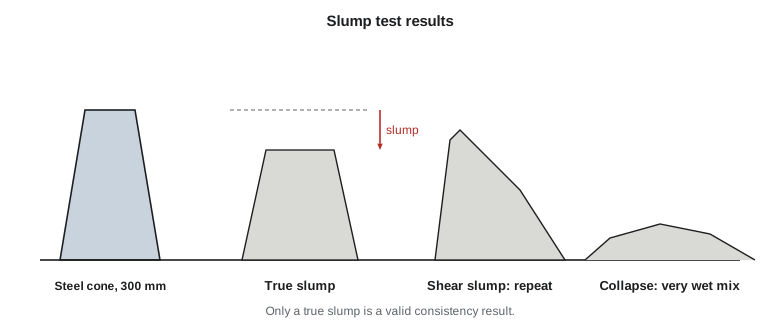
A true slump subsides evenly. A shear slump, where one side slides away, suggests a harsh, poorly cohesive mix and must be repeated. A collapse means the mix is too wet for the test, or is a flowing mix. Typical slumps are 50 to 100 mm (2 to 4 in) for slabs and walls, less for pavements placed with slipform pavers, and higher, using superplasticizers, for congested sections.
Air content, density and temperature
Air content is measured on fresh concrete by the pressure method, in which a sealed bowl of concrete is pressurized and the drop in pressure shows the volume of air, or by the volumetric (roll-a-meter) method, which is used for lightweight aggregates whose pores would distort the pressure reading. Because each percent of air changes strength and durability so much, the air test is done on every acceptance sample of exterior concrete. Some agencies also measure the spacing of the air voids on hardened samples or use a sequential pressure test on fresh concrete to estimate void quality.
Fresh density (unit weight) is measured by filling and weighing a container of known volume. It is used to check the yield of the batch and, compared with the theoretical air-free density, gives another estimate of air content. Concrete temperature is measured with a thermometer inserted into the sample, and specifications set limits because temperature affects setting, strength development and cracking.
Worked problem
Yield check from fresh density
A truck carries 10.0 yd³ of the deck mix, whose batch weights total 38 200 lb per truck. Jonah measures a unit weight of 140.0 lb/ft³. Is the yield correct?
Show solution
- \[\text{volume produced} = \frac{38\,200}{140.0 \times 27} = 10.11\ \text{yd}^3\]
- \[\text{relative yield} = 10.11 / 10.0 = 1.011\]
Answer: The truck produced about 1.1 percent more concrete than ordered. The likely cause is air content above the design value, since unit weight is lower than the 141.5 lb/ft³ expected; Jonah checks the air test from the same sample before the producer adjusts the sand content.
Segregation and bleeding
Segregation is the separation of coarse aggregate from mortar. It happens when concrete is dropped from a height, moved sideways with vibrators, conveyed long distances, or is too wet or poorly graded. Segregated concrete leaves rock pockets (honeycombing) and weak, porous zones. Bleeding is the rise of water to the surface as heavier solids settle. Some bleeding is normal and helps prevent plastic shrinkage cracking, but excessive bleeding weakens the top layer, and finishing while bleed water is on the surface works water into the surface paste, causing dusting and scaling later. Bleed water also collects under reinforcing bars and large aggregate, weakening the bond.
Batching, mixing and transport
Ready-mixed concrete is batched by weight at a central plant and either fully mixed there or mixed in truck mixers en route. ASTM C94 limits discharge to 90 minutes after batching or 300 drum revolutions, whichever comes first, unless the purchaser waives the limit, and allows water to be added only once on arrival, within the specified w/cm and slump.
Delivery tickets record the time of batching, the mix code, the quantities batched, the water added at the plant and any water withheld for site adjustment. The field technician checks every ticket against the approved mix and rejects loads that are late, the wrong mix, or out of specification.
Placing and consolidation
Concrete is placed by chute, bucket, pump or conveyor as close to its final position as possible, in horizontal layers, at a rate that lets each layer be vibrated into the one below before it sets. Free fall should be limited, especially through congested reinforcement, and drop chutes or tremies are used for deep walls and columns. Placing under water uses a tremie pipe whose end stays buried in fresh concrete.
Consolidation removes the entrapped air (large, irregular voids, not the small entrained bubbles) and makes the concrete flow around reinforcement and into corners. Internal (poker) vibrators are inserted vertically at regular spacing, overlapping their radius of action, and withdrawn slowly. Under-vibration leaves honeycombing and voids; prolonged over-vibration of a wet mix can cause segregation and bring excess paste to the surface. Form vibrators are used for precast work and thin walls.
A cold joint forms when fresh concrete is placed against concrete that has already set without proper preparation. Placement plans set the sequence and rate, and planned construction joints are located where they do least harm and are prepared by cleaning and roughening the hardened surface.
Finishing slabs and decks
Slab finishing follows a sequence: screeding to grade, bull-floating to embed aggregate and level the surface, waiting for bleed water to evaporate, then floating and troweling to the specified texture. Exterior slabs and decks receive a broom or tined finish for skid resistance and should not be hard-troweled when air-entrained, because troweling can seal the surface and cause delamination. Bridge decks are usually finished with a mechanical finishing machine running on rails, followed by texturing.
Plastic shrinkage and early cracking
When water evaporates from the surface faster than bleed water rises to replace it, the surface dries and shrinks while the concrete is still plastic, producing short, often parallel cracks. Hot, dry, windy weather and low-bleed mixes such as those with silica fume are most at risk. Evaporation rate is estimated from air and concrete temperature, humidity and wind speed with a well-known nomograph; above roughly 1 kg/m²/h (0.2 lb/ft²/h), and lower for silica fume concrete, precautions are needed: windbreaks, sunshades, fog misting, evaporation retarders sprayed on the surface, and prompt curing.
Hot and cold weather
High temperatures speed up slump loss and setting, raise water demand and lower long-term strength. Hot-weather practices include cooling the aggregates and water, using ice, scheduling placements at night or early morning, using retarders and keeping placement and finishing crews ready so that delays are short.
Cold temperatures slow hydration, and fresh concrete that freezes before it reaches about 3.5 MPa (500 psi) can be permanently damaged. Cold-weather practices include heating water and aggregates, using accelerating (non-chloride) admixtures or high-early-strength cement, placing on thawed and frost-free subgrade, and protecting the concrete with insulated blankets, enclosures and heaters. Combustion heaters must be vented outside an enclosure: carbon dioxide from unvented heaters reacts with the fresh surface (carbonation), leaving a soft, dusty layer, and carbon monoxide endangers workers.
Curing
Curing maintains enough moisture and a favorable temperature for hydration to continue in the early days. It is the cheapest way to improve the strength and durability of the cover concrete that protects reinforcement, and it is the step most often skimped. Methods include ponding or continuous sprinkling, wet burlap kept damp under plastic sheeting, plastic sheeting alone, membrane-forming curing compounds sprayed on the surface, and leaving forms in place.
ACI and state DOT specifications set minimum curing periods, commonly seven days for ordinary concrete or until a set fraction of the specified strength is reached, and longer periods for concrete with high SCM contents. Many state DOTs require seven days or more of continuous wet curing for bridge decks, often with wet burlap and plastic, and some do not allow curing compounds on silica fume decks.
Strength development and the maturity method
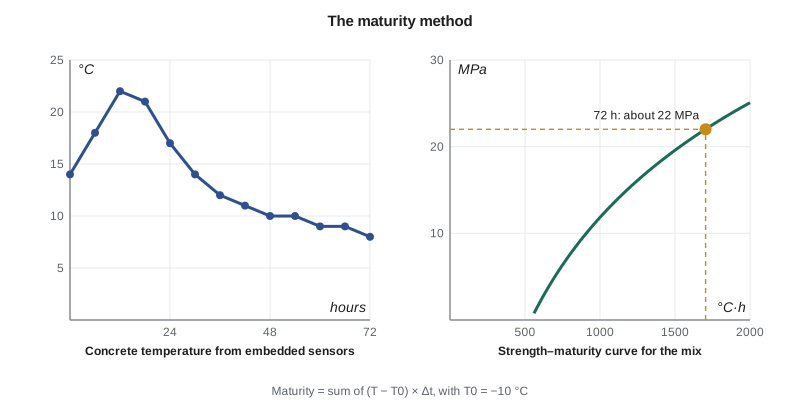
Because hydration speeds up with temperature, concrete cured warm gains strength faster than concrete cured cold. The maturity method uses this to estimate in-place strength from the temperature history recorded by sensors cast into the concrete. The simplest form is the Nurse–Saul temperature–time factor:
where \(T_a\) is the average concrete temperature over a time interval \(\Delta t\), and \(T_0\) is a datum temperature below which hydration is assumed to stop, often taken as −10 °C (14 °F) or 0 °C. Before the project, a strength–maturity curve is developed by testing cylinders of the same mix at several ages while recording their maturity. On site, the maturity from the sensors is converted to an estimated strength, which tells the contractor when it is safe to strip forms, cut joints or post-tension.
import math
# Temperature readings every 6 h for 3 days in a cold-weather deck pour (deg C)
temps = [14, 18, 22, 21, 17, 14, 12, 11, 10, 10, 9, 9, 8]
T0, dt = -10.0, 6.0
M = [0.0]
for a, b in zip(temps[:-1], temps[1:]):
    M.append(M[-1] + max(0.0, (a + b) / 2 - T0) * dt)

# Strength-maturity relation fitted to calibration cylinders: f = a + b*ln(M)
a, b = -120.1, 19.1         # MPa; fitted for M between about 600 and 20000 deg C-h
for hours, m in zip(range(0, 73, 6), M):
    f = a + b * math.log(m) if m > 500 else 0.0
    if hours % 12 == 0:
print(f"t = {hours:2d} h maturity = {m:6.0f} degC-h estimated strength = {max(f, 0):4.1f} MPa")t = 0 h maturity = 0 degC-h estimated strength = 0.0 MPa t = 12 h maturity = 336 degC-h estimated strength = 0.0 MPa t = 24 h maturity = 699 degC-h estimated strength = 5.0 MPa t = 36 h maturity = 990 degC-h estimated strength = 11.6 MPa t = 48 h maturity = 1242 degC-h estimated strength = 16.0 MPa t = 60 h maturity = 1479 degC-h estimated strength = 19.3 MPa t = 72 h maturity = 1704 degC-h estimated strength = 22.0 MPa
The estimate shows that the deck reaches roughly 22 MPa after three days of cold-weather curing. If the form-stripping criterion were 20 MPa, the contractor could strip at about 60 to 72 hours. The maturity method works only for the mix that was calibrated; a change of cement, SCM or w/cm needs a new curve, and specifications usually require cylinder or core confirmation for acceptance.
Common mistakes
MistakeAdding water to a stiff load on arrival without checking how much the ticket allows.
InsteadOnly water withheld at the plant may be added, once, within the approved w/cm; otherwise use admixture or reject the load.
MistakeDragging concrete sideways with a vibrator.
InsteadPlace concrete near its final position and use vibrators only to consolidate.
MistakeFinishing while bleed water is on the surface.
InsteadWait until bleed water has evaporated; working it in causes weak, scaling surfaces.
MistakeRemoving curing as soon as the forms come off or after one day.
InsteadContinue curing for the required period; the cover concrete depends on it.
Summary and key terms
- Workability combines consistency, cohesiveness and finishability; it declines with time after mixing.
- The slump test measures consistency; air, density and temperature tests accompany every acceptance sample.
- Segregation and excessive bleeding create weak zones; good placing and consolidation prevent them.
- Transport time and retempering are limited by specification, and delivery tickets are checked for every load.
- Plastic shrinkage cracking is controlled by limiting evaporation and curing promptly.
- Hot and cold weather need special measures; fresh concrete must not freeze before about 3.5 MPa.
- Curing keeps concrete moist and warm; the maturity method estimates in-place strength from temperature history.
- Workability
- The ease with which fresh concrete can be placed, consolidated and finished without segregation.
- Slump
- The drop in height of a cone of fresh concrete, a measure of consistency.
- Segregation
- Separation of coarse aggregate from mortar in fresh concrete.
- Bleeding
- Upward movement of water in fresh concrete as solids settle.
- Consolidation
- Removal of entrapped air from fresh concrete, usually by vibration.
- Cold joint
- A plane of weakness where fresh concrete was placed against concrete that had already set.
- Curing
- Maintaining moisture and temperature so hydration can continue in early ages.
- Maturity
- A temperature–time factor used to estimate in-place strength of concrete.
Practice problems
Work each problem on paper first, then reveal the answer to check.
A slump test shows one side of the cone sliding away. What should the technician do?
Show answer
Record it as a shear slump and repeat the test on another portion of the sample.
Why are combustion heaters vented outside a cold-weather enclosure?
Show answer
Carbon dioxide causes surface carbonation and a dusty layer, and carbon monoxide endangers workers.
Average concrete temperature is 15 °C for 24 h with datum −10 °C. What maturity is gained?
Show answer
\((15 - (-10)) \times 24 = 600\) °C·h.
What causes plastic shrinkage cracks?
Show answer
Surface evaporation faster than bleeding while the concrete is still plastic.
Why is the air test done on every acceptance sample of exterior concrete?
Show answer
Air content strongly affects both freeze–thaw durability and strength and varies from load to load.
Name two ways to cure a bridge deck.
Show answer
Continuous wet burlap under plastic sheeting; ponding or fogging; curing compound where allowed.
Lesson quiz · 5 questions
Score 60% or more to complete this lesson.
Create a free account to save your progress, take quizzes and earn a certificate.