
CIV-230 · Lesson 12 of 12 · 20 min
Sustainability, embodied carbon and material selection
The previous lessons treated each material on its own terms. Real projects require choices among them, and those choices increasingly weigh environmental impact alongside strength, durability and cost. Construction materials account for a large share of global greenhouse gas emissions: cement and steel alone are often estimated at around 15 percent of energy-related carbon dioxide. Engineers can reduce that share substantially by specifying materials wisely, using less of them, making them last longer and reusing them, and owners and governments now ask for evidence that they have done so. This final lesson brings the course together around material selection and sustainability, and ends with Tamarack's three projects.
Embodied and operational carbon
Operational carbon comes from the energy used to heat, cool, light and run a building or to operate infrastructure. Embodied carbon comes from making, transporting, installing, maintaining and eventually disposing of the materials. As buildings become more energy efficient and electricity grids cleaner, embodied carbon becomes a larger share of the total; for a new, efficient building, the emissions from its structure and envelope may exceed several decades of operational emissions. For bridges, roads and other infrastructure, which use little operating energy, embodied carbon dominates.
Embodied carbon is reported as global warming potential (GWP) in kilograms of carbon dioxide equivalent (kg CO₂e), counting other greenhouse gases by their warming effect relative to CO₂. It is usually expressed per unit of material (per cubic meter of concrete, per metric ton of steel) or per functional unit, such as per square meter of floor area or per meter of bridge.
Life cycle assessment and EPDs
Life cycle assessment (LCA), standardized in ISO 14040 and 14044, accounts for the environmental impacts of a product or building across its whole life. For construction products, the life cycle is divided into modules: A1 to A3 for raw material supply, transport to the factory and manufacturing (the product stage, or cradle-to-gate); A4 and A5 for transport to site and construction; B1 to B7 for use, maintenance, repair and replacement; C1 to C4 for demolition, transport, processing and disposal; and module D for benefits beyond the system boundary, such as recycling steel.
An environmental product declaration (EPD) is a verified LCA report for a product, prepared according to a product category rule so that products of the same type can be compared. Concrete producers can now issue EPDs for individual mix designs, and steel mills, cement plants, timber manufacturers and asphalt plants publish them too. Industry-average EPDs and regional benchmarks give baselines against which specific products are compared.
US policy increasingly requires this information. Buy Clean laws in California and several other states set maximum GWP values for materials such as structural steel and reinforcing bar on public projects, and some agencies and cities set limits for concrete. Federal policy on low-carbon materials has shifted with changes in administration, so engineers should check the current requirements for each project. Concrete specifications increasingly allow or require performance-based mixes with a maximum GWP.
Typical embodied carbon of materials
The values below are rough, cradle-to-gate (A1 to A3) figures to show orders of magnitude. Actual values vary widely by plant, energy source and recipe, and project decisions should use product-specific EPDs.
| Material | Unit | Approximate GWP (kg CO₂e) | Main drivers |
|---|---|---|---|
| Ready-mix concrete, 35 MPa, conventional | per m³ | 300–400 | Cement content and clinker factor |
| Ready-mix concrete, 35 MPa, high-SCM or optimized | per m³ | 180–260 | Slag, fly ash, limestone, lower paste content |
| Structural steel sections (EAF, scrap-based) | per metric ton | 700–1200 | Electricity source, scrap share |
| Steel plate or sections (blast furnace route) | per metric ton | 1800–2500 | Coke and ore smelting |
| Reinforcing bar (EAF) | per metric ton | 500–1000 | Electricity source |
| Glulam or CLT (fossil emissions only) | per m³ | 100–250 | Kiln drying, adhesives, transport |
| Hot-mix asphalt | per metric ton | 40–80 | Binder content, burner fuel, RAP use |
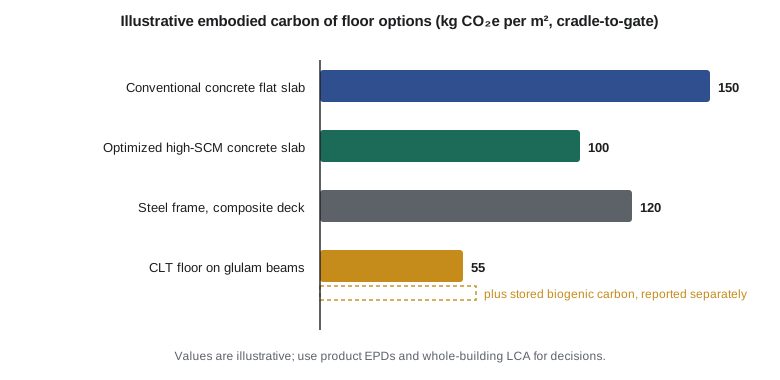
Wood products also store biogenic carbon absorbed by the trees, roughly 1.6 kg CO₂ per kilogram of dry wood, which is reported separately in EPDs. Whether and how to credit that storage depends on forest management and on what happens to the wood at the end of its life, and standards treat it cautiously; engineers should report fossil and biogenic carbon separately rather than netting them silently.
Strategies to reduce embodied carbon
The most effective strategies are, roughly in order of impact: build less (reuse existing structures, avoid over-design), build with less material (efficient structural forms, appropriate spans, higher-strength materials where they reduce quantities), choose lower-carbon versions of each material, and design for long life and future reuse.
- Concrete: use portland-limestone cement and SCMs; specify strength at 56 or 90 days where early strength is not needed; avoid unnecessary minimum cement contents; optimize aggregate gradation to reduce paste; use performance-based specifications; and consider emerging options such as calcined clays and carbon dioxide mineralization.
- Steel: specify scrap-based EAF steel where available, use higher-strength grades where they save tonnage, and design for disassembly so members can be reused.
- Wood: source from sustainably managed and certified forests, minimize waste, protect from moisture so the structure lasts, and plan for reuse or recycling.
- Asphalt: use warm mix, high RAP contents with rejuvenators where performance allows, and pavement preservation treatments that extend life at low carbon cost.
Durability is sustainability
A low-carbon material that fails early is not sustainable. A bridge deck that must be rehabilitated after 25 years instead of 75 roughly triples the embodied carbon of the deck over the bridge's life, plus the emissions of traffic delays during repairs. Life cycle cost analysis, which converts future maintenance and replacement costs to present worth using a discount rate, puts durable options on a fair footing against cheaper initial choices. The same discounting logic, applied to carbon over a design life, often favors durable materials such as stainless or GFRP reinforcement in the most exposed zones, dense high-SCM concrete and well-detailed weathering steel.
Selecting materials systematically
For a given function, the best material maximizes performance per unit of whatever is being minimized: mass, cost or carbon. Michael Ashby's material indices formalize this. For a tie of fixed length carrying a given tensile force, the mass is \(m = \rho L F / \sigma_y\), so the best material minimizes \(\rho / \sigma_y\). For a beam of fixed length and loading whose depth can change to meet a stiffness requirement, the best material minimizes \(\rho / E^{1/2}\). Replacing density by density multiplied by carbon per kilogram turns these into carbon indices.
where \(c\) is the embodied carbon per kilogram. Such indices are screening tools: they ignore connections, fire protection, buckling, durability and constructability, all of which must be added before a final choice. They are, however, an excellent way to see why steel excels in tension, why timber does well in light, stiff spanning members, and why concrete's low carbon per kilogram is offset by its weight and low tensile strength.
# Screening materials with carbon-based indices (illustrative property values)
mats = {
    #               rho kg/m3, strength MPa, E GPa, kg CO2e per kg
    "Steel (EAF)":   (7850, 350, 200, 0.90),
    "Glulam":        (500,   30,  12, 0.35),
    "Concrete 35":   (2350,   3,  27, 0.12),   # tensile strength used for ties
    "Al alloy":      (2700, 250,  70, 8.0),
}
print(f"{'material':12s} {'tie':>8s} {'stiff beam':>11s} {'strong beam':>12s}   (lower is better)")
base = None
for name, (rho, s, E, c) in mats.items():
    tie = rho * c / s
    stiff = rho * c / (E * 1e3) ** 0.5
    strong = rho * c / s ** (2 / 3)
    base = base or (tie, stiff, strong)
print(f"{name:12s} {tie/base[0]:8.2f} {stiff/base[1]:11.2f} {strong/base[2]:12.2f}")material tie stiff beam strong beam (lower is better) Steel (EAF) 1.00 1.00 1.00 Glulam 0.29 0.10 0.13 Concrete 35 4.66 0.11 0.95 Al alloy 4.28 5.17 3.83
The results, normalized to steel, show plain concrete far behind steel for ties (concrete is useless in tension without reinforcement), and aluminum heavily penalized by its carbon-intensive smelting. Glulam scores best on all three indices with these inputs, because it is light and its fossil carbon per kilogram is low. Concrete looks surprisingly good on the stiff-beam index, thanks to its low carbon per kilogram; in practice its self-weight, cracking and the reinforcement it needs change the picture, which is why indices are only a first screen. The numbers depend entirely on the input data, which is why EPDs for the actual products matter.
A second caution is that the indices compare materials for a single member, while real structures are systems. A timber floor may need a concrete topping for acoustics and vibration, steel connections and gypsum encapsulation for fire; a concrete flat slab may let the story height drop, saving cladding on every floor. Whole-building LCA, which models all the structure and envelope over the full life cycle, is the tool that captures these trade-offs, and many owners now ask for one at the design development stage, when changes are still cheap.
End of life and circularity
What happens to materials at the end of a structure's life matters too. Structural steel is recovered and recycled at very high rates, and bolted steel members can be reused directly if their grade and condition are documented. Old concrete is commonly crushed into recycled aggregate for granular base or, with extra testing, for new concrete; crushed concrete also slowly reabsorbs some carbon dioxide by carbonation. Reclaimed asphalt pavement is one of the most recycled materials of all, returned to new mixes at the plant. Timber can be reused, remanufactured into new engineered products, or used for energy, while landfilling it releases methane. Designing for disassembly, with mechanical connections, standard sizes and recorded material data, keeps these options open for the next generation of engineers, and a materials passport for a building records what is in it so that future owners can recover it.
Bringing it together: Tamarack's three projects
At the end of the year, Amara asks Jonah and Lucie to write a short lessons-learned note on the firm's three projects for the state and city clients.
- The interchange deck used a 35 MPa, low-w/cm mix with slag and silica fume, generous cover and extended wet curing. Its resistivity results were well inside the specification, the chloride diffusion estimate gives decades before corrosion starts, and the binder blend cut the cement-related carbon by about a third compared with a straight portland cement mix. The one acceptance issue, a low cylinder set, traced to poor field curing of the specimens, not the deck.
- The asphalt approaches used PG 58-34 on the mainline and a polymer-modified grade on the ramps, with warm-mix technology and moderate RAP. In-place densities averaged about 94 percent of maximum, and joint densities, after a mid-season change in the rolling pattern, came up to specification.
- The sports complex steel was scrap-based EAF steel with low carbon equivalents; one heat with too high a yield-to-tensile ratio was rejected for the moment frames and reassigned to gravity members after engineering review. The exposed truss chords met their toughness requirement.
- The library's glulam and CLT arrived at 11 to 14 percent moisture content. A wet spring raised the surface moisture of some roof panels above 19 percent before the roof membrane went on; temporary protection and drying brought them back down before close-in, and the episode became a recommendation for full weather protection on future mass timber jobs.
Across all three, the note concludes, the greatest value came not from any single test but from getting materials right at the specification and submittal stage, sampling and testing carefully, and acting quickly when results looked wrong.
Common mistakes
MistakeComparing materials per kilogram or per cubic meter instead of per functional unit.
InsteadCompare complete options that perform the same function, such as per square meter of floor or per meter of bridge.
MistakeChoosing the lowest initial-carbon option without considering service life.
InsteadInclude maintenance and replacement over the design life; durable choices often win.
MistakeNetting biogenic carbon against fossil emissions without explanation.
InsteadReport fossil and biogenic carbon separately and state assumptions about forest management and end of life.
MistakeUsing generic carbon factors for final decisions.
InsteadUse product-specific, third-party-verified EPDs whenever available.
Summary and key terms
- Embodied carbon from materials is a large and growing share of construction's climate impact.
- LCA divides the life cycle into modules A to D; EPDs report verified product-specific impacts.
- Cement and blast-furnace steel are carbon intensive; SCMs, limestone, EAF steel, mass timber and warm mix with RAP reduce emissions.
- Build less, use less material, choose lower-carbon versions and design for long life and reuse.
- Durability and life cycle cost are central to sustainability.
- Material indices screen options by strength, stiffness and carbon per unit of function.
- Embodied carbon
- Greenhouse gas emissions from producing, transporting, installing, maintaining and disposing of materials.
- Global warming potential
- Emissions expressed as an equivalent mass of carbon dioxide.
- Life cycle assessment
- A standardized accounting of environmental impacts over a product’s life.
- Environmental product declaration
- A third-party-verified report of a product’s life cycle impacts.
- Cradle-to-gate
- Life cycle stages from raw material extraction to the factory gate (modules A1 to A3).
- Biogenic carbon
- Carbon absorbed from the atmosphere by plants and stored in wood products.
- Functional unit
- The quantified function used as the basis for comparing alternatives.
- Material index
- A combination of properties that measures how well a material performs a given function.
Practice problems
Work each problem on paper first, then reveal the answer to check.
A deck uses 780 yd³ of concrete. Switching from a 275 kg CO₂e/yd³ mix to a 185 kg CO₂e/yd³ mix saves how much?
Show answer
\(780 \times 90 = 70\,200\ \text{kg}\), about 70 metric tons of CO₂e.
What life cycle modules does a cradle-to-gate EPD cover?
Show answer
A1 to A3: raw material supply, transport to the factory and manufacturing.
Which index identifies the lightest material for a tie of given strength?
Show answer
Minimize \(\rho/\sigma_y\).
Why can a more expensive, more durable material be the more sustainable choice?
Show answer
It avoids future repairs and replacements, whose materials and disruption add cost and carbon.
Give two ways to reduce concrete's embodied carbon without changing the structure.
Show answer
Use portland-limestone cement and SCMs; specify strength at a later age; optimize the mix to reduce paste.
A repair costing 1,000,000 dollars occurs in 30 years. What is its present worth at 4 percent?
Show answer
\(1\,000\,000/1.04^{30} = 308\,000\) dollars, approximately.
Lesson quiz · 5 questions
Score 60% or more to complete this lesson.
Create a free account to save your progress, take quizzes and earn a certificate.