
CHEM-261 · Lesson 8 of 12 · 23 min
Reaction mechanisms: curved arrows, energy diagrams and intermediates
A balanced equation tells you what reacts and what forms. A mechanism tells you how: which bonds break and form, in what order, and through which intermediates. Mechanisms are the most powerful idea in organic chemistry because a few patterns explain thousands of reactions. If you understand why hydroxide attacks bromomethane at carbon, you understand why cyanide, ammonia and thiolates do the same, and you can predict what happens with a reagent you have never met. This lesson sets out the language of mechanisms: kinds of reactions, curved-arrow notation, nucleophiles and electrophiles, and the energy diagrams that link mechanism to rate and equilibrium.
Kinds of organic reactions
Most organic reactions fall into four classes by what happens overall. In an addition, two reactants combine into one product, as when HBr adds to ethene to give bromoethane. In an elimination, one reactant splits into two, as when bromoethane loses HBr to give ethene; elimination is the reverse of addition. In a substitution, a group on a molecule is replaced by another, as when hydroxide replaces bromide in bromomethane. In a rearrangement, a molecule's atoms reorganize into an isomer. Oxidations and reductions, which change the oxidation level of carbon as described in lesson 3, cut across these classes.
Mechanistically, reactions are classified by how bonds break. A bond can break homolytically, with each fragment keeping one electron, giving radicals; or heterolytically, with one fragment keeping both electrons, giving ions. Polar reactions, which involve heterolysis and electron-pair movement, are the most common class in solution and the focus of this course. Radical reactions dominate in the gas phase, in combustion and in many polymerizations.
Curved arrows
Curved arrows show the movement of electron pairs. Each arrow starts at a source of electrons, a lone pair or a bond, and ends where the electrons go, either at an atom (making a new lone pair or bond) or at a bond (making a double bond from a single one). A half-headed arrow, a fishhook, shows the movement of a single electron in radical reactions. The rules are strict, and following them prevents most mistakes:
1. Arrows always go from electrons to an electron-poor site, never from a positive charge or from a hydrogen atom.
2. Each arrow moves two electrons; a fishhook moves one.
3. When a new bond forms to an atom that already has a full octet, another bond to that atom must break, shown by a second arrow, or the atom would exceed its octet.
4. Charges must balance: the total charge is the same before and after each step.
5. Atoms other than electrons do not move in a single arrow; a proton is transferred by an arrow to it from a base and a second arrow from its bond.
Most polar mechanisms are built from a small number of elementary steps, each with a characteristic arrow pattern: nucleophilic attack (a lone pair attacks an electrophilic atom), loss of a leaving group (a bond breaks with its electrons leaving), proton transfer (two arrows, as in lesson 4), and rearrangement (a group shifts with its bonding pair to an adjacent electron-poor atom). Learn to recognize and draw these four, and every mechanism in the course becomes a sequence of familiar moves.
Nucleophiles and electrophiles
A nucleophile, meaning nucleus-loving, is an electron-rich species that donates a pair of electrons to form a new bond. Nucleophiles have lone pairs (HO⁻, CH₃O⁻, NH₃, H₂O, Cl⁻, CN⁻) or π bonds (alkenes, aromatic rings). An electrophile, electron-loving, is an electron-poor species that accepts an electron pair. Electrophiles have an empty orbital (carbocations, BF₃), a positively polarized atom (the δ+ carbon of a C–Br or C=O bond), or a weak bond that breaks easily as it accepts electrons (Br₂, H–Cl). A polar reaction is the meeting of a nucleophile's electron pair with an electrophile.
Nucleophilicity and basicity are related but not identical. Basicity is a thermodynamic property, measured by pKaH; nucleophilicity is kinetic, measured by the rate of attack on carbon. Strong bases are often good nucleophiles, but size matters: large, polarizable atoms such as iodide and sulfur in thiolates are excellent nucleophiles but weak bases, and bulky bases such as tert-butoxide are strong bases but poor nucleophiles because they cannot easily approach a carbon. Lesson 9 develops these trends.
Energy diagrams and transition states
An energy diagram, or reaction coordinate diagram, plots the free energy of the system against the progress of the reaction. Reactants and products sit in valleys; between them is at least one peak. The top of a peak is the transition state, a fleeting arrangement in which bonds are partly broken and partly formed. It has no measurable lifetime, about the period of a single molecular vibration, and cannot be isolated. It is drawn in square brackets with a double dagger, ‡. The difference in free energy between the reactants and the transition state is the free energy of activation, ΔG‡, which controls the rate. The difference between reactants and products is the standard free energy change, ΔG°, which controls the position of equilibrium.
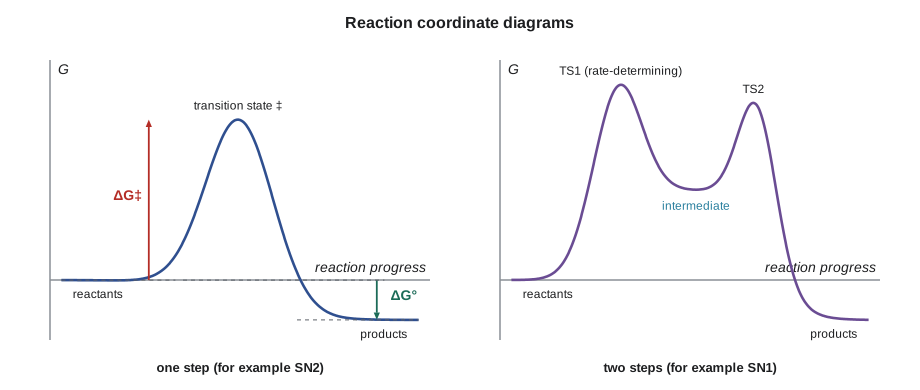
Many reactions have more than one step. Between the steps lies an intermediate, a species with a real, if short, lifetime that sits in a valley on the diagram. Carbocations, carbanions and radicals are the common reactive intermediates of organic chemistry. The step with the highest transition state relative to the starting materials is the rate-determining step, and the overall rate depends on it alone. A reaction can be fast but unfavorable (small ΔG‡, positive ΔG°) or favorable but slow (large ΔG‡, negative ΔG°); kinetics and thermodynamics are separate questions.
Linking energy to rate and equilibrium
The equilibrium constant follows from ΔG° by the relation used in CHEM-102:
At 25 °C, RT is 2.48 kJ/mol, so every 5.7 kJ/mol of ΔG° changes K by a factor of ten. A reaction with ΔG° = −20 kJ/mol has K ≈ 3200 and goes essentially to completion.
Rate constants follow from ΔG‡ by the Eyring equation of transition state theory (Henry Eyring, Meredith Evans and Michael Polanyi, 1935):
The factor k_BT/h is about 6.2 × 10¹² s⁻¹ at 25 °C, roughly the frequency of a bond vibration. A barrier of 80 kJ/mol gives k ≈ 6 × 10⁻² s⁻¹, a half-life of about ten seconds; 100 kJ/mol gives a half-life of several hours. Reactions that occur at a convenient rate at room temperature typically have barriers of 70 to 95 kJ/mol. The older Arrhenius equation, k = A e^(−Ea/RT), expresses the same exponential dependence with an empirical activation energy and pre-exponential factor. A rule of thumb follows from both: near room temperature, raising the temperature by 10 °C roughly doubles or triples the rate of a typical reaction.
When two reactions compete from the same starting material, the ratio of their products under kinetic control is set by the difference between their barriers, ΔΔG‡:
A difference of 5.7 kJ/mol gives a 10:1 ratio at 25 °C, and 11.4 kJ/mol gives 100:1. Small energy differences produce large selectivities, which is why chemists care so much about the stability of transition states.
Kinetic and thermodynamic control
When a reaction can give two products and the products can interconvert under the reaction conditions, the outcome depends on time and temperature. At low temperature, or when the reaction is stopped early, the product that forms faster dominates, even if it is less stable: the reaction is under kinetic control, and the ratio follows ΔΔG‡. At higher temperature, or after a long time, the products reach equilibrium, and the more stable product dominates: the reaction is under thermodynamic control, and the ratio follows ΔG° between the products. The two can give opposite answers. The classic example is the addition of HBr to buta-1,3-diene, which at −80 °C gives mainly the 1,2-adduct, formed faster, and at 40 °C mainly the 1,4-adduct, which is more stable; CHEM-263 explains why. Many reactions in this course are effectively irreversible, so kinetic control applies, but recognizing when equilibration is possible is part of predicting products.
Concentration and the rate law
Mechanisms make testable predictions about how the rate depends on concentration. For an elementary step, the rate is proportional to the concentration of each species that takes part: a step in which one molecule falls apart is first order, and a step in which two molecules collide is second order. The experimental rate law of a multistep reaction reflects its rate-determining step and anything before it. Measuring how the rate changes when the concentration of each reactant is doubled is therefore one of the oldest tools for testing mechanisms, and lesson 9 uses it to distinguish the two pathways of nucleophilic substitution. Other tools include stereochemistry, isotope labeling, the detection of intermediates by spectroscopy, and the effect of substituents on rate.
The Hammond postulate
Transition states cannot be observed, so how can we reason about their structure and energy? George Hammond proposed in 1955 that a transition state resembles the species, reactant or product, that it is closer to in energy. For a strongly endothermic step, such as the formation of a carbocation from a neutral molecule, the transition state lies close in energy to the product and resembles it; anything that stabilizes the carbocation also stabilizes the transition state leading to it, and so speeds the reaction. For a strongly exothermic step the transition state resembles the reactants and is less sensitive to the stability of the product. The Hammond postulate explains why the stability of intermediates predicts rates, why tertiary carbocations form faster than primary ones (lesson 9), why addition to alkenes follows Markovnikov's rule (lesson 11), and why bromination of alkanes is more selective than chlorination (lesson 5).
Reactive intermediates
Carbocations are electron-deficient carbons with three bonds and an empty p orbital; they are sp² and planar. Their stability increases with the number of alkyl groups attached, tertiary > secondary > primary > methyl, because alkyl groups donate electron density by hyperconjugation (overlap of neighboring C–H and C–C σ bonds with the empty p orbital) and by induction. Resonance stabilizes them further: allylic and benzylic carbocations are especially stable. Carbanions have three bonds and a lone pair; they are stabilized by electronegative atoms, resonance and s character, the same factors that make their conjugate acids acidic. Radicals have seven valence electrons and show the same stability order as carbocations, though the differences are smaller.
Worked problem
Using ΔΔG‡ to predict a product ratio
Two pathways from the same intermediate have barriers of 62.0 and 67.5 kJ/mol at 25 °C. What is the ratio of products under kinetic control, and what would it be at −78 °C if the barriers were the same?
Show solution
- ΔΔG‡ = 67.5 − 62.0 = 5.5 kJ/mol.
- At 298 K: RT = 2.479 kJ/mol; ratio = e^(5.5/2.479) = e^(2.22) ≈ 9.2.
- At 195 K: RT = 1.621 kJ/mol; ratio = e^(5.5/1.621) = e^(3.39) ≈ 30.
Answer: About 9:1 at room temperature and about 30:1 at −78 °C. Lowering the temperature increases selectivity, which is why many selective reactions are run in a dry-ice bath.
import math
R = 8.314e-3            # kJ/(mol K)
kB, h = 1.380649e-23, 6.62607015e-34

def K_from_dG(dG, T=298.15):
    return math.exp(-dG / (R * T))

def eyring_k(dG_act, T=298.15):
    return kB * T / h * math.exp(-dG_act / (R * T))

for dG in (-20, -5.7, 0, 5.7, 20):
    print(f'dG0 = {dG:+6.1f} kJ/mol   K = {K_from_dG(dG):10.3g}')
print()
for barrier in (60, 70, 80, 90, 100, 110):
    k = eyring_k(barrier)
    half = math.log(2) / k
    unit = 's' if half < 120 else ('min' if half < 7200 else 'h')
    scale = {'s': 1, 'min': 60, 'h': 3600}[unit]
    print(f'dG++ = {barrier:3d} kJ/mol  k = {k:9.3g} /s  half-life = {half / scale:8.3g} {unit}')
print()
for T in (195.15, 273.15, 298.15, 348.15):
    ratio = math.exp(5.5 / (R * T))
    print(f'T = {T - 273.15:6.1f} C   product ratio for ddG++ = 5.5 kJ/mol: {ratio:5.1f} : 1')
k25, k35 = eyring_k(85, 298.15), eyring_k(85, 308.15)
print(f'raising T from 25 to 35 C multiplies k by {k35 / k25:.2f} for an 85 kJ/mol barrier')dG0 = -20.0 kJ/mol K = 3.19e+03 dG0 = -5.7 kJ/mol K = 9.97 dG0 = +0.0 kJ/mol K = 1 dG0 = +5.7 kJ/mol K = 0.1 dG0 = +20.0 kJ/mol K = 0.000313 dG++ = 60 kJ/mol k = 191 /s half-life = 0.00363 s dG++ = 70 kJ/mol k = 3.38 /s half-life = 0.205 s dG++ = 80 kJ/mol k = 0.0599 /s half-life = 11.6 s dG++ = 90 kJ/mol k = 0.00106 /s half-life = 10.9 min dG++ = 100 kJ/mol k = 1.88e-05 /s half-life = 10.3 h dG++ = 110 kJ/mol k = 3.32e-07 /s half-life = 580 h T = -78.0 C product ratio for ddG++ = 5.5 kJ/mol: 29.7 : 1 T = 0.0 C product ratio for ddG++ = 5.5 kJ/mol: 11.3 : 1 T = 25.0 C product ratio for ddG++ = 5.5 kJ/mol: 9.2 : 1 T = 75.0 C product ratio for ddG++ = 5.5 kJ/mol: 6.7 : 1 raising T from 25 to 35 C multiplies k by 3.14 for an 85 kJ/mol barrier
The output shows the exponential sensitivity that makes mechanisms useful: each extra 10 kJ/mol of barrier slows a reaction by a factor of about 57 at room temperature, and the same small barrier difference gives a better product ratio the colder the reaction.
Common mistakes
MistakeDrawing an arrow from H⁺ to a lone pair.
InsteadArrows start at electrons: from the lone pair of the base to the proton.
MistakeTreating a transition state as an intermediate that can be isolated.
InsteadA transition state is an energy maximum with no lifetime; intermediates sit in valleys.
MistakeA reaction with a negative ΔG° must be fast.
InsteadΔG° controls equilibrium; the rate depends on ΔG‡.
MistakeThe rate-determining step is always the first step.
InsteadIt is the step whose transition state is highest relative to the starting materials.
MistakeNucleophilicity always parallels basicity.
InsteadPolarizable, large nucleophiles can be weak bases, and bulky strong bases can be poor nucleophiles.
MistakeA small energy difference gives a small selectivity.
Instead5.7 kJ/mol already gives 10:1 at room temperature.
Summary and key terms
- Organic reactions are additions, eliminations, substitutions and rearrangements; polar mechanisms involve electron-pair movement.
- Curved arrows go from electron pairs to electron-poor sites; fishhooks move single electrons.
- Nucleophiles donate electron pairs and electrophiles accept them; nucleophilicity is kinetic and basicity thermodynamic.
- Energy diagrams show transition states (maxima) and intermediates (minima); ΔG‡ sets the rate and ΔG° the equilibrium.
- K = e^(−ΔG°/RT); the Eyring equation gives k = (k_BT/h) e^(−ΔG‡/RT); product ratios follow ΔΔG‡.
- The Hammond postulate: a transition state resembles the nearer species in energy, linking intermediate stability to rate.
- Carbocation and radical stability: 3° > 2° > 1° > methyl; resonance adds further stabilization.
- Mechanism
- The sequence of elementary steps by which reactants become products.
- Nucleophile
- An electron-pair donor that forms a bond to an electron-poor atom.
- Electrophile
- An electron-pair acceptor.
- Transition state
- The highest-energy arrangement along a reaction step, with partial bonds.
- Intermediate
- A species formed and consumed during a reaction, at an energy minimum.
- Rate-determining step
- The step with the highest transition state, which controls the overall rate.
- Hammond postulate
- A transition state resembles the species nearer to it in energy.
- Hyperconjugation
- Stabilization by overlap of a filled σ bond with an adjacent empty or partly filled orbital.
Practice problems
Work each problem on paper first, then reveal the answer to check.
Classify each as addition, elimination, substitution or rearrangement: CH₃Br + CN⁻ → CH₃CN + Br⁻; CH₃CH₂OH → CH₂=CH₂ + H₂O; CH₂=CH₂ + Br₂ → BrCH₂CH₂Br.
Show answer
Substitution; elimination; addition.
Draw curved arrows for the reaction of ammonia with H–Cl.
Show answer
One arrow from the N lone pair to H, one from the H–Cl bond to Cl, giving NH₄⁺ and Cl⁻.
Identify the nucleophile and electrophile in the reaction of CH₃O⁻ with CH₃CH₂Br.
Show answer
CH₃O⁻ (oxygen lone pair) is the nucleophile; the δ+ carbon bonded to Br is the electrophile.
A reaction has ΔG‡ = 92 kJ/mol at 25 °C. Estimate its half-life.
Show answer
k = 6.2 × 10¹² × e^(−92/2.479) ≈ 4.6 × 10⁻⁴ s⁻¹; t½ = 0.693/k ≈ 1500 s, about 25 minutes.
Using the Hammond postulate, explain why a tertiary halide ionizes faster than a primary one.
Show answer
Ionization is endothermic, so its transition state resembles the carbocation; the more stable tertiary carbocation means a lower transition state.
What ΔΔG‡ gives a 99:1 product ratio at 25 °C?
Show answer
ΔΔG‡ = RT ln 99 = 2.479 × 4.60 ≈ 11.4 kJ/mol.
Lesson quiz · 5 questions
Score 60% or more to complete this lesson.
Create a free account to save your progress, take quizzes and earn a certificate.