
CHEM-261 · Lesson 12 of 12 · 24 min
Capstone: alkenes II and alkynes — hydroboration, oxidation, polymerization and synthesis planning
The electrophilic additions of lesson 11 all pass through carbocations or halonium ions, and so all follow Markovnikov orientation. A complete toolkit needs more: a way to add water with the opposite orientation, ways to add hydrogen and oxygen atoms with controlled stereochemistry, ways to cut a double bond, and ways to join alkenes into polymers. This capstone lesson gathers these reactions, extends them to alkynes, and then puts the whole course to work in the art of planning a synthesis, working backward from a target molecule to simple starting materials.
Hydroboration–oxidation
Herbert C. Brown discovered in the 1950s that borane, BH₃, adds rapidly to alkenes. Borane is a Lewis acid with an empty p orbital and is handled as a complex with tetrahydrofuran (BH₃·THF). It adds across the C=C in a single concerted step through a four-membered transition state: the π electrons attack boron while a hydride moves from boron to the other carbon. Two features follow from this mechanism. The addition is syn, with B and H adding to the same face, because both bonds form at once from the same side. And it is anti-Markovnikov: boron, the larger group and the electrophile, attaches to the less substituted, less hindered carbon, while hydrogen goes to the more substituted one. In the transition state the more substituted carbon carries a small partial positive charge, which alkyl groups stabilize; the steric preference points the same way.
Each B–H bond can add to an alkene, so with simple alkenes all three add, giving a trialkylborane. Treating it with hydrogen peroxide in aqueous sodium hydroxide replaces each C–B bond with a C–OH bond, with retention of configuration at carbon. The overall result, hydroboration–oxidation, is the addition of H and OH across the double bond with anti-Markovnikov regiochemistry and syn stereochemistry, and with no carbocation, so no rearrangement. Brown shared the 1979 Nobel Prize in Chemistry for the development of boron reagents in synthesis.
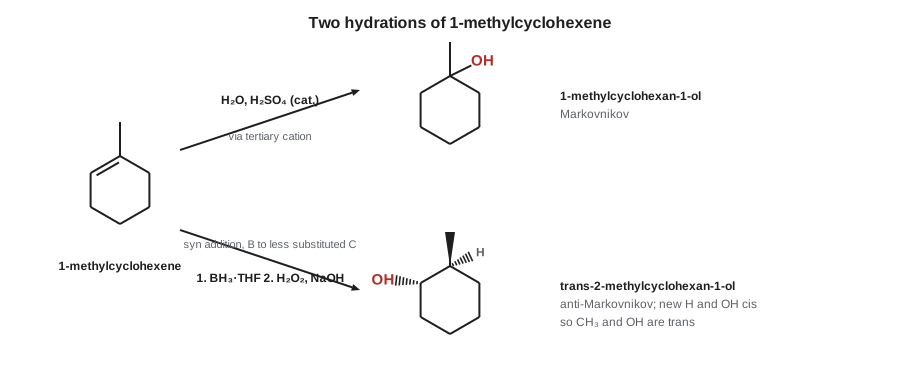
The two hydration methods are complementary. 1-Methylcyclohexene gives 1-methylcyclohexan-1-ol by acid-catalyzed hydration and trans-2-methylcyclohexan-1-ol by hydroboration–oxidation. The trans label refers to the relationship between CH₃ and OH: since H and OH were added to the same face, the new H on C1 and the OH on C2 are cis, so the methyl, on the opposite face from that H, is trans to the OH.
Catalytic hydrogenation
Hydrogen adds to alkenes in the presence of a finely divided metal catalyst, palladium on carbon, platinum oxide (Adams' catalyst) or Raney nickel, to give alkanes. Both the alkene and H₂ are adsorbed on the metal surface, where hydrogen atoms are delivered one after another to the same face of the alkene: hydrogenation is a syn addition. 1,2-Dimethylcyclohexene gives cis-1,2-dimethylcyclohexane. Paul Sabatier's work on nickel-catalyzed hydrogenation earned the 1912 Nobel Prize, and the process is used on a vast scale in the food industry to harden vegetable oils. Partial hydrogenation of oils was found to produce trans fats, whose links to heart disease led the US Food and Drug Administration to remove partially hydrogenated oils from the list of foods generally recognized as safe, effective in 2018.
Oxidation of alkenes
Three oxidations convert alkenes into oxygen-containing products.
Epoxidation. Peroxy acids, RCO₃H, such as meta-chloroperoxybenzoic acid (mCPBA), transfer an oxygen atom to the double bond in one concerted step, forming an epoxide, a three-membered cyclic ether. The addition is syn and stereospecific: cis alkenes give cis epoxides. The ring strain of epoxides, similar to that of cyclopropane, makes them reactive toward nucleophiles, which open the ring by SN2 backside attack; acid-catalyzed opening with water gives a trans-1,2-diol. Ethylene oxide, made industrially from ethylene and oxygen over silver, is the precursor of ethylene glycol for antifreeze and polyester.
Dihydroxylation. Osmium tetroxide, OsO₄, adds to alkenes through a cyclic osmate ester and, after cleavage, gives a cis-1,2-diol: syn dihydroxylation. Because OsO₄ is expensive and highly toxic, it is used in catalytic amounts with a co-oxidant such as N-methylmorpholine N-oxide, and only by trained chemists with appropriate containment. Cold, dilute, basic potassium permanganate does the same job less cleanly. Barry Sharpless's development of an enantioselective version earned part of the 2001 Nobel Prize. The two routes to diols are again complementary: epoxidation followed by ring opening gives trans diols, and OsO₄ gives cis diols.
Oxidative cleavage. Ozone, O₃, cleaves the C=C bond entirely. It adds to give an unstable primary ozonide that rearranges to an ozonide; a reductive workup with zinc or dimethyl sulfide then gives two carbonyl compounds, one from each half of the alkene. Each alkene carbon becomes a C=O: a CH₂= end gives formaldehyde, a CHR= end gives an aldehyde, and a CR₂= end gives a ketone. Ozonolysis was long used to locate double bonds in natural products, by identifying the fragments, and is still used in synthesis and in industry. Hot, concentrated potassium permanganate also cleaves alkenes, but oxidizes the aldehyde fragments further to carboxylic acids.
Polymerization
Alkenes can add to each other. In radical polymerization, an initiator such as a peroxide produces a radical that adds to ethylene; the new radical adds to another ethylene, and so on, building a chain of thousands of units: n CH₂=CH₂ → –(CH₂CH₂)ₙ–. Each addition converts a π bond into a σ bond and releases about 90 kJ/mol. Substituted alkenes, called vinyl monomers, give the familiar plastics: propylene gives polypropylene, chloroethene (vinyl chloride) gives PVC, styrene gives polystyrene, and tetrafluoroethylene gives PTFE. Radical polymerization of ethylene at high pressure gives branched, low-density polyethylene used for films. Karl Ziegler and Giulio Natta discovered in the 1950s that titanium and aluminum catalysts polymerize ethylene at low pressure into linear, high-density polyethylene, and polymerize propylene into stereoregular isotactic polypropylene, in which every methyl group points the same way; they shared the 1963 Nobel Prize. CHEM-401 covers polymers in depth. Global plastics production now exceeds 400 million metric tons a year, and its persistence in the environment is driving research into recycling and into polymers that break down after use.
Alkynes
Alkynes contain a C≡C triple bond, one σ and two π bonds, with sp carbons in a straight line. Their degree of unsaturation is 2. Ethyne (acetylene) burns with oxygen at about 3300 °C and is used in welding torches. Alkynes undergo many of the same additions as alkenes, often twice, and some reactions unique to them.
Acidity and alkylation. The C–H of a terminal alkyne (pKa 25) is acidic enough to be removed by sodium amide (lesson 4). The acetylide ion is a strong nucleophile that reacts with methyl and primary haloalkanes by SN2, forming a new C–C bond: HC≡C⁻ Na⁺ + CH₃CH₂Br → HC≡CCH₂CH₃. Repeating the sequence on the other end gives an internal alkyne. Secondary and tertiary halides give elimination instead, because acetylide is also a strong base (lesson 10). Acetylide alkylation is one of the few reactions in this course that makes carbon–carbon bonds, which makes it central to synthesis planning.
Reduction. Hydrogenation over palladium or platinum adds two equivalents of H₂ and gives the alkane. A poisoned catalyst, Lindlar's catalyst (palladium on calcium carbonate deactivated with lead acetate and quinoline), stops at the alkene and, being a syn addition, gives the cis (Z) alkene. A dissolving-metal reduction with sodium or lithium in liquid ammonia gives the trans (E) alkene, through a radical anion and a vinyl anion that adopts the more stable trans geometry. These two reductions let the chemist choose either alkene geometry from one alkyne.
Additions. HX adds to alkynes with Markovnikov orientation, and a second equivalent gives a geminal dihalide, with both halogens on the same carbon. Halogens add once or twice. Hydration of an alkyne, catalyzed by mercury(II) sulfate in aqueous sulfuric acid, gives an enol, a compound with OH on a C=C, which rapidly tautomerizes to the more stable ketone; terminal alkynes give methyl ketones. Hydroboration–oxidation of a terminal alkyne, using a bulky borane so that only one addition occurs, gives an aldehyde instead. Mercury salts are highly toxic, and gold catalysts that avoid mercury are increasingly used for alkyne hydration.
Planning a synthesis: retrosynthetic analysis
With the reactions of this course you can make a large number of molecules from simple starting materials. The question is how to find a route. Elias James Corey formalized the method chemists use, retrosynthetic analysis, for which he received the 1990 Nobel Prize. You start from the target and work backward, one step at a time, asking: what immediate precursor could give this molecule in one known reaction? Each backward step is written with an open arrow, ⇒, and is called a disconnection. The process continues until you reach simple, available starting materials. Then you check the forward route for problems: will the right regiochemistry and stereochemistry result, will any step give unwanted side reactions, and will any functional group interfere with another step?
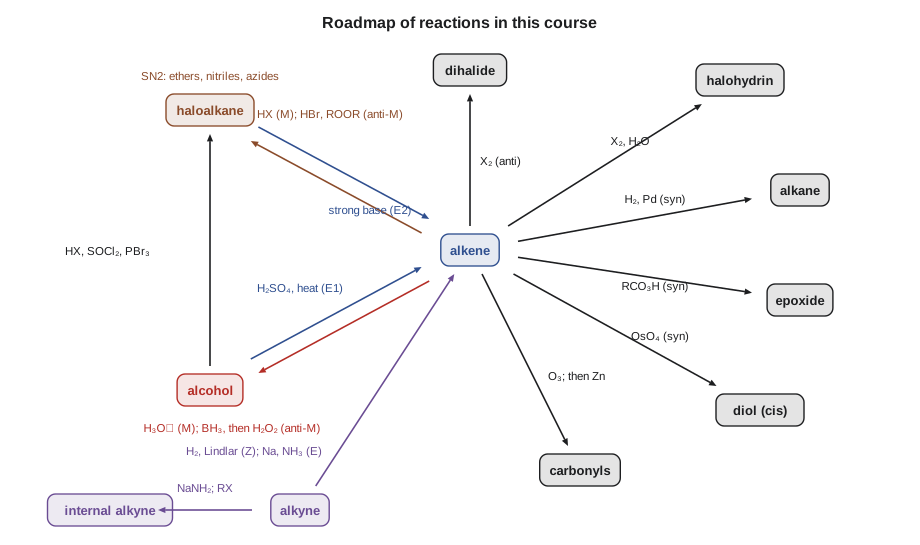
Some guiding principles: disconnect C–C bonds where you know a C–C bond-forming reaction, such as acetylide alkylation; use functional group interconversions to reach a group that can be disconnected; and choose reactions whose selectivity gives exactly the isomer you want. The roadmap figure collects the reactions of this course into a network of interconversions.
Worked problem
A three-step synthesis by retrosynthesis
Plan a synthesis of (Z)-hex-3-ene from ethyne and any other reagents with no more than two carbons.
Show solution
- Target: a cis alkene. Retrosynthesis: (Z)-hex-3-ene ⇒ hex-3-yne, by Lindlar hydrogenation (syn, gives Z).
- Hex-3-yne is CH₃CH₂C≡CCH₂CH₃: disconnect each C–CH₂CH₃ bond ⇒ ethyne and two bromoethane units, by two acetylide alkylations.
- Forward: ethyne + NaNH₂, then CH₃CH₂Br, gives but-1-yne; NaNH₂ again, then CH₃CH₂Br, gives hex-3-yne; H₂ with Lindlar catalyst gives (Z)-hex-3-ene.
- Check: bromoethane is primary, so SN2 is favored over E2; Lindlar stops at the alkene and gives cis geometry. For the E isomer, Na in NH₃ would replace the Lindlar step.
Answer: 1. NaNH₂; 2. CH₃CH₂Br; 3. NaNH₂; 4. CH₃CH₂Br; 5. H₂, Lindlar catalyst.
from collections import deque

# A tiny reaction network: (start, reagents, product). Breadth-first search finds
# the shortest route between two compounds using only these known steps.
STEPS = [
    ('ethyne', 'NaNH2; CH3CH2Br', 'but-1-yne'),
    ('but-1-yne', 'NaNH2; CH3CH2Br', 'hex-3-yne'),
    ('but-1-yne', 'H2, Lindlar', 'but-1-ene'),
    ('hex-3-yne', 'H2, Lindlar', '(Z)-hex-3-ene'),
    ('hex-3-yne', 'Na, NH3(l)', '(E)-hex-3-ene'),
    ('hex-3-yne', 'H2 (2 equiv), Pd/C', 'hexane'),
    ('(E)-hex-3-ene', 'Br2', 'meso-3,4-dibromohexane'),
    ('(Z)-hex-3-ene', 'Br2', 'rac-3,4-dibromohexane'),
    ('(Z)-hex-3-ene', 'OsO4 (cat.), NMO', 'meso-hexane-3,4-diol'),
    ('(E)-hex-3-ene', 'O3; then Zn', 'propanal'),
    ('but-1-ene', 'BH3; then H2O2, NaOH', 'butan-1-ol'),
    ('but-1-ene', 'H2O, H2SO4', 'butan-2-ol'),
    ('but-1-ene', 'HBr', '2-bromobutane'),
    ('but-1-ene', 'HBr, peroxides', '1-bromobutane'),
    ('1-bromobutane', 'NaCN, DMSO', 'pentanenitrile'),
    ('2-bromobutane', 'KOC(CH3)3', 'but-1-ene'),
]

def route(start, target):
    graph = {}
    for a, r, b in STEPS:
        graph.setdefault(a, []).append((r, b))
    queue, seen = deque([(start, [])]), {start}
    while queue:
        node, path = queue.popleft()
        if node == target:
            return path
        for reagent, nxt in graph.get(node, []):
            if nxt not in seen:
                seen.add(nxt)
                queue.append((nxt, path + [(reagent, nxt)]))
    return None

for target in ['(Z)-hex-3-ene', 'meso-hexane-3,4-diol', 'propanal', 'pentanenitrile', 'butan-1-ol']:
    path = route('ethyne', target)
    print(f'ethyne -> {target}: {len(path)} steps')
    for i, (reagent, product) in enumerate(path, 1):
print(f' {i}. {reagent:24s} -> {product}')ethyne -> (Z)-hex-3-ene: 3 steps 1. NaNH2; CH3CH2Br -> but-1-yne 2. NaNH2; CH3CH2Br -> hex-3-yne 3. H2, Lindlar -> (Z)-hex-3-ene ethyne -> meso-hexane-3,4-diol: 4 steps 1. NaNH2; CH3CH2Br -> but-1-yne 2. NaNH2; CH3CH2Br -> hex-3-yne 3. H2, Lindlar -> (Z)-hex-3-ene 4. OsO4 (cat.), NMO -> meso-hexane-3,4-diol ethyne -> propanal: 4 steps 1. NaNH2; CH3CH2Br -> but-1-yne 2. NaNH2; CH3CH2Br -> hex-3-yne 3. Na, NH3(l) -> (E)-hex-3-ene 4. O3; then Zn -> propanal ethyne -> pentanenitrile: 4 steps 1. NaNH2; CH3CH2Br -> but-1-yne 2. H2, Lindlar -> but-1-ene 3. HBr, peroxides -> 1-bromobutane 4. NaCN, DMSO -> pentanenitrile ethyne -> butan-1-ol: 3 steps 1. NaNH2; CH3CH2Br -> but-1-yne 2. H2, Lindlar -> but-1-ene 3. BH3; then H2O2, NaOH -> butan-1-ol
The search finds the shortest route through the network, just as a chemist does mentally. Note the stereochemical logic it captures: the meso diol comes from the Z alkene by syn dihydroxylation, while the meso dibromide (in the network) comes from the E alkene by anti addition. Computer-aided synthesis planning, pioneered by Corey's LHASA program in the late 1960s and now powered by large reaction databases and machine learning, works on the same principle with millions of reactions.
Looking ahead
This course has built a foundation: structure and bonding, nomenclature, acidity, conformation, stereochemistry, the language of mechanism, substitution and elimination at sp³ carbon, and addition to alkenes and alkynes. CHEM-263 continues with aromatic compounds and electrophilic aromatic substitution, alcohols and ethers, and the large family of carbonyl compounds, aldehydes, ketones, carboxylic acids and their derivatives, and amines. The same ideas, nucleophiles meeting electrophiles, stability of intermediates, and the three-dimensional shapes of molecules, will explain all of it. CHEM-282 introduces the spectroscopic methods, infrared, NMR and mass spectrometry, by which the products of every reaction in this course are identified.
Common mistakes
MistakeHydroboration–oxidation follows Markovnikov's rule.
InsteadIt is anti-Markovnikov: B, then OH, goes to the less substituted carbon.
MistakeHydroboration adds H and OH anti.
InsteadB and H add syn, and oxidation keeps the configuration, so H and OH end up syn.
MistakeLindlar hydrogenation gives the trans alkene.
InsteadLindlar gives the cis (Z) alkene; Na in liquid NH₃ gives the trans (E) alkene.
MistakeAcetylide ions alkylate tertiary halides.
InsteadAcetylides are strong bases; with secondary and tertiary halides they cause E2.
MistakeOzonolysis of a CR₂= end gives an aldehyde.
InsteadEach carbon becomes a C=O; a carbon with two R groups gives a ketone.
MistakeRetrosynthesis starts from the starting materials.
InsteadIt starts from the target and works backward one known reaction at a time.
Summary and key terms
- Hydroboration–oxidation adds H and OH syn and anti-Markovnikov, without rearrangement.
- Catalytic hydrogenation is a syn addition of H₂; it hardens oils and reduces alkynes fully.
- Peroxy acids give epoxides (syn); OsO₄ gives cis diols; epoxide opening gives trans diols; ozonolysis cleaves C=C into carbonyls.
- Radical and Ziegler–Natta polymerization join alkenes into polyethylene, polypropylene and other plastics.
- Terminal alkynes are deprotonated by NaNH₂; acetylides alkylate methyl and primary halides to build C–C bonds.
- Lindlar reduction gives Z alkenes and Na/NH₃ gives E alkenes; alkyne hydration gives ketones through enols.
- Retrosynthetic analysis works backward from a target through known reactions to available starting materials.
- Hydroboration
- Syn addition of a B–H bond across a C=C, boron going to the less substituted carbon.
- Syn addition
- Addition of two groups to the same face of a π bond.
- Epoxide
- A three-membered cyclic ether.
- Ozonolysis
- Cleavage of a C=C by ozone to give two carbonyl compounds.
- Polymer
- A large molecule made of many repeating monomer units.
- Acetylide ion
- The conjugate base of a terminal alkyne, a strong nucleophile and base.
- Tautomer
- An isomer related by the movement of a hydrogen and a double bond, as between an enol and a ketone.
- Retrosynthetic analysis
- Planning a synthesis by working backward from the target molecule.
Practice problems
Work each problem on paper first, then reveal the answer to check.
Give the product of hydroboration–oxidation of 2-methylpropene and of propene.
Show answer
2-Methylpropan-1-ol and propan-1-ol (anti-Markovnikov).
Predict the products of ozonolysis (O₃; then Zn) of 2-methylpent-2-ene.
Show answer
(CH₃)₂C=CHCH₂CH₃ gives propanone (acetone) and propanal.
Which reagent converts cyclohexene into cis-cyclohexane-1,2-diol, and which into the trans diol?
Show answer
Cis: OsO₄ (catalytic, with NMO). Trans: mCPBA to the epoxide, then H₃O⁺ ring opening.
Plan a synthesis of (E)-oct-4-ene from ethyne and haloalkanes.
Show answer
Ethyne → NaNH₂, CH₃CH₂CH₂Br → pent-1-yne → NaNH₂, CH₃CH₂CH₂Br → oct-4-yne → Na, NH₃(l) → (E)-oct-4-ene.
Why does propyne with HgSO₄ in aqueous H₂SO₄ give acetone rather than an alcohol?
Show answer
Water adds Markovnikov to give an enol, CH₃C(OH)=CH₂, which tautomerizes to the more stable ketone.
Plan a synthesis of 1-bromobutane from but-1-ene, and of butan-2-ol from but-1-ene.
Show answer
1-Bromobutane: HBr with peroxides (anti-Markovnikov). Butan-2-ol: H₂O with H₂SO₄ catalyst (Markovnikov).
Lesson quiz · 5 questions
Score 60% or more to complete this lesson.
Create a free account to save your progress, take quizzes and earn a certificate.