
CHEM-261 · Lesson 3 of 12 · 27 min
Drawing and naming organic molecules: functional groups and IUPAC nomenclature
Organic chemists need a fast, unambiguous way to draw molecules and a systematic way to name them. A Lewis structure of cholesterol, with all 74 atoms and every bond drawn, would fill a page and hide what matters. The skeletal formula used throughout organic chemistry shows the same molecule clearly in a few seconds of drawing. Names matter just as much: a name in a paper, a patent, a safety data sheet or a regulation must identify one compound and no other. This lesson covers the conventions for drawing structures, surveys the functional groups you will meet in this course and the next, and sets out the main rules of the IUPAC system of nomenclature.
Ways of drawing structures
A molecule can be drawn at several levels of detail. A full structural formula shows every atom and bond. A condensed formula writes atoms in order with their hydrogens, such as CH₃CH₂CH₂OH for propan-1-ol, sometimes with parentheses for branches, as in (CH₃)₂CHOH for propan-2-ol. A skeletal formula, also called a line-angle or bond-line drawing, is the one chemists use most. Its conventions are:
1. Carbon atoms are not written. Each end of a line and each vertex where lines meet is a carbon.
2. Hydrogens on carbon are not written; each carbon has as many as it needs to make four bonds.
3. Heteroatoms are always written, with any hydrogens attached to them (OH, NH₂, SH).
4. Chains are drawn as zigzags, which reflects the real 109.5° angles at sp³ carbons and the preferred extended conformation.
5. Double bonds are two lines and triple bonds three; atoms around a triple bond are drawn in a straight line.
6. Wedges and dashes show bonds coming toward and going away from the viewer (lesson 6).
To read a skeletal formula, count the carbons at each vertex and end, then supply hydrogens. A vertex with two lines is a CH₂, with three lines a CH, with four a C with no hydrogens; a line end is a CH₃. Practice converting in both directions until it is automatic; it is the most used skill in the subject.
Functional groups
Functional groups are the reactive parts of molecules. They can be grouped by the kind of carbon they involve and by the oxidation level of that carbon. The table lists those covered in CHEM-261 and CHEM-263, with the suffix or prefix each takes in a name.
| Class | Group | Example | Name ending |
|---|---|---|---|
| Alkane | C–C, C–H only | CH₃CH₂CH₃, propane | -ane |
| Alkene | C=C | CH₂=CHCH₃, propene | -ene |
| Alkyne | C≡C | HC≡CCH₃, propyne | -yne |
| Arene | benzene ring | C₆H₅CH₃, methylbenzene (toluene) | -benzene |
| Haloalkane | C–X (X = F, Cl, Br, I) | CH₃CH₂Br, bromoethane | prefix halo- |
| Alcohol | C–OH | CH₃CH₂OH, ethanol | -ol |
| Ether | C–O–C | CH₃CH₂OCH₂CH₃, ethoxyethane | prefix alkoxy- |
| Thiol | C–SH | CH₃SH, methanethiol | -thiol |
| Amine | C–N | CH₃NH₂, methanamine | -amine |
| Aldehyde | H–C=O | CH₃CHO, ethanal | -al |
| Ketone | C–C(=O)–C | CH₃COCH₃, propanone (acetone) | -one |
| Carboxylic acid | C(=O)OH | CH₃COOH, ethanoic acid | -oic acid |
| Ester | C(=O)O–C | CH₃COOCH₃, methyl ethanoate | -oate |
| Amide | C(=O)N | CH₃CONH₂, ethanamide | -amide |
| Acid chloride | C(=O)Cl | CH₃COCl, ethanoyl chloride | -oyl chloride |
| Nitrile | C≡N | CH₃CN, ethanenitrile | -nitrile |
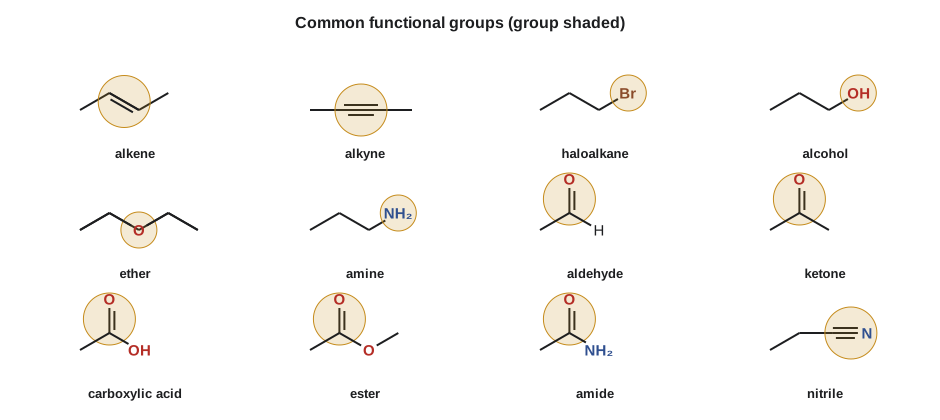
A useful way to see relationships among groups is the oxidation level of the carbon bearing the heteroatom, counted by its number of bonds to heteroatoms. Alkanes are at level 0. Alcohols, ethers, haloalkanes and amines are at level 1, with one bond to a heteroatom. Aldehydes and ketones are at level 2, since a C=O counts as two bonds. Carboxylic acids, esters, amides, acid chlorides and nitriles are at level 3. Reactions that interconvert groups at the same level, such as an alcohol to a haloalkane or an acid to an ester, need no oxidizing or reducing agent; moving between levels, such as an alcohol to a ketone, does.
IUPAC nomenclature: the principles
The International Union of Pure and Applied Chemistry (IUPAC) publishes the rules of systematic nomenclature; the current recommendations for organic compounds date from 2013. A systematic name has a parent, a chain or ring that gives the root of the name; a suffix for the principal functional group; prefixes for substituents; and locants, numbers that say where each feature is. Many compounds also have common or trivial names, such as acetone, acetic acid and toluene, which IUPAC retains for some and which remain in daily use. You should know both for the common compounds.
The roots for chains of one to ten carbons are meth-, eth-, prop-, but-, pent-, hex-, hept-, oct-, non- and dec-. The first four come from historical names; the rest from Greek numbers. Substituent groups derived from alkanes are alkyl groups: methyl, ethyl, propyl and so on. Some branched alkyl groups have retained names: isopropyl, (CH₃)₂CH–; isobutyl, (CH₃)₂CHCH₂–; sec-butyl, CH₃CH₂CH(CH₃)–; and tert-butyl, (CH₃)₃C–.
Carbons are classified by how many other carbons they are bonded to: a primary (1°) carbon to one, secondary (2°) to two, tertiary (3°) to three and quaternary (4°) to four. The same terms apply to the hydrogens on those carbons and to the alcohols and haloalkanes whose functional group sits on them: 2-bromopropane is a secondary haloalkane and tert-butyl alcohol a tertiary alcohol. These classes will matter a great deal for reactivity in lessons 9 and 10.
Naming alkanes
The procedure for an alkane is:
1. Find the longest continuous carbon chain; it is the parent. If two chains tie, choose the one with more substituents.
2. Number the chain from the end that gives the first substituent the lowest locant. If that ties, compare the next locant, and so on (the first point of difference rule).
3. Name each substituent and give its locant. Use di-, tri- and tetra- for repeated identical substituents, with a locant for each.
4. List substituents in alphabetical order, ignoring the multiplying prefixes di-, tri- and so on, and the prefixes sec- and tert-, but not iso-.
5. Write the name as one word, with commas between numbers and hyphens between numbers and letters.
Worked problem
Naming a branched alkane
Name (CH₃)₂CHCH₂CH(CH₂CH₃)CH₂CH₃.
Show solution
- Write the carbons out: C1 and its branch are the two CH₃ groups on a CH; then CH₂, then a CH carrying an ethyl group, then CH₂CH₃.
- Longest chain: start at one CH₃ of the isopropyl end, through CH, CH₂, CH, and along either ethyl arm: six carbons. The two six-carbon choices (through either ethyl) are equivalent.
- Substituents on the hexane chain: a methyl on C2 and an ethyl on C4, numbering from the isopropyl end (locants 2,4). From the other end they would be 3,5, so 2,4 wins.
- Alphabetical order: ethyl before methyl.
Answer: 4-Ethyl-2-methylhexane.
Naming compounds with functional groups
When a molecule has a functional group, the group named as a suffix is the principal characteristic group, chosen by a priority order. In decreasing priority, the main ones are: carboxylic acids, esters, acid halides, amides, nitriles, aldehydes, ketones, alcohols, thiols and amines. Alkenes and alkynes are treated as modifications of the parent chain (-ene, -yne), and halogens, alkoxy groups and nitro groups are always prefixes. The rules then change slightly:
1. The parent chain must contain the principal group, and should include any C=C or C≡C bonds if possible.
2. Number the chain to give the principal group the lowest locant, then multiple bonds, then substituents.
3. The locant of the suffix goes immediately before the suffix in current IUPAC style, as in pent-2-ene and butan-2-ol. The older style, 2-pentene and 2-butanol, is still common in North American textbooks and catalogs, and you should recognize both.
4. When a lower-priority group is a prefix, it takes the prefix form: hydroxy- for OH, oxo- for C=O, amino- for NH₂.
Aldehydes and carboxylic acids are always at the end of a chain, so their carbon is C1 and needs no locant: butanal, hexanoic acid. In rings, the carbon bearing the principal group is C1: cyclohexanol, 3-methylcyclohexanone. Esters are named as alkyl alkanoates, with the part from the alcohol first as a separate word: ethyl ethanoate (ethyl acetate) is the solvent of nail polish remover.
Worked problem
Naming a compound with two functional groups
Name CH₃CH(OH)CH₂C(=O)CH₃ and HOCH₂CH=CHCH₂CH₃ (ignoring cis–trans isomerism for now).
Show solution
- First compound: the ketone outranks the alcohol, so the parent is a five-carbon chain with -one, numbered from the ketone end: C2 is the C=O, C4 carries the OH.
- The alcohol becomes a prefix, hydroxy-: 4-hydroxypentan-2-one.
- Second compound: the alcohol is the principal group (-ol), the chain of five carbons includes the C=C, and numbering from the OH end gives OH at C1 and C=C at C2.
- Name: pent-2-en-1-ol. The final e of -ene is dropped before a vowel.
Answer: 4-Hydroxypentan-2-one and pent-2-en-1-ol.
Rings, alkenes and alkynes
Cycloalkanes are named by adding cyclo- to the root for the number of ring carbons: cyclopropane, cyclobutane, cyclopentane, cyclohexane. A ring is the parent if it has at least as many carbons as the largest chain attached to it; otherwise the ring is named as a substituent, cyclohexyl or cyclopentyl. Substituents on a ring are numbered to give the lowest locants, with the first-cited substituent in alphabetical order taking C1 when there is a choice: 1-ethyl-3-methylcyclohexane, not 3-ethyl-1-methylcyclohexane. When a ring carries a principal group, that carbon is C1 and the numbering continues in the direction that gives the next feature the lower number, as in 3-methylcyclohexan-1-one, usually shortened to 3-methylcyclohexanone.
Alkenes and alkynes take the endings -ene and -yne, with a locant for the first carbon of the multiple bond: but-1-ene, CH₂=CHCH₂CH₃, and but-2-ene, CH₃CH=CHCH₃. A chain is numbered to give the multiple bond the lowest locant unless a higher-priority group outranks it. Two double bonds make a diene (buta-1,3-diene), three a triene, and a molecule with both a double and a triple bond is an enyne, with the double bond cited first: pent-1-en-4-yne. If the double and triple bonds would get the same locants from either end, the double bond takes the lower number. Some common substituent names for unsaturated groups are worth learning because they appear constantly: vinyl, CH₂=CH–; allyl, CH₂=CHCH₂–; phenyl, C₆H₅–; and benzyl, C₆H₅CH₂–. A vinyl group is attached through an sp² carbon of the double bond, an allyl group through the sp³ carbon next to it, and the difference matters for reactivity in lessons 9 and 11.
Cis–trans isomerism in alkenes, and the E/Z system that names it unambiguously, is covered with the other kinds of stereoisomerism in lessons 6 and 7. For now, note that a name such as but-2-ene is incomplete if the compound is one specific isomer: (E)-but-2-ene and (Z)-but-2-ene are different compounds with different boiling points, 1 °C and 4 °C.
Common names that every chemist uses
Many compounds are known almost exclusively by common names, and IUPAC retains several of them. You should be able to draw these on sight: acetone (propanone), acetic acid (ethanoic acid), formaldehyde (methanal), acetaldehyde (ethanal), formic acid (methanoic acid), ethylene (ethene), acetylene (ethyne), isopropyl alcohol (propan-2-ol, rubbing alcohol), toluene (methylbenzene), phenol (hydroxybenzene), aniline (benzenamine), chloroform (trichloromethane), diethyl ether (ethoxyethane) and ethyl acetate (ethyl ethanoate). Common names often survive because the compounds were known long before systematic nomenclature: formic acid takes its name from the Latin for ant, and acetic acid from the Latin for vinegar. Suppliers' catalogs and safety documents generally list both the common and the systematic name, and the CAS number removes any doubt.
Names in practice
Names do not replace structures; they let you write a structure in words and find it again. Chemists also use registry numbers, such as the CAS number, and line notations designed for computers, such as SMILES (Simplified Molecular Input Line Entry System). In SMILES, ethanol is CCO, acetic acid CC(=O)O, and benzene c1ccccc1, with lower case for aromatic atoms and digits to close rings. Databases such as PubChem accept names, SMILES and drawings and return the compound with its properties and safety data. In the United States, chemical names on labels and safety data sheets follow the OSHA Hazard Communication Standard, and the TSCA Inventory maintained by the EPA identifies compounds by CAS number.
import re
ROOT = ['meth', 'eth', 'prop', 'but', 'pent', 'hex', 'hept', 'oct', 'non', 'dec']
MASS = {'C': 12.011, 'H': 1.008, 'N': 14.007, 'O': 15.999, 'Cl': 35.45, 'Br': 79.904}
VAL = {'C': 4, 'N': 3, 'O': 2, 'Cl': 1, 'Br': 1}

def alkane(n):
    return ROOT[n - 1] + 'ane'

def smiles_formula(smi):
    """Molecular formula of a SMILES string with C, N, O, Cl, Br, branches,
    =, # and ring-closure digits (no aromatic atoms, no charges)."""
    tokens = re.findall(r'Cl|Br|[CNO]|[=#]|\(|\)|\d', smi)
    atoms, used, stack, prev, order, rings = [], [], [], None, 1, {}
    for t in tokens:
        if t in VAL:
            atoms.append(t); used.append(0); i = len(atoms) - 1
            if prev is not None:
                used[prev] += order; used[i] += order
            prev, order = i, 1
        elif t == '=': order = 2
        elif t == '#': order = 3
        elif t == '(': stack.append(prev)
        elif t == ')': prev = stack.pop()
        else:                                   # ring closure digit
            if t in rings:
                j = rings.pop(t); used[j] += 1; used[prev] += 1
            else:
                rings[t] = prev
    count = {}
    for a, u in zip(atoms, used):
        count[a] = count.get(a, 0) + 1
        count['H'] = count.get('H', 0) + VAL[a] - u
    return count

def show(c):
    order = ['C', 'H'] + sorted(k for k in c if k not in 'CH')
    return ''.join(k + (str(c[k]) if c[k] > 1 else '') for k in order if c.get(k))

print([alkane(n) for n in (1, 4, 7, 10)])
for name, smi in [('propan-2-ol', 'CC(O)C'), ('butanal', 'CCCC=O'),
                  ('cyclohexanone', 'O=C1CCCCC1'), ('ethyl ethanoate', 'CCOC(=O)C'),
                  ('4-ethyl-2-methylhexane', 'CC(C)CC(CC)CC'), ('ethanenitrile', 'CC#N'),
                  ('2-bromopropane', 'CC(Br)C')]:
    c = smiles_formula(smi)
    m = sum(MASS[k] * v for k, v in c.items())
print(f'{name:24s} {smi:14s} {show(c):10s} {m:7.2f} g/mol')['methane', 'butane', 'heptane', 'decane'] propan-2-ol CC(O)C C3H8O 60.10 g/mol butanal CCCC=O C4H8O 72.11 g/mol cyclohexanone O=C1CCCCC1 C6H10O 98.15 g/mol ethyl ethanoate CCOC(=O)C C4H8O2 88.11 g/mol 4-ethyl-2-methylhexane CC(C)CC(CC)CC C9H20 128.26 g/mol ethanenitrile CC#N C2H3N 41.05 g/mol 2-bromopropane CC(Br)C C3H7Br 122.99 g/mol
The small parser fills each atom's remaining valence with hydrogens, just as you do when reading a skeletal formula: a carbon with two neighbors gets two hydrogens, a carbon with a double bond and one other neighbor gets one, and so on. Real cheminformatics software, such as the open-source RDKit, handles the full SMILES language, but the principle is the same.
Common mistakes
MistakeChoosing the parent as the longest chain drawn horizontally.
InsteadThe parent is the longest continuous chain, which often bends through branches.
MistakeNumbering to give the lowest sum of locants.
InsteadUse the first point of difference: compare locants one at a time, starting with the lowest.
MistakeAlphabetizing di-, tri- and tert- as part of the name.
InsteadIgnore multiplying prefixes and sec-/tert- when alphabetizing; iso- is included.
MistakeWriting 2-methylbutane as 3-methylbutane.
InsteadNumber from the end nearer the first substituent.
MistakeNaming CH₃CH(OH)CH₂COCH₃ as a pentanol.
InsteadThe ketone outranks the alcohol; it is 4-hydroxypentan-2-one.
MistakeForgetting that every vertex in a skeletal formula is a carbon with hydrogens.
InsteadCount lines at each vertex and add hydrogens to make four bonds.
Summary and key terms
- Skeletal formulas omit C and the H on carbon; every vertex and line end is a carbon.
- Functional groups are the reactive parts of molecules and can be grouped by the oxidation level of their carbon.
- IUPAC names consist of a parent, a principal-group suffix, substituent prefixes and locants.
- For alkanes, use the longest chain, the first point of difference and alphabetical order of substituents.
- The principal group follows a priority order (acids > esters > amides > nitriles > aldehydes > ketones > alcohols > amines) and gets the lowest locant.
- Current IUPAC style puts locants before the suffix (butan-2-ol); the older style (2-butanol) is still widely used.
- SMILES strings and registry numbers identify compounds in databases.
- Skeletal formula
- A drawing in which carbons are vertices and line ends and hydrogens on carbon are omitted.
- Parent chain
- The main chain or ring that gives the root of a systematic name.
- Locant
- A number that gives the position of a substituent or functional group.
- Alkyl group
- A substituent formed by removing one hydrogen from an alkane, such as methyl or tert-butyl.
- Primary, secondary, tertiary carbon
- A carbon bonded to one, two or three other carbons.
- Principal characteristic group
- The highest-priority functional group, named as the suffix.
- SMILES
- A line notation that encodes a molecular structure as a string of characters.
Practice problems
Work each problem on paper first, then reveal the answer to check.
Name CH₃CH₂CH(CH₃)CH(CH₃)₂.
Show answer
Longest chain five carbons; methyls at 2 and 3 from the right-hand end: 2,3-dimethylpentane.
Draw the skeletal formula of 3-ethyl-2,2-dimethylheptane and give its formula.
Show answer
A seven-carbon zigzag with two methyls on C2 and an ethyl on C3; C₁₁H₂₄.
Name CH₂=CHCH₂CH₂OH and CH₃COCH₂CH₂CHO.
Show answer
But-3-en-1-ol; 4-oxopentanal (the aldehyde outranks the ketone).
Classify each carbon of 2-methylbutane as 1°, 2° or 3°.
Show answer
Three CH₃ groups are 1°, the CH₂ is 2°, and the CH bearing the methyl is 3°.
Write the condensed formula and the SMILES string of methyl propanoate.
Show answer
CH₃CH₂COOCH₃; CCC(=O)OC.
A student names a compound 2-ethylbutane. What is wrong, and what is the correct name?
Show answer
The longest chain is five carbons, not four: the compound is 3-methylpentane.
Lesson quiz · 5 questions
Score 60% or more to complete this lesson.
Create a free account to save your progress, take quizzes and earn a certificate.