
CHEM-261 · Lesson 4 of 12 · 23 min
Acids and bases in organic chemistry: pKa, structure and reactivity
Acid–base reactions are the simplest organic reactions and the most important to understand first. Many reactions begin with a proton transfer: an alcohol is protonated before it loses water, a ketone is deprotonated to form an enolate before it attacks an electrophile, and an amine is a base before it is a nucleophile. The ideas that explain acidity, electronegativity, atomic size, resonance, induction and hybridization, are the same ideas that explain the stability of the charged intermediates in every later mechanism. This lesson builds a working knowledge of pKa values and shows how to predict them from structure.
Brønsted–Lowry and Lewis acids
CHEM-102 defined acids and bases in water. In organic chemistry we use the same two definitions more broadly. In the Brønsted–Lowry definition (1923), an acid is a proton donor and a base a proton acceptor. When acetic acid donates a proton to water, acetate is its conjugate base and hydronium is the conjugate acid of water. In the Lewis definition (also 1923), an acid is an electron-pair acceptor and a base an electron-pair donor. Every Brønsted base is a Lewis base, but Lewis acids include species with no proton at all, such as BF₃, AlCl₃ and carbocations. Lewis acid–base reasoning merges into the language of mechanisms: a nucleophile is a Lewis base attacking carbon, and an electrophile is a Lewis acid.
Proton transfers are drawn with curved arrows: one arrow from a lone pair on the base to the proton, and a second from the H–A bond to A, showing the bond's electrons staying with A as the conjugate base. Getting this two-arrow pattern right is good practice for every mechanism that follows.
The pKa scale
The strength of an acid HA is measured by its acid dissociation constant in water, Ka = [H₃O⁺][A⁻]/[HA], and more conveniently by pKa = −log Ka. The stronger the acid, the larger Ka and the smaller pKa. Each unit of pKa is a factor of ten in Ka. Organic chemists use a pKa scale that runs from about −10 (very strong acids such as HI) to about 50 (alkanes), far beyond the range that can be measured in water; values outside roughly 0 to 14 are measured in other solvents and extrapolated, and should be treated as approximate.
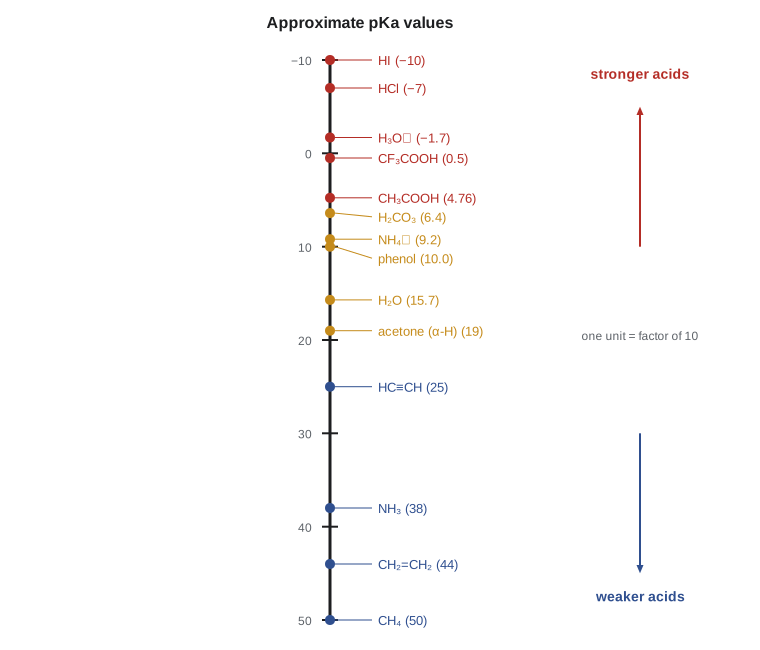
| Acid | Conjugate base | Approximate pKa |
|---|---|---|
| HCl | Cl⁻ | −7 |
| H₃O⁺ | H₂O | −1.7 |
| CF₃COOH | CF₃COO⁻ | 0.5 |
| CH₃COOH | CH₃COO⁻ | 4.76 |
| NH₄⁺ | NH₃ | 9.2 |
| C₆H₅OH, phenol | C₆H₅O⁻ | 10.0 |
| CH₃CH₂OH | CH₃CH₂O⁻ | 16 |
| H₂O | HO⁻ | 15.7 |
| CH₃COCH₃ (α-H) | enolate | 19 |
| HC≡CH | HC≡C⁻ | 25 |
| NH₃ | NH₂⁻ | 38 |
| CH₄ | CH₃⁻ | about 50 |
The pKa of water is often given as 15.7, a value obtained by dividing Kw by the concentration of water, 55.5 mol/L. On a consistent thermodynamic basis the value is 14.0, and some modern texts use it. The difference rarely matters for predictions, but you should know that both appear.
Predicting the position of an acid–base equilibrium
An acid–base equilibrium always lies on the side of the weaker acid and weaker base. If you know the pKa of the acid on each side, the equilibrium constant follows directly:
For example, does hydroxide deprotonate ethyne? The acid on the left is ethyne (pKa 25) and on the right is water (15.7). log K = 15.7 − 25 = −9.3, so the equilibrium lies far to the left: hydroxide is too weak a base. Sodium amide, NaNH₂, works instead: ammonia (38) on the right gives log K = 38 − 25 = +13, and deprotonation is essentially complete. This is how terminal alkynes are converted into acetylide anions, which lesson 12 uses as nucleophiles.
Structural factors that determine acidity
An acid is strong if its conjugate base is stable. Every factor that stabilizes the negative charge of A⁻ makes HA more acidic. Five factors cover nearly every case, and it helps to consider them in a fixed order, often remembered with the acronym ARIO plus hybridization:
Atom. Within a row of the periodic table, acidity increases with electronegativity: CH₄ (50) < NH₃ (38) < H₂O (15.7) < HF (3.2). Down a group, acidity increases with atomic size even though electronegativity falls: HF (3.2) < HCl (−7) < HBr (−9) < HI (−10), and similarly H₂O < H₂S (7.0). The larger atom spreads the negative charge over a bigger volume, and its bond to hydrogen is weaker. Size dominates down a group; electronegativity dominates across a row.
Resonance. Delocalizing the charge over several atoms stabilizes the conjugate base. Acetic acid (4.76) is about 10¹¹ times more acidic than ethanol (16), even though both lose a proton from an O–H group, because acetate spreads its charge equally over two oxygens while ethoxide keeps it on one. Phenol (10) is more acidic than cyclohexanol (18) because the phenoxide charge is delocalized into the ring. The α-hydrogen of acetone (19) is remarkably acidic for a C–H because the enolate puts the charge on oxygen through resonance.
Induction. Electronegative atoms nearby pull electron density through σ bonds and stabilize a nearby negative charge. The effect is additive and falls off quickly with distance. Acetic acid has pKa 4.76, chloroacetic acid 2.87, dichloroacetic acid 1.35 and trichloroacetic acid 0.66. Moving the chlorine farther away weakens the effect: 2-chlorobutanoic acid 2.86, 3-chlorobutanoic 4.05, 4-chlorobutanoic 4.52, against butanoic acid itself at 4.82.
Orbital (hybridization). A lone pair in an orbital with more s character is held closer to the nucleus and is more stable: ethyne (sp, 25) > ethene (sp², 44) > ethane (sp³, 50). The same factor makes a nitrile nitrogen a much weaker base than an amine nitrogen.
Solvation and sterics are a fifth, subtler factor. In water, small anions are stabilized by hydrogen bonding to the solvent. tert-Butanol (pKa about 18) is less acidic than methanol (15.5) in water mainly because the bulky tert-butoxide ion is poorly solvated; in the gas phase the order reverses.
Worked problem
Ranking acids by structure
Rank in order of increasing acidity: CH₃CH₂OH, CH₃COOH, CF₃COOH, CH₃CH₂NH₂ and C₆H₅OH. Justify each step.
Show solution
- Ethylamine (N–H, about 40) is least acidic: nitrogen is less electronegative than oxygen (atom factor).
- Ethanol (16): O–H, charge on one oxygen, no delocalization.
- Phenol (10): O–H, charge delocalized into the benzene ring (resonance).
- Acetic acid (4.76): charge delocalized equally over two oxygens (better resonance).
- Trifluoroacetic acid (0.5): carboxylate resonance plus strong induction from three fluorines.
Answer: CH₃CH₂NH₂ < CH₃CH₂OH < C₆H₅OH < CH₃COOH < CF₃COOH.
Bases and the pKa of conjugate acids
The strength of a base is described by the pKa of its conjugate acid, written pKaH. The higher the pKaH, the stronger the base. Methylamine has pKaH 10.6, so it is a stronger base than ammonia (9.2), because the methyl group donates electron density and the alkyl groups help stabilize the ammonium ion. Aniline, C₆H₅NH₂, has pKaH 4.6: its lone pair is delocalized into the ring and is less available. An amide nitrogen is barely basic at all (pKaH about −0.5), and amides are protonated on oxygen, not nitrogen, because of the resonance described in lesson 2. Strong bases used in synthesis include hydroxide, alkoxides such as tert-butoxide, amide ion (NH₂⁻, pKaH 38), lithium diisopropylamide (LDA, pKaH about 36) and hydride (as NaH).
Carbon acids and Lewis acids in organic reactions
Most C–H bonds are not acidic at all in the ordinary sense, but some are, and those are central to synthesis. A C–H bond becomes acidic when the carbanion formed by removing the proton is stabilized. The strongest stabilization comes from resonance with a carbonyl or nitrile group, which places the negative charge on an electronegative atom. Acetone's α-hydrogens have pKa 19, ethyl acetate's about 25, and acetonitrile's about 25 (in water-based estimates; some tables quote 29 to 31 in DMSO). Two carbonyl groups flanking one CH₂ make it far more acidic: pentane-2,4-dione has pKa 9, comparable with phenol, so it is fully deprotonated by hydroxide. Hybridization stabilizes the acetylide ion, as you have seen. A plain alkane C–H has none of these advantages, and its pKa near 50 means that only the most reactive organometallic bases, such as butyllithium (whose conjugate acid, butane, has pKa about 50), can remove it.
Lewis acids appear constantly in organic chemistry as catalysts. Aluminum chloride and iron(III) bromide activate halogens and acyl chlorides for reactions with benzene (CHEM-263). Boron trifluoride, usually as its complex with diethyl ether, coordinates to the oxygen of a carbonyl group or an epoxide and makes the attached carbon more electrophilic. Metal ions such as Zn²⁺ and Mg²⁺ play the same role in many enzymes. In each case the Lewis acid accepts a lone pair from oxygen or a halogen, which draws electron density away from the neighboring carbon. Protonation by a Brønsted acid does the same thing, and it is why many reactions of alcohols, ethers and carbonyl compounds are acid-catalyzed: a protonated alcohol, ROH₂⁺, carries the excellent leaving group water, while the neutral alcohol would have to lose the very poor leaving group hydroxide (lesson 9).
Using acid–base reactions to separate compounds
Acid–base chemistry is also a laboratory tool. In an extraction, a mixture dissolved in an organic solvent such as diethyl ether or ethyl acetate is shaken with an aqueous acid or base. A neutral organic compound stays in the organic layer, but one that is converted into an ion moves into the water, because ions are far more soluble in water. Shaking with aqueous sodium bicarbonate pulls out carboxylic acids as their sodium salts; aqueous sodium hydroxide also removes phenols; and dilute hydrochloric acid removes amines as their ammonium salts. Acidifying or basifying the separated aqueous layer then regenerates the neutral compound, which can be extracted back into fresh solvent. The choice of reagent follows directly from the pKa values in this lesson: a base removes an acid only if the conjugate acid of the base is weaker than the acid being removed. Bicarbonate (pKaH 6.4) removes benzoic acid (4.2) but not phenol (10); hydroxide (15.7) removes both. Carbon dioxide gas is released when bicarbonate reacts with an acid, so the separatory funnel must be vented often.
Acidity, pH and the fraction ionized
In aqueous solution, whether an acid group is mostly protonated or mostly ionized depends on the pH relative to its pKa, through the Henderson–Hasselbalch relation from CHEM-211:
At pH equal to pKa, half the acid is ionized; each unit of pH above the pKa multiplies the ratio A⁻/HA by ten. At the pH of blood, 7.4, a carboxylic acid (pKa about 4.5) is more than 99.8 per hundred ionized, while a typical amine (pKaH about 10) is more than 99 per hundred protonated. Amino acids therefore exist in the body as zwitterions, with both a carboxylate and an ammonium group. The same reasoning explains how drugs are absorbed: neutral forms cross cell membranes much more easily than charged ones, so the pKa of a drug strongly affects where it goes in the body.
import math

PKA = {'HCl': -7, 'H3O+': -1.7, 'CF3COOH': 0.5, 'CH3COOH': 4.76, 'NH4+': 9.2,
       'phenol': 10.0, 'H2O': 15.7, 'ethanol': 16, 'acetone': 19, 'ethyne': 25,
       'NH3': 38, 'CH4': 50}

def log_k(acid_left, acid_right):
    """HA(left) + base -> A- + HB(right): log K = pKa(right) - pKa(left)."""
    return PKA[acid_right] - PKA[acid_left]

pairs = [('ethyne', 'H2O', 'HO- with ethyne'),
         ('ethyne', 'NH3', 'NH2- with ethyne'),
         ('CH3COOH', 'H2O', 'HO- with acetic acid'),
         ('acetone', 'ethanol', 'ethoxide with acetone'),
         ('phenol', 'CH3COOH', 'acetate with phenol')]
for left, right, label in pairs:
    lk = log_k(left, right)
    side = 'products' if lk > 0 else 'reactants'
    print(f'{label:22s} log K = {lk:+6.1f}  -> lies toward {side}')

def fraction_ionized(pka, ph):
    return 1 / (1 + 10 ** (pka - ph))

print()
for name, pka in [('acetic acid', 4.76), ('phenol', 10.0), ('ibuprofen (COOH)', 4.4)]:
    row = '  '.join(f'pH {ph}: {100 * fraction_ionized(pka, ph):5.1f}' for ph in (2, 4.76, 7.4))
print(f'{name:18s} ionized per hundred -> {row}')HO- with ethyne log K = -9.3 -> lies toward reactants NH2- with ethyne log K = +13.0 -> lies toward products HO- with acetic acid log K = +10.9 -> lies toward products ethoxide with acetone log K = -3.0 -> lies toward reactants acetate with phenol log K = -5.2 -> lies toward reactants acetic acid ionized per hundred -> pH 2: 0.2 pH 4.76: 50.0 pH 7.4: 99.8 phenol ionized per hundred -> pH 2: 0.0 pH 4.76: 0.0 pH 7.4: 0.3 ibuprofen (COOH) ionized per hundred -> pH 2: 0.4 pH 4.76: 69.6 pH 7.4: 99.9
The output confirms the predictions: hydroxide fails to deprotonate ethyne but amide succeeds; hydroxide deprotonates acetic acid completely; ethoxide makes only a small equilibrium amount of the enolate of acetone, which is why a stronger base such as LDA is used when the enolate must form completely (CHEM-263); and acetate does not deprotonate phenol.
Common mistakes
MistakeA lower pKa means a weaker acid.
InsteadA lower pKa means a larger Ka and a stronger acid.
MistakeHF is the strongest hydrohalic acid because fluorine is most electronegative.
InsteadDown a group, size dominates: HI is the strongest and HF the weakest.
MistakeEquilibria favor the side with the stronger acid.
InsteadThey favor the side with the weaker acid and weaker base.
MistakeInductive effects act over any distance.
InsteadThey fall off rapidly, roughly halving with each bond.
MistakeHydroxide can deprotonate any C–H with an electronegative neighbor.
InsteadOnly acids with pKa well below 15.7 are deprotonated extensively by hydroxide.
MistakeThe basicity of a base is given by its own pKa.
InsteadIt is given by the pKa of its conjugate acid (pKaH).
Summary and key terms
- Brønsted acids donate protons; Lewis acids accept electron pairs, and Lewis bases donate them.
- pKa = −log Ka; each unit is a factor of ten, and the organic scale runs from about −10 to 50.
- An equilibrium favors the weaker acid; log K = pKa(acid on the right) − pKa(acid on the left).
- Acidity depends on the stability of the conjugate base: atom (electronegativity across, size down), resonance, induction and hybridization, plus solvation.
- Base strength is measured by the pKa of the conjugate acid.
- The fraction ionized at a given pH follows from pH − pKa, which governs the forms of amino acids and drugs in the body.
- Brønsted acid
- A proton donor.
- Lewis acid
- An electron-pair acceptor.
- Conjugate base
- The species formed when an acid loses a proton.
- pKa
- The negative base-10 logarithm of the acid dissociation constant.
- pKaH
- The pKa of the conjugate acid of a base, a measure of base strength.
- Inductive effect
- Stabilization or destabilization of charge through σ bonds by nearby polar groups.
- Zwitterion
- A neutral molecule carrying both a positive and a negative formal charge, such as an amino acid in water.
Practice problems
Work each problem on paper first, then reveal the answer to check.
Will sodium bicarbonate (H₂CO₃ pKa 6.4) dissolve benzoic acid (pKa 4.2) by deprotonating it?
Show answer
log K = 6.4 − 4.2 = +2.2, so yes; this is the standard test that separates carboxylic acids from phenols, which bicarbonate cannot deprotonate (log K = 6.4 − 10 < 0).
Explain why CH₃SH (pKa 10.3) is more acidic than CH₃OH (15.5).
Show answer
Sulfur is larger; the charge of CH₃S⁻ is spread over a bigger atom and the S–H bond is weaker (size dominates down a group).
Rank fluoroacetic, chloroacetic and bromoacetic acids by acidity.
Show answer
Fluoroacetic (2.6) > chloroacetic (2.9) > bromoacetic (2.9); induction follows electronegativity, with Cl and Br nearly equal.
Which is the stronger base, CH₃CH₂O⁻ or CH₃COO⁻? Explain.
Show answer
Ethoxide: its conjugate acid, ethanol (16), is far weaker than acetic acid (4.76), so ethoxide holds a proton more strongly.
At pH 7.4, what fraction of an amine with pKaH 10.6 is in the neutral form?
Show answer
Neutral fraction = 1/(1 + 10^(10.6 − 7.4)) = 1/(1 + 1585) ≈ 0.06 per hundred; essentially all is protonated.
Draw curved arrows for the reaction of tert-butoxide with ethanol and predict the position of equilibrium.
Show answer
Arrow from O⁻ of tert-butoxide to H of ethanol, and from the O–H bond to O. pKa ethanol 16, tert-butanol 18: log K = +2, products favored.
Lesson quiz · 5 questions
Score 60% or more to complete this lesson.
Create a free account to save your progress, take quizzes and earn a certificate.