
CHEM-261 · Lesson 1 of 12 · 25 min
What organic chemistry is: carbon, structure and function
Organic chemistry is the chemistry of carbon compounds. The definition sounds narrow, but carbon forms more compounds than all the other elements combined: the Chemical Abstracts Service registry, which records every substance described in the chemical literature, passed 200 million entries in the 2020s, and the great majority contain carbon. Your own body is built from organic molecules: proteins, fats, sugars, DNA and the small signal molecules that carry messages between cells. So are almost all medicines, plastics, dyes, fuels, fibers, pesticides, flavors and fragrances. This course is the first half of a two-term introduction. In it you will learn to read and draw organic structures, to name them, to think about their shapes in three dimensions, and to explain and predict their reactions with a small number of mechanistic ideas. The second half, CHEM-263, applies the same ideas to aromatic compounds, alcohols, carbonyl compounds and amines.
CHEM-101 introduced Lewis structures, formal charge, VSEPR, hybridization and molecular orbitals. CHEM-241 took bonding further for the whole periodic table. Here we narrow the focus to carbon and the elements it most often bonds to, hydrogen, oxygen, nitrogen, the halogens, sulfur and phosphorus, and we ask what structure tells us about reactivity.
A short history: from vital force to synthesis
In the early 1800s chemists divided substances into inorganic ones, obtained from minerals, and organic ones, obtained from living things. Many believed that organic compounds could be made only by living organisms through a vital force. Friedrich Wöhler's synthesis of urea in 1828 is the usual starting point of the modern subject. He heated ammonium cyanate, an inorganic salt, and obtained urea, a compound previously isolated from urine. The idea of a vital force did not disappear at once, and historians point out that the change was gradual, but by the middle of the century Hermann Kolbe had made acetic acid from carbon disulfide and Marcellin Berthelot had made many organic compounds from their elements. The distinction between organic and inorganic became a matter of convenience, not of principle.
The structural theory followed. In 1858 August Kekulé and, independently, Archibald Scott Couper proposed that carbon is tetravalent, forming four bonds, and that carbon atoms can bond to each other to form chains. Couper drew the first structural formulas with lines for bonds. In 1865 Kekulé proposed a ring structure for benzene. In 1874 Jacobus van 't Hoff and Joseph Le Bel independently proposed that the four bonds of a saturated carbon point to the corners of a tetrahedron, which explained why some compounds exist as mirror-image pairs. Gilbert Lewis's electron-pair bond of 1916 and the quantum mechanical theories of the 1930s gave these ideas their modern form. Throughout, the guiding principle has been that the properties of a compound follow from its structure, and that structure can be deduced from properties and reactions.
Why carbon?
Several features of carbon together explain its unique position.
First, carbon forms four strong covalent bonds. With four valence electrons it neither loses nor gains electrons easily, so it shares them. A carbon atom can bond to four other atoms, to three with one double bond, or to two with a triple bond or two double bonds.
Second, carbon–carbon bonds are strong, about 350 kJ/mol for a single bond, and nearly as strong as carbon's bonds to hydrogen (about 410 kJ/mol) and oxygen (about 360 kJ/mol). Chains of carbon atoms are therefore stable. Silicon, the element below carbon, forms Si–Si bonds of only about 225 kJ/mol but very strong Si–O bonds (about 450 kJ/mol), so silicon chemistry is dominated by silicates and silicones rather than by long chains of silicon atoms.
Third, carbon has an intermediate electronegativity, 2.55 on the Pauling scale. Its bonds to hydrogen are almost nonpolar, and its bonds to more electronegative atoms such as oxygen, nitrogen and the halogens are polar but covalent. This makes possible a range of reactivity, from the inertness of alkanes to the high reactivity of acid chlorides.
Fourth, organic compounds are kinetically stable. Most organic molecules in air are thermodynamically unstable with respect to carbon dioxide and water, yet they persist, because the reactions that would convert them have high activation energies. Wood does not burst into flame at room temperature. This kinetic stability is what allows life, and the chemist can choose conditions that open particular reaction pathways while others stay closed.
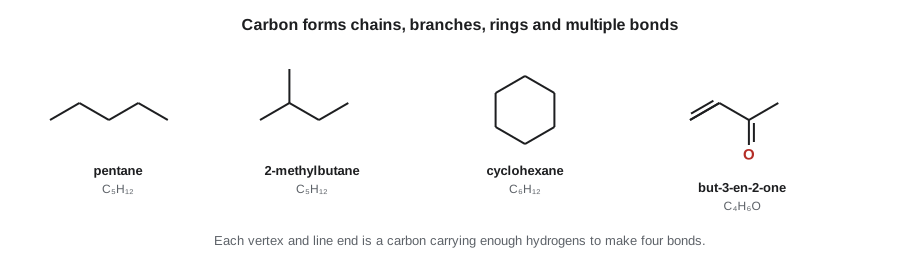
The elements of organic chemistry
Organic molecules contain far fewer elements than the periodic table offers. Carbon and hydrogen form the framework. Oxygen and nitrogen are the most common heteroatoms, the name for any atom other than carbon or hydrogen. Sulfur, phosphorus and the halogens fluorine, chlorine, bromine and iodine are frequent. Metals appear in reagents, catalysts and organometallic compounds, which CHEM-441 covers.
Each element has a typical number of bonds in a neutral molecule, its usual valence. Carbon forms four bonds, nitrogen three with one lone pair, oxygen two with two lone pairs, and hydrogen and the halogens one each, with the halogens carrying three lone pairs. These numbers are worth knowing by heart, because they let you check any structure you draw: a neutral carbon with five bonds, or a neutral oxygen with three, is a mistake. When an atom has more or fewer bonds than usual, it carries a formal charge, as lesson 2 shows. A nitrogen with four bonds, as in the ammonium ion, is positive; an oxygen with one bond and three lone pairs, as in hydroxide, is negative.
| Element | Usual bonds (neutral) | Lone pairs | Example |
|---|---|---|---|
| C | 4 | 0 | CH₄, methane |
| N | 3 | 1 | NH₃, ammonia; CH₃NH₂, methylamine |
| O | 2 | 2 | H₂O, water; CH₃OH, methanol |
| H | 1 | 0 | every C–H bond |
| F, Cl, Br, I | 1 | 3 | CH₃Cl, chloromethane |
| S | 2 (also 4 or 6) | 2 | CH₃SH, methanethiol |
| P | 3 (also 5) | 1 | phosphates in DNA |
Molecular formulas and the degree of unsaturation
A molecular formula such as C₆H₁₂O₆ tells you which atoms a molecule contains but not how they are joined. Many different structures, called isomers, share a formula. Even so, the formula carries structural information. A saturated, acyclic hydrocarbon, an alkane, has the formula CₙH₂ₙ₊₂: the chain has n carbons, each carbon uses two of its bonds for its neighbors except the two ends, and hydrogen fills the rest. Every ring or π bond removes two hydrogens. The number of rings plus π bonds is the degree of unsaturation, also called the index of hydrogen deficiency:
Here C, H, N and X are the numbers of carbon, hydrogen, nitrogen and halogen atoms. Oxygen and sulfur do not appear, because inserting a divalent atom into a chain does not change the hydrogen count. A halogen counts like hydrogen, since it forms one bond. Each nitrogen adds one, because a trivalent atom in the chain brings one extra position for hydrogen. The formula is easy to derive: count the bonding capacity. A saturated acyclic molecule with C carbons, N nitrogens and no rings needs 2C + 2 + N monovalent atoms; every hydrogen or halogen missing in pairs from that total signals one ring or π bond.
Worked problem
Degree of unsaturation of three formulas
Find the degree of unsaturation of C₆H₆ (benzene), C₄H₉N and C₅H₇Cl.
Show solution
- C₆H₆: (2 × 6 + 2 − 6)/2 = 8/2 = 4. Benzene has one ring and three double bonds.
- C₄H₉N: (8 + 2 + 1 − 9)/2 = 2/2 = 1. One ring or one π bond, for example pyrrolidine or but-3-en-1-amine.
- C₅H₇Cl: (10 + 2 − 7 − 1)/2 = 4/2 = 2. Two rings or π bonds, for example a chlorocyclopentene or a chloropentyne.
Answer: DoU = 4, 1 and 2. A DoU of 4 or more in a formula with six or more carbons often suggests a benzene ring.
The degree of unsaturation is the first thing a chemist calculates for an unknown compound, before turning to spectroscopy (CHEM-282). It limits the structures you need to consider. It also gives a quick check that a structure you have drawn matches its formula.
Isomers
Compounds with the same molecular formula but different structures are isomers. The simplest kind are constitutional isomers, which differ in which atoms are bonded to which. Butane and 2-methylpropane, both C₄H₁₀, are constitutional isomers; so are ethanol, CH₃CH₂OH, and dimethyl ether, CH₃OCH₃, which share the formula C₂H₆O but have very different properties. Ethanol boils at 78 °C and mixes with water in all proportions; dimethyl ether is a gas that boils at −24 °C, because it cannot donate a hydrogen bond. The number of constitutional isomers grows rapidly with size: C₄H₁₀ has 2, C₆H₁₄ has 5, C₁₀H₂₂ has 75, and C₂₀H₄₂ has 366,319.
Stereoisomers have the same connectivity but differ in the arrangement of atoms in space. They are the subject of lessons 6 and 7. Among them are enantiomers, which are non-superimposable mirror images, and diastereomers, which are stereoisomers that are not mirror images. Conformations, the different shapes a molecule takes by rotation about single bonds, are usually not counted as isomers because they interconvert rapidly at room temperature; they are the subject of lesson 5.
Functional groups: the idea that organizes the subject
A molecule's reactivity is concentrated in a few places. Most of the carbon skeleton, made of C–C and C–H bonds, is unreactive under ordinary conditions. Reactions happen at functional groups: specific arrangements of atoms, such as a C=C double bond, an O–H group or a C=O group, that behave in much the same way whatever skeleton they are attached to. An alcohol reacts as an alcohol whether it has two carbons or twenty. This is the idea that makes organic chemistry learnable. Instead of memorizing the reactions of millions of compounds, you learn the reactions of a few dozen functional groups. Lesson 3 surveys them.
How organic reactions happen
The second organizing idea is the reaction mechanism, the step-by-step description of how bonds break and form. Most organic reactions are polar reactions, in which an electron-rich species, a nucleophile, donates a pair of electrons to an electron-poor species, an electrophile. Chemists track the movement of electron pairs with curved arrows. Once you can identify nucleophiles and electrophiles in a structure, and once you understand how the stability of intermediates and transition states controls rates, you can predict the products of reactions you have never seen. Lessons 8 to 12 build this skill, starting from substitution and elimination at saturated carbon and moving to addition to alkenes and alkynes.
Two other kinds of mechanism appear in organic chemistry. Radical reactions involve species with unpaired electrons and single-electron movements, as in the chlorination of methane. Pericyclic reactions, such as the Diels–Alder reaction, proceed through a cyclic transition state in which several bonds form and break at once. We will meet radical halogenation in lesson 5 and leave pericyclic reactions to CHEM-363.
Organic chemistry in society
Organic chemistry is also an industry. The petrochemical industry converts crude oil and natural gas into a small set of building blocks, ethylene, propylene, the butenes, benzene, toluene and the xylenes, and from these into the polymers, solvents and intermediates of modern life. Ethylene is the most produced organic chemical in the world, at more than 150 million metric tons a year. The US Gulf Coast of Texas and Louisiana is the largest center of petrochemical production in the world, turning ethane from shale gas into ethylene and polyethylene. The pharmaceutical industry depends on organic synthesis to make drugs and on the understanding of shape and chirality to design them.
The same knowledge raises responsibilities. Organic compounds can be toxic, persistent or both: chlorofluorocarbons damaged the ozone layer, some pesticides accumulated in food chains, and per- and polyfluoroalkyl substances (PFAS) are now found in water worldwide. Green chemistry, a set of principles articulated by Paul Anastas and John Warner in 1998, asks chemists to design reactions that use less hazardous materials, waste fewer atoms and need less energy. Throughout the course we will note when a reaction is wasteful or a reagent hazardous, and in the laboratory you will follow the safety practices of CHEM-101: know the hazards of every substance from its safety data sheet, work in a fume hood with volatile or toxic materials, wear eye protection, and dispose of waste correctly.
import re

MASS = {'C': 12.011, 'H': 1.008, 'N': 14.007, 'O': 15.999, 'S': 32.06,
        'F': 18.998, 'Cl': 35.45, 'Br': 79.904, 'I': 126.904, 'P': 30.974}

def parse(formula):
    """Count atoms in a simple formula such as C6H12O6 or C5H7Cl."""
    counts = {}
    for sym, num in re.findall(r'([A-Z][a-z]?)(\d*)', formula):
        counts[sym] = counts.get(sym, 0) + (int(num) if num else 1)
    return counts

def dou(c):
    halogens = sum(c.get(x, 0) for x in ('F', 'Cl', 'Br', 'I'))
    return (2 * c.get('C', 0) + 2 + c.get('N', 0) - c.get('H', 0) - halogens) / 2

def molar_mass(c):
    return sum(MASS[s] * n for s, n in c.items())

for f in ['CH4', 'C6H6', 'C2H6O', 'C4H9N', 'C5H7Cl', 'C6H12O6', 'C8H10N4O2']:
    c = parse(f)
print(f'{f:10s} DoU = {dou(c):3.0f} M = {molar_mass(c):7.2f} g/mol')CH4 DoU = 0 M = 16.04 g/mol C6H6 DoU = 4 M = 78.11 g/mol C2H6O DoU = 0 M = 46.07 g/mol C4H9N DoU = 1 M = 71.12 g/mol C5H7Cl DoU = 2 M = 102.56 g/mol C6H12O6 DoU = 1 M = 180.16 g/mol C8H10N4O2 DoU = 6 M = 194.19 g/mol
The last formula is caffeine, C₈H₁₀N₄O₂, with a degree of unsaturation of 6: two rings and four π bonds (two C=O and two C=C or C=N). The program shows how much a formula alone tells you.
How to study organic chemistry
Organic chemistry rewards a particular way of working. Draw structures by hand, often, until you can sketch a molecule in skeletal form without hesitation. Build molecular models, physical or on a computer, to see shapes in three dimensions. Learn mechanisms, not just reactions: if you know why a reaction goes, you can work out the products of a new one. Work problems in quantity, because recognition comes from practice. And connect each new reaction to the ideas behind it, electronegativity, resonance, sterics and the stability of charges, which are few in number and come up again and again.
Common mistakes
MistakeOrganic compounds can only be made by living things.
InsteadWöhler's urea synthesis (1828) and much since showed that they can be made in the laboratory from inorganic starting materials.
MistakeOxygen changes the degree of unsaturation.
InsteadDivalent atoms such as O and S do not affect it; only C, H, N and the halogens appear in the formula.
MistakeA halogen counts as nothing in the DoU formula.
InsteadA halogen forms one bond, so it is counted like a hydrogen.
MistakeEthanol and dimethyl ether are the same compound because they share a formula.
InsteadThey are constitutional isomers with different connectivity and very different properties.
MistakeOrganic molecules are stable because they are thermodynamically stable.
InsteadMost are kinetically stable: their reactions with oxygen are favorable but slow.
MistakeReactivity depends on the whole molecule equally.
InsteadIt is concentrated in functional groups; the hydrocarbon skeleton is largely unreactive.
Summary and key terms
- Organic chemistry is the chemistry of carbon compounds, which outnumber the compounds of all other elements.
- Wöhler's urea synthesis (1828) and the structural theory of Kekulé and Couper (1858) and van 't Hoff and Le Bel (1874) founded the modern subject.
- Carbon forms four strong bonds, strong C–C bonds and bonds of moderate polarity, and its compounds are kinetically stable.
- Neutral C, N, O and H or halogens form 4, 3, 2 and 1 bonds; other bond counts mean a formal charge.
- The degree of unsaturation, (2C + 2 + N − H − X)/2, counts rings plus π bonds.
- Isomers share a formula; constitutional isomers differ in connectivity and stereoisomers in spatial arrangement.
- Functional groups and reaction mechanisms are the two ideas that organize the subject.
- Organic compound
- A compound of carbon, usually with hydrogen, other than simple carbonates, oxides and cyanides.
- Heteroatom
- Any atom in an organic molecule other than carbon or hydrogen.
- Degree of unsaturation
- The number of rings plus π bonds in a molecule, calculated from its formula.
- Isomers
- Different compounds with the same molecular formula.
- Constitutional isomers
- Isomers that differ in the order in which atoms are connected.
- Stereoisomers
- Isomers with the same connectivity but a different arrangement of atoms in space.
- Functional group
- A group of atoms with characteristic reactions largely independent of the rest of the molecule.
- Reaction mechanism
- The step-by-step description of bond breaking and bond making in a reaction.
Practice problems
Work each problem on paper first, then reveal the answer to check.
Calculate the degree of unsaturation of C₇H₈ (toluene) and of C₃H₆O.
Show answer
C₇H₈: (14 + 2 − 8)/2 = 4 (a benzene ring). C₃H₆O: (6 + 2 − 6)/2 = 1 (one ring or one π bond, for example acetone, propanal, allyl alcohol or oxetane).
Draw the two constitutional isomers of C₄H₁₀ and the three of C₅H₁₂.
Show answer
Butane and 2-methylpropane; pentane, 2-methylbutane and 2,2-dimethylpropane.
A compound has formula C₄H₈Br₂. What is its degree of unsaturation, and what does this tell you?
Show answer
(8 + 2 − 8 − 2)/2 = 0. It is saturated and acyclic: a dibromobutane or dibromomethylpropane.
Why are long chains of silicon atoms rare while chains of carbon atoms are common?
Show answer
Si–Si bonds (about 225 kJ/mol) are much weaker than Si–O bonds (about 450), so silicon chemistry favors silicates; C–C bonds are nearly as strong as C–H and C–O.
Explain why ethanol boils 100 °C higher than dimethyl ether although they share a formula.
Show answer
Ethanol has an O–H group and forms hydrogen bonds between molecules; dimethyl ether has no O–H and can only accept hydrogen bonds.
Check the structure CH₃–O–CH₂–N(H)–CH₃ for valence errors and give its formula.
Show answer
C uses 4 bonds, O 2, N 3 and each H 1, so it is valid; formula C₃H₉NO, DoU = (6 + 2 + 1 − 9)/2 = 0.
Lesson quiz · 5 questions
Score 60% or more to complete this lesson.
Create a free account to save your progress, take quizzes and earn a certificate.