
CHEM-241 · Lesson 9 of 12 · 22 min
Redox chemistry: reduction potentials, Latimer and Frost diagrams
Manganese can be found in compounds in every oxidation state from +2 to +7. Purple permanganate, MnO₄⁻, is a powerful oxidizing agent used to treat drinking water; brown manganese dioxide, MnO₂, is the cathode of ordinary alkaline batteries; pale pink Mn²⁺ is the form found in most minerals and in living cells. Which of these states is stable in water, and which will oxidize or reduce something else, or simply fall apart into two other states? Inorganic chemists answer such questions with a few compact diagrams built from standard reduction potentials. This lesson reviews the thermodynamics of redox reactions from CHEM-102, shows how potentials combine, and introduces the Latimer, Frost and Pourbaix diagrams that summarize the redox chemistry of an element on a single page.
Reduction potentials and free energy
A standard reduction potential E° measures the tendency of a half-reaction to proceed as a reduction relative to the standard hydrogen electrode, 2H⁺(aq) + 2e⁻ → H₂(g), which is assigned E° = 0. The link to thermodynamics is
where n is the number of electrons transferred and F = 96 485 C/mol is the Faraday constant. A positive E° means a negative ΔG°, a spontaneous reduction. A strong oxidizing agent has a large positive E° (F₂/F⁻ +2.87 V, MnO₄⁻/Mn²⁺ +1.51 V); a strong reducing agent has a large negative one (Li⁺/Li −3.04 V, Na⁺/Na −2.71 V). The Nernst equation gives the potential under non-standard conditions:
For half-reactions involving H⁺ or OH⁻, Q contains [H⁺], so the potential depends on pH. For MnO₄⁻ + 8H⁺ + 5e⁻ → Mn²⁺ + 4H₂O, the potential falls by 8 × 0.05916/5 = 0.095 V per pH unit when the other concentrations are at their standard values. Permanganate is a much stronger oxidizing agent in acid than in neutral or basic solution, where it is reduced only to MnO₂.
Combining potentials
Potentials are intensive: they do not add directly. To find the potential of a half-reaction from two others, combine the free energies, which are extensive, and divide by the total number of electrons:
Worked problem
Combining half-reactions for iron
Given Fe³⁺ + e⁻ → Fe²⁺ (E° = +0.771 V) and Fe²⁺ + 2e⁻ → Fe (E° = −0.447 V), find E° for Fe³⁺ + 3e⁻ → Fe.
Show solution
- Free energy of each step in volt-equivalents (nE°): 1 × 0.771 = +0.771 V and 2 × (−0.447) = −0.894 V.
- Total for three electrons: 0.771 − 0.894 = −0.123 V.
- Divide by n = 3: E° = −0.041 V.
Answer: E°(Fe³⁺/Fe) = −0.04 V. Simply adding the two potentials, which gives +0.32 V, would be wrong.
Latimer diagrams
Wendell Latimer, in his 1938 book on oxidation potentials, introduced a compact way to list the potentials of an element. The species are written in order of decreasing oxidation state from left to right, with the standard potential for each step written above the arrow joining them. For manganese in acid solution:
Each arrow stands for a balanced half-reaction, with H⁺ and H₂O added as needed; for example, MnO₂ + 4H⁺ + e⁻ → Mn³⁺ + 2H₂O for the +0.95 V step. Potentials for non-adjacent species are found by the combination rule: from MnO₄⁻ to Mn²⁺ (5 electrons), E° = (0.56 + 2 × 2.26 + 0.95 + 1.51)/5 = 7.54/5 = 1.51 V; from MnO₄⁻ to MnO₂ (3 electrons), E° = (0.56 + 4.52)/3 = 1.69 V.
A Latimer diagram reveals disproportionation at a glance. A species disproportionates (reacts with itself to give a higher and a lower oxidation state) when the potential on its right is greater than the potential on its left. For Mn³⁺, the potential to its right (+1.51 V, reduction to Mn²⁺) is greater than that on its left (+0.95 V, the reduction of MnO₂ to Mn³⁺), so 2Mn³⁺ + 2H₂O → MnO₂ + Mn²⁺ + 4H⁺ is spontaneous: E° = 1.51 − 0.95 = +0.56 V. Manganate, MnO₄²⁻, likewise disproportionates in acid (2.26 > 0.56) to MnO₄⁻ and MnO₂, which is why it is stable only in strongly basic solution. The reverse process, in which a higher and a lower state react to form an intermediate one, is called comproportionation.
Frost diagrams
Arthur Frost proposed in 1951 a graphical form that makes these relationships even clearer. A Frost diagram plots nE° (the free energy of a species relative to the element, in volt-equivalents, equal to −ΔG°/F) against oxidation state N. Each point is calculated by adding the nE° contributions from the element up to that species. For manganese, starting from Mn (0, 0): Mn²⁺ is at 2 × (−1.18) = −2.36 V; Mn³⁺ at −2.36 + 1.51 = −0.85; MnO₂ at −0.85 + 0.95 = +0.10; MnO₄²⁻ at 0.10 + 2 × 2.26 = 4.62; and MnO₄⁻ at 4.62 + 0.56 = 5.18 V.
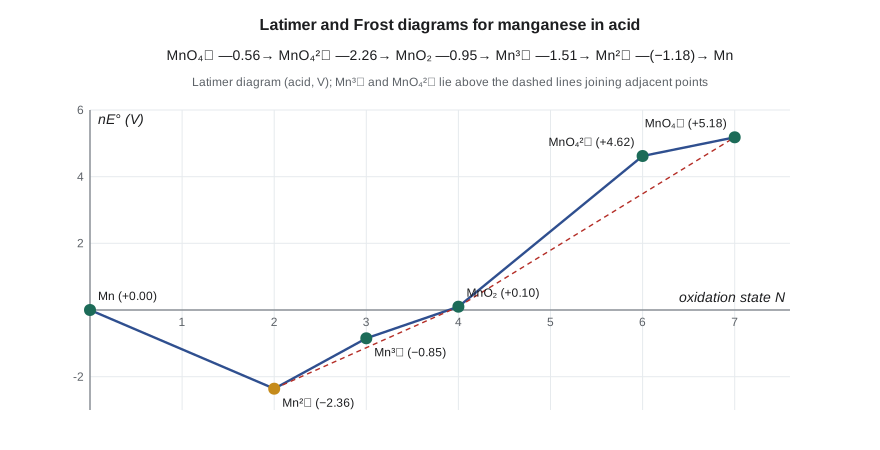
Reading a Frost diagram takes a few rules:
1. The lowest point is the most thermodynamically stable oxidation state. For manganese in acid it is Mn²⁺, which is why manganese is found as Mn²⁺ in many minerals and natural waters.
2. The slope of the line joining two points equals the standard potential of the couple. A steep positive slope (as from MnO₂ to MnO₄²⁻) means the higher state is a strong oxidizing agent.
3. A species that lies above the line joining its two neighbors is unstable with respect to disproportionation into them. Mn³⁺ and MnO₄²⁻ are such species.
4. A species that lies below the line joining its neighbors is stable toward disproportionation, and those neighbors will comproportionate to form it. MnO₂ lies below the line from Mn³⁺ to MnO₄²⁻.
5. Comparing diagrams for acid and base shows how pH changes the picture. In basic solution, the high oxidation states of manganese are less strongly oxidizing and MnO₂ and Mn(OH)₂ become important.
Disproportionation in practice: chlorine bleach
The Latimer diagram for chlorine in basic solution explains the chemistry of household bleach:
Chlorine has a larger potential on its right (+1.36) than on its left (+0.42), so in base it disproportionates: Cl₂ + 2OH⁻ → Cl⁻ + ClO⁻ + H₂O. This is how sodium hypochlorite bleach is made, by passing chlorine into cold sodium hydroxide. Hypochlorite is itself unstable toward further disproportionation, slowly at room temperature and faster when heated: 3ClO⁻ → 2Cl⁻ + ClO₃⁻. That is why bleach loses strength in a warm cupboard and why hot alkali converts chlorine to chlorate. In acid the situation reverses: the potential for HClO → Cl₂ (+1.63) exceeds that for Cl₂ → Cl⁻ (+1.36), so HClO and Cl⁻ comproportionate to chlorine, which is why mixing bleach with an acidic cleaner releases toxic chlorine gas.
A worked computation
The steps from a Latimer diagram to a Frost diagram, and the tests for disproportionation, are easy to automate. The code below builds the Frost diagram for manganese and for copper, flags any species that lies above the line joining its neighbors, and computes the pH dependence of the permanganate potential.
# Latimer -> Frost conversion and disproportionation tests (acid solution, 25 C).
def frost(latimer):
    """latimer: list of (species, oxidation state) from high to low, and potentials between them.
    Returns points (N, nE) with the element (N = 0) at nE = 0."""
    species, potentials = latimer
    pts = {species[-1][0]: (species[-1][1], 0.0)}
    nE = 0.0
    for i in range(len(species) - 2, -1, -1):
        (name, N), (_, N_low) = species[i], species[i + 1]
        nE += (N - N_low) * potentials[i]
        pts[name] = (N, nE)
    return pts

def report(title, latimer):
    pts = frost(latimer)
    print(title)
    for name, (N, nE) in sorted(pts.items(), key=lambda kv: kv[1][0]):
        print(f'   {name:7} N = {N:+d}   nE = {nE:+6.2f} V')
    order = sorted(pts.items(), key=lambda kv: kv[1][0])
    for (a, (Na, Ea)), (b, (Nb, Eb)), (c, (Nc, Ec)) in zip(order, order[1:], order[2:]):
        line = Ea + (Ec - Ea) * (Nb - Na) / (Nc - Na)
        verdict = 'disproportionates' if Eb > line else 'stable to disproportionation'
        print(f'   {b:7}: {Eb:+.2f} V vs line {line:+.2f} V -> {verdict}')
    lowest = min(pts.items(), key=lambda kv: kv[1][1])[0]
    print('   most stable species:', lowest)

mn = ([('MnO4-', 7), ('MnO4 2-', 6), ('MnO2', 4), ('Mn3+', 3), ('Mn2+', 2), ('Mn', 0)],
      [0.56, 2.26, 0.95, 1.51, -1.18])
cu = ([('Cu2+', 2), ('Cu+', 1), ('Cu', 0)], [0.153, 0.521])
report('Manganese, acid', mn)
report('Copper, acid', cu)

pts = frost(mn)
E_mno4_mn2 = (pts['MnO4-'][1] - pts['Mn2+'][1]) / 5
print(f'\nE(MnO4-/Mn2+) from the diagram: {E_mno4_mn2:.3f} V')
for pH in (0, 3, 7):
    E = E_mno4_mn2 - 0.05916 * 8 / 5 * pH
print(f' at pH {pH}: E = {E:.2f} V')Manganese, acid Mn N = +0 nE = +0.00 V Mn2+ N = +2 nE = -2.36 V Mn3+ N = +3 nE = -0.85 V MnO2 N = +4 nE = +0.10 V MnO4 2- N = +6 nE = +4.62 V MnO4- N = +7 nE = +5.18 V Mn2+ : -2.36 V vs line -0.57 V -> stable to disproportionation Mn3+ : -0.85 V vs line -1.13 V -> disproportionates MnO2 : +0.10 V vs line +0.97 V -> stable to disproportionation MnO4 2-: +4.62 V vs line +3.49 V -> disproportionates most stable species: Mn2+ Copper, acid Cu N = +0 nE = +0.00 V Cu+ N = +1 nE = +0.52 V Cu2+ N = +2 nE = +0.67 V Cu+ : +0.52 V vs line +0.34 V -> disproportionates most stable species: Cu E(MnO4-/Mn2+) from the diagram: 1.508 V at pH 0: E = 1.51 V at pH 3: E = 1.22 V at pH 7: E = 0.85 V
The copper result explains a familiar observation: Cu⁺ disproportionates in water to Cu²⁺ and copper metal (E° = 0.521 − 0.153 = +0.37 V). Copper(I) survives only when it is stabilized by precipitation (CuCl, CuI), by complexation with soft ligands such as cyanide or by a non-aqueous solvent such as acetonitrile, a nice application of the HSAB principle of lesson 8.
The stability field of water
Water itself can be oxidized and reduced, which sets limits on what can exist in it. At 25 °C, O₂ + 4H⁺ + 4e⁻ → 2H₂O has E = 1.229 − 0.0592 pH V, and 2H⁺ + 2e⁻ → H₂ has E = −0.0592 pH V. Any species with a reduction potential above the first line can, in principle, oxidize water to oxygen; any species with a potential below the second can reduce water to hydrogen. Fluorine, cobalt(III) aqua ions and permanganate in acid are thermodynamically able to oxidize water, and the alkali metals reduce it vigorously. Many reactions that are thermodynamically allowed are slow, however, because electron transfer to and from water needs a large overpotential, typically 0.4 to 0.6 V at many electrodes. This is why acidic permanganate solutions can be kept for weeks, and why aqueous batteries can operate at voltages somewhat above the 1.23 V window.
Pourbaix diagrams
Marcel Pourbaix extended these ideas in the 1940s into potential–pH diagrams, now called Pourbaix diagrams, which show the most stable form of an element over a range of potential and pH. Lines mark the boundaries between regions where one species dominates: horizontal lines for electron transfers that do not involve protons, vertical lines for acid–base reactions with no electron transfer, and sloping lines for reactions involving both. Pourbaix diagrams for iron show the conditions under which steel corrodes (Fe²⁺ or Fe³⁺ regions), stays passive under an oxide film (Fe₂O₃ and Fe₃O₄ regions) or is immune (Fe metal). They are the standard tool of corrosion engineers and of geochemists studying how metals move in natural waters.
Redox in metal extraction
The same thermodynamics, applied at high temperature, governs how metals are won from their ores. Harold Ellingham plotted in 1944 the standard free energy of formation of oxides against temperature. A metal can reduce the oxide of any metal whose line lies above its own on the diagram, and carbon, whose CO line slopes downward (because 2C + O₂ → 2CO increases the amount of gas), becomes a better reducing agent as the temperature rises. This is why iron oxides are reduced by coke and carbon monoxide in a blast furnace at about 1500 °C, while aluminum oxide, whose line lies far below carbon's at any practical temperature, must be reduced electrolytically in molten cryolite by the Hall–Héroult process, invented independently by Charles Martin Hall and Paul Héroult in 1886. Magnesium, titanium and the alkali metals likewise need electrolysis or reduction by an even more reactive metal.
Common mistakes
MistakePotentials of consecutive steps can be added.
InsteadAdd nE° values (free energies) and divide by the total number of electrons.
MistakeA positive E° means a reaction is fast.
InsteadE° gives thermodynamics only; many favorable reactions, especially with water, are slow.
MistakeThe highest point on a Frost diagram is the most stable.
InsteadThe lowest point is; high points are strong oxidizing or reducing agents.
MistakeA species disproportionates if the potential to its left is larger.
InsteadIt disproportionates if the potential to its right exceeds the one to its left.
MistakePermanganate oxidizes equally well at any pH.
InsteadIts potential falls by about 0.095 V per pH unit for reduction to Mn²⁺.
MistakeCu⁺ is stable in water because Cu⁺/Cu is positive.
InsteadCu⁺ disproportionates because E°(Cu⁺/Cu) > E°(Cu²⁺/Cu⁺).
Summary and key terms
- ΔG° = −nFE° links potentials to free energy; the Nernst equation gives the dependence on concentration and pH.
- Potentials for combined steps are found from nE° values, not by adding potentials.
- Latimer diagrams list potentials between successive oxidation states; a larger potential on the right means disproportionation.
- Frost diagrams plot nE° against oxidation state: the lowest point is most stable, slopes are potentials, and points above a line disproportionate.
- Chlorine disproportionates in base to make bleach; in acid, hypochlorite and chloride comproportionate to chlorine.
- Water's stability field, Pourbaix diagrams and Ellingham diagrams apply the same thermodynamics to solutions, corrosion and metallurgy.
- Standard reduction potential
- The potential of a half-reaction under standard conditions relative to the standard hydrogen electrode.
- Latimer diagram
- A list of species of an element in order of oxidation state with the potentials between them.
- Frost diagram
- A plot of nE° against oxidation state for the species of an element.
- Disproportionation
- A reaction in which one species is both oxidized and reduced.
- Comproportionation
- A reaction in which two species of an element in different oxidation states form an intermediate state.
- Overpotential
- The extra potential beyond the thermodynamic value needed to drive an electrode reaction at a useful rate.
- Pourbaix diagram
- A potential–pH map of the most stable species of an element.
Practice problems
Work each problem on paper first, then reveal the answer to check.
From MnO₂ → Mn³⁺ (+0.95 V) and Mn³⁺ → Mn²⁺ (+1.51 V), find E° for MnO₂ → Mn²⁺.
Show answer
(0.95 + 1.51)/2 = +1.23 V.
Does H₂O₂ disproportionate? O₂ → H₂O₂ is +0.70 V and H₂O₂ → H₂O is +1.76 V in acid.
Show answer
Yes: 1.76 > 0.70, so 2H₂O₂ → 2H₂O + O₂ with E° = +1.06 V; it is slow without a catalyst.
Calculate the Frost point nE° for Fe³⁺ using the data of the iron example.
Show answer
Fe²⁺: 2 × (−0.447) = −0.894; Fe³⁺: −0.894 + 0.771 = −0.123 V.
At what pH does the O₂/H₂O potential equal 0.82 V?
Show answer
1.229 − 0.0592 pH = 0.82 gives pH = 6.9, close to neutral water.
Explain why Mn²⁺ is the form of manganese found in reduced groundwater.
Show answer
It is the lowest point on the Frost diagram in acid to neutral solution.
Why can aluminum not be made by heating alumina with coke at 1500 °C?
Show answer
On the Ellingham diagram the Al₂O₃ line lies below carbon's; carbon cannot reduce it at practical temperatures.
Lesson quiz · 5 questions
Score 60% or more to complete this lesson.
Create a free account to save your progress, take quizzes and earn a certificate.