
CHEM-241 · Lesson 7 of 12 · 23 min
Molecular orbital theory: diatomics and polyatomics
Liquid oxygen is pale blue and sticks to the poles of a strong magnet; liquid nitrogen is colorless and pours straight past them. No Lewis structure of O₂ explains this, because every reasonable one pairs all the electrons. Molecular orbital (MO) theory explains it at once: two of oxygen's electrons sit unpaired in a pair of degenerate antibonding orbitals. MO theory, developed by Friedrich Hund and Robert Mulliken from 1927, treats electrons as belonging to the molecule as a whole rather than to individual bonds. It is the theory behind photoelectron spectra, the colors of compounds, the reactivity of carbon monoxide toward metals and the bonding in electron-deficient molecules such as diborane. Mulliken received the Nobel Prize in Chemistry in 1966 for this work. CHEM-101 introduced MO diagrams of the first-row diatomics; this lesson derives them, explains s–p mixing, extends the theory to heteronuclear molecules and, using the symmetry tools of lessons 5 and 6, to polyatomic molecules.
The LCAO approximation and H₂⁺
Molecular orbitals are approximated as linear combinations of atomic orbitals (LCAO). The simplest case, the hydrogen molecule ion H₂⁺, has one electron and two protons. Combine a 1s orbital on each nucleus, φ_A and φ_B:
The best coefficients minimize the energy E = ∫ψĤψ/∫ψ². Writing α = ∫φ_A Ĥ φ_A (the Coulomb integral, roughly the energy of an electron in the isolated atomic orbital), β = ∫φ_A Ĥ φ_B (the resonance integral, negative, measuring the energy of interaction) and S = ∫φ_A φ_B (the overlap integral), setting the derivatives of E with respect to c_A and c_B to zero gives two linear equations, the secular equations. They have a nontrivial solution only if the secular determinant vanishes:
The lower root, E₊ = (α + β)/(1 + S), belongs to the bonding orbital ψ₊ ∝ φ_A + φ_B, which concentrates electron density between the nuclei. The upper root, E₋ = (α − β)/(1 − S), belongs to the antibonding orbital ψ₋ ∝ φ_A − φ_B, which has a node between the nuclei. Because 1 − S < 1 + S, the antibonding orbital is raised more than the bonding orbital is lowered. This asymmetry explains why He₂, with two electrons in each, is not bound: the destabilization of the filled antibonding orbital outweighs the stabilization of the bonding one.
Bond order and the first-row diatomics
In a diatomic molecule, the bond order is half the difference between the number of electrons in bonding and antibonding orbitals. For the molecules from Li₂ to Ne₂, the 2s orbitals form σ₂s and σ*₂s; the 2p orbitals form one σ₂p pair (from p_z, along the bond) and two degenerate π₂p pairs (from p_x and p_y), with their antibonding partners σ*₂p and π*₂p. Electrons fill these from the bottom, following the Pauli principle and Hund's rule.
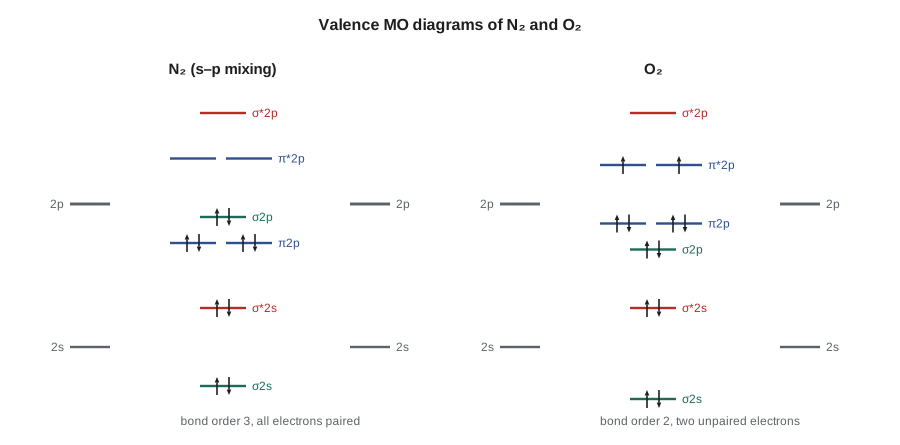
For O₂, the twelve valence electrons fill σ₂s², σ*₂s², σ₂p², π₂p⁴ and π*₂p². The last two electrons go into the two degenerate π* orbitals with parallel spins, as Hund's rule requires. The bond order is ½(8 − 4) = 2, in agreement with a double bond, and the two unpaired electrons make O₂ paramagnetic with a triplet ground state. Removing an electron from π* strengthens the bond: O₂⁺ (bond order 2.5) has a shorter bond (112 pm) than O₂ (121 pm). Adding electrons weakens it: superoxide O₂⁻ (1.5, about 133 pm) and peroxide O₂²⁻ (1, about 149 pm). These ions are real; they occur in KO₂ and Na₂O₂, and the O–O distances in their crystals follow the predicted order.
s–p mixing
For B₂, C₂ and N₂ the order of the orbitals is different: the σ₂p orbital lies above the π₂p pair. The reason is that the 2s and 2p_z orbitals have the same symmetry (σ_g for the bonding combinations, σ_u for antibonding) and can mix when they are close in energy. Mixing pushes the lower σ_g (mostly 2s) down and the upper σ_g (mostly 2p) up. In the early first-row elements the 2s–2p gap is small (about 5.7 eV for boron), so the effect is strong enough to lift σ₂p above π₂p. From oxygen onward the gap is large (about 16 eV in O and 21 eV in F) and the normal order is restored.
The evidence is magnetic and spectroscopic. B₂ is paramagnetic: with ten electrons in all, its last two valence electrons occupy the two π₂p orbitals singly, which is possible only if π₂p lies below σ₂p. Without mixing, B₂ would be diamagnetic. Photoelectron spectroscopy of N₂ shows the first ionization (15.6 eV) from σ₂p and the second (16.7 eV) from π₂p, confirming that σ₂p is the highest occupied orbital. For N₂ the bond order is 3, matching its very short (110 pm) and strong (945 kJ/mol) triple bond, which explains why breaking N₂ for fertilizer manufacture requires the high temperatures, pressures and catalysts of the Haber–Bosch process.
| Molecule | Valence electrons | Bond order | Unpaired electrons | Bond length (pm) | Bond enthalpy (kJ/mol) |
|---|---|---|---|---|---|
| B₂ | 6 | 1 | 2 | 159 | 290 |
| C₂ | 8 | 2 | 0 | 124 | 602 |
| N₂ | 10 | 3 | 0 | 110 | 945 |
| O₂ | 12 | 2 | 2 | 121 | 498 |
| F₂ | 14 | 1 | 0 | 141 | 159 |
| Ne₂ | 16 | 0 | 0 | (not bound) | — |
Heteronuclear diatomics
When the two atoms differ, their atomic orbitals start at different energies, and the coefficients in each MO are no longer equal. The general rule, which follows from the secular determinant with different Coulomb integrals α_A and α_B, is that the bonding orbital lies closer in energy to, and has a larger coefficient on, the lower-lying (more electronegative) atom's orbital, while the antibonding orbital resembles the higher-lying one. The larger the energy gap, the weaker the interaction: when the gap is very large compared with β, the bonding orbital is almost purely on the electronegative atom, and the bond is mostly ionic.
Hydrogen fluoride shows these principles clearly. The H 1s orbital (−13.6 eV) lies far above the F 2s (about −40 eV) and closer to F 2p (about −18.7 eV). By symmetry, H 1s can combine only with F 2s and 2p_z (σ symmetry along the bond), not with 2p_x or 2p_y, which are π. In practice F 2s is too low to interact much, so H 1s and F 2p_z form a bonding σ orbital, largely on fluorine, and an antibonding σ* largely on hydrogen. The F 2p_x and 2p_y orbitals remain as two nonbonding lone pairs. Eight valence electrons fill F 2s, σ and the two nonbonding orbitals. The bond order is 1, and because the bonding pair sits mostly on fluorine, the bond is very polar (dipole moment 1.83 D).
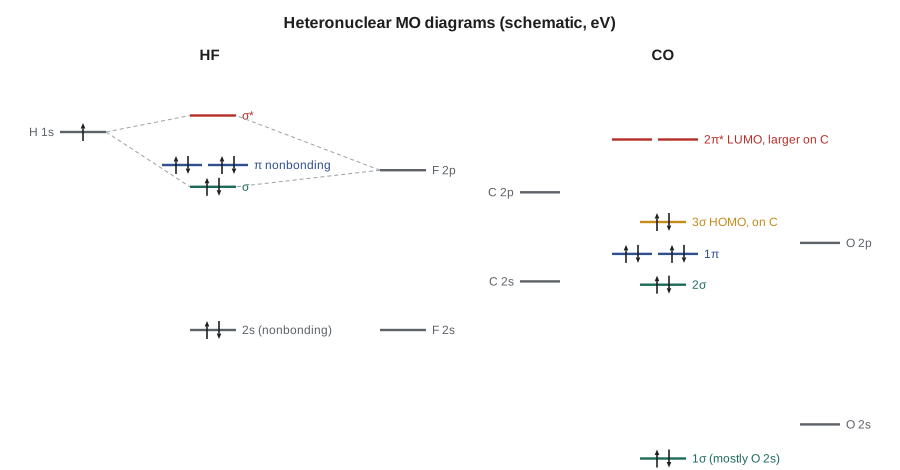
Carbon monoxide is isoelectronic with N₂ and also has a bond order of 3, with a bond length of 113 pm and the largest bond enthalpy of any diatomic molecule (1072 kJ/mol). Its MO diagram resembles that of N₂ with s–p mixing, but the orbitals are polarized. The highest occupied MO (HOMO), labeled 3σ, is mostly a lone pair on carbon, because s–p mixing has pushed it up and the antibonding contributions from oxygen shift its density toward carbon. The lowest unoccupied MO (LUMO), the pair of 2π* orbitals, is also larger on carbon. These two facts explain the chemistry of CO with transition metals: it binds through carbon, donating its 3σ pair to the metal, and accepts electron density from filled metal d orbitals into its empty 2π* orbitals, a synergic bond that makes metal carbonyls stable (CHEM-441). They also explain why CO is so toxic: it binds to the iron in hemoglobin about 200 times more strongly than O₂ does.
Solving the two-orbital problem
The secular determinant for two different orbitals, neglecting overlap for simplicity, gives
When α_A = α_B, the splitting is ±β. When the difference Δ = |α_A − α_B| is large compared with β, the bonding orbital is lowered by only about β²/Δ, which is why orbitals far apart in energy interact weakly. The code below solves the general 2 × 2 problem (with overlap), finds the coefficients, and computes bond orders and unpaired electrons for the first-row diatomics and their ions from the orbital filling.
import math
def two_orbital(aA, aB, beta, S=0.0):
    """Solve the 2x2 secular problem; return energies and normalized coefficients (cA, cB)."""
    # (aA - E) cA + (beta - E S) cB = 0 ; (beta - E S) cA + (aB - E) cB = 0
    a = 1 - S * S
    b = -(aA + aB) + 2 * beta * S
    c = aA * aB - beta * beta
    disc = math.sqrt(b * b - 4 * a * c)
    out = []
    for E in sorted([(-b - disc) / (2 * a), (-b + disc) / (2 * a)]):
        cA, cB = (beta - E * S), -(aA - E)
        norm = math.sqrt(cA * cA + cB * cB + 2 * cA * cB * S)
        if cA < 0: norm = -norm          # choose cA > 0
        out.append((E, cA / norm, cB / norm))
    return out

print('H2+ like, alpha = -13.6, beta = -6.0 eV, S = 0.25:')
for E, cA, cB in two_orbital(-13.6, -13.6, -6.0, 0.25):
    print(f'   E = {E:6.2f} eV   cA = {cA:+.3f}  cB = {cB:+.3f}')
print('H 1s with F 2p (alpha = -13.6 and -18.7 eV, beta = -4.0 eV, S = 0):')
for E, cA, cB in two_orbital(-13.6, -18.7, -4.0):
    print(f'   E = {E:6.2f} eV   c(H) = {cA:+.3f}  c(F) = {cB:+.3f}   share on F = {cB * cB:.2f}')

# Bond orders from MO filling (valence electrons only)
mixed = [('s2s', 1), ('s*2s', -1), ('p2p', 1), ('p2p', 1), ('s2p', 1), ('p*2p', -1), ('p*2p', -1), ('s*2p', -1)]
normal = [('s2s', 1), ('s*2s', -1), ('s2p', 1), ('p2p', 1), ('p2p', 1), ('p*2p', -1), ('p*2p', -1), ('s*2p', -1)]

def fill(n, order):
    occ = [0] * len(order)
    i = 0
    while n > 0:
        # degenerate pi sets: fill singly first (Hund)
        group = [j for j in range(len(order)) if order[j][0] == order[i][0]]
        for j in group:
            if n and occ[j] == 0: occ[j] += 1; n -= 1
        for j in group:
            if n and occ[j] == 1: occ[j] += 1; n -= 1
        i = group[-1] + 1
    bo = sum(o * s for o, (_, s) in zip(occ, order)) / 2
    unpaired = sum(1 for o in occ if o == 1)
    return bo, unpaired

species = [('B2', 6, mixed), ('C2', 8, mixed), ('N2', 10, mixed), ('N2+', 9, mixed), ('O2', 12, normal),
           ('O2+', 11, normal), ('O2-', 13, normal), ('O2 2-', 14, normal), ('F2', 14, normal), ('NO', 11, normal)]
for name, n, order in species:
    bo, up = fill(n, order)
print(f'{name:6} valence electrons {n:2}: bond order {bo:3.1f}, unpaired electrons {up}')H2+ like, alpha = -13.6, beta = -6.0 eV, S = 0.25: E = -15.68 eV cA = +0.632 cB = +0.632 E = -10.13 eV cA = +0.816 cB = -0.816 H 1s with F 2p (alpha = -13.6 and -18.7 eV, beta = -4.0 eV, S = 0): E = -20.89 eV c(H) = +0.481 c(F) = +0.877 share on F = 0.77 E = -11.41 eV c(H) = +0.877 c(F) = -0.481 share on F = 0.23 B2 valence electrons 6: bond order 1.0, unpaired electrons 2 C2 valence electrons 8: bond order 2.0, unpaired electrons 0 N2 valence electrons 10: bond order 3.0, unpaired electrons 0 N2+ valence electrons 9: bond order 2.5, unpaired electrons 1 O2 valence electrons 12: bond order 2.0, unpaired electrons 2 O2+ valence electrons 11: bond order 2.5, unpaired electrons 1 O2- valence electrons 13: bond order 1.5, unpaired electrons 1 O2 2- valence electrons 14: bond order 1.0, unpaired electrons 0 F2 valence electrons 14: bond order 1.0, unpaired electrons 0 NO valence electrons 11: bond order 2.5, unpaired electrons 1
The coefficients for the HF-like case show the polarization: about 77 % of the bonding pair's density is on fluorine, and the antibonding orbital is mostly on hydrogen. The bond orders reproduce the table above and predict the ions: O₂⁺ (2.5), O₂⁻ (1.5) and O₂²⁻ (1), and nitric oxide with bond order 2.5 and one unpaired electron, which is why NO is a stable radical and is easily oxidized to NO⁺ (bond order 3), the nitrosonium ion found in salts such as NOBF₄.
Polyatomic molecules: water
For polyatomic molecules the symmetry methods of lesson 6 make MO construction systematic. Take water in C₂ᵥ. The oxygen valence orbitals transform as 2s (A₁), 2p_z (A₁), 2p_x (B₁) and 2p_y (B₂), with the molecule in the xz plane. The two hydrogen 1s orbitals form SALCs of A₁ and B₁ symmetry. Orbitals combine only with others of the same symmetry, so:
1. The A₁ SALC combines with O 2s and 2p_z to give three A₁ molecular orbitals: a deep bonding orbital (mostly O 2s), a weakly bonding or nearly nonbonding orbital, and an antibonding one.
2. The B₁ SALC combines with O 2p_x to give a bonding and an antibonding B₁ pair.
3. O 2p_y (B₂) has no partner and remains a nonbonding orbital, perpendicular to the molecular plane.
Eight valence electrons fill four orbitals, labeled in order of energy 2a₁, 1b₁, 3a₁ and 1b₂. The photoelectron spectrum of water shows four bands at about 32.6, 18.7, 14.8 and 12.6 eV, one for each occupied valence orbital, rather than the two kinds (bonds and lone pairs) that a simple Lewis or hybrid picture implies. The two 'lone pairs' are not equivalent: one is the nonbonding 1b₂ orbital, pure O 2p, and the other is the 3a₁ orbital, a mixture of O 2s, O 2p and H 1s. The localized sp³ picture and the delocalized MO picture describe the same total electron density, but only the MO picture predicts the separate ionization energies.
Walsh diagrams: why water is bent
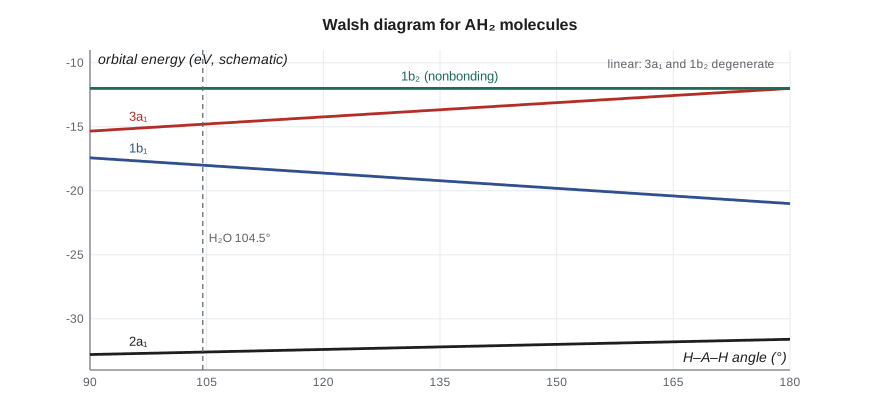
A Walsh diagram, introduced by Arthur Walsh in 1953, plots orbital energies against a change in geometry. For an AH₂ molecule, follow each orbital from linear (180°) to bent. The key orbital is 3a₁. In the linear molecule it is a pure nonbonding p orbital on A, perpendicular to the molecular axis. As the molecule bends, this orbital can mix with A s and overlap with the hydrogen 1s orbitals, and its energy falls steeply. The 1b₁ bonding orbital rises a little on bending, because its overlap with the hydrogens decreases, and the nonbonding 1b₂ orbital, perpendicular to the plane, hardly changes.
The shape of a molecule follows from how many electrons occupy orbitals that favor bending. BeH₂ has four valence electrons, filling only 2a₁ and 1b₁ (in bent labels), which prefer the linear geometry, so BeH₂ is linear. BH₂ (five electrons) puts one electron in 3a₁ and bends (about 131°). CH₂ (six) bends further (about 102° for singlet methylene), and H₂O (eight), with 3a₁ doubly occupied, is bent at 104.5°. Walsh diagrams give a molecular orbital justification for the same shapes that VSEPR predicts by electron-pair repulsion, and they also explain cases VSEPR handles poorly, such as the different angles of the singlet and triplet states of CH₂.
Three-center two-electron bonds
Diborane, B₂H₆, has only twelve valence electrons, not enough for the eight two-electron bonds that its eight B–H contacts seem to need. Its structure has four terminal B–H bonds and two hydrogens bridging the borons. MO theory explains the bridges as three-center, two-electron (3c–2e) bonds: an sp³-like orbital on each boron combines with the bridging H 1s to form a bonding orbital spread over B–H–B, holding one electron pair. Two such bonds hold the molecule together, with each bridging B–H bond of order ½. William Lipscomb extended this idea to the whole family of boron hydrides and won the Nobel Prize in Chemistry in 1976. The 3c–2e bond is the electron-deficient counterpart of the 3c–4e bond of XeF₂ in lesson 4, and both are natural consequences of molecular orbital theory.
Common mistakes
MistakeAntibonding orbitals are lowered as much as bonding orbitals are raised.
InsteadWith overlap, antibonding orbitals are raised more, which is why He₂ is not bound.
Mistakeσ₂p always lies above π₂p.
InsteadOnly for B₂, C₂ and N₂, where s–p mixing is strong; from O₂ on, σ₂p is lower.
MistakeO₂ has all its electrons paired.
InsteadTwo electrons occupy degenerate π* orbitals with parallel spins; O₂ is paramagnetic.
MistakeIn HF the F 2p_x and 2p_y form π bonds with H.
InsteadH 1s has σ symmetry and cannot overlap with them; they remain nonbonding.
MistakeCO binds metals through oxygen because oxygen is more electronegative.
InsteadIts HOMO is a carbon lone pair and its LUMO is larger on carbon, so it binds through C.
MistakeThe two lone pairs of water are identical.
InsteadMO theory and photoelectron spectra show they differ: 1b₂ (pure p) and 3a₁ (mixed).
Summary and key terms
- LCAO molecular orbitals and the secular determinant give bonding and antibonding orbitals, E± = (α ± β)/(1 ± S).
- Bond order is half the difference of bonding and antibonding electrons; it predicts bond lengths, strengths and magnetism.
- s–p mixing lifts σ₂p above π₂p in B₂, C₂ and N₂ and explains the paramagnetism of B₂.
- In heteronuclear molecules the bonding MO is concentrated on the more electronegative atom; orbitals far apart in energy interact weakly.
- The HOMO and LUMO of CO are concentrated on carbon, explaining metal carbonyl bonding.
- Symmetry-based MO diagrams and Walsh diagrams explain polyatomic shapes and photoelectron spectra; 3c–2e bonds explain diborane.
- LCAO
- Linear combination of atomic orbitals, the approximation used to build molecular orbitals.
- Resonance integral
- The integral β measuring the interaction energy between two atomic orbitals.
- Bond order
- Half the difference between the numbers of bonding and antibonding electrons.
- s–p mixing
- Interaction between σ orbitals derived from s and p atomic orbitals of the same symmetry.
- HOMO and LUMO
- The highest occupied and lowest unoccupied molecular orbitals.
- Walsh diagram
- A plot of orbital energies against a change in molecular geometry.
- Three-center two-electron bond
- A single electron pair bonding three atoms, as in the B–H–B bridges of diborane.
Practice problems
Work each problem on paper first, then reveal the answer to check.
Give the bond order and magnetism of C₂²⁻ (the acetylide ion in CaC₂).
Show answer
Isoelectronic with N₂: ten valence electrons, bond order 3, diamagnetic.
Rank O₂, O₂⁺, O₂⁻ and O₂²⁻ by bond length.
Show answer
O₂⁺ (2.5) < O₂ (2) < O₂⁻ (1.5) < O₂²⁻ (1).
Is B₂ paramagnetic without s–p mixing? Explain.
Show answer
No: σ₂p would hold the last two electrons as a pair; mixing puts them in the degenerate π₂p orbitals with parallel spins.
Why does the ionization of CO from its HOMO strengthen the C–O bond only slightly?
Show answer
The 3σ HOMO is nearly nonbonding (a carbon lone pair), so removing an electron changes the bond order little.
Using the Walsh diagram, predict whether H₂O⁺ is more or less bent than H₂O.
Show answer
Removing a 1b₂ (nonbonding, flat) electron changes the angle little; it is about as bent (measured about 110°).
How many valence electrons does B₂H₆ have and how many bonds of each kind?
Show answer
12: four 2c–2e terminal B–H bonds (8 electrons) and two 3c–2e bridges (4 electrons).
Lesson quiz · 5 questions
Score 60% or more to complete this lesson.
Create a free account to save your progress, take quizzes and earn a certificate.