
CHEM-241 · Lesson 1 of 12 · 25 min
What inorganic chemistry is: the whole periodic table
Organic chemistry is the chemistry of carbon compounds, mostly built from a handful of elements: carbon, hydrogen, oxygen, nitrogen, sulfur and the halogens. Inorganic chemistry takes everything else, which means it takes almost the whole periodic table. It explains why salt dissolves and sand does not, why copper is red and gold is yellow, why the catalytic converter in a car contains platinum, why a lithium-ion battery works, why silicon makes computer chips and why nitrogen from the air must be broken apart at high pressure before plants can use it as fertilizer. It is the chemistry of minerals and metals, of glasses, ceramics, semiconductors, pigments, catalysts, fertilizers and many medicines.
This course builds on CHEM-101 and CHEM-102. There you met electron configurations, periodic trends, Lewis structures, VSEPR, a first look at molecular orbitals, a Born–Haber cycle, unit cells, acids and bases, and electrochemistry. Inorganic Chemistry I returns to each of these ideas and turns it into a working tool. Atomic structure becomes a quantitative account of shielding and penetration. Ionic bonding becomes a calculation of lattice energy that can say whether a compound should exist. VSEPR is joined by symmetry and group theory, which predict which vibrations of a molecule appear in an infrared spectrum. Molecular orbital theory is extended from diatomics to polyatomic molecules. Acids and bases are widened to Lewis acids and the hard–soft principle, and redox chemistry is summarized in Latimer and Frost diagrams that show at a glance which oxidation states are stable. The second half of the course surveys the main-group elements and ends with the structures of solids and the band theory that explains metals and semiconductors.
A short history of the periodic table
By the 1860s about sixty elements were known, and chemists had noticed families with similar properties: lithium, sodium and potassium; chlorine, bromine and iodine; calcium, strontium and barium. In 1869 Dmitri Mendeleev arranged the elements by atomic weight in rows so that elements with similar properties fell into the same column. His table was not the first attempt, but it was the boldest: he left gaps for elements not yet discovered and predicted their properties. When gallium (1875), scandium (1879) and germanium (1886) were found with almost exactly the densities, atomic weights and oxides he had predicted for eka-aluminum, eka-boron and eka-silicon, the periodic table was accepted as a law of nature rather than a bookkeeping device.
Mendeleev ordered elements by atomic weight, and a few pairs, such as tellurium and iodine, had to be swapped to keep families together. The explanation came in 1913, when Henry Moseley measured the X-ray frequencies emitted by elements bombarded with electrons and found that the square root of the frequency rose in equal steps from one element to the next. The step was the nuclear charge, the atomic number Z. Ordering by Z removed the anomalies and showed exactly which elements were still missing between hydrogen and uranium. Quantum mechanics, developed in the 1920s, then explained why the table has the shape it does: the rows correspond to the filling of electron shells, and the blocks to the type of orbital being filled.
The table was completed for the naturally occurring elements with the discovery of rhenium in 1925 and the synthesis of technetium in 1937, and it has been extended by nuclear synthesis ever since. The seventh row was completed in 2016, when the International Union of Pure and Applied Chemistry (IUPAC) approved the names nihonium (113), moscovium (115), tennessine (117) and oganesson (118). The table now has 118 elements arranged in 18 groups and 7 periods.
Groups, periods and blocks
The modern IUPAC table numbers the groups 1 to 18. Groups 1 and 2 form the s-block, where the last electron enters an s orbital; groups 13 to 18 form the p-block; groups 3 to 12 form the d-block of transition metals; and the lanthanides and actinides, usually printed below the main table, form the f-block. Helium is an exception to the visual layout: its configuration 1s² puts it in the s-block, but it is placed above neon in group 18 because its chemistry, like that of the other noble gases, is almost nonexistent.
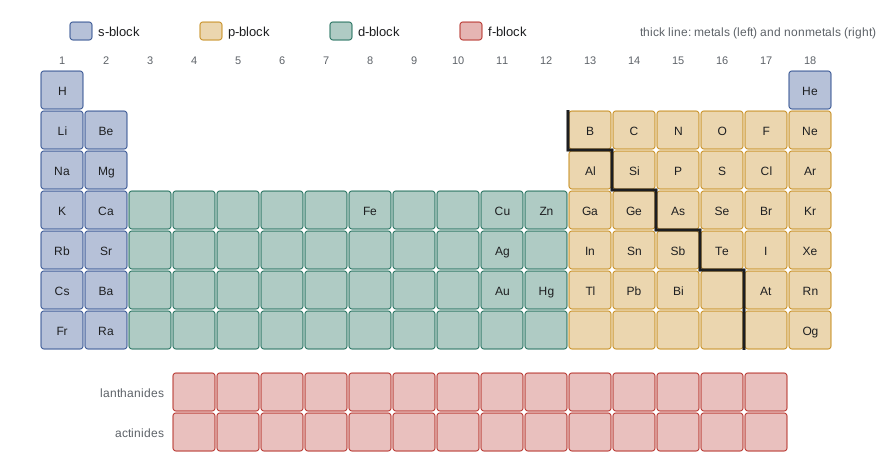
The block structure explains much of the chemistry. In the s-block the valence electrons are easily lost, so the elements are reactive metals that form ions with the group charge: Na⁺, Mg²⁺. In the p-block the elements range from metals at the bottom left (aluminum, tin, lead, bismuth) through metalloids (boron, silicon, germanium, arsenic, antimony, tellurium) to nonmetals at the top right. Their chemistry is dominated by covalent bonding and by a wide range of oxidation states. In the d-block the partly filled d orbitals give colored compounds, magnetism, many oxidation states and catalytic activity; these are the subject of CHEM-341. The f-block elements are chemically similar to one another because the 4f and 5f orbitals are buried inside the atom.
The main-group elements
This course concentrates on the main-group elements, those of the s- and p-blocks, together with the general principles of structure and bonding that apply to every element. The main group contains the most abundant elements on Earth and the most heavily produced chemicals. Oxygen and silicon together make up about three quarters of the Earth's crust by mass, mostly as silicate minerals; aluminum, iron, calcium, sodium, magnesium and potassium make up most of the rest. Hydrogen and helium make up nearly all of the visible matter in the universe.
| Rank | Element | Mass fraction of the crust (approximate) |
|---|---|---|
| 1 | Oxygen | 46 % |
| 2 | Silicon | 28 % |
| 3 | Aluminum | 8 % |
| 4 | Iron | 5 % |
| 5 | Calcium | 4 % |
| 6 | Sodium | 2.5 % |
| 7 | Magnesium | 2.3 % |
| 8 | Potassium | 2 % |
Inorganic chemicals are also the largest products of the chemical industry by mass. Sulfuric acid, made from sulfur by the contact process, is used to make phosphate fertilizers and in metal processing. Ammonia, made by the Haber–Bosch process from nitrogen and hydrogen, feeds roughly half of the world's population through nitrogen fertilizer. Chlorine and sodium hydroxide are made together by electrolysis of brine in the chlor-alkali process. Lime (calcium oxide) from limestone, sodium carbonate, titanium dioxide for white pigment, and phosphoric acid round out the list. The chemistry of each of these appears in the main-group lessons later in the course.
The United States is a major producer of phosphate rock for fertilizer (mostly from Florida and Idaho), soda ash (sodium carbonate) from the trona deposits of Wyoming, and iron ore, most of which comes from the taconite of Minnesota's Mesabi Range. Each of these industries rests on inorganic chemistry: separating, purifying and converting minerals into useful materials.
Oxidation states
Because inorganic compounds involve so many elements and so many kinds of bonding, chemists need a simple bookkeeping tool that works for all of them. The oxidation state (or oxidation number) of an atom is the charge it would have if every bond to it were ionic, with the bonding electrons assigned to the more electronegative partner. The familiar rules follow from this definition: the sum of oxidation states equals the charge of the species; fluorine is always −1; oxygen is usually −2 (but −1 in peroxides and positive in OF₂); hydrogen is +1 with nonmetals and −1 in metal hydrides such as NaH.
Worked problem
Assigning oxidation states
Find the oxidation state of the central atom in (a) KMnO₄, (b) S₂O₃²⁻ (thiosulfate), (c) XeOF₄ and (d) NaBH₄.
Show solution
- (a) K is +1 and four O give −8, so Mn + 1 − 8 = 0 and Mn is +7.
- (b) Three O give −6 and the ion has charge −2, so 2S − 6 = −2 and the average S is +2. Structurally the central S is +5 and the terminal S is −1 (it replaces an O), which average to +2.
- (c) O is −2 and four F give −4, so Xe − 2 − 4 = 0 and Xe is +6.
- (d) Na is +1 and B is less electronegative than H, so H is −1 here: B + 1 − 4 = 0 and B is +3.
Answer: Mn +7, S +2 on average (+5 and −1 individually), Xe +6 and B +3. Oxidation states are formal; they do not describe the real charge on an atom.
Oxidation states run from −4 (carbon in CH₄, silicon in Mg₂Si) to +8 (osmium in OsO₄, xenon in XeO₄). The highest state of a main-group element usually equals its group number in the old system (the number of valence electrons): +7 for chlorine in ClO₄⁻, +6 for sulfur in SO₄²⁻, +5 for phosphorus in PO₄³⁻. For the heavier p-block elements, a state two lower than the group maximum becomes more stable, a pattern called the inert-pair effect that we explain in lesson 10. Lead is common as Pb²⁺, thallium as Tl⁺ and bismuth as Bi³⁺.
Naming inorganic compounds
IUPAC nomenclature for inorganic compounds uses Roman numerals for oxidation states (the Stock system) when a metal can have more than one: iron(II) chloride, FeCl₂, and iron(III) chloride, FeCl₃. Oxoanions are named from the parent acid: sulfate SO₄²⁻ from sulfuric acid and sulfite SO₃²⁻ from sulfurous acid; perchlorate, chlorate, chlorite and hypochlorite for ClO₄⁻, ClO₃⁻, ClO₂⁻ and ClO⁻. Binary molecular compounds use Greek prefixes: dinitrogen tetroxide N₂O₄, sulfur hexafluoride SF₆, xenon tetrafluoride XeF₄. Coordination compounds have their own rules, met in CHEM-341. IUPAC spellings such as sulfur are used throughout this course, as in most chemistry journals worldwide.
Electron configurations and the Aufbau principle
The block of an element follows from its ground-state electron configuration. In a many-electron atom, orbitals with the same principal quantum number n no longer have the same energy: s orbitals lie below p, which lie below d, because of the penetration and shielding effects we study in lesson 2. The approximate filling order follows the Madelung (n + l) rule: orbitals fill in order of increasing n + l, and for equal n + l in order of increasing n. This gives the familiar sequence 1s, 2s, 2p, 3s, 3p, 4s, 3d, 4p, 5s, 4d and so on.
The rule has exceptions. Chromium is [Ar]3d⁵4s¹ rather than [Ar]3d⁴4s², and copper is [Ar]3d¹⁰4s¹ rather than [Ar]3d⁹4s². Several heavier transition metals and many lanthanides and actinides also differ from the simple prediction. The exceptions arise because the 3d and 4s orbitals are close in energy, and because half-filled and filled subshells are stabilized by exchange energy. For main-group elements the rule works without exception, and the code below uses it to build configurations, assign blocks and count the elements in each block.
# Build ground-state configurations with the Madelung (n + l) rule
# and count elements in each block. A few known exceptions are patched in.
L_NAME = 'spdf'
order = sorted(((n, l) for n in range(1, 8) for l in range(0, 4) if l < n),
               key=lambda nl: (nl[0] + nl[1], nl[0]))
EXCEPTIONS = {24: '[Ar] 3d5 4s1', 29: '[Ar] 3d10 4s1', 42: '[Kr] 4d5 5s1',
              47: '[Kr] 4d10 5s1', 79: '[Xe] 4f14 5d10 6s1'}

def config(Z):
    left, parts = Z, []
    for n, l in order:
        if left == 0:
            break
        k = min(left, 2 * (2 * l + 1))
        parts.append((n, l, k))
        left -= k
    return parts

def block(Z):
    if Z == 2:
        return 's'          # 1s2, although drawn in group 18
    n, l, k = config(Z)[-1]
    return L_NAME[l]

def text(Z):
    return ' '.join(f'{n}{L_NAME[l]}{k}' for n, l, k in config(Z))

for Z, sym in [(11, 'Na'), (17, 'Cl'), (26, 'Fe'), (35, 'Br'), (50, 'Sn'), (82, 'Pb')]:
    print(f'{sym:2} Z = {Z:3}: {text(Z)}')
print('Madelung prediction for Cr:', text(24), '; observed:', EXCEPTIONS[24])
counts = {b: 0 for b in 'spdf'}
for Z in range(1, 119):
    counts[block(Z)] += 1
print('elements per block (Z = 1 to 118):', counts, '; total', sum(counts.values()))Na Z = 11: 1s2 2s2 2p6 3s1
Cl Z = 17: 1s2 2s2 2p6 3s2 3p5
Fe Z = 26: 1s2 2s2 2p6 3s2 3p6 4s2 3d6
Br Z = 35: 1s2 2s2 2p6 3s2 3p6 4s2 3d10 4p5
Sn Z = 50: 1s2 2s2 2p6 3s2 3p6 4s2 3d10 4p6 5s2 4d10 5p2
Pb Z = 82: 1s2 2s2 2p6 3s2 3p6 4s2 3d10 4p6 5s2 4d10 5p6 6s2 4f14 5d10 6p2
Madelung prediction for Cr: 1s2 2s2 2p6 3s2 3p6 4s2 3d4 ; observed: [Ar] 3d5 4s1
elements per block (Z = 1 to 118): {'s': 14, 'p': 36, 'd': 40, 'f': 28} ; total 118The counts show 14 s-block elements (groups 1 and 2 plus hydrogen and helium), 36 p-block elements, 40 d-block elements and 28 f-block elements. The simple rule puts lanthanum and actinium in the f-block and lutetium and lawrencium in the d-block; IUPAC has discussed which pair belongs in group 3, and many modern tables place lutetium and lawrencium there, as the rule implies.
Metals, nonmetals and metalloids
About three quarters of the elements are metals: shiny, malleable conductors of heat and electricity, whose oxides are basic. Nonmetals cluster in the upper right of the table; they are poor conductors (graphite is the notable exception) and form acidic oxides. Between them, along the staircase line from boron to astatine, lie the metalloids, whose properties are intermediate. Silicon and germanium are semiconductors, and their conductivity rises with temperature, the opposite of a metal. Lesson 12 explains these differences with band theory: metals have partly filled bands, semiconductors have a small gap between a filled and an empty band, and insulators have a large gap.
The metallic character of the elements increases down a group and decreases across a period. This is why carbon is a nonmetal, silicon and germanium are metalloids, and tin and lead are metals, all in group 14. The same trend explains the acid–base character of the oxides: CO₂ and SiO₂ are acidic, GeO₂ is amphoteric, and SnO and PbO are amphoteric to basic. Across period 3, the oxides change from strongly basic Na₂O and MgO, through amphoteric Al₂O₃, to acidic SiO₂, P₄O₁₀, SO₃ and Cl₂O₇.
| Oxide | Na₂O | MgO | Al₂O₃ | SiO₂ | P₄O₁₀ | SO₃ | Cl₂O₇ |
|---|---|---|---|---|---|---|---|
| Bonding | Ionic | Ionic | Ionic/covalent | Covalent network | Molecular | Molecular | Molecular |
| Character | Strongly basic | Basic | Amphoteric | Weakly acidic | Acidic | Strongly acidic | Strongly acidic |
| With water | NaOH | Mg(OH)₂ (slow) | None | None | H₃PO₄ | H₂SO₄ | HClO₄ |
How inorganic chemists know structures
Much of what follows in this course rests on knowing where atoms are in a molecule or solid. The most direct method is X-ray diffraction from a single crystal, developed by William Henry and William Lawrence Bragg from 1913, which gives bond lengths and angles to about 0.1 pm for light atoms in good crystals. Neutron diffraction locates hydrogen atoms better than X-rays do. Infrared and Raman spectroscopy probe vibrations and, through the symmetry rules of lesson 6, reveal molecular shape. Nuclear magnetic resonance of nuclei such as ¹¹B, ¹⁹F, ²⁷Al, ²⁹Si and ³¹P is as important to inorganic chemists as ¹H and ¹³C NMR are to organic chemists. Photoelectron spectroscopy measures orbital energies directly and tests molecular orbital diagrams (lesson 7).
How this course is organized
The first nine lessons develop the principles: atomic structure (lesson 2), ionic bonding and lattice energy (lesson 3), covalent bonding and molecular shape (lesson 4), symmetry and group theory (lessons 5 and 6), molecular orbital theory (lesson 7), acid–base chemistry (lesson 8) and redox chemistry (lesson 9). Lessons 10 and 11 apply them in a tour of the main-group elements, from hydrogen to the noble gases. The capstone, lesson 12, turns to solids: how atoms and ions pack, the common crystal structures, and band theory. The course prepares you for CHEM-341 Inorganic Chemistry II, which treats the transition metals, and CHEM-421 Materials Chemistry.
Common mistakes
MistakeInorganic chemistry is the chemistry of compounds without carbon.
InsteadIt covers all elements; CO₂, carbonates, carbides, cyanides and metal carbonyls are inorganic, and organometallic chemistry bridges both fields.
MistakeMendeleev ordered elements by atomic number.
InsteadHe used atomic weight; Moseley's X-ray work in 1913 showed that atomic number is the true ordering principle.
MistakeOxidation states are the real charges on atoms.
InsteadThey are formal bookkeeping charges assuming ionic bonds; real partial charges are much smaller.
MistakeHydrogen is always +1.
InsteadIn metal hydrides such as NaH and in BH₄⁻ hydrogen is −1, because it is the more electronegative partner.
MistakeThe Madelung rule gives every configuration.
InsteadIt fails for Cr, Cu and many heavier d- and f-block elements; it holds for the main-group elements.
MistakeMetalloids conduct like poor metals.
InsteadSemiconductors such as Si conduct better as temperature rises, the opposite of metals; band theory explains why.
Summary and key terms
- Inorganic chemistry covers all the elements, with emphasis on structure, bonding and reactivity across the periodic table.
- Mendeleev's 1869 table predicted unknown elements; Moseley showed in 1913 that atomic number orders the elements.
- The s-, p-, d- and f-blocks follow the type of orbital being filled, given approximately by the Madelung (n + l) rule.
- Main-group elements include the most abundant elements and the largest industrial chemicals.
- Oxidation states are formal charges used to track electrons; the maximum for a main-group element is its number of valence electrons.
- Metallic character increases down groups and decreases across periods, and oxides change from basic to acidic across a period.
- Main-group element
- An element of the s- or p-block.
- Block
- A region of the periodic table defined by the type of orbital that receives the last electron.
- Oxidation state
- The charge an atom would have if all its bonds were ionic.
- Madelung rule
- Orbitals fill in order of increasing n + l, and for equal n + l in order of increasing n.
- Metalloid
- An element with properties between those of metals and nonmetals, such as silicon.
- Amphoteric
- Able to react as both an acid and a base, like aluminum oxide.
- Inert-pair effect
- The increasing stability, down the p-block, of an oxidation state two below the group maximum.
Practice problems
Work each problem on paper first, then reveal the answer to check.
Give the oxidation state of the central atom in (a) Cr₂O₇²⁻, (b) ClO₂, (c) SF₄, (d) H₂O₂.
Show answer
(a) 2Cr − 14 = −2, Cr +6. (b) Cl + (−4) = 0, Cl +4. (c) S + (−4) = 0, S +4. (d) 2(+1) + 2O = 0, O −1.
Write the configurations of Se (Z = 34) and Rb (Z = 37) and assign their blocks.
Show answer
Se: [Ar] 3d¹⁰ 4s² 4p⁴, p-block. Rb: [Kr] 5s¹, s-block.
Why did Mendeleev place tellurium (127.6) before iodine (126.9)?
Show answer
Tellurium's properties match sulfur and selenium in group 16 and iodine's match the halogens; Moseley later showed Z(Te) = 52 and Z(I) = 53.
Predict whether BaO, Al₂O₃ and P₄O₁₀ are acidic, basic or amphoteric.
Show answer
BaO is basic, Al₂O₃ amphoteric, P₄O₁₀ acidic.
Name (a) N₂O₅, (b) Fe₂(SO₄)₃, (c) NaClO₂.
Show answer
(a) Dinitrogen pentoxide. (b) Iron(III) sulfate. (c) Sodium chlorite.
Which is the more common oxidation state of thallium in water, +1 or +3, and why?
Show answer
+1, because of the inert-pair effect: the 6s² pair is held tightly in the heavy p-block elements.
Lesson quiz · 5 questions
Score 60% or more to complete this lesson.
Create a free account to save your progress, take quizzes and earn a certificate.