
CHEM-241 · Lesson 6 of 12 · 23 min
Character tables and applications of symmetry
In lesson 5 we classified molecules into point groups and represented symmetry operations by matrices. This lesson shows what the classification is good for. The central tool is the character table, a compact summary of every way a group's operations can act on functions, orbitals or atomic displacements. With a character table and one formula, the reduction formula, you can find how many vibrations a molecule has of each symmetry type, predict which are seen in infrared and Raman spectra, and identify which atomic orbitals can combine in molecular orbitals. These are among the most useful calculations in inorganic chemistry, and once the method is clear they take only a few minutes by hand, or a fraction of a second by computer.
Representations and the character table
A representation of a group is any set of matrices that multiply in the same way as the operations. The 3 × 3 coordinate matrices of lesson 5 are one representation, but there are many others. If we follow what each operation does to a single function, such as the z coordinate, we get a one-dimensional representation: in C₂ᵥ, z is unchanged by all four operations, so it is represented by the numbers 1, 1, 1, 1. The function x is unchanged by E and σᵥ(xz) but changes sign under C₂ and σᵥ′(yz), giving 1, −1, 1, −1.
Large representations can usually be broken into smaller ones by a clever choice of basis, in the same way that a matrix can be brought into block-diagonal form. Representations that cannot be broken down further are called irreducible representations, or irreps. Each group has a fixed, small number of them, equal to the number of classes, and their characters are listed in the character table. Here is the table for C₂ᵥ:
| C₂ᵥ | E | C₂ | σᵥ(xz) | σᵥ′(yz) | Linear, rotations | Quadratic |
|---|---|---|---|---|---|---|
| A₁ | 1 | 1 | 1 | 1 | z | x², y², z² |
| A₂ | 1 | 1 | −1 | −1 | R_z | xy |
| B₁ | 1 | −1 | 1 | −1 | x, R_y | xz |
| B₂ | 1 | −1 | −1 | 1 | y, R_x | yz |
The rows are the irreps, and the columns the classes. The two columns on the right show which functions transform like each irrep: the coordinates x, y and z (and so the components of a dipole moment and of p orbitals), rotations about the axes, R_x, R_y and R_z, and quadratic functions such as x², xy and z² (and so the components of the polarizability and of d orbitals). These columns are what connect the abstract table to chemistry.
Irreps are labeled by Mulliken symbols. A and B are one-dimensional: A is symmetric (character +1) under rotation about the principal axis and B antisymmetric (−1). E is two-dimensional (not to be confused with the identity operation E) and T three-dimensional. Subscripts 1 and 2 indicate symmetry or antisymmetry with respect to a C₂ axis perpendicular to the principal axis or, if there is none, to a vertical plane. Subscripts g (gerade, even) and u (ungerade, odd) indicate symmetry or antisymmetry under inversion, and primes (′ and ″) symmetry or antisymmetry under σₕ.
Here is the table for C₃ᵥ, the group of ammonia, which contains a two-dimensional irrep:
| C₃ᵥ | E | 2C₃ | 3σᵥ | Linear, rotations | Quadratic |
|---|---|---|---|---|---|
| A₁ | 1 | 1 | 1 | z | x² + y², z² |
| A₂ | 1 | 1 | −1 | R_z | |
| E | 2 | −1 | 0 | (x, y), (R_x, R_y) | (x² − y², xy), (xz, yz) |
The functions x and y must be treated together in C₃ᵥ, because a rotation by 120° turns x into a mixture of x and y. Their 2 × 2 rotation matrix has trace 2cos 120° = −1, the E character under C₃, and their reflection matrix has trace 0. Two properties of character tables are worth remembering. The sum of the squares of the dimensions of the irreps equals the order of the group: for C₃ᵥ, 1² + 1² + 2² = 6. And the irreps are orthogonal: if you multiply the characters of two different irreps class by class, weight by the number of operations in each class and add, the result is zero.
The reduction formula
Orthogonality gives a way to break any reducible representation Γ into irreps. The number of times the irrep i appears in Γ is
where h is the order of the group, g_c is the number of operations in class c, χ_Γ(c) is the character of the reducible representation and χᵢ(c) that of the irrep (for real characters, as in all the groups we use here). The formula works like taking the components of a vector along perpendicular axes. All we need is the characters of Γ, and for molecular vibrations these are easy to find.
Counting vibrations
A molecule of N atoms has 3N degrees of freedom: each atom can move in x, y and z. Three of them are translations of the whole molecule, three are rotations (two for a linear molecule), and the remaining 3N − 6 (or 3N − 5) are vibrations. To find their symmetries, attach three small displacement arrows x, y and z to every atom and see what each operation does to the 3N arrows.
Only atoms that stay in place under an operation contribute to its character; an atom moved to another position contributes zero to the diagonal of the matrix. For each atom that stays put, the three arrows contribute the character of the 3 × 3 coordinate matrix: 3 for E, −1 for C₂, 0 for C₃, 1 for C₄, 1 for any reflection, −3 for inversion, −1 for S₄ and so on (1 + 2cos θ for a rotation by θ, −1 + 2cos θ for an improper rotation). So
Worked problem
The vibrations of water
Find the symmetries of the vibrations of H₂O (C₂ᵥ, molecule in the xz plane) and decide which are IR and Raman active.
Show solution
- Unshifted atoms: E 3, C₂ 1 (oxygen only), σᵥ(xz) 3 (the molecular plane), σᵥ′(yz) 1. Contributions per atom: 3, −1, 1, 1. So χ₃N = 9, −1, 3, 1.
- Reduce: n(A₁) = ¼(9 − 1 + 3 + 1) = 3; n(A₂) = ¼(9 − 1 − 3 − 1) = 1; n(B₁) = ¼(9 + 1 + 3 − 1) = 3; n(B₂) = ¼(9 + 1 − 3 + 1) = 2. Γ₃N = 3A₁ + A₂ + 3B₁ + 2B₂ (9 dimensions in total).
- Translations transform as x, y, z: B₁ + B₂ + A₁. Rotations as R_x, R_y, R_z: B₂ + B₁ + A₂. Remove both.
- Γ_vib = 2A₁ + B₁: three vibrations, as 3N − 6 = 3 requires.
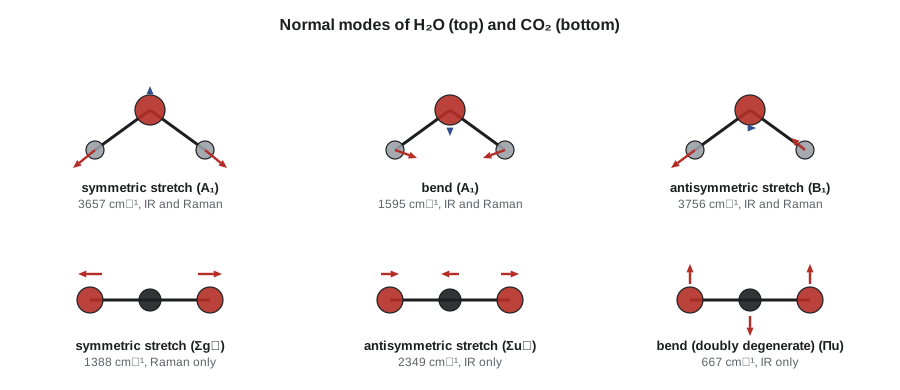
Answer: Water has two A₁ vibrations (the symmetric stretch at 3657 cm⁻¹ and the bend at 1595 cm⁻¹) and one B₁ vibration (the antisymmetric stretch at 3756 cm⁻¹). All three are both IR and Raman active, as the selection rules below show.
Selection rules: infrared and Raman
A vibration absorbs infrared light only if it changes the dipole moment of the molecule. In group-theoretical terms, the vibration must have the same symmetry as one of the dipole components x, y or z. So a mode is IR active if its irrep has x, y or z in the 'linear' column of the character table.
Raman scattering depends instead on a change in the polarizability, which transforms like the quadratic functions x², y², z², xy, xz and yz. A mode is Raman active if its irrep has a quadratic function in the right-hand column. A totally symmetric mode (A₁, A_1g and so on) is always Raman active and gives a polarized Raman line, a useful experimental test for identifying it.
For molecules with an inversion center, the rule of mutual exclusion follows immediately: x, y and z are all odd (u) under inversion, while the quadratic functions are all even (g). So no vibration of a centrosymmetric molecule can be both IR and Raman active. Carbon dioxide (D∞ₕ) shows this beautifully. Its symmetric stretch (Σ_g⁺, 1388 cm⁻¹) is Raman active but IR inactive; its antisymmetric stretch (Σ_u⁺, 2349 cm⁻¹) and doubly degenerate bend (Π_u, 667 cm⁻¹) are IR active but Raman inactive. The infrared absorption of CO₂ that drives the greenhouse effect comes from the bend and the antisymmetric stretch.
Selection rules make vibrational spectroscopy a structural tool. Xenon tetrafluoride could be square planar (D₄ₕ) or tetrahedral (T_d). For a square planar XeF₄, group theory predicts 3 IR-active and 3 Raman-active fundamentals with no coincidences, because the molecule has an inversion center; for a tetrahedral one, 2 IR and 4 Raman bands with two coincidences. The observed spectra, with no coincident bands, confirmed the square planar structure soon after XeF₄ was first made in 1962.
Ammonia and methane
The same method works for any molecule. For NH₃ in C₃ᵥ, the unshifted atoms are 4 (E), 1 (C₃) and 2 (each σᵥ contains N and one H), with contributions 3, 0 and 1, so χ₃N = 12, 0, 2. The reduction gives Γ₃N = 3A₁ + A₂ + 4E; removing translations (A₁ + E) and rotations (A₂ + E) leaves Γ_vib = 2A₁ + 2E. Each E mode is a degenerate pair, so the six vibrations appear as four fundamental frequencies, all IR and Raman active. For CH₄ in T_d, the result is Γ_vib = A₁ + E + 2T₂ (nine vibrations in four frequencies). Only the two T₂ modes transform like (x, y, z), so methane has just two IR bands, near 3019 and 1306 cm⁻¹, while all four are Raman active. The code below carries out these reductions.
# Reduction formula for vibrational modes.
TABLES = {
 'C2v': {'classes': [('E', 1, 3), ('C2', 1, -1), ('sv(xz)', 1, 1), ('sv(yz)', 1, 1)],
         'irreps': {'A1': [1, 1, 1, 1], 'A2': [1, 1, -1, -1], 'B1': [1, -1, 1, -1], 'B2': [1, -1, -1, 1]},
         'trans': ['A1', 'B1', 'B2'], 'rot': ['A2', 'B1', 'B2'],
         'IR': {'A1', 'B1', 'B2'}, 'Raman': {'A1', 'A2', 'B1', 'B2'}},
 'C3v': {'classes': [('E', 1, 3), ('2C3', 2, 0), ('3sv', 3, 1)],
         'irreps': {'A1': [1, 1, 1], 'A2': [1, 1, -1], 'E': [2, -1, 0]},
         'trans': ['A1', 'E'], 'rot': ['A2', 'E'], 'IR': {'A1', 'E'}, 'Raman': {'A1', 'E'}},
 'Td': {'classes': [('E', 1, 3), ('8C3', 8, 0), ('3C2', 3, -1), ('6S4', 6, -1), ('6sd', 6, 1)],
        'irreps': {'A1': [1, 1, 1, 1, 1], 'A2': [1, 1, 1, -1, -1], 'E': [2, -1, 2, 0, 0],
                   'T1': [3, 0, -1, 1, -1], 'T2': [3, 0, -1, -1, 1]},
        'trans': ['T2'], 'rot': ['T1'], 'IR': {'T2'}, 'Raman': {'A1', 'E', 'T2'}},
 'D3h': {'classes': [('E', 1, 3), ('2C3', 2, 0), ('3C2', 3, -1), ('sh', 1, 1), ('2S3', 2, -2), ('3sv', 3, 1)],
         'irreps': {"A1'": [1, 1, 1, 1, 1, 1], "A2'": [1, 1, -1, 1, 1, -1], "E'": [2, -1, 0, 2, -1, 0],
                    "A1''": [1, 1, 1, -1, -1, -1], "A2''": [1, 1, -1, -1, -1, 1], "E''": [2, -1, 0, -2, 1, 0]},
         'trans': ["E'", "A2''"], 'rot': ["A2'", "E''"], 'IR': {"E'", "A2''"}, 'Raman': {"A1'", "E'", "E''"}},
}

def vibrations(group, unshifted):
    T = TABLES[group]
    h = sum(g for _, g, _ in T['classes'])
    chi = [n * c for n, (_, _, c) in zip(unshifted, T['classes'])]
    counts = {}
    for irrep, ch in T['irreps'].items():
        n = sum(g * a * b for (_, g, _), a, b in zip(T['classes'], chi, ch)) / h
        counts[irrep] = round(n)
    total = dict(counts)
    for irrep in T['trans'] + T['rot']:
        counts[irrep] -= 1
    vib = {k: v for k, v in counts.items() if v}
    text = ' + '.join((f'{v}' if v > 1 else '') + k for k, v in vib.items())
    ir = [k for k in vib if k in T['IR']]
    raman = [k for k in vib if k in T['Raman']]
    return chi, total, text, ir, raman

for name, group, unshifted in [('H2O', 'C2v', [3, 1, 3, 1]), ('NH3', 'C3v', [4, 1, 2]),
                               ('CH4', 'Td', [5, 2, 1, 1, 3]), ('BF3', 'D3h', [4, 1, 2, 4, 1, 2])]:
    chi, total, text, ir, raman = vibrations(group, unshifted)
    print(f'{name} ({group}): chi_3N = {chi}')
print(f' vibrations: {text}; IR active: {ir}; Raman active: {raman}')H2O (C2v): chi_3N = [9, -1, 3, 1] vibrations: 2A1 + B1; IR active: ['A1', 'B1']; Raman active: ['A1', 'B1'] NH3 (C3v): chi_3N = [12, 0, 2] vibrations: 2A1 + 2E; IR active: ['A1', 'E']; Raman active: ['A1', 'E'] CH4 (Td): chi_3N = [15, 0, -1, -1, 3] vibrations: A1 + E + 2T2; IR active: ['T2']; Raman active: ['A1', 'E', 'T2'] BF3 (D3h): chi_3N = [12, 0, -2, 4, -2, 2] vibrations: A1' + 2E' + A2''; IR active: ["E'", "A2''"]; Raman active: ["A1'", "E'"]
The output for BF₃ is worth reading carefully: Γ_vib = A₁′ + A₂″ + 2E′. The symmetric stretch A₁′ is Raman active only, the out-of-plane bend A₂″ is IR active only, and the two E′ modes are both. This pattern, one Raman-only band and one IR-only band, is a fingerprint of a planar AX₃ molecule and distinguishes it from a pyramidal one such as NH₃, where every mode is active in both.
Symmetry-adapted linear combinations
The reduction formula can be applied to any set of objects that the operations shuffle, not only displacement arrows. If the basis is a set of atomic orbitals on the outer atoms of a molecule, such as the two hydrogen 1s orbitals of water, the reduction tells us which combinations of them, the symmetry-adapted linear combinations (SALCs), have the right symmetry to overlap with orbitals on the central atom. For water, the two H 1s orbitals give χ = 2, 0, 2, 0 in C₂ᵥ (both stay put under E and σᵥ(xz), both move under C₂ and σᵥ′), which reduces to A₁ + B₁. The A₁ combination, 1s_a + 1s_b, can combine with the oxygen 2s and 2p_z orbitals (both A₁); the B₁ combination, 1s_a − 1s_b, can combine only with oxygen 2p_x (B₁). The oxygen 2p_y orbital (B₂) has no partner and stays nonbonding. This is the starting point of the molecular orbital diagram of water in lesson 7.
Other uses of symmetry
Symmetry reaches well beyond vibrations and bonding. Electronic transitions follow similar selection rules: in a centrosymmetric molecule, transitions between two g states (or two u states) are forbidden, the Laporte rule, which is why the d–d transitions of octahedral transition-metal complexes are weak and their colors pale (CHEM-341). The number of signals in an NMR spectrum depends on how many sets of symmetry-equivalent nuclei there are: SF₄ shows two ¹⁹F environments (axial and equatorial) at low temperature. Crystals are classified into 32 crystallographic point groups and 230 space groups, which add translations to the operations of this lesson, and crystal symmetry decides which materials can be piezoelectric or show second-harmonic generation of light.
Common mistakes
MistakeThe E irrep and the E operation are the same.
InsteadE as an operation is the identity; E as an irrep label means a two-dimensional representation.
MistakeEvery atom contributes to every character of Γ₃N.
InsteadOnly atoms left in place by an operation contribute.
MistakeAll vibrations are seen in the infrared spectrum.
InsteadOnly those transforming like x, y or z are IR active.
MistakeA mode can be IR and Raman active in a centrosymmetric molecule.
InsteadThe rule of mutual exclusion forbids it.
MistakeΓ_vib is the full Γ₃N.
InsteadTranslations and rotations must be subtracted first.
MistakeA degenerate E mode counts as one vibration.
InsteadIt is two vibrations with the same frequency; a T mode is three.
Summary and key terms
- Character tables list the characters of the irreducible representations of a group and the functions that transform like each one.
- The reduction formula, nᵢ = (1/h) Σ g_c χ_Γ χᵢ, breaks any representation into irreps.
- For vibrations, χ₃N = (unshifted atoms) × (contribution per atom); removing translations and rotations leaves Γ_vib.
- IR-active modes transform like x, y or z; Raman-active modes like quadratic functions; mutual exclusion holds for centrosymmetric molecules.
- Vibrational spectra can distinguish structures, as for square planar XeF₄.
- SALCs found by the same method decide which orbitals can combine in molecular orbitals.
- Irreducible representation
- A representation that cannot be reduced to smaller ones; the rows of a character table.
- Character table
- A table of the characters of each irreducible representation for each class of a group.
- Mulliken symbols
- Labels A, B, E and T with subscripts g, u, 1, 2 and primes that classify irreducible representations.
- Reduction formula
- The formula giving how many times each irrep appears in a reducible representation.
- Mutual exclusion
- In a centrosymmetric molecule, no vibration is both IR and Raman active.
- SALC
- A symmetry-adapted linear combination of atomic orbitals with the symmetry of one irrep.
- Laporte rule
- Electronic transitions between states of the same parity (g to g, u to u) are forbidden.
Practice problems
Work each problem on paper first, then reveal the answer to check.
Check that the C₂ᵥ irreps A₂ and B₁ are orthogonal.
Show answer
Products by class: 1·1 + 1·(−1) + (−1)·1 + (−1)·(−1) = 0.
How many vibrations does SF₆ have, and how many does CO₂ have?
Show answer
SF₆: 3 × 7 − 6 = 15. CO₂ (linear): 3 × 3 − 5 = 4.
For SO₂ (C₂ᵥ), find Γ_vib.
Show answer
Like water: 2A₁ + B₁, all IR and Raman active.
Why does the symmetric stretch of CH₄ not appear in the infrared spectrum?
Show answer
It is A₁, which does not transform like x, y or z; it does not change the dipole moment.
Predict the number of IR bands of planar BCl₃ and of pyramidal PCl₃.
Show answer
BCl₃ (D₃ₕ): A₂″ + 2E′, three IR bands. PCl₃ (C₃ᵥ): 2A₁ + 2E, four IR bands.
Which SALCs do the four H 1s orbitals of CH₄ form?
Show answer
χ = 4, 1, 0, 0, 2 in T_d, which reduces to A₁ + T₂, matching C 2s (A₁) and 2p (T₂).
Lesson quiz · 5 questions
Score 60% or more to complete this lesson.
Create a free account to save your progress, take quizzes and earn a certificate.