
CHE-345 · Lesson 8 of 12 · 21 min
Energy balances and non-isothermal reactors
So far every reactor has been isothermal, its temperature fixed by assumption. Real reactions release or absorb heat, and unless the reactor exchanges that heat with its surroundings at exactly the right rate, the temperature changes as the reaction proceeds. Because rate constants depend exponentially on temperature, even modest changes alter the rate, the selectivity and the equilibrium. The ethanol dehydration is strongly endothermic, absorbing about 46 kJ per mole of ethanol converted, so a bed without heat input cools quickly as it reacts and the reaction stalls. This lesson adds the energy balance to the mole balance and shows how the pilot's beds are arranged to cope.
The energy balance for a flow reactor
For a steady-state flow reactor with negligible shaft work, kinetic and potential energy changes, the first law relates the heat added to the change in enthalpy of the stream. Written in terms of conversion for a single reaction, it becomes
where \(\Theta_i\) are the feed ratios, \(C_{P,i}\) the heat capacities, \(\Delta H_R^{\circ}\) the heat of reaction at a reference temperature \(T_R\), and \(\Delta C_P\) the change in heat capacity on reaction. For many reactions \(\Delta C_P\) is small and can be neglected in a first design. For an adiabatic reactor, \(\dot{Q} = 0\), and the balance gives a straight line relating temperature and conversion:
This line holds for any adiabatic reactor, CSTR or PFR, whatever the kinetics, because it follows from the energy balance alone. For an exothermic reaction, \(\Delta H_R < 0\), the temperature rises with conversion; for an endothermic one it falls. The slope is set by the heat of reaction and by the heat capacity of the whole stream, including any inert or diluent.
The adiabatic dehydration bed
For the pilot feed, 1.5 mol of steam per mole of ethanol, the heat capacity per mole of ethanol fed is about \(105 + 1.5 \times 37 = 160\) J/K, using approximate vapor heat capacities near 400 °C. Complete conversion would therefore cool the stream by \(46{,}000/160 = 287\) K. Every 1 % of ethanol converted costs 2.9 K. A single adiabatic bed fed at 450 °C would cool to 300 °C after about half the ethanol had reacted, where the rate, with an activation energy of 120 kJ/mol, has fallen by a factor of several hundred. The reaction effectively stops long before completion.
Steam dilution helps here too, as a heat carrier: more steam per mole of ethanol means a flatter adiabatic line and a smaller temperature fall. That is the third reason, after selectivity and ether suppression, why dehydration plants dilute with steam, and why some designs use a much higher steam ratio than the pilot's. The cost is the energy to raise and later condense the steam.
Beds with interstage heating
The common solution for an endothermic gas-phase reaction is a series of adiabatic beds with reheating between them. Each bed runs until its temperature, and therefore its rate, has fallen too far; the gas is then reheated in a furnace or exchanger and enters the next bed hot again. The code integrates the mole and energy balances together through each bed of 400 kg of catalyst, with the first-order rate of lesson 4 and its Arrhenius temperature dependence, and reheats to 450 °C between beds.
# Energy balances: adiabatic beds with interstage reheating for ethanol dehydration
import math
R = 8.314
dH = 46.0e3                       # J/mol, endothermic (approximate at reaction temperature)
cp_A, cp_W = 105.0, 37.0          # J/(mol K), ethanol and steam vapor near 400 C (approximate)
theta_W = 1.5                     # mol steam per mol ethanol in the feed (40 % ethanol)
sum_cp = cp_A + theta_W * cp_W    # per mol of ethanol fed; product heat capacities taken equal (dCp about 0)
print(f"adiabatic temperature change for complete conversion: {dH / sum_cp:.0f} K")

P0 = 3.0; yA0 = 0.4; eps = yA0
FA0 = 4.25 / 3600 * 1000           # mol/s of ethanol
FT0 = FA0 / yA0
def k(T): return 1.8e-4 * math.exp(-120e3 / R * (1 / T - 1 / 623.15))     # m3/(kg s)
def dXdW(X, T):
    CA = yA0 * P0 * 1e5 / (R * T) * (1 - X) / (1 + eps * X)               # mol/m3, pressure drop ignored here
    return k(T) * CA / FA0

def bed(X, Tin, W):
    h, w = 0.5, 0.0
    T = Tin
    while w < W:
        X += h * dXdW(X, T); T = Tin - dH * (X - X0) / sum_cp; w += h
    return X, T
Tin = 450 + 273.15
X = 0.0
print("bed   inlet T (C)   outlet T (C)   outlet X")
for n in range(1, 6):
    X0 = X
    X, Tout = bed(X, Tin, 400.0)
    print(f"{n:3d}      {Tin - 273.15:5.0f}          {Tout - 273.15:5.1f}        {X:.4f}")
    if X > 0.98: break
    print(f"      reheat to 450 C before the next bed: {FA0 * sum_cp * (Tin - Tout) / 1000:.1f} kW")
# equilibrium is not limiting: Kp rises with temperature for this endothermic reaction (approximate values)
for Tc, Kp in ((150, 8.3), (250, 99.0), (350, 538.0), (450, 1830.0)):
    lo, hi = 0.0, 0.999999
    for _ in range(100):
        Xm = (lo + hi) / 2; nt = 1 + yA0 * Xm
        f = (yA0 * Xm / nt) * ((1 - yA0 + yA0 * Xm) / nt) * P0 / (yA0 * (1 - Xm) / nt) - Kp
        lo, hi = (lo, Xm) if f > 0 else (Xm, hi)
    print(f"{Tc} C: Kp = {Kp:6.1f} bar, equilibrium X = {Xm:.4f}")
# for comparison, the nearly thermoneutral esterification: dH about -3 kJ/mol
for Tc in (60, 80, 100):
    K = 4.0 * math.exp(3000 / R * (1 / (Tc + 273.15) - 1 / 353.15))
print(f"esterification K at {Tc} C = {K:.2f}")adiabatic temperature change for complete conversion: 287 K
bed inlet T (C) outlet T (C) outlet X
1 450 298.3 0.5292
reheat to 450 C before the next bed: 28.7 kW
2 450 338.1 0.9196
reheat to 450 C before the next bed: 21.2 kW
3 450 427.0 1.0000
150 C: Kp = 8.3 bar, equilibrium X = 0.7988
250 C: Kp = 99.0 bar, equilibrium X = 0.9789
350 C: Kp = 538.0 bar, equilibrium X = 0.9960
450 C: Kp = 1830.0 bar, equilibrium X = 0.9988
esterification K at 60 C = 4.25
esterification K at 80 C = 4.00
esterification K at 100 C = 3.79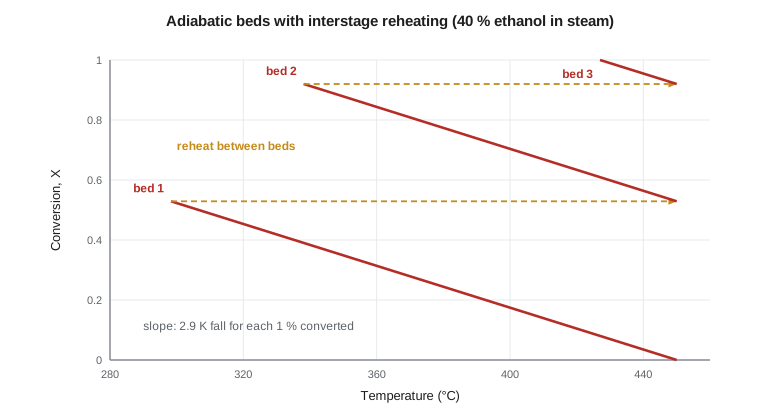
Reading the results
The first bed converts 53 % and cools to 298 °C. After reheating, the second bed converts the next 39 % and cools only to 338 °C, because there is less ethanol left to react. The third bed takes the conversion past 99.9 %, ending at 427 °C, and could be smaller. The reheats require about 29 kW before the second bed and 21 kW before the third for the pilot's 1.2 mol/s of ethanol. On the staircase plot, each bed is a straight line with the adiabatic slope, and each reheat is a horizontal step back to the inlet temperature. Commercial dehydration plants commonly use three or four beds in series, or tubular reactors heated from outside, for this reason.
Equilibrium and temperature
For a reversible reaction, the equilibrium constant changes with temperature according to the van 't Hoff equation, \(d\ln K/dT = \Delta H_R/RT^2\). For an endothermic reaction, \(K\) rises with temperature, so higher temperature favors both rate and equilibrium. The dehydration's equilibrium conversion, with the feed and pressure of the pilot, rises from about 80 % at 150 °C to 98 % at 250 °C and over 99.6 % at 350 °C. At the pilot's temperatures equilibrium never limits; rate does.
For an exothermic reversible reaction the opposite holds: \(K\) falls with temperature. High temperature speeds the rate but lowers the equilibrium conversion, and an adiabatic bed's rising temperature drives it toward an equilibrium limit that falls as it warms. On a conversion-temperature plot, the adiabatic line meets the equilibrium curve and stops. Industrial exothermic reversible reactions, such as ammonia and methanol synthesis or sulfur dioxide oxidation, therefore use beds with interstage cooling, the mirror image of the staircase here, and each bed is stopped short of the equilibrium curve. The optimum temperature at each conversion lies between the high temperatures that favor rate and the low ones that favor equilibrium.
The esterification sits between these cases. Its heat of reaction is small, a few kilojoules per mole, so its equilibrium constant barely changes: the code gives \(K\) of about 4.25 at 60 °C, 4.0 at 80 °C and 3.8 at 100 °C. For this reaction, temperature can be chosen for rate and catalyst life alone, and an adiabatic bed hardly warms at all, as lesson 12 confirms.
Worked problem
Outlet temperature of an adiabatic bed
An adiabatic bed of the pilot is fed at 450 °C and reaches 40 % conversion. What is the outlet temperature?
Show solution
- \(\Delta T = -\Delta H_RX/\sum\Theta_iC_{P,i} = -46{,}000 \times 0.40/160.5 = -115\) K.
- Outlet temperature \(= 450 - 115 = 335\) °C.
Answer: About 335 °C.
Heat exchange along a reactor
When a reactor exchanges heat through a wall, the energy balance for a PFR becomes a differential equation solved alongside the mole balance:
where \(U\) is the overall heat-transfer coefficient, \(a\) the heat-transfer area per unit volume and \(T_a\) the temperature of the heating or cooling medium. For an endothermic reaction, a multitubular reactor with tubes inside a furnace or a hot-oil shell keeps the temperature up all along the bed, and the reaction can be completed in one pass. The design then balances the cost of the heat-transfer area against the cost of extra catalyst and reheaters in the staged design. For an exothermic reaction, the same equation describes a cooled tubular reactor, and it shows the dangerous possibility of a hot spot, a local temperature peak where heat release exceeds removal, which can damage catalyst or start runaway side reactions.
Energy integration
The reheaters, the steam raising and the product cooling all move heat. A designer looks for ways to reuse it: the hot reactor outlet can preheat the incoming feed in a feed-effluent exchanger, and the condensing steam in the product can raise new steam at lower pressure. Such integration can cut the energy use of a dehydration plant substantially, but it couples the reactor to the rest of the process, so a disturbance in one place travels around the loop. Lesson 9 shows that this coupling can create instability even when each part is stable alone.
Where the heat data come from
The energy balance is only as good as its heat of reaction and heat capacities. Heats of reaction come from standard heats of formation, corrected to the reaction temperature with heat capacities; CHE-220 and CHE-320 worked through that procedure, and the dehydration's 46 kJ/mol is the value near reaction conditions from those data, rounded. Vapor heat capacities rise with temperature, by roughly a third for ethanol between 25 and 400 °C, so values must be taken at the right temperature. For a final design, Theo's simulator calculates enthalpies from a property package at each point rather than from constant heat capacities. The hand calculation still earns its place: it shows the structure of the answer, and it catches gross errors in the simulator's setup, such as a reaction entered with the wrong sign of heat.
Common mistakes
MistakeDesigning an endothermic gas-phase reactor as isothermal.
InsteadInclude the energy balance; the temperature fall can stop the reaction.
MistakeForgetting the diluent in the heat capacity of the stream.
InsteadSum \(\Theta_iC_{P,i}\) over all species fed, including steam and inerts.
MistakeAssuming higher temperature always raises equilibrium conversion.
InsteadOnly for endothermic reactions; for exothermic ones it lowers it.
MistakeIgnoring hot spots in a cooled tubular reactor.
InsteadCheck the peak temperature along the tube, not just the outlet.
Summary and key terms
- The steady-state energy balance links temperature and conversion; adiabatic reactors follow \(T = T_0 - \Delta H_RX/\sum\Theta_iC_{P,i}\).
- The dehydration cools the stream by about 2.9 K for each 1 % converted with the pilot's steam ratio.
- Three adiabatic beds with reheating to 450 °C convert 53 %, then 92 %, then over 99.9 %.
- Endothermic reactions gain equilibrium conversion with temperature; exothermic ones lose it.
- The esterification's small heat of reaction leaves \(K\) nearly constant.
- Heat exchange through the wall is added as \(Ua(T_a - T)\) in the PFR energy balance.
- Heat of reaction
- The enthalpy change per mole of reaction; negative for exothermic, positive for endothermic.
- Adiabatic reactor
- A reactor with no heat exchange with its surroundings.
- Adiabatic temperature change
- The temperature change for complete conversion with no heat exchange.
- Interstage heating or cooling
- Heat exchange between adiabatic beds in series.
- Van 't Hoff equation
- The relation d ln K/dT = ΔH_R/RT², giving the temperature dependence of equilibrium.
- Hot spot
- A local temperature maximum in a cooled exothermic reactor.
Practice problems
Work each problem on paper first, then reveal the answer to check.
With twice the steam, 3 mol per mole of ethanol, what is the adiabatic temperature change for complete conversion?
Show answer
\(46{,}000/(105 + 3 \times 37) = 213\) K.
Why does the second bed cool less than the first?
Show answer
Less ethanol is left to react, so less heat is absorbed.
For an exothermic reversible reaction, would you use interstage heating or cooling?
Show answer
Cooling, so that each bed starts cool enough for a favorable equilibrium.
Using the van 't Hoff equation, by what factor does \(K\) change from 80 to 100 °C if \(\Delta H_R = -3\) kJ/mol?
Show answer
\(K_{100}/K_{80} = \exp[(\Delta H_R/R)(1/353.15 - 1/373.15)] = \exp(-360.8 \times 1.52\times10^{-4}) = 0.95\).
What does \(\Delta C_P\) represent in the energy balance?
Show answer
The change in heat capacity between products and reactants.
What is a feed-effluent exchanger?
Show answer
A heat exchanger that uses the hot reactor outlet to preheat the feed.
Lesson quiz · 5 questions
Score 60% or more to complete this lesson.
Create a free account to save your progress, take quizzes and earn a certificate.