
CHE-345 · Lesson 10 of 12 · 21 min
Unsteady operation and semibatch reactors
Reactors spend part of their life away from steady state: starting up, shutting down, changing rate, and responding to disturbances. Some are designed never to reach steady state, such as semibatch reactors, which are fed while they react. Before the continuous ethyl acetate line is commissioned, the operations group wants to make first product in an existing 8 m³ stirred tank, and Ingrid suggests a semibatch scheme: charge the ethanol, add the resin in a basket, and feed the acetic acid over two hours. Theo models it, and then looks at how long the continuous pre-reactor will take to reach steady state when it starts.
Unsteady mole balances
For any well-mixed vessel, the general mole balance of lesson 1 keeps its accumulation term:
In a batch, both flows are zero. In a CSTR during start-up, both are present and the accumulation decays to zero as steady state is approached. In a semibatch reactor, one or more species are fed but nothing leaves, so the volume grows with time and the balances must be written in moles rather than concentrations: \(dN_j/dt = F_{j0} + r_jV\), with \(dV/dt = v_0\) for a constant-density feed. Concentrations are then \(C_j = N_j/V\). The set of equations is integrated numerically, with the rate evaluated from the current moles and volume at each step.
Why semibatch?
Semibatch operation serves three purposes. It controls heat release: if the fed reactant reacts quickly, the rate of heat release is limited by the feed rate, and stopping the feed stops the reaction within minutes, a powerful safety feature for exothermic reactions after lesson 9. It controls selectivity: feeding one reactant slowly keeps its concentration low, which favors a desired reaction of lower order in that reactant, as lesson 6 showed. And it can shift an equilibrium: some semibatch processes remove a product, by distilling it off for example, while feeding a reactant. Reactive distillation, the next step after the pre-reactor in the ethyl acetate line, is the continuous version of that last idea.
The semibatch esterification
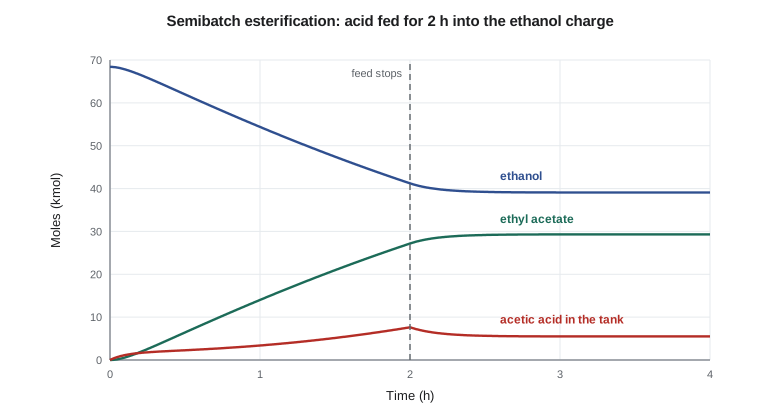
Theo's scheme charges 4.0 m³ of dry ethanol, 68.4 kmol, and feeds glacial acetic acid at 1.0 m³/h for two hours, 34.8 kmol in all, giving a final ratio of about 2 mol of ethanol per mole of acid. The rate law is the reversible one of lesson 2 at 80 °C, written in moles: \(-r_A = k(N_AN_B - N_CN_D/K)/V^2\). The code integrates the five balances, for the four species and the volume, through the two hours of feeding and two more hours of reaction.
# Unsteady operation: a semibatch esterification and the start-up of a CSTR
# Semibatch: ethanol charged first, acetic acid fed over 2 h; liquid volumes added (ideal mixing approximation)
K, k = 4.0, 1.5e-4 * 3600        # m3/(kmol h) at 80 C, illustrative (lesson 2 value)
V0, NB0 = 4.0, 4.0 * 17.1         # m3 of ethanol, kmol ethanol
cA_feed, v_feed, t_feed = 17.4, 1.0, 2.0     # kmol/m3 acid, m3/h, h of feeding (34.8 kmol acid in all)
def deriv(t, y):
    NA, NB, NC, ND, V = y
    vin = v_feed if t < t_feed else 0.0
    r = k * (NA * NB - NC * ND / K) / V ** 2         # kmol/(m3 h)
    return [cA_feed * vin - r * V, -r * V, r * V, r * V, vin]
y, t, h = [0.0, NB0, 0.0, 0.0, V0], 0.0, 0.005
print(" t (h)   V (m3)   acid fed   acid left   ester (kmol)   conversion of acid fed")
nxt = 0.5
while t < 4.0 + 1e-9:
    if t >= nxt - 1e-9:
        fed = cA_feed * v_feed * min(t, t_feed)
        print(f"{t:5.1f}    {y[4]:5.2f}    {fed:6.1f}     {y[0]:6.2f}       {y[2]:6.2f}          {y[2] / fed:.3f}")
        nxt += 0.5
    a = deriv(t, y); b = deriv(t + h / 2, [yi + h * ai / 2 for yi, ai in zip(y, a)])
    c = deriv(t + h / 2, [yi + h * bi / 2 for yi, bi in zip(y, b)]); d = deriv(t + h, [yi + h * ci for yi, ci in zip(y, c)])
    y = [yi + h * (ai + 2 * bi + 2 * ci + di) / 6 for yi, ai, bi, ci, di in zip(y, a, b, c, d)]; t += h
# equilibrium for the final mixture: ethanol:acid = 68.4:34.8, about 2:1
thB = NB0 / (cA_feed * v_feed * t_feed)
import math
a_ = K - 1; b_ = -K * (1 + thB); c_ = K * thB
print(f"equilibrium conversion of acid for ethanol:acid = {thB:.2f}: {(-b_ - math.sqrt(b_ * b_ - 4 * a_ * c_)) / (2 * a_):.3f}")
# heat release in the semibatch is limited by the feed rate: about 3 kJ/mol (approximate)
print(f"largest heat release if fed acid reacted instantly: {cA_feed * v_feed * 3000 / 3.6:.0f} W")

# CSTR start-up: first-order reaction, tank initially full of solvent, step to feed concentration
ktau = 2.0                      # k tau, steady-state X = ktau/(1+ktau)
print("t/tau   CA/CA0   steady value", f"{1 / (1 + ktau):.3f}")
for tt in (0.25, 0.5, 1.0, 1.5, 2.0):
    CA = (1 - math.exp(-(1 + ktau) * tt)) / (1 + ktau)
    print(f"{tt:5.2f}    {CA:.3f}")
print(f"time to within 1 % of steady state: {math.log(100) / (1 + ktau):.2f} tau")t (h) V (m3) acid fed acid left ester (kmol) conversion of acid fed 0.5 4.50 8.7 2.27 6.43 0.739 1.0 5.00 17.4 3.38 14.02 0.806 1.5 5.50 26.1 5.14 20.96 0.803 2.0 6.00 34.8 7.63 27.17 0.781 2.5 6.00 34.8 5.64 29.17 0.838 3.0 6.00 34.8 5.51 29.31 0.842 3.5 6.00 34.8 5.50 29.32 0.842 4.0 6.00 34.8 5.50 29.32 0.842 equilibrium conversion of acid for ethanol:acid = 1.97: 0.842 largest heat release if fed acid reacted instantly: 14500 W t/tau CA/CA0 steady value 0.333 0.25 0.176 0.50 0.259 1.00 0.317 1.50 0.330 2.00 0.333 time to within 1 % of steady state: 1.54 tau
Reading the semibatch results
While the acid is fed into excess ethanol, it reacts almost as fast as it arrives: after half an hour, only 2.3 of the 8.7 kmol fed is still unreacted, a conversion of 74 %, and at one hour 81 %. As the batch proceeds, ester and water build up and the reverse reaction slows the net rate, so unreacted acid grows to 7.6 kmol by the end of feeding. After the feed stops, the remaining acid reacts over the next hour and the batch levels off at 84.2 % conversion, the equilibrium value for a 2:1 mixture from lesson 3. The batch makes 29.3 kmol of ester in about four hours, roughly 2.6 metric tons. A cycle including emptying, separation and recharging would take perhaps six hours, so the interim scheme could supply about 10 metric tons of ester a day while the continuous line is commissioned.
The heat release is modest. Even if every mole of fed acid reacted the moment it entered, the release would be only about 14.5 kW, using the small heat of reaction of a few kilojoules per mole. The tank's jacket can remove many times that. For this reaction the semibatch's safety advantage is not needed, but its scheduling flexibility is: the feed can be stopped at any time to hold the batch.
Worked problem
Moles and concentrations during feeding
At 1.0 h the tank holds 5.0 m³, with 3.38 kmol of acid and 14.0 kmol of ester. What are the acid and ester concentrations, and how much ethanol is left?
Show solution
- \(C_A = 3.38/5.0 = 0.68\) kmol/m³; \(C_C = 14.0/5.0 = 2.80\) kmol/m³.
- Ethanol consumed equals ester formed: \(68.4 - 14.0 = 54.4\) kmol, or 10.9 kmol/m³.
Answer: Acid 0.68 and ester 2.80 kmol/m³; 54.4 kmol of ethanol remains.
Starting up a CSTR
A continuous stirred tank reaches steady state gradually. For a first-order reaction in a tank initially full of solvent with no reactant, the unsteady balance \(dC_A/dt = (C_{A0} - C_A)/\tau - kC_A\) has the solution
The approach to steady state is governed by the time constant \(\tau/(1 + k\tau)\): faster for a faster reaction. For \(k\tau = 2\), the concentration is within 1 % of its steady value after about 1.5 space times. A slower reaction takes longer, up to about 4.6 space times for a reaction so slow it barely converts. As a rule of thumb, a CSTR settles within three to five space times, and product made during that time may be off specification. For the continuous pre-reactor, whose space time is about half an hour, start-up product would go to a slops tank for reprocessing for the first two hours or so.
Start-up of a non-isothermal reactor is harder. The energy balance has its own time constant, often longer than the mole balance's because the vessel's metal and its contents must heat up, and the two balances interact. Lesson 9 showed that an exothermic CSTR can have several steady states; which one a start-up reaches depends on the path taken. A reactor started too hot may ignite and overshoot; one started too cold may settle on the low-conversion branch. Start-up procedures for such reactors are designed with dynamic simulations and written with specific temperature and feed-rate limits at each stage.
Shutting down
Shutdown is start-up in reverse and deserves the same care. When the pre-reactor's feed stops, the liquid in the bed sits on the resin and keeps reacting toward equilibrium; that is harmless for the esterification, but a reactor holding an exothermic mixture would continue to release heat with no flow to carry it away. Procedures therefore specify the order in which feeds stop, whether the vessel is flushed with a non-reacting liquid, and how temperature is watched until the contents are inert. For the resin bed, Ingrid adds one more step: flush with ethanol before a long shutdown, because acid left standing on the resin for weeks can slowly degrade the catalyst and its supports.
Dynamic models in plant life
Beyond start-up, unsteady models are used to design control systems, to test how a reactor responds to a feed interruption or a loss of cooling, and to train operators on simulators. They are the same mole and energy balances used throughout this course, with the accumulation terms kept and integrated in time. CHE-374 builds on them to design the controllers that hold a reactor at its chosen steady state, and the safety studies of lesson 9 use them to check that protective systems act in time.
Choosing the feed rate
The feed rate is the semibatch's main design variable. Feeding faster shortens the batch but lets unreacted acid build up, because the reaction cannot keep pace; feeding slower keeps the acid low but lengthens the cycle. Theo runs the model at three feed times, one, two and four hours, and plots the peak unreacted acid against batch time. Two hours is a reasonable compromise for this mild reaction. For an exothermic reaction the same plot becomes a safety tool: the peak accumulation of unreacted feed sets the worst-case heat that could be released if the reaction stopped and then restarted all at once, for example after an agitator failure. Process safety reviews of semibatch reactors therefore ask for the accumulation profile, and many plants interlock the feed with the agitator and the reactor temperature so that feed stops automatically if the reaction is not consuming it.
Common mistakes
MistakeWriting semibatch balances in concentrations with a constant volume.
InsteadUse moles and include \(dV/dt\); the volume grows as feed is added.
MistakeAssuming a CSTR reaches steady state in one space time.
InsteadAllow three to five space times, and longer for slow reactions.
MistakeUsing a semibatch scheme without checking the accumulation of unreacted feed.
InsteadTrack unreacted reactant; if it builds up, a delayed reaction can release heat all at once.
MistakeStarting an exothermic reactor without a planned temperature path.
InsteadUse a dynamic model to choose a start-up that reaches the intended steady state.
Summary and key terms
- Unsteady balances keep the accumulation term: \(dN_j/dt = F_{j0} - F_j + r_jV\).
- Semibatch reactors control heat release, improve selectivity and can shift equilibria.
- The semibatch esterification converts 84.2 % of the acid, the equilibrium value for a 2:1 mixture, in about four hours.
- Acid accumulates slowly while fed into excess ethanol; the batch finishes within an hour of the end of feeding.
- A first-order CSTR approaches steady state with time constant \(\tau/(1 + k\tau)\); allow three to five space times.
- Dynamic models support start-up, control design, safety studies and operator training.
- Semibatch reactor
- A reactor fed with one or more reactants during the reaction, with no outflow.
- Accumulation
- The rate of change of the amount of a species in a system.
- Start-up
- The period during which a continuous reactor moves from its initial state to steady state.
- Time constant
- The characteristic time of an exponential approach to steady state.
- Feed-limited reaction
- A semibatch reaction in which the rate is set by how fast a reactant is added.
- Dynamic simulation
- A model that integrates the unsteady balances in time.
Practice problems
Work each problem on paper first, then reveal the answer to check.
A semibatch reactor starts with 3 m³ and is fed at 1.5 m³/h for 2 h. What is the final volume?
Show answer
\(3 + 1.5 \times 2 = 6\) m³.
For \(k\tau = 0.5\), how many space times does a first-order CSTR need to come within 1 % of steady state?
Show answer
\(\ln 100/1.5 = 3.1\) space times.
Why did the semibatch reach 84.2 % rather than more?
Show answer
That is the equilibrium conversion for a 2:1 ratio with \(K = 4\).
How would feeding acid faster change the acid concentration during feeding?
Show answer
It would rise faster, because the reaction would keep up less well.
Name one hazard of accumulated unreacted feed in a semibatch exothermic reaction.
Show answer
If the reaction starts late, all the accumulated reactant can react at once and release its heat quickly.
What is the steady value of \(C_A/C_{A0}\) for \(k\tau = 2\)?
Show answer
\(1/3 = 0.333\).
Lesson quiz · 5 questions
Score 60% or more to complete this lesson.
Create a free account to save your progress, take quizzes and earn a certificate.