
CHE-345 · Lesson 12 of 12 · 21 min
Capstone: designing the esterification pre-reactor
Four months into the work term, Theo brings the pieces together. Ingrid asks for a pre-reactor design basis she can review and seal: the bed volume and dimensions, the operating conditions, the expected outlet composition, the heat balance, the by-products sent forward to the reactive distillation column, and a reactive hazards assessment. Each item draws on an earlier lesson, and each number must trace back to a mole balance, a rate law and data. This lesson walks through the design as Theo writes it up.
Design basis
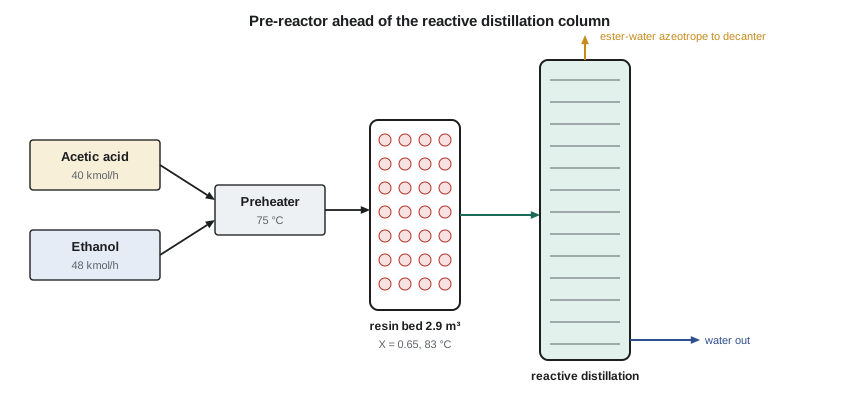
The line will make about 25,000 metric tons of ethyl acetate a year. The pre-reactor receives 40 kmol/h of acetic acid and 48 kmol/h of dry ethanol, a ratio of 1.2:1 chosen in lesson 3 to raise the equilibrium conversion without a large ethanol recycle. Dry ethanol comes from the plant's molecular sieve unit, so the feed carries little water. The catalyst is a macroporous sulfonic acid ion-exchange resin of the type widely used for esterification. Its kinetics are the reversible rate law of lesson 2, with the rate constant confirmed by Dev's measurements on plant materials at the design ratio and an activation energy of 62 kJ/mol from lesson 5. The reactor is a vertical fixed bed with downflow of liquid. The column behind it completes the conversion by removing water as it forms.
Equilibrium and the design conversion
With a 1.2:1 feed and \(K = 4\), the equilibrium conversion of the acid is 72.4 %. Lesson 2 showed that pushing a reactor close to equilibrium costs a great deal of volume for little gain, so the design target is 90 % of the equilibrium value, a conversion of 65.2 %. The column handles the rest more cheaply, because removing water shifts the equilibrium itself.
Sizing the bed with the energy balance
The esterification is slightly exothermic, with a heat of reaction of about −3 kJ/mol. With heat capacities of about 123 J/(mol K) for liquid acetic acid and 112 for ethanol, the feed's heat capacity is 257 J/K per mole of acid, and the adiabatic temperature rise to the design conversion is under 8 K. The bed can therefore be adiabatic, with no cooling coils, which keeps the vessel simple. The code integrates the mole balance with the adiabatic temperature rise for three inlet temperatures.
# Capstone: the esterification pre-reactor ahead of the reactive distillation column
import math
R = 8.314
FA0 = 40.0                         # kmol/h acetic acid
thB = 1.2                          # ethanol:acid feed ratio
Vm_A, Vm_B = 0.0572, 0.0584        # m3/kmol liquid molar volumes (approximate)
v0 = FA0 * (Vm_A + thB * Vm_B)     # m3/h, ideal-mixing approximation
CA0 = FA0 / v0
K = 4.0
a_ = K - 1; b_ = -K * (1 + thB); c_ = K * thB
Xe = (-b_ - math.sqrt(b_ * b_ - 4 * a_ * c_)) / (2 * a_)
Xt = 0.90 * Xe
print(f"feed {v0:.2f} m3/h, CA0 = {CA0:.2f} kmol/m3, equilibrium X = {Xe:.3f}, design X = {Xt:.3f}")

dH, cp_A, cp_B = -3.0e3, 123.0, 112.0                  # J/mol and J/(mol K), approximate
sum_cp = cp_A + thB * cp_B
def k(T): return 1.5e-4 * 3600 * math.exp(-62e3 / R * (1 / T - 1 / 353.15))    # m3/(kmol h), lesson 5 energy
def rate(X, T):
    return k(T) * CA0 ** 2 * ((1 - X) * (thB - X) - X * X / K)                  # kmol/(m3 h)
for Tin in (343.15, 348.15, 353.15):
    X, T, V, h = 0.0, Tin, 0.0, 0.001
    while X < Xt:
        V += h; X += h * rate(X, T) / FA0; T = Tin - dH * X / sum_cp
    print(f"inlet {Tin - 273.15:.0f} C: ideal plug-flow bed {V:.2f} m3, outlet {T - 273.15:.1f} C")
    if abs(Tin - 348.15) < 0.01: V75 = V; Tout75 = T
# design margins: non-ideal flow (about 5 % conversion loss, lesson 11) and catalyst aging
V_design = V75 * 1.10 * 1.25
D = (4 * V_design / (math.pi * 3.0)) ** (1 / 3)
print(f"design bed volume with 10 % for dispersion and 25 % for aging: {V_design:.2f} m3; L/D 3 gives D = {D:.2f} m, L = {3 * D:.2f} m")
u = v0 / 3600 / (math.pi * D ** 2 / 4)
print(f"superficial liquid velocity {u * 1000:.2f} mm/s; space time on the empty bed {V_design / v0 * 60:.0f} min")
# heat and safety: maximum temperature of the synthesis reaction if all remaining acid reacted adiabatically
dTad_full = -dH * Xe / sum_cp
print(f"adiabatic rise to equilibrium from the inlet: {dTad_full:.1f} K; maximum temperature about {75 + dTad_full:.0f} C")
print("the resin's upper temperature limit (about 120 C) and the boiling point at operating pressure set the guard band")
# side reaction to diethyl ether: illustrative first-order selectivity at 80 C
S = 0.0008
print(f"diethyl ether formed: about {S * FA0 * Xt * 1000:.0f} mol/h ({S * FA0 * Xt * 74.1:.2f} kg/h), sent forward to the column")
print(f"ester made in the pre-reactor: {FA0 * Xt:.1f} kmol/h = {FA0 * Xt * 88.1 / 1000:.2f} t/h")feed 5.09 m3/h, CA0 = 7.86 kmol/m3, equilibrium X = 0.724, design X = 0.652 inlet 70 C: ideal plug-flow bed 2.81 m3, outlet 77.6 C inlet 75 C: ideal plug-flow bed 2.08 m3, outlet 82.6 C inlet 80 C: ideal plug-flow bed 1.55 m3, outlet 87.6 C design bed volume with 10 % for dispersion and 25 % for aging: 2.86 m3; L/D 3 gives D = 1.07 m, L = 3.20 m superficial liquid velocity 1.58 mm/s; space time on the empty bed 34 min adiabatic rise to equilibrium from the inlet: 8.4 K; maximum temperature about 83 C the resin's upper temperature limit (about 120 C) and the boiling point at operating pressure set the guard band diethyl ether formed: about 21 mol/h (1.55 kg/h), sent forward to the column ester made in the pre-reactor: 26.1 kmol/h = 2.30 t/h
Choosing the inlet temperature
An ideal plug-flow bed needs 2.81 m³ with a 70 °C inlet, 2.08 m³ at 75 °C and 1.55 m³ at 80 °C. Higher temperature means a smaller bed, but two constraints argue for restraint. First, acid resins of this type lose sulfonic acid groups faster at higher temperature; vendors commonly quote an upper limit around 120 °C, and catalyst life improves well below it. Second, the mixture's bubble point must stay above the bed temperature so the reactor stays liquid; the ternary azeotrope met in CHE-320 boils near 70 °C at atmospheric pressure, so the bed runs under a few bar of pressure, set by the column's feed pressure. Theo chooses a 75 °C inlet. The outlet is 82.6 °C, well inside both limits.
Design margins
Two corrections turn the ideal volume into a design volume. Lesson 11's tracer test showed that the bed reaches about 95 % of the ideal plug-flow conversion at the same residence time; about 10 % more volume restores the target. Lesson 7 showed that catalysts lose activity in service; resin esterification catalysts deactivate slowly, mainly through loss of acid groups and fouling by metal ions from corrosion, and a 25 % allowance lets the bed hold its conversion for the planned catalyst life with modest temperature increases. The design bed is therefore \(2.08 \times 1.10 \times 1.25 = 2.86\) m³.
With a length-to-diameter ratio of 3, the bed is 1.07 m in diameter and 3.2 m deep. The superficial liquid velocity is 1.6 mm/s, low enough for a small pressure drop through resin beads of under a millimeter and high enough, with a good distributor, for even flow. The space time on the empty bed is 34 minutes, an LHSV of about 1.8 per hour, inside the range resin vendors typically recommend. The vessel itself is stainless steel, because hot acetic acid attacks carbon steel, as CHE-280 discussed.
Worked problem
Checking the design conversion by hand
Verify that the design target is 90 % of equilibrium for a 1.2:1 feed with \(K = 4\).
Show solution
- Equilibrium: \(K(1 - X)(1.2 - X) = X^2\), or \(3X^2 - 8.8X + 4.8 = 0\).
- \(X = [8.8 - \sqrt{77.44 - 57.6}]/6 = (8.8 - 4.454)/6 = 0.724\).
- Design: \(0.90 \times 0.724 = 0.652\).
Answer: Equilibrium 72.4 %; design 65.2 %.
Outlet composition and by-products
At 65.2 % conversion the pre-reactor makes 26.1 kmol/h of ester, about 2.3 t/h, and the same amount of water. The outlet carries 13.9 kmol/h of unreacted acid and 21.9 of ethanol to the column. The main side reaction over acid resin at these temperatures is the dehydration of two ethanol molecules to diethyl ether, the same reaction lesson 6 met in the gas phase. At 80 °C it is slow; Theo uses an illustrative selectivity of 0.08 % of the converted acid, about 21 mol/h or 1.6 kg/h of ether. Ether boils at 35 °C, so it will leave the top of the column with the light ends and must be purged before it builds up in the recycle. Ingrid asks Dev to measure the ether formation rate directly in the next set of laboratory runs, because the purge sizing depends on it.
Reactive hazards
Theo's hazards section follows lesson 9. The reaction's heat is small: if the whole bed reached equilibrium adiabatically from the inlet, the temperature would rise by 8.4 K to about 83 °C. There is no credible runaway of the main reaction. The hazards lie elsewhere. The feed and products are flammable liquids, so the vessel needs the fire protection and electrical classification the fire code adopted by the state requires. Acetic acid is corrosive. The resin could release heat if it were dried out and contacted with concentrated oxidants, which the operating procedures exclude. The bed must be protected against overpressure from blocked outlets and against fire exposure, so the relief valve is sized for both cases. The process falls under the plant's existing framework, the PSM standard, and Ingrid arranges for the design to go through the plant's process hazard analysis before it is sealed.
What the design basis records
Ingrid's checklist for the design basis is short and strict. Every number has a source: the rate constant from Dev's runs, with their temperatures and compositions; the activation energy from the Arrhenius fit; the equilibrium constant from the thermodynamic model of CHE-320; the margins from the tracer test and the catalyst vendor's aging data. Every assumption is stated: adiabatic operation, ideal mixing of the liquid volumes, a constant heat of reaction. Every uncertain value is flagged with what would change if it were wrong; if the rate constant were 20 % low, for example, the design margins would absorb most of the shortfall, and the column would handle the rest at a small energy cost. The code and its inputs are attached so that anyone can repeat the calculation.
Theo's last task is to list what he would measure after start-up to confirm the design: the bed's inlet and outlet temperatures and compositions every shift, to track the apparent rate constant and catalyst aging; a tracer test on the full-scale bed after loading, to check its flow; and the ether in the column overhead, to confirm the side-reaction rate. With those, the plant will know within months whether the design basis holds. Ingrid reviews the package, asks for two clarifications, and seals it. The pre-reactor goes out for bids.
What this course has built
The pre-reactor design used every idea in this course: a mole balance and a rate law, a stoichiometric table, a Levenspiel comparison of reactor types, laboratory kinetics fitted by regression, the Arrhenius temperature dependence, selectivity to a by-product, an energy balance, a hazards review, and a measured residence time distribution. Larger and more complex reactors add more species, more heat transfer and more detailed flow models, but the structure is the same. CHE-350 next designs the reactive distillation column and the separations around it, CHE-374 controls the reactor and column, and CHE-446 puts the whole line into a costed process design.
Common mistakes
MistakeDesigning a reversible reaction to its equilibrium conversion.
InsteadDesign to a fraction of equilibrium and let downstream steps or changed conditions go further.
MistakeReporting the ideal plug-flow volume as the design volume.
InsteadAdd margins for non-ideal flow and catalyst aging, and state them.
MistakeChoosing the highest temperature the kinetics allow.
InsteadCheck catalyst temperature limits, bubble point and side reactions.
MistakeLeaving by-products out of the reactor design basis.
InsteadEstimate them, because they set purges and product purity downstream.
Summary and key terms
- Design target: 65.2 % conversion, 90 % of the 72.4 % equilibrium for a 1.2:1 feed.
- Adiabatic bed with a 75 °C inlet: 2.08 m³ ideal, 2.86 m³ with margins for dispersion and aging.
- Bed 1.07 m in diameter and 3.2 m deep; outlet at 82.6 °C; LHSV about 1.8 per hour.
- The pre-reactor makes about 2.3 t/h of ester and a small amount of diethyl ether that must be purged.
- The main reaction cannot run away; flammability, corrosion and overpressure are the hazards to manage.
- Every number in the design basis traces to data, a balance or a stated assumption.
- Design basis
- The documented set of data, assumptions and results on which a design rests.
- Design margin
- An allowance added to an ideal result to cover non-ideal behavior and uncertainty.
- Ion-exchange resin catalyst
- A polymer bead carrying acid groups that catalyze reactions such as esterification.
- Reactive distillation
- A column in which reaction and separation happen together, removing products to shift equilibrium.
- Purge
- A small stream withdrawn to stop an impurity building up in a recycle.
- LHSV
- Liquid hourly space velocity, the liquid volumetric feed rate divided by the catalyst bed volume.
Practice problems
Work each problem on paper first, then reveal the answer to check.
What is the ideal bed volume at an 80 °C inlet, and why might Theo still prefer 75 °C?
Show answer
1.55 m³; the lower temperature extends resin life and keeps a wider margin to the bubble point.
How much ester does the pre-reactor make per year at 8,400 h?
Show answer
\(2.30 \times 8{,}400 = 19{,}300\) t, the rest coming from the column.
If the dispersion margin were 20 % instead of 10 %, what would the design volume be?
Show answer
\(2.08 \times 1.20 \times 1.25 = 3.12\) m³.
Why is no cooling needed in the bed?
Show answer
The adiabatic temperature rise is only about 8 K.
Why must diethyl ether be purged from the recycle?
Show answer
It is light and inert in the process, so it would otherwise accumulate.
Name three measurements that will confirm the design after start-up.
Show answer
Bed inlet and outlet compositions and temperatures, a full-scale tracer test, and ether in the column overhead.
Lesson quiz · 5 questions
Score 60% or more to complete this lesson.
Create a free account to save your progress, take quizzes and earn a certificate.