
CHE-345 · Lesson 1 of 12 · 23 min
Mole balances and the ideal reactor types
Theo Laurent's fourth work term at Kingfisher Bioenergy in Cedar Rapids starts with a new project and a new subject. The plant is building a line to make bio-based ethyl acetate from its own ethanol and purchased acetic acid, and a small pilot unit will test whether ethylene can be made from ethanol on a solid acid catalyst. Both projects turn on reactors. Ingrid Solheim, the process engineering lead who reviews and seals the design basis as a licensed PE, hands Theo a short list of reactor questions for the next four months and one rule: every reactor size he reports must come from a mole balance, written out, with the rate law and the data behind it. This course follows that list.
Chemical reaction engineering is the part of chemical engineering that decides how big a reactor must be, what type it should be, at what temperature and pressure it should run, and how much of the feed becomes the wanted product. It combines three things: a balance on each species, a rate law that says how fast the reaction goes at given conditions, and stoichiometry that relates concentrations to one another as the reaction proceeds. With energy balances added for non-isothermal reactors, those few ideas size nearly every reactor in industry, from a fermenter to a refinery cracker.
The general mole balance
Every reactor calculation starts from one statement, a balance on species \(j\) over a control volume:
Here \(F_{j0}\) and \(F_j\) are the molar flow rates of \(j\) in and out, in mol/s; \(r_j\) is the rate of formation of \(j\) per unit volume, in mol/(m³ s), which is negative for a reactant; and \(N_j\) is the number of moles of \(j\) in the system. The integral allows the rate to vary from point to point, as it does along a tube. The four ideal reactor types used in this course are four ways of simplifying that one equation.
A convention used throughout: for a reactant A, the rate of disappearance is written \(-r_A\), a positive number. A rate law such as \(-r_A = kC_A\) describes how \(-r_A\) depends on concentration and temperature; it is a property of the chemistry and the catalyst, not of the reactor. The same rate law applies in a flask, a tank or a tube. What changes from one reactor to another is how the concentrations seen by the reaction change with time or position.
The batch reactor
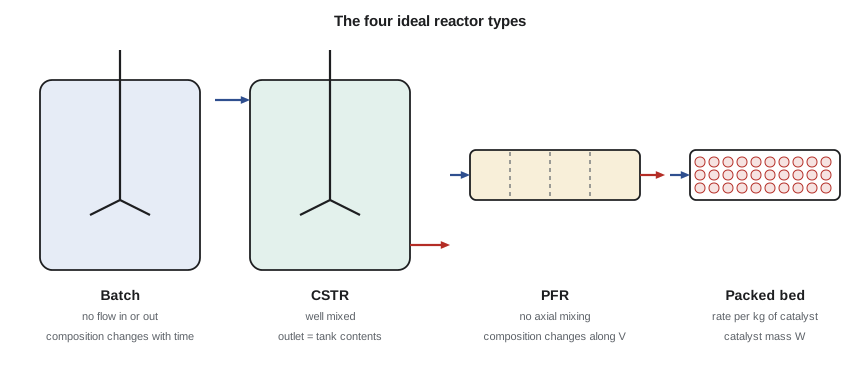
A batch reactor has no flow in or out while the reaction runs. If it is well mixed, the rate is the same everywhere, the integral becomes \(r_AV\), and the balance becomes \(dN_A/dt = r_AV\). For a liquid at constant volume, dividing by \(V\) gives \(dC_A/dt = r_A\). Batch reactors suit small volumes, many products made in campaigns, and reactions that need long times. Pharmaceutical and specialty chemical plants run mostly in batch. Their drawback is the time between batches: charging, heating, sampling, cooling and emptying can take as long as the reaction itself.
The continuous stirred-tank reactor
A continuous stirred-tank reactor, or CSTR, is fed and emptied continuously and is assumed perfectly mixed. Perfect mixing has a striking consequence: the composition everywhere in the tank equals the composition of the outlet stream. At steady state the accumulation term is zero and the rate is uniform, so the balance is algebraic:
The rate in the denominator is evaluated at the outlet concentration, which for most reactions is the lowest concentration of reactant anywhere in the process. A CSTR therefore runs its whole volume at the slowest rate in the system, which is its main disadvantage. Its advantages are easy temperature control, because the large well-mixed volume damps disturbances, and the ability to hold a reactant at a deliberately low concentration, which matters for selectivity in lesson 6.
The plug-flow reactor
A plug-flow reactor, or PFR, is a tube in which the fluid moves as a series of thin slices, each well mixed across the tube but not mixed with the slices ahead or behind. Concentration changes smoothly along the length. A balance on a thin slice of volume \(\Delta V\), with \(\Delta V \to 0\), gives the differential form
Each slice behaves like a small batch reactor traveling down the tube, with the travel time playing the role of the batch time. That is why a PFR and a batch reactor of the same residence time reach the same conversion at the same temperature. Long tubes at high velocity, such as steam crackers and many gas-phase reactors, come close to plug flow.
The packed-bed reactor
For a reaction on a solid catalyst, the rate is naturally expressed per mass of catalyst, \(-r_A'\) in mol/(kg s), because the catalyst is what does the work. The packed-bed reactor, or PBR, is a tube filled with catalyst particles, and its balance uses catalyst mass \(W\) instead of volume:
The ethylene pilot unit is a packed bed. Lesson 4 adds the pressure drop through the particles, which is often what limits how long a bed can be.
A first problem: treating a dilute ester stream
Ingrid starts Theo on a small, real problem. Wash water from the ethyl acetate line will carry a little ester when the line starts up and during upsets. Before that water goes to the plant's biological treatment, she wants the ester hydrolyzed with caustic soda, which turns it into sodium acetate and ethanol, both easily digested by the treatment bacteria. The reaction is the saponification of ethyl acetate,
It is irreversible, it is first order in each reactant, and its rate constant at 25 °C is about 0.11 L/(mol s). It is a classic laboratory reaction because its progress can be followed simply by measuring the conductivity of the solution. Dosing caustic in proportion to the ester gives equal concentrations of the two reactants, so \(-r_A = kC_A^2\) with \(C_A = C_{A0}(1 - X)\), where \(X\) is the fraction of ester converted. The design stream carries 0.050 mol/L of ester at 2.0 L/s.
Conversion is the natural variable for one reaction. Defined as moles of A reacted per mole of A fed, it turns each balance into an equation in \(X\) alone: for the batch reactor, \(t = \int dX/(kC_{A0}(1-X)^2)\); for the CSTR, \(V = F_{A0}X/(-r_A)_{\text{exit}}\); for the PFR, \(V = F_{A0}\int dX/(-r_A)\). The code evaluates all three.
# Mole balances: batch, CSTR and PFR for the caustic treatment of ethyl acetate in a wastewater stream
# Saponification: CH3COOC2H5 + NaOH -> CH3COONa + C2H5OH, -rA = k CA CB, equimolar feed so CA = CB
k = 0.11        # L/(mol s) at 25 C (approximate literature value)
CA0 = 0.050     # mol/L ethyl acetate (and NaOH) in the treated stream
v0 = 2.0        # L/s volumetric flow (7.2 m3/h)
FA0 = CA0 * v0  # mol/s

print(f"feed: CA0 = {CA0} mol/L, v0 = {v0} L/s, FA0 = {FA0:.3f} mol/s")
print("X      batch time (min)   CSTR volume (m3)   PFR volume (m3)   CSTR/PFR")
for X in (0.50, 0.80, 0.90, 0.95, 0.99):
    t = X / (k * CA0 * (1 - X))                        # batch, constant volume
    V_cstr = FA0 * X / (k * (CA0 * (1 - X)) ** 2)      # exit rate, L
    V_pfr = v0 / (k * CA0) * X / (1 - X)               # integral of FA0 dX / (-rA), L
    print(f"{X:4.2f}   {t / 60:10.1f}        {V_cstr / 1000:10.2f}         {V_pfr / 1000:9.2f}       {V_cstr / V_pfr:5.1f}")

tau_pfr = 0.99 / (k * CA0 * 0.01)
print(f"for X = 0.99 the PFR space time equals the batch time: {tau_pfr / 60:.1f} min")feed: CA0 = 0.05 mol/L, v0 = 2.0 L/s, FA0 = 0.100 mol/s X batch time (min) CSTR volume (m3) PFR volume (m3) CSTR/PFR 0.50 3.0 0.73 0.36 2.0 0.80 12.1 7.27 1.45 5.0 0.90 27.3 32.73 3.27 10.0 0.95 57.6 138.18 6.91 20.0 0.99 300.0 3600.00 36.00 100.0 for X = 0.99 the PFR space time equals the batch time: 300.0 min
What the numbers say
At 50 % conversion the CSTR is twice the size of the PFR; at 90 % it is ten times; at 99 % it is a hundred times, an absurd 3,600 m³. The reason is the one stated above: the CSTR runs at the outlet concentration, and for a second-order reaction the rate there falls with the square of the remaining reactant. The PFR uses the high rates near its inlet before the reactant is depleted. For any reaction whose rate falls as conversion rises, which is almost every reaction, a PFR needs less volume than a CSTR for the same conversion. Lesson 2 makes this graphical.
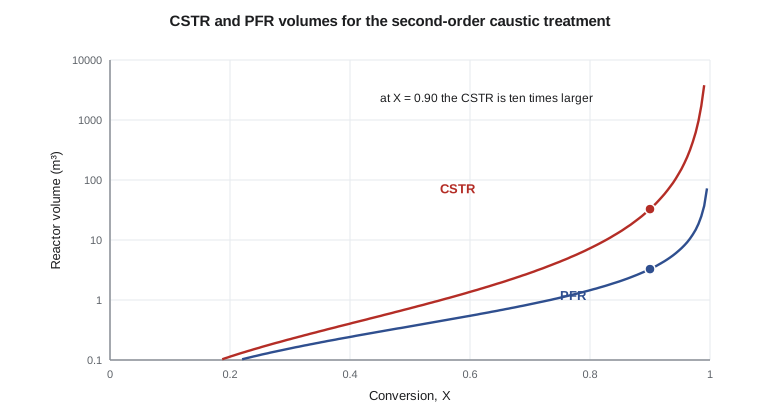
The output also shows the batch time to reach 99 % conversion, 300 minutes, equal to the PFR space time. Space time \(\tau = V/v_0\) is the time needed to process one reactor volume of feed, measured at inlet conditions; for a liquid PFR at constant density it equals the residence time of every fluid element.
Worked problem
Choosing the treatment reactor
Ingrid needs 90 % of the ester destroyed before the water leaves the treatment step. Which reactor should Theo propose?
Show solution
- PFR volume at \(X = 0.90\): \(V = (v_0/kC_{A0})\,X/(1-X) = (2.0/(0.11 \times 0.050)) \times 9 = 3{,}270\) L, about 3.3 m³.
- CSTR volume at the same conversion: \(V = F_{A0}X/(kC_A^2) = 0.100 \times 0.9/(0.11 \times 0.005^2) = 32{,}700\) L.
- A 3.3 m³ length of pipe, a coiled tube or a tank with baffles to approach plug flow, followed by a pH check, does the job; a single stirred tank would need ten times the volume.
Answer: A tubular reactor of about 3.3 m³, roughly 27 minutes of residence time.
Why mixing matters so much
The difference between the two continuous reactors is not about their shape. It is about mixing. Perfect mixing in the CSTR instantly dilutes fresh feed to the outlet concentration, wasting the driving force the feed brought in. Plug flow keeps fresh and reacted fluid apart, so each element of fluid experiences the full sequence of concentrations from inlet to outlet. Real reactors lie between the two extremes: a stirred tank with poor mixing has some plug-flow character, and a packed bed has some back-mixing caused by the flow around particles. Lesson 11 measures where a real vessel sits between the extremes by injecting a tracer and watching it come out.
Two practical points follow. First, splitting a CSTR into several smaller tanks in series approaches plug flow, because each tank runs at a higher concentration than the last one alone would. Lesson 2 shows that two tanks in series can cut the volume by more than half. Second, a stirred tank still has a place. It handles slurries, heat removal and reactions where low reactant concentration is wanted, and it is cheaper to build and clean than a long tube.
Batch or continuous?
The choice between batch and continuous operation depends on scale and product range more than on kinetics. A continuous reactor makes one product at a steady quality with little labor and is the right choice above a few thousand metric tons a year. A batch reactor gives flexibility: the same vessel can make ten products in a year, and the operator can hold, sample and adjust each batch. The ethyl acetate line, at about 25,000 metric tons a year, will be continuous. The pilot ethylene unit is continuous too, because its catalyst sits in a fixed bed through which the feed flows.
Batch processes also bring a specific hazard. All the reactants are in the vessel at the start, so if the cooling fails the whole charge can react at once. Lesson 9 returns to this through the 2007 explosion at T2 Laboratories in Jacksonville, Florida, which the US Chemical Safety Board traced to a cooling failure in a batch reactor. Continuous reactors hold less material at any moment, which is one reason they are inherently safer for large hazardous duties.
Units and conventions
This course works in SI units: concentrations in mol/L or kmol/m³ (the two are equal), flows in mol/s or kmol/h, volumes in m³ and catalyst in kg. Rate constants carry units that depend on the reaction order: 1/s for first order, L/(mol s) or m³/(kmol s) for second order. A rate constant quoted without units is useless, and checking the units of every rate law before using it catches many errors. When a rate law is written per mass of catalyst, the primed rate \(-r_A'\) is related to the volumetric rate by the bulk density of the bed: \(-r_A = \rho_b(-r_A')\).
Common mistakes
MistakeEvaluating the CSTR rate at the inlet concentration.
InsteadA perfectly mixed tank runs at its outlet composition; use the exit concentration.
MistakeTreating the rate law as a property of the reactor.
InsteadThe rate law belongs to the chemistry and catalyst; the reactor determines the concentrations the rate law sees.
MistakeReporting a reactor size without the rate data behind it.
InsteadState the rate law, the constants, their temperature and their source with every design number.
MistakeAssuming a stirred tank is always the cheaper choice.
InsteadFor high conversion a CSTR can need many times the volume of a tubular reactor.
Summary and key terms
- All reactor design starts from the general mole balance \(F_{j0} - F_j + \int r_j\,dV = dN_j/dt\).
- Batch: \(dN_A/dt = r_AV\). CSTR: \(V = (F_{A0} - F_A)/(-r_A)\) at exit conditions. PFR: \(dF_A/dV = r_A\). PBR: \(dF_A/dW = r_A'\).
- The CSTR runs its whole volume at the outlet concentration, so it needs more volume than a PFR for the same conversion.
- For the second-order caustic treatment at 90 % conversion, the CSTR is ten times larger than the PFR.
- A batch reactor and a PFR with equal residence time give the same conversion.
- Real reactors lie between perfect mixing and plug flow.
- Mole balance
- Accounting of the moles of a species entering, leaving, formed and accumulated in a control volume.
- Batch reactor
- A closed vessel in which reaction proceeds with time and no flow in or out.
- CSTR
- A continuous, perfectly mixed tank whose contents have the outlet composition.
- PFR
- A tube in which fluid moves in plug flow, with composition changing only along the length.
- Packed-bed reactor
- A tube filled with catalyst particles, designed on catalyst mass.
- Conversion
- Moles of a reactant reacted per mole of that reactant fed.
- Space time
- Reactor volume divided by inlet volumetric flow, τ = V/v₀.
Practice problems
Work each problem on paper first, then reveal the answer to check.
Write the PFR design equation in terms of conversion.
Show answer
\(F_{A0}\,dX/dV = -r_A\), so \(V = F_{A0}\int_0^X dX/(-r_A)\).
A first-order liquid reaction has \(k = 0.2\) 1/min. What CSTR space time gives 80 % conversion?
Show answer
\(\tau = X/(k(1-X)) = 0.8/(0.2 \times 0.2) = 20\) min.
What PFR space time gives the same 80 % for that reaction?
Show answer
\(\tau = \ln(1/(1-X))/k = 1.609/0.2 = 8.0\) min.
Why is the batch time equal to the PFR space time for a constant-density reaction?
Show answer
Each slice of fluid in plug flow is a small batch reactor whose reaction time is its travel time.
A catalytic rate is 0.02 mol/(kg s) and the bed density is 600 kg/m³. What is the volumetric rate?
Show answer
\(600 \times 0.02 = 12\) mol/(m³ s).
Give two reasons a plant might still choose a stirred tank.
Show answer
Easy heat removal and temperature control; handling of solids or slurries; keeping a reactant at low concentration for selectivity.
Lesson quiz · 5 questions
Score 60% or more to complete this lesson.
Create a free account to save your progress, take quizzes and earn a certificate.