
CHE-345 · Lesson 4 of 12 · 20 min
Isothermal design of batch, CSTR, PFR and packed-bed reactors
With a rate law and a stoichiometric table, the design equations of lessons 1 and 2 can be solved for any isothermal reactor. Fogler's textbook calls this the algorithm of reaction engineering: write the mole balance, the rate law and the stoichiometry, combine them, and evaluate. This lesson applies it to two plant problems. The first is a batch: Dev Raman's laboratory wants to know how long its one-liter esterification runs will take, and the operations group asks whether a batch reactor could make ester while the continuous line is being commissioned. The second is the ethylene pilot's packed bed, where pressure drop through the catalyst competes with the reaction.
The algorithm
| Step | Batch | CSTR | PFR or PBR |
|---|---|---|---|
| Mole balance | \(dX/dt = -r_AV/N_{A0}\) | \(V = F_{A0}X/(-r_A)\) | \(dX/dW = -r_A'/F_{A0}\) |
| Rate law | \(-r_A = f(C_i, T)\) | same | same |
| Stoichiometry | \(C_i\) from \(X\), constant \(V\) | \(C_i\) at exit \(X\) | \(C_i\) from \(X\), \(\varepsilon\), \(P/P_0\) |
| Combine and solve | integrate in \(t\) | algebra | integrate in \(W\) with \(dP/dW\) |
When the combined equation has an analytic integral, it gives a formula; when it does not, as soon as pressure drop or several reactions appear, it is integrated numerically. The code in this course uses the classical fourth-order Runge-Kutta method, which takes four slope evaluations per step and is accurate enough for reactor design with modest step sizes.
Batch esterification
For the equimolar esterification at constant volume, the batch balance is \(dX/dt = kC_{A0}[(1 - X)^2 - X^2/K]\), with \(kC_{A0} = 1.3\times10^{-3}\) per second for a well-stirred mixture with the same amount of resin per liter as the pre-reactor bed. The equation has an analytic solution, but the numerical one is easier to adapt, so the code integrates it.
The reaction reaches 30 % in under 6 minutes and 50 % in 14 minutes, then slows as it approaches equilibrium: 60 % takes 25 minutes and 65 % takes 42. A batch reactor in production would also need time to charge the reactants, heat them to 80 °C, filter off the resin or let it settle, cool and empty the vessel, perhaps an hour or more. Dev's laboratory runs will take about half an hour of reaction time each, and the operations group's interim batch scheme would make one batch every two hours or so.
Packed bed with pressure drop
The ethylene pilot unit passes ethanol vapor diluted with steam, 40 % ethanol at 3 bar inlet pressure and 350 °C, through a bed of solid acid catalyst. At these conditions the dehydration is effectively irreversible and first order in ethanol, so per kilogram of catalyst \(-r_A' = k'C_A\), with \(k' = 1.8\times10^{-4}\) m³/(kg s), an illustrative value for the pilot catalyst. Ethanol feed is 4.25 kmol/h, about 1,000 metric tons of ethylene a year if all converted.
Gas flowing through a packed bed loses pressure by friction. The Ergun equation describes this loss in terms of particle size, void fraction, gas density and velocity. For an isothermal bed it reduces to a simple form for the pressure ratio \(p = P/P_0\):
where \(\alpha\) collects the bed properties. The \((1 + \varepsilon X)\) term appears because the expanding gas flows faster. Pressure drop matters to the reaction because the concentration is proportional to pressure: \(C_A = C_{A0}(1 - X)p/(1 + \varepsilon X)\). The mole balance and the Ergun equation must be integrated together.
# Isothermal design: batch esterification time, and a packed bed for ethanol dehydration with Ergun pressure drop
import math
# 1. Batch esterification, 1:1, K = 4, k CA0 = 1.3e-3 1/s at 80 C (illustrative, from lesson 2)
kc = 1.5e-4 * 8.7
def dXdt(X): return kc * ((1 - X) ** 2 - X ** 2 / 4.0)
t, X, h = 0.0, 0.0, 1.0
marks = [0.3, 0.5, 0.6, 0.65]
while marks:
    k1 = dXdt(X); k2 = dXdt(X + h * k1 / 2); k3 = dXdt(X + h * k2 / 2); k4 = dXdt(X + h * k3)
    X += h * (k1 + 2 * k2 + 2 * k3 + k4) / 6; t += h
    if X >= marks[0]:
        print(f"batch reaches X = {marks.pop(0):.2f} after {t / 60:5.1f} min");
print("a full batch cycle adds charging, heating, cooling and emptying time")

# 2. Packed bed: C2H5OH -> C2H4 + H2O, first order in ethanol, isothermal at 350 C
R = 0.08314
P0, T = 3.0, 623.15          # bar inlet, K
yA0 = 0.4; eps = yA0           # 40 % ethanol in steam
FT0 = 10.6 / 3600              # kmol/s total feed (4.25 kmol/h ethanol)
FA0 = yA0 * FT0
CA0 = yA0 * P0 / (R * T)       # kmol/m3
kp = 1.8e-4                    # m3/(kg cat s), illustrative first-order constant at 350 C
alpha = 2.0e-4                 # 1/kg, Ergun pressure-drop parameter for the chosen particles (illustrative)

def f(W, X, y, dp=True):
    CA = CA0 * (1 - X) / (1 + eps * X) * y
    dX = kp * CA / FA0
    dy = -alpha / (2 * y) * (1 + eps * X) if dp else 0.0
    return dX, dy

def run(Wmax, dp):
    W, X, y, h = 0.0, 0.0, 1.0, 1.0
    out = {}
    while W < Wmax - 1e-9:
        a = f(W, X, y, dp); b = f(W + h / 2, X + h * a[0] / 2, y + h * a[1] / 2, dp)
        c = f(W + h / 2, X + h * b[0] / 2, y + h * b[1] / 2, dp); d = f(W + h, X + h * c[0], y + h * c[1], dp)
        X += h * (a[0] + 2 * b[0] + 2 * c[0] + d[0]) / 6; y += h * (a[1] + 2 * b[1] + 2 * c[1] + d[1]) / 6; W += h
        if y < 0.05: break
        if int(W) % 500 == 0: out[int(W)] = (X, y)
    return out
noDP = run(2500, False); DP = run(2500, True)
print("W (kg)   X without dP   X with dP   P/P0")
for W in (500, 1000, 1500, 2000, 2500):
    print(f"{W:6d}      {noDP[W][0]:.3f}        {DP[W][0]:.3f}      {DP[W][1]:.2f}")
# catalyst needed for X = 0.98 without pressure drop (analytic): W = FA0/(k CA0) [(1+eps) ln(1/(1-X)) - eps X]
X = 0.98
Wa = FA0 / (kp * CA0) * ((1 + eps) * math.log(1 / (1 - X)) - eps * X)
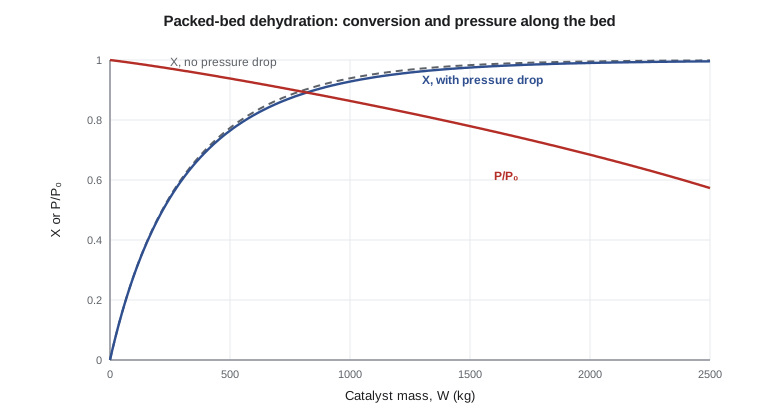
print(f"analytic catalyst mass for X = 0.98 with no pressure drop: {Wa:.0f} kg")batch reaches X = 0.30 after 5.6 min batch reaches X = 0.50 after 14.0 min batch reaches X = 0.60 after 24.9 min batch reaches X = 0.65 after 42.1 min a full batch cycle adds charging, heating, cooling and emptying time W (kg) X without dP X with dP P/P0 500 0.774 0.764 0.94 1000 0.939 0.928 0.86 1500 0.983 0.975 0.78 2000 0.995 0.990 0.68 2500 0.999 0.996 0.57 analytic catalyst mass for X = 0.98 with no pressure drop: 1436 kg
Reading the bed results
Without pressure drop, 1,000 kg of catalyst gives 93.9 % conversion and 1,436 kg reaches 98 %, matching the analytic formula \(W = (F_{A0}/k'C_{A0})[(1 + \varepsilon)\ln(1/(1-X)) - \varepsilon X]\). With pressure drop, conversion lags slightly, 92.8 % at 1,000 kg, and the pressure falls to 86 % of the inlet value; at 2,000 kg it is down to 68 %. The conversion penalty is small because the reaction is first order and fast. The larger cost is downstream: ethylene leaves at lower pressure and must be compressed further before separation and storage.
Choosing particles is a trade-off. Smaller particles give more external surface and less internal diffusion resistance, which raises the effective rate, but they raise the pressure drop roughly in inverse proportion to particle size, and more steeply at high flow. Engineers often use shaped extrudates, rings or trilobes, which give a short diffusion path with an open bed. A wider, shorter bed lowers the velocity and the pressure drop for the same catalyst mass, at the cost of a larger vessel and a harder job distributing the gas evenly across it.
Worked problem
Catalyst for 98 % conversion
Find the catalyst mass for 98 % conversion without pressure drop, using \(F_{A0} = 1.18\times10^{-3}\) kmol/s, \(C_{A0} = 0.0232\) kmol/m³, \(k' = 1.8\times10^{-4}\) m³/(kg s) and \(\varepsilon = 0.4\).
Show solution
- \(F_{A0}/(k'C_{A0}) = 1.18\times10^{-3}/(1.8\times10^{-4} \times 0.0232) = 283\) kg.
- Bracket: \(1.4\ln(1/0.02) - 0.4 \times 0.98 = 1.4 \times 3.912 - 0.392 = 5.08\).
- \(W = 283 \times 5.08 = 1{,}436\) kg.
Answer: About 1.44 metric tons of catalyst, before allowing for pressure drop and aging.
Isothermal CSTR and PFR formulas
For reference, the simplest cases have closed forms. For a first-order liquid reaction with \(k\tau = Da\), the Damköhler number, a CSTR gives \(X = Da/(1 + Da)\) and a PFR gives \(X = 1 - e^{-Da}\). For a second-order liquid reaction with equal feeds and \(Da = kC_{A0}\tau\), a CSTR gives \(X = [(1 + 2Da) - \sqrt{1 + 4Da}]/(2Da)\) and a PFR gives \(X = Da/(1 + Da)\). The Damköhler number compares the reaction rate with the flow rate through the reactor; values much less than 0.1 mean little conversion, values above 10 mean nearly complete conversion of an irreversible reaction.
Two first-order CSTRs in series of equal size each with \(Da\) give \(X = 1 - 1/(1 + Da)^2\); \(n\) tanks give \(1 - 1/(1 + Da)^n\). As \(n\) grows with the total space time fixed, this approaches \(1 - e^{-Da_{\text{total}}}\), the PFR result, which is the analytic version of the Levenspiel staircase in lesson 2.
Scale-up of a batch reaction
Scaling a batch reaction from Dev's one-liter flask to a production vessel keeps the kinetics but changes almost everything else. Heat transfer area per unit volume falls as the vessel grows, roughly in proportion to one over the diameter, so a reaction that held its temperature easily in a flask may need a cooling coil or an external exchanger in a large tank. Mixing times grow too. For the nearly thermoneutral esterification these effects are minor; for the strongly exothermic reactions of lesson 9 they decide whether a process is safe. Every scale-up therefore starts by checking that the rate measured in the laboratory was not limited by mixing or heat transfer, and that the production vessel can remove the heat at the same rate the reaction will release it.
Checking a numerical answer
A numerical integration is only as good as its step size and its equations. Theo checks the code three ways before he reports anything. First, he turns off the pressure drop and compares the result with the analytic formula: the numerical 98.3 % at 1,500 kg and the formula's 1,436 kg for 98 % agree. Second, he halves the step size and confirms that the answers do not change in the third decimal place. Third, he checks the limits: with no catalyst there is no conversion, with very large catalyst mass the conversion approaches 1, and the pressure ratio never rises along the bed. Ingrid asks for this kind of check on every calculation that goes into a design basis, because a single wrong sign in a differential equation can give a plausible-looking but wrong number, and nobody downstream will rerun the code.
The same habits apply to simulator results. A process simulator's reactor model is a set of differential equations solved numerically with the user's kinetics. Checking a simulated reactor against a simple hand calculation at one condition is the fastest way to catch a unit error in a rate constant or a wrong basis for the rate, the two most common mistakes in practice.
Common mistakes
MistakeIgnoring pressure drop in a long packed bed.
InsteadIntegrate the Ergun equation with the mole balance; concentration falls with pressure.
MistakeQuoting a batch reaction time as the batch cycle time.
InsteadAdd charging, heating, separation, cooling and cleaning times.
MistakeUsing liquid-phase formulas for a gas whose moles change.
InsteadInclude \(\varepsilon\) and \(p = P/P_0\) in the concentration.
MistakeChoosing the smallest particles for the highest rate without checking the pressure drop.
InsteadParticle size trades rate against pressure drop; check both.
Summary and key terms
- Isothermal design follows the algorithm: mole balance, rate law, stoichiometry, combine, evaluate.
- Batch esterification at 80 °C reaches 50 % in 14 min and 60 % in 25 min.
- The packed bed needs about 1.44 t of catalyst for 98 % conversion without pressure drop.
- The Ergun equation, \(dp/dW = -(\alpha/2p)(1 + \varepsilon X)\), is solved with the mole balance; pressure falls to 0.86 at 1 t of catalyst.
- Closed forms exist for first- and second-order CSTRs and PFRs in terms of the Damköhler number.
- Scale-up keeps the kinetics but changes heat transfer and mixing.
- Design algorithm
- The sequence mole balance, rate law, stoichiometry, combine, evaluate.
- Runge-Kutta method
- A numerical method for ordinary differential equations using several slope evaluations per step.
- Ergun equation
- An equation for pressure drop of a fluid flowing through a packed bed.
- Damköhler number
- The ratio of reaction rate to flow rate through a reactor, kτ for first order.
- Batch cycle time
- Reaction time plus all the non-reaction steps of a batch.
- Pressure ratio
- p = P/P₀, the local pressure divided by the inlet pressure.
Practice problems
Work each problem on paper first, then reveal the answer to check.
A first-order liquid reaction has \(Da = 3\). Compare CSTR and PFR conversions.
Show answer
CSTR \(3/4 = 0.75\); PFR \(1 - e^{-3} = 0.95\).
Three equal first-order CSTRs in series have a total \(Da\) of 3. What conversion do they give?
Show answer
Each has \(Da = 1\): \(1 - 1/2^3 = 0.875\).
From the batch output, how long does the esterification take to go from 50 % to 60 %?
Show answer
\(24.9 - 14.0 = 10.9\) min.
If the bed pressure fell to 0.5 of its inlet value at the outlet, what happens to the rate there at fixed conversion?
Show answer
It halves, because \(C_A\) is proportional to \(P\).
For a second-order PFR with equal feeds and \(Da = 4\), what is the conversion?
Show answer
\(4/5 = 0.80\).
Why does a shorter, wider bed lower the pressure drop?
Show answer
The gas velocity falls, and Ergun losses rise with velocity and with bed length.
Lesson quiz · 5 questions
Score 60% or more to complete this lesson.
Create a free account to save your progress, take quizzes and earn a certificate.