
CHE-345 · Lesson 7 of 12 · 21 min
Reaction mechanisms, catalysis and catalyst deactivation
The rate laws of lessons 3 to 6 were power laws, a constant times concentrations raised to powers. Many real rate laws are not. The dehydration catalyst's data show the rate rising with ethanol pressure at first and then leveling off, and slowing when water is added to the feed. Those are signatures of reaction on a surface, where molecules must first adsorb on a limited number of active sites. This lesson shows how such rate laws are derived from a mechanism, how their constants are fitted, and how catalysts lose activity in service, which the pilot unit must plan for from the first day.
Mechanisms and the pseudo-steady-state hypothesis
Most reactions proceed through a sequence of elementary steps involving short-lived intermediates: free radicals, ions, or species bound to a catalyst. The overall rate law follows from the mechanism if the concentrations of the intermediates can be eliminated. The pseudo-steady-state hypothesis, or PSSH, does this by assuming that each active intermediate is consumed as fast as it is formed, so its net rate of formation is zero. That gives an algebraic equation for each intermediate's concentration in terms of the stable species.
A classic example is the decomposition of a molecule A that must first be energized by collision, \(A + M \xrightleftharpoons{} A^* + M\), followed by \(A^* \to \text{products}\). Setting the net rate of \(A^*\) to zero gives a rate law that is second order at low pressure, where activating collisions are rare, and first order at high pressure, where they are plentiful. A single mechanism thus explains an apparent order that changes with conditions, which no power law can do. Enzyme kinetics, which CHE-380 develops, follows the same logic with an enzyme-substrate complex as the intermediate, and gives the Michaelis-Menten law met in CHE-250.
Catalysis and active sites
A catalyst speeds a reaction by offering a path with a lower activation energy, without being consumed. A heterogeneous catalyst, a solid in contact with a gas or liquid, works through active sites on its surface; for the dehydration, those are acidic sites on an alumina or zeolite that donate a proton to the ethanol's oxygen. Catalytic reaction on a surface takes place in a sequence of steps: diffusion of the reactant from the bulk fluid to the outer surface of the particle, diffusion into the pores, adsorption on a site, surface reaction, desorption of the products, and diffusion back out. Any of these can be the slowest, rate-limiting step. Lesson 5 described the laboratory checks that remove the two diffusion steps from the measured rate, leaving the adsorption, reaction and desorption steps.
A Langmuir-Hinshelwood rate law
Suppose ethanol adsorbs on a site S, \(A + S \xrightleftharpoons{} A{\cdot}S\), reacts on the surface to give ethylene and adsorbed water, and water adsorbs and desorbs, \(W + S \xrightleftharpoons{} W{\cdot}S\). If the surface reaction is the slowest step, the adsorption steps are close to equilibrium, and a site balance, total sites equal to vacant plus occupied sites, gives
Here \(k\) is the rate constant of the surface reaction, proportional to the number of sites, and \(K_A\) and \(K_W\) are adsorption equilibrium constants. The form explains both observations. At low ethanol pressure, \(K_AP_A \ll 1\) and the rate is first order. At high pressure the surface is nearly full, the denominator is dominated by \(K_AP_A\), and the rate approaches \(k\), zero order. Water competes for the sites and slows the reaction, an inhibition that grows as conversion rises and more water forms. Rate laws of this type are named after Irving Langmuir and Cyril Hinshelwood; a related form, in which reaction occurs between two adsorbed species, gives a squared denominator.
Fitting the rate law
Dev measures the rate in a differential packed bed at 350 °C, at eight combinations of ethanol and water pressure. The rate law can be rearranged into a form that is linear in the unknown groups:
A multiple linear regression of \(P_A/(-r_A')\) on \(P_A\) and \(P_W\) gives three coefficients, from which \(k\), \(K_A\) and \(K_W\) follow. As lesson 5 warned, a linearized fit weights the data unevenly, so the result is used as a starting point for a nonlinear fit in practice; here the data are good enough that both give nearly the same answer.
# Catalytic rate law for ethanol dehydration on a solid acid, fitted to differential-reactor data,
# then catalyst deactivation by coke. Single-site Langmuir-Hinshelwood form with water inhibition:
#   r' = k KA PA / (1 + KA PA + KW PW)      (mol per kg of catalyst per s, pressures in bar)
# Rearranged: PA / r' = 1/(k KA) + PA/k + (KW/(k KA)) PW, which is linear in PA and PW.
import math
data = [  # PA, PW (bar), measured r' (mol/(kg s)) at 350 C, rounded
    (0.2, 0.0, 0.0300), (0.5, 0.0, 0.0469), (1.0, 0.0, 0.0577), (2.0, 0.0, 0.0652),
    (0.5, 0.5, 0.0349), (1.0, 0.5, 0.0464), (1.0, 1.0, 0.0388), (2.0, 1.0, 0.0513)]
rows = [(1.0, pa, pw) for pa, pw, r in data]; ys = [pa / r for pa, pw, r in data]
# normal equations for three parameters, solved by Gaussian elimination
M = [ [sum(a[i] * a[j] for a in rows) for j in range(3)] for i in range(3)]
v = [sum(a[i] * y for a, y in zip(rows, ys)) for i in range(3)]
for i in range(3):
    for j in range(i + 1, 3):
        f = M[j][i] / M[i][i]
        for c in range(3): M[j][c] -= f * M[i][c]
        v[j] -= f * v[i]
b = [0.0] * 3
for i in (2, 1, 0):
    b[i] = (v[i] - sum(M[i][c] * b[c] for c in range(i + 1, 3))) / M[i][i]
k = 1 / b[1]; KA = 1 / (b[0] * k); KW = b[2] * k * KA
print(f"fitted: k = {k:.4f} mol/(kg s), KA = {KA:.2f} 1/bar, KW = {KW:.2f} 1/bar")
for pa, pw, r in data:
    rp = k * KA * pa / (1 + KA * pa + KW * pw)
    print(f"PA = {pa:.1f}, PW = {pw:.1f}: measured {r:.4f}, model {rp:.4f}")
print(f"at high ethanol pressure the rate approaches k = {k:.3f}: the surface is saturated (zero order)")

# Deactivation: activity a(t) = exp(-kd t); raise temperature to hold the rate constant (Ea about 120 kJ/mol)
kd = 0.020   # 1/day at 350 C, illustrative coke deposition
Ea, R, T0 = 120e3, 8.314, 623.15
print("day   activity   inlet T needed to hold conversion (C)")
for day in (0, 30, 60, 90, 120, 150, 160):
    a = math.exp(-kd * day)
    # k(T) a = k(T0): 1/T = 1/T0 + (R/Ea) ln a
    T = 1 / (1 / T0 + R / Ea * math.log(a))
    print(f"{day:3d}     {a:.3f}       {T - 273.15:5.1f}")
print("regenerate by burning off the coke when the temperature limit of about 450 C is reached")
d_max = math.log(1 / math.exp(-Ea / R * (1 / T0 - 1 / 723.15))) / kd
print(f"days until 450 C is needed: {d_max:.0f}")fitted: k = 0.0745 mol/(kg s), KA = 3.46 1/bar, KW = 2.14 1/bar PA = 0.2, PW = 0.0: measured 0.0300, model 0.0305 PA = 0.5, PW = 0.0: measured 0.0469, model 0.0472 PA = 1.0, PW = 0.0: measured 0.0577, model 0.0578 PA = 2.0, PW = 0.0: measured 0.0652, model 0.0651 PA = 0.5, PW = 0.5: measured 0.0349, model 0.0339 PA = 1.0, PW = 0.5: measured 0.0464, model 0.0466 PA = 1.0, PW = 1.0: measured 0.0388, model 0.0391 PA = 2.0, PW = 1.0: measured 0.0513, model 0.0513 at high ethanol pressure the rate approaches k = 0.074: the surface is saturated (zero order) day activity inlet T needed to hold conversion (C) 0 1.000 350.0 30 0.549 366.6 60 0.301 384.0 90 0.165 402.5 120 0.091 422.0 150 0.050 442.7 160 0.041 449.9 regenerate by burning off the coke when the temperature limit of about 450 C is reached days until 450 C is needed: 160
The fit gives \(k = 0.0745\) mol/(kg s), \(K_A = 3.46\) per bar and \(K_W = 2.14\) per bar, and reproduces all eight measured rates within about 3 %. At 2 bar of ethanol the rate is already 87 % of its saturated value \(k\), so the bed's inlet runs close to zero order and its outlet, where ethanol is scarce and water plentiful, close to first order with strong water inhibition. A power law fitted to the same data would fail at one end or the other.
Worked problem
Effect of water on the rate
At \(P_A = 1.0\) bar, compare the rate with no water and with \(P_W = 1.0\) bar.
Show solution
- No water: \(-r_A' = 0.0745 \times 3.46 \times 1/(1 + 3.46) = 0.0578\) mol/(kg s).
- With water: \(0.0745 \times 3.46/(1 + 3.46 + 2.14) = 0.0391\) mol/(kg s).
- Water occupies about a third of the sites and cuts the rate by 32 %.
Answer: 0.058 against 0.039 mol/(kg s): steam dilution helps selectivity but costs rate.
That last result sets up a trade-off with lesson 6. Steam dilution lowers the ethanol concentration and suppresses ether, but steam also competes for the acid sites and slows the main reaction. The best dilution balances selectivity, rate and the energy cost of raising steam, and it is found with a reactor model that includes all three.
Catalyst deactivation
Catalysts lose activity in service. The main causes are poisoning, where an impurity binds strongly to the active sites, such as basic nitrogen compounds on an acid catalyst; fouling or coking, where carbon-rich deposits cover the sites and block the pores; and sintering, where high temperature makes small metal crystals or support pores grow together, losing surface area. For ethanol dehydration on solid acids, coke formed from the oligomers of lesson 6 is the main cause.
Deactivation is described by an activity \(a(t)\), the ratio of the rate at time \(t\) to the rate on fresh catalyst, so that \(-r_A'(t) = a(t)\,(-r_A')_{\text{fresh}}\). The decay law is found by experiment; first-order decay, \(a = e^{-k_dt}\), is a common description of coking. To keep conversion steady as activity falls, operators raise the inlet temperature so that the rate constant rises in step: \(k(T)\,a(t) = k(T_0)\). With an activation energy of 120 kJ/mol and an illustrative decay constant of 0.020 per day, the code shows the required inlet temperature climbing from 350 °C to about 403 °C after 90 days and 450 °C after 160 days.
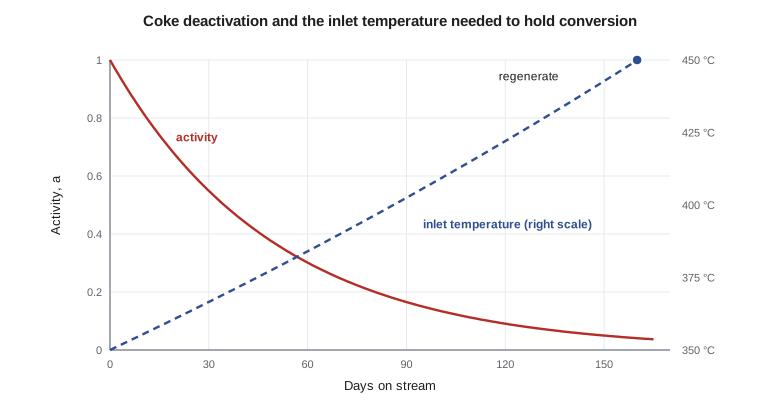
Raising the temperature cannot go on forever. Higher temperature speeds coking itself and the series reactions to oligomers, and the vessel and catalyst have upper limits. When the limit, here about 450 °C, is reached, the bed is taken off line and regenerated by burning off the coke with dilute air, carefully, because the burn is exothermic and an uncontrolled burn can overheat and sinter the catalyst. Commercial dehydration plants commonly run several beds so that one can be regenerated while the others produce. The pilot will run two beds in parallel to test the cycle.
Measuring and using deactivation
Deactivation is slow, so it is measured on long runs in the pilot rather than in short laboratory tests, or accelerated deliberately with a harsher feed. The pilot logs the inlet temperature needed to hold conversion each day; plotted against time, that record gives the decay constant directly through the equation above. It is the most valuable data the pilot will produce, because the economics of a full-scale plant depend more on catalyst life and regeneration frequency than on the fresh-catalyst rate.
Common mistakes
MistakeFitting a power law to data that clearly saturate at high pressure.
InsteadUse a mechanism-based form such as Langmuir-Hinshelwood.
MistakeIgnoring product inhibition in a catalytic rate law.
InsteadInclude terms for products that adsorb, such as water on acid sites.
MistakeDesigning a catalytic reactor on fresh-catalyst activity alone.
InsteadAllow for deactivation and plan regeneration or replacement.
MistakeRegenerating a coked bed with full-strength air.
InsteadUse dilute oxygen and control the burn to avoid overheating the catalyst.
Summary and key terms
- The pseudo-steady-state hypothesis eliminates active intermediates and explains orders that change with conditions.
- Catalytic reactions proceed by diffusion, adsorption, surface reaction and desorption; the slowest step limits the rate.
- A single-site Langmuir-Hinshelwood law, \(kK_AP_A/(1 + K_AP_A + K_WP_W)\), fits the dehydration data with \(k = 0.0745\) mol/(kg s).
- The rate is near zero order at high ethanol pressure and is inhibited by water.
- Activity \(a(t)\) multiplies the fresh rate; temperature is raised to compensate until a limit is reached.
- With illustrative coking, the pilot needs regeneration after about 160 days.
- Pseudo-steady-state hypothesis
- The assumption that an active intermediate has zero net rate of formation.
- Active site
- A location on a catalyst surface where reactants adsorb and react.
- Langmuir-Hinshelwood kinetics
- Rate laws derived from adsorption equilibrium and a rate-limiting surface reaction.
- Rate-limiting step
- The slowest step in a sequence, which controls the overall rate.
- Catalyst activity
- The ratio of the rate on aged catalyst to the rate on fresh catalyst.
- Coking
- Deactivation by carbon-rich deposits on the catalyst surface.
- Regeneration
- Restoring catalyst activity, for example by burning off coke.
Practice problems
Work each problem on paper first, then reveal the answer to check.
At \(P_A = 0.1\) bar and no water, what is the apparent order of the fitted rate law?
Show answer
Nearly first order: \(K_AP_A = 0.35\), so the denominator is close to 1.
What fraction of sites is occupied by ethanol at \(P_A = 2\) bar with no water?
Show answer
\(K_AP_A/(1 + K_AP_A) = 6.92/7.92 = 0.87\).
Name three causes of catalyst deactivation.
Show answer
Poisoning, coking or fouling, and sintering.
If \(a = e^{-k_dt}\) with \(k_d = 0.02\) per day, what is the activity after 50 days?
Show answer
\(e^{-1} = 0.37\).
Why does raising temperature to compensate for deactivation eventually fail?
Show answer
It speeds coking and side reactions, and equipment and catalyst have temperature limits.
Why do plants with coking catalysts often run several beds in parallel?
Show answer
So one can be regenerated while the others keep producing.
Lesson quiz · 5 questions
Score 60% or more to complete this lesson.
Create a free account to save your progress, take quizzes and earn a certificate.