
BUS-220 · Lesson 5 of 12 · 33 min
Business-to-business marketing
Most people think of marketing in terms of consumer brands: soft drinks, phones and fashion. Yet the dollar volume of business markets is far larger than that of consumer markets. Before a single loaf of bread reaches a supermarket shelf, farmers have bought seed and equipment, millers have bought grain, bakeries have bought flour, ovens, packaging and software, and trucking firms have bought fuel and trailers. Each step is a business purchase. Business buyer behavior refers to the buying behavior of organizations that buy goods and services for use in producing other products and services or to resell or rent them to others at a profit, as well as of governments and institutions. This lesson explains how business markets differ, who takes part in business buying, how the buying process works and how marketers reach organizational buyers.
How business markets differ
Business markets resemble consumer markets in some ways: both involve people who assume buying roles and make decisions to satisfy needs. But they differ in market structure and demand, in the nature of the buying unit, and in the types of decisions and processes involved.
Business marketers usually deal with far fewer but far larger buyers. A tire maker selling to car manufacturers in North America faces a handful of customers, each buying millions of tires. Losing one account can be devastating, so relationships matter enormously. Business demand is also derived demand: it ultimately derives from the demand for consumer goods. Demand for steel depends on demand for cars, appliances and buildings. Smart business marketers therefore watch final consumer demand and sometimes market directly to end users, as when a chip maker advertises that its processors are inside a laptop or a fiber maker promotes its waterproof fabric in outdoor clothing.
Many business markets have inelastic demand in the short run: total demand for many business products is not much affected by price changes. A shoe maker will not buy much more leather if leather prices fall, unless lower costs lead to lower shoe prices and higher shoe sales. Business demand also tends to fluctuate more, and more quickly, than consumer demand. A small percentage change in consumer demand can cause a much larger change in demand for the equipment and materials needed to produce more, an effect economists call the accelerator principle.
Worked problem
Derived demand and the accelerator
A bottler of sparkling water runs 50 filling machines. Each machine lasts 10 years, so in a normal year it replaces 5 machines. Consumer demand for its drinks then rises 10 %, and it decides to expand capacity by 10 %. How many machines does it buy this year, and what is the percentage change in its equipment purchases? What happens if consumer demand then stays flat the following year?
Show solution
- Normal replacement = 50 ÷ 10 = 5 machines a year.
- Expansion of 10 % requires 50 × 0.10 = 5 extra machines.
- Purchases this year = 5 replacements + 5 new = 10 machines, a 100 % increase over the normal 5.
- If demand stays flat next year, purchases fall back to about 5.5 (replacement for 55 machines), a drop of about 45 %.
- A 10 % change in consumer demand thus caused a 100 % jump and then a 45 % fall in demand for machines.
Answer: A 10 % rise in consumer demand doubled equipment purchases for one year and then caused a sharp fall, showing why suppliers of capital equipment face volatile demand.
Business purchases involve more buyers and more professional purchasing effort. Purchasing agents, procurement specialists and supply chain managers are trained to buy well, and large purchases often require detailed specifications, formal bids, written contracts and approval from several managers. The buyer and seller are often highly interdependent and work together over long periods, sometimes designing products jointly. Many firms practice supplier development, systematically building networks of partners to ensure a dependable supply.
| Characteristic | Consumer markets | Business markets |
|---|---|---|
| Number and size of buyers | Many, small | Fewer, larger |
| Nature of demand | Direct | Derived from consumer demand |
| Price sensitivity in the short run | Often elastic | Often inelastic |
| Demand volatility | Moderate | Higher (accelerator effect) |
| Buying unit | Individual or household | Buying center of several people |
| Process | Often informal | Formal: specifications, bids, contracts |
| Relationship | Often transactional | Long-term, interdependent |
Buying situations
Business buyers face three major types of buying situation. In a straight rebuy, the buyer reorders something without any modification, often routinely through the purchasing department; the incumbent supplier tries to maintain quality and service, while out-suppliers look for a way in. In a modified rebuy, the buyer wants to change product specifications, prices, terms or suppliers, which usually involves more people and gives out-suppliers an opportunity. In a new task situation, the buyer purchases something for the first time; the greater the cost or risk, the larger the number of decision participants and the more effort spent collecting information. New tasks are the marketer's greatest opportunity and challenge.
Many buyers prefer to buy a packaged solution from a single seller rather than buy separate products and services from several suppliers and assemble them. This is called systems selling or solutions selling. A hospital may prefer to buy an imaging system with installation, training, maintenance and software updates included rather than coordinate several vendors.
The buying center
The decision-making unit of a buying organization is called its buying center: all the individuals and units that play a role in the purchase decision-making process. It is not a fixed, formally identified unit; it changes with the purchase. Frederick Webster and Yoram Wind identified five roles.
| Role | Description | Example in buying new hospital beds |
|---|---|---|
| Users | People who will use the product or service | Nurses and patient-care staff |
| Influencers | People who affect the decision, often by defining specifications | Infection-control specialists, physiotherapists, engineers |
| Buyers | People with formal authority to select suppliers and arrange terms | The procurement department |
| Deciders | People with formal or informal power to approve the final choice | The chief nursing officer and the chief financial officer |
| Gatekeepers | People who control the flow of information to others | Procurement staff who screen vendor contacts |
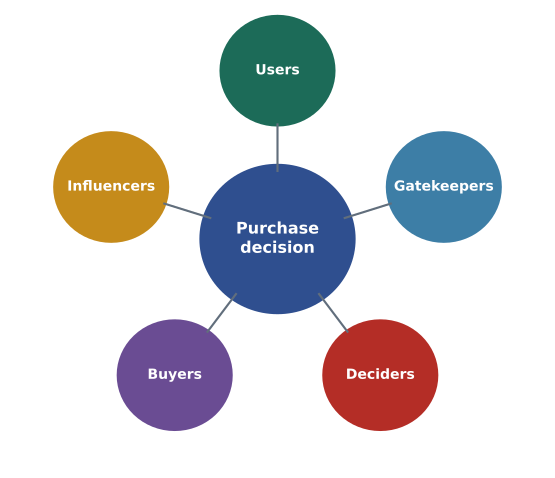
The buying center concept presents a major marketing challenge. The business marketer must learn who participates in the decision, each participant's relative influence and what evaluation criteria each uses. Nurses care about comfort and ease of use, infection-control staff about cleanability, engineers about maintenance and the chief financial officer about lifetime cost. A sales presentation that speaks only to the buyer in procurement may miss the people whose views actually decide the outcome.
Influences on business buyers
Business buyers are subject to environmental, organizational, interpersonal and individual influences. Environmental factors include the economic outlook, supply conditions, technology, regulation and competition. Organizational factors include the firm's objectives, strategies, structure, systems and procurement policies; many organizations now require suppliers to meet sustainability, diversity or cybersecurity standards. Interpersonal factors involve the different interests, authority and persuasiveness of buying center members. Individual factors include each participant's age, education, job position, personality and attitude toward risk.
Although business buying is often described as rational, emotions play a real part. Buyers fear blame if a supplier fails. The old saying that 'nobody ever got fired for buying IBM' captures the appeal of a safe, well-known supplier. Strong business brands reduce perceived risk, which is why business-to-business firms invest in reputation, case studies, certifications and references from respected customers.
The business buying process
Patrick Robinson and colleagues described eight stages of the business buying process. A new task purchase usually goes through all of them; straight rebuys may skip several.
| Stage | What happens |
|---|---|
| 1. Problem recognition | Someone recognizes a problem or need that can be met by acquiring a product or service |
| 2. General need description | The buyer describes the characteristics and quantity of the needed item |
| 3. Product specification | The buying organization develops technical specifications, often with value analysis |
| 4. Supplier search | The buyer looks for the best vendors, through directories, online searches, trade shows and referrals |
| 5. Proposal solicitation | Qualified suppliers are invited to submit proposals, often through a request for proposal (RFP) |
| 6. Supplier selection | The buying center evaluates proposals and selects one or more suppliers |
| 7. Order-routine specification | The final order is written, listing specifications, quantities, delivery schedules, returns and warranties |
| 8. Performance review | The buyer reviews supplier performance and decides whether to continue, modify or drop the relationship |
In supplier selection, buying centers often use a weighted scoring model similar to the consumer multi-attribute model in lesson 4. Typical criteria include product quality, price, delivery reliability, technical support, financial stability, reputation and sustainability performance. Because business purchases often involve years of use, sophisticated buyers look beyond purchase price to total cost of ownership (TCO): the purchase price plus installation, training, energy, maintenance, downtime and disposal, minus any resale value.
Worked problem
Supplier selection with weighted scoring
A food processor is choosing a supplier of packaging film. It weights quality at 0.30, price at 0.25, delivery reliability at 0.20, technical support at 0.15 and sustainability at 0.10. On a 1–5 scale, Supplier X scores 5, 3, 4, 4, 3; Supplier Y scores 4, 5, 3, 3, 4; Supplier Z scores 4, 4, 5, 3, 5. Which supplier wins?
Show solution
- X = 0.30×5 + 0.25×3 + 0.20×4 + 0.15×4 + 0.10×3 = 1.50 + 0.75 + 0.80 + 0.60 + 0.30 = 3.95.
- Y = 0.30×4 + 0.25×5 + 0.20×3 + 0.15×3 + 0.10×4 = 1.20 + 1.25 + 0.60 + 0.45 + 0.40 = 3.90.
- Z = 0.30×4 + 0.25×4 + 0.20×5 + 0.15×3 + 0.10×5 = 1.20 + 1.00 + 1.00 + 0.45 + 0.50 = 4.15.
- Supplier Z wins, mainly on delivery reliability and sustainability, despite not being cheapest or highest quality.
Answer: Supplier Z scores highest (4.15). A supplier that understands the buyer's weights can see where it needs to improve to win.
Worked problem
Total cost of ownership
A warehouse is comparing two floor scrubbers over five years. Machine A costs $18,000, uses $1,200 of electricity and consumables a year and needs $900 of maintenance a year. Machine B costs $24,000, uses $700 a year and needs $400 of maintenance a year, and its maker guarantees a resale value of $4,000 after five years (A has none). Ignoring the time value of money, which has the lower TCO?
Show solution
- A: $18,000 + 5 × ($1,200 + $900) = $18,000 + $10,500 = $28,500.
- B: $24,000 + 5 × ($700 + $400) − $4,000 = $24,000 + $5,500 − $4,000 = $25,500.
- B is $3,000 cheaper over five years despite a $6,000 higher purchase price.
- The maker of B should lead with a TCO comparison rather than defend its price.
Answer: Machine B has a lower five-year TCO ($25,500 against $28,500). Business marketers with premium-priced products often win by showing buyers the full cost picture.
Reaching business buyers
Personal selling is the most important promotional tool in many business markets, because purchases are complex, large and negotiated. Lesson 11 discusses the sales process. Increasingly, though, business buyers do much of their research online before speaking to a salesperson, so business marketers invest heavily in websites, content marketing (white papers, webinars, case studies and calculators), search and professional social networks such as LinkedIn. Industry trade shows remain important for meeting many buyers and demonstrating equipment.
Account-based marketing (ABM) treats a small number of high-value target accounts as markets of one, coordinating marketing and sales efforts around each account's buying center with personalized content and outreach. ABM suits firms that sell large, complex solutions to a defined set of potential customers, such as enterprise software vendors or specialist engineering firms.
Business marketers often manage a sales pipeline, also called a funnel, in which prospects move from lead to qualified lead, opportunity, proposal and closed sale. Tracking conversion rates between stages lets managers forecast sales and see where deals stall. Software-as-a-service firms also watch customer acquisition cost (CAC) and how many months of gross margin it takes to recover it, the CAC payback period.
Worked problem
Pipeline forecast and CAC payback
A software firm selling scheduling tools to clinics generates 600 leads a quarter. Historically, 30 % become qualified leads, 40 % of those become opportunities, 50 % of opportunities receive proposals and 35 % of proposals close. The average contract is $900 a month at an 80 % gross margin. Sales and marketing costs for the quarter are $126,000. Forecast new customers and calculate CAC and CAC payback.
Show solution
- Qualified leads = 600 × 0.30 = 180.
- Opportunities = 180 × 0.40 = 72.
- Proposals = 72 × 0.50 = 36.
- New customers = 36 × 0.35 ≈ 12.6, so about 12 or 13.
- CAC = $126,000 ÷ 12.6 = $10,000 per customer.
- Monthly gross margin per customer = $900 × 0.80 = $720.
- CAC payback = $10,000 ÷ $720 ≈ 13.9 months.
Answer: The firm can expect about 12 or 13 new clinics a quarter at a CAC of $10,000, recovered in about 14 months, a reasonable figure for business software if customers stay several years.
Institutional and government markets
The institutional market consists of schools, hospitals, nursing homes, prisons and other institutions that provide goods and services to people in their care. Institutions often have low budgets and captive patrons, so they may emphasize cost while still requiring quality and safety. Many buy through group purchasing organizations that pool the buying power of many members.
Government markets are large and follow strict rules designed to ensure fairness and value for public money. In the United States, federal opportunities are posted on SAM.gov, where vendors must also register, and purchases follow the Federal Acquisition Regulation. States, counties, cities and school districts have their own procurement rules and portals. Federal agencies have goals for contracting with small businesses and specific groups, and certain contracts are set aside for them. Government buyers typically require detailed documentation, may apply domestic-content rules such as the Buy American Act and award contracts on published evaluation criteria rather than relationships.
Selling to government requires patience and attention to detail. Bids that miss a mandatory requirement are usually rejected without evaluation, however good the product. Many firms start with smaller contracts, partner with established prime contractors or join standing offers and supply arrangements to build a record.
Common mistakes
MistakeAssuming business buyers are purely rational.
InsteadRecognize risk aversion and personal motives; build trust with references, certifications and strong brands.
MistakePitching only to the purchasing department.
InsteadMap the buying center and address each member's criteria.
MistakeCompeting on purchase price alone.
InsteadShow total cost of ownership, including energy, maintenance, downtime and resale value.
MistakeIgnoring end-consumer demand in a business market.
InsteadWatch derived demand and, where useful, market to end users.
MistakeSubmitting a creative but non-compliant government bid.
InsteadMeet every mandatory requirement exactly before adding extras.
Summary and key terms
- Business markets have fewer, larger buyers, derived and often inelastic demand, and more volatile demand.
- The accelerator principle magnifies small changes in consumer demand into large changes in equipment demand.
- Buying situations are straight rebuys, modified rebuys and new tasks.
- The buying center includes users, influencers, buyers, deciders and gatekeepers.
- Environmental, organizational, interpersonal and individual factors influence business buyers.
- The business buying process has eight stages, from problem recognition to performance review.
- Weighted scoring and total cost of ownership guide supplier selection.
- Personal selling, content marketing, trade shows and account-based marketing reach business buyers; pipelines and CAC payback track performance.
- Institutional and government buyers follow formal, rule-based procurement.
- Business buyer behavior
- The buying behavior of organizations that buy goods and services for production, resale or operations.
- Derived demand
- Business demand that ultimately comes from demand for consumer goods.
- Accelerator principle
- Small changes in consumer demand causing larger changes in demand for capital goods.
- Straight rebuy
- A routine reorder without modification.
- New task
- A situation in which the buyer purchases a product or service for the first time.
- Buying center
- All the individuals and units that play a role in a business purchase decision.
- Gatekeeper
- A person who controls the flow of information to the buying center.
- Total cost of ownership
- All costs of acquiring, using and disposing of a product over its life.
- Account-based marketing
- Treating individual high-value accounts as markets of one with coordinated, personalized efforts.
- CAC payback period
- The months of gross margin needed to recover the cost of acquiring a customer.
Practice problems
Work each problem on paper first, then reveal the answer to check.
Why is demand for steel called derived demand?
Show answer
It depends on demand for consumer goods made of steel, such as cars and appliances.
Classify a firm switching to a new supplier for the same part at a lower price.
Show answer
A modified rebuy.
In buying office software, who might act as gatekeeper?
Show answer
An executive assistant or IT staff who screen vendor contacts.
Name the eight stages of the business buying process.
Show answer
Problem recognition, general need description, product specification, supplier search, proposal solicitation, supplier selection, order-routine specification, performance review.
Machine A costs $10,000 plus $2,000 a year; B costs $14,000 plus $1,000 a year. Which is cheaper over five years?
Show answer
A = $20,000; B = $19,000; B.
1,000 leads convert at 20 %, 50 % and 25 % through three stages. How many sales result?
Show answer
25.
CAC is $6,000; monthly revenue is $500 at 75 % margin. What is CAC payback?
Show answer
$6,000 ÷ $375 = 16 months.
What is systems selling?
Show answer
Selling a complete packaged solution from a single supplier.
Why might a buyer choose a well-known supplier at a higher price?
Show answer
To reduce perceived risk and personal blame if something goes wrong.
Portfolio task: map the buying center for a purchase at an organization you know.
Show answer
Answers vary; a good answer names each role and its likely criteria.
Lesson quiz · 5 questions
Score 60% or more to complete this lesson.
Create a free account to save your progress, take quizzes and earn a certificate.