
BUS-220 · Lesson 10 of 12 · 35 min
Distribution channels and omnichannel retail
A great product at the right price is worthless if customers cannot get it where and when they want it. Place, the third P, covers the decisions that make products available to target customers: which channels to use, which intermediaries to work with, how many outlets to have, how to coordinate online and physical retail and how to move goods efficiently from factory to customer. Channel decisions are among the most important a firm makes, because they directly affect every other marketing decision and because they often involve long-term commitments to other firms that are hard to change. This lesson covers channel structures and functions, channel conflict and cooperation, channel design and management, retailing and omnichannel strategy, and the basics of marketing logistics. Detailed inventory and supply chain management is the subject of BUS-230 Operations Management.
Supply chains and the value delivery network
Producing a product and making it available to buyers requires building relationships not only with customers but also with key suppliers and resellers. Upstream from the company is the set of firms that supply the raw materials, components, parts, information, finances and expertise needed to create a product. Downstream is the set of marketing channels, also called distribution channels, that look toward the customer and include intermediaries such as wholesalers and retailers. Because the term supply chain suggests a one-way, make-and-sell view, many marketers prefer to talk about a value delivery network: the company, suppliers, distributors and, ultimately, customers who partner with one another to improve the performance of the entire system in delivering customer value.
A marketing channel is a set of interdependent organizations that help make a product or service available for use or consumption by the consumer or business user. Few producers sell their goods directly to final users. Intermediaries create efficiencies by reducing the number of transactions needed: if three manufacturers each sell directly to three customers, nine contacts are needed; if all go through one distributor, only six are needed. More importantly, intermediaries transform the assortments of products made by producers, who make large quantities of a limited variety, into the assortments wanted by consumers, who want small quantities of a wide variety.
Channel functions and levels
Channel members add value by bridging the major time, place and possession gaps that separate goods and services from those who use them. They perform key functions. Some help complete transactions: information (gathering and distributing research about customers, competitors and other forces), promotion (developing and spreading persuasive communications), contact (finding and communicating with prospective buyers), matching (shaping and fitting the offer to the buyer's needs, including sorting, assembling and packaging) and negotiation (reaching agreement on price and other terms). Others help fulfill completed transactions: physical distribution (transporting and storing goods), financing (acquiring and using funds to cover the costs of channel work) and risk taking (assuming the risks of carrying out channel work). The question is not whether these functions must be performed, but who will perform them. Eliminating an intermediary does not eliminate its functions; someone else, often the producer or the customer, must take them on.
Each layer of intermediaries that performs some work in bringing the product closer to the final buyer is a channel level. A direct marketing channel has no intermediary levels; the company sells directly to consumers, as with a farm stand, a direct-to-consumer brand selling only through its own website or a software firm selling subscriptions online. An indirect marketing channel contains one or more intermediaries: for example, manufacturer to retailer to consumer, or manufacturer to wholesaler to retailer to consumer. Business-to-business channels may use industrial distributors and manufacturers' representatives or sales branches.
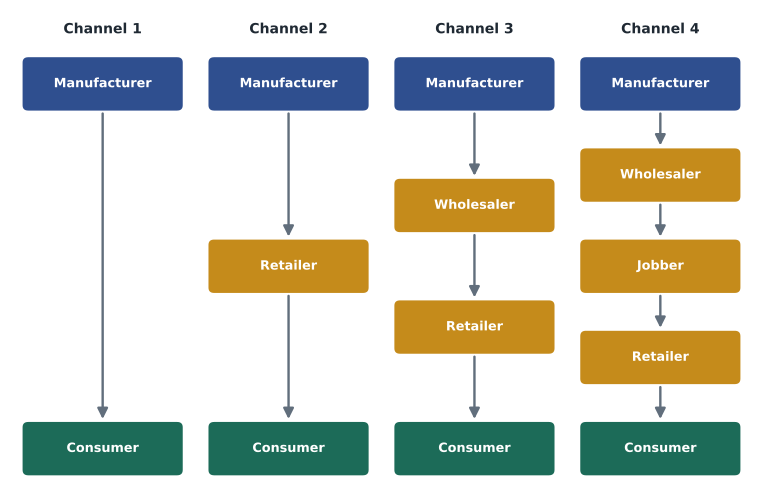
Each intermediary needs a margin to cover its costs and earn a profit, so the price the final customer pays must cover the margins of every level. Understanding the channel margin chain helps manufacturers set list prices and see how much of the final price they actually keep.
Worked problem
Building a channel price chain
A maker of kitchen knives wants a knife to sell at a suggested retail price of $80. Retailers in the category expect a 45 % gross margin on their selling price, and the wholesaler expects a 20 % gross margin on its selling price to retailers. What price must the manufacturer charge the wholesaler, and what share of the retail price does it receive? If its unit cost is $22, what is its margin?
Show solution
- Retailer's cost = $80 × (1 − 0.45) = $44.00, which is the wholesaler's selling price.
- Wholesaler's cost = $44.00 × (1 − 0.20) = $35.20, which is the manufacturer's selling price.
- Manufacturer's share of retail price = $35.20 ÷ $80 = 44 %.
- Manufacturer's gross margin = ($35.20 − $22) ÷ $35.20 = $13.20 ÷ $35.20 = 37.5 %.
- If the maker sold direct online at $80, it would keep the channel margins but take on the work of marketing, fulfillment, payments and returns.
Answer: The manufacturer must sell at $35.20, receiving 44 % of the $80 retail price and earning a 37.5 % margin. The rest pays for the functions the channel performs.
Channel behavior and organization
A channel is more than a collection of firms tied together by flows; it is a complex behavioral system in which people and companies interact to accomplish individual, company and channel goals. Ideally, members cooperate, because the channel's success depends on it. In practice, individual members often focus on their own short-run interests. Channel conflict is disagreement among channel members over goals, roles and rewards. Horizontal conflict occurs among firms at the same level of the channel, such as two franchisees in the same city complaining that the other is poaching customers. Vertical conflict occurs between different levels, such as a manufacturer and its retailers disputing prices, promotional support or the manufacturer's decision to sell directly online. Some conflict can be healthy, pushing channels to innovate, but severe or prolonged conflict damages the channel's effectiveness.
In a conventional distribution channel, producers, wholesalers and retailers are independent businesses, each seeking to maximize its own profits, even at the expense of the system. A vertical marketing system (VMS) consists of producers, wholesalers and retailers acting as a unified system, with one member owning the others, having contracts with them or having so much power that they all cooperate. In a corporate VMS, successive stages of production and distribution are under single ownership, as when a clothing brand designs, makes and sells through its own stores. In a contractual VMS, independent firms join through contracts; franchising is the most common type, in which a franchisor licenses its brand and business system to franchisees in return for fees. In an administered VMS, leadership comes from the size and power of one of the parties, such as a dominant retailer that can dictate terms on display, pricing and promotion to its suppliers.
Franchising is regulated by the FTC's Franchise Rule, which requires franchisors to give prospective franchisees a Franchise Disclosure Document with 23 prescribed items, including fees, litigation history and audited financial statements, at least 14 calendar days before the franchisee signs or pays. About a dozen states, including California, New York and Illinois, also require franchisors to register before selling franchises in the state, and some states have relationship laws limiting termination.
Horizontal marketing systems occur when two or more companies at one level join to follow a new marketing opportunity, combining financial, production or marketing resources, as when a coffee chain operates outlets inside grocery stores or banks place automated teller machines in convenience stores. Multichannel distribution systems, in which a single firm sets up two or more marketing channels to reach one or more customer segments, are now the norm.
Disintermediation and direct-to-consumer brands
Disintermediation is the cutting out of marketing channel intermediaries by product or service producers, or the displacement of traditional resellers by radical new types of intermediaries. Travel agents were partly displaced by online booking; record stores by streaming. Direct-to-consumer (DTC) brands selling mattresses, eyewear, razors and clothing online grew quickly in the 2010s by cutting out retailers. Many later found that customer acquisition through digital advertising became expensive and that physical presence still mattered, and several opened their own stores or returned to wholesale through major retailers. Disintermediation creates opportunities and conflicts: a producer that sells directly may anger the retailers it still depends on, so many firms keep online prices in line with retail or offer different products in each channel.
Channel design decisions
Designing a channel calls for analyzing consumer needs, setting channel objectives, identifying major channel alternatives and evaluating them. The firm first finds out what target customers want from the channel: do they want to buy from nearby locations or are they willing to travel or order online? Do they value breadth of assortment, add-on services such as delivery and installation, or speed? Providing the fastest delivery, greatest assortment and most services may not be possible or practical; the firm must balance customer needs against costs and customers' price preferences.
A firm must also decide on the number of intermediaries at each level. Intensive distribution stocks the product in as many outlets as possible and suits convenience products such as snacks and toothpaste. Exclusive distribution gives a limited number of dealers the exclusive right to distribute the product in their territories and suits luxury cars, high-end fashion and specialist equipment; it enhances brand image and allows higher markups. Selective distribution, in between, uses more than one but fewer than all of the intermediaries willing to carry the product, and suits shopping products such as appliances and furniture.
| Strategy | Number of outlets | Suits | Advantages | Drawbacks |
|---|---|---|---|---|
| Intensive | As many as possible | Convenience products | Maximum availability and impulse purchase | Less control; retailers may compete on price |
| Selective | Several but not all | Shopping products | Good coverage with more control and dealer support | Some customers find it less convenient |
| Exclusive | One or a few per territory | Specialty and luxury products | Brand image, dealer commitment, higher margins | Limited coverage; dependence on few dealers |
Each alternative is evaluated against economic criteria (sales, costs and profitability of different channels), control criteria (giving products to intermediaries means giving them some control over marketing) and adaptability criteria (channels involve long-term commitments, but the firm wants to stay flexible). Firms then manage channel members by selecting good partners, motivating them through partner relationship management, and evaluating their performance against quotas, delivery times, treatment of damaged goods, promotion and customer service.
Antitrust law limits some channel practices. Under the Clayton Act and Sherman Act, exclusive dealing, tying arrangements and territorial restrictions are judged under the rule of reason: they are illegal if their anticompetitive effects outweigh their pro-competitive benefits, which depends on market power and market coverage. Since the Supreme Court's 2007 Leegin decision, minimum resale price maintenance agreements are also judged under the rule of reason at the federal level, although some states still treat them as illegal per se.
Retailing and omnichannel strategy
Retailing includes all the activities involved in selling products or services directly to final consumers for their personal, non-business use. Store retailers range from specialty stores and department stores to supermarkets, convenience stores, discount stores, warehouse clubs and off-price retailers. Each competes on a combination of product assortment, services, prices and location. Nonstore retailing includes online retailing, catalogs, vending and direct selling. Online marketplaces, where many independent sellers list products on a platform run by a single company, have become a dominant channel in many categories.
Online sales have grown steadily but remain a minority of retail. The Census Bureau reported that e-commerce accounted for about 17.1 % of total US retail sales in the second quarter of 2026, seasonally adjusted, with online sales growing considerably faster than total retail. Statistics Canada's measure for Canada, which counts only online sales by firms classified as retailers, was about 6.1 % in 2025; because the definitions differ, the two figures should not be compared directly.
Rather than treating online and physical stores as separate businesses, many retailers now pursue omnichannel retailing: creating a seamless cross-channel buying experience that integrates in-store, online and mobile shopping. Customers might research on a phone, check stock at a nearby store, buy online and pick up in store (BOPIS), or buy in store and have the item shipped home. Stores increasingly double as showrooms, pick-up points and mini-warehouses for local delivery. Omnichannel requires shared inventory systems, consistent pricing and promotions across channels, and staff incentives that do not penalize employees when customers buy online.
Selling through a large online marketplace offers instant access to millions of shoppers and fulfillment services, but at a cost: referral fees, fulfillment fees, advertising to win visibility and limited access to customer data. Selling through one's own website keeps more of the margin and the customer relationship but requires the seller to attract its own traffic.
Worked problem
Marketplace or own website?
A small maker of yoga mats sells a mat for $70. On a marketplace, it pays a 15 % referral fee and $9.50 for fulfillment, and spends an average of $6 a sale on sponsored listings. On its own website, payment processing costs 2.9 % plus $0.30, shipping and packing cost $11, and it spends about $14 a sale on digital advertising to attract shoppers. The mat costs $24 to make. Compare the contribution per sale in each channel.
Show solution
- Marketplace costs = $70 × 0.15 + $9.50 + $6.00 = $10.50 + $15.50 = $26.00.
- Marketplace contribution = $70 − $24 − $26.00 = $20.00.
- Website costs = $70 × 0.029 + $0.30 + $11 + $14 = $2.03 + $25.30 = $27.33.
- Website contribution = $70 − $24 − $27.33 = $18.67.
- The marketplace earns slightly more per sale here, but the website builds a customer list for repeat purchases at a much lower marketing cost.
Answer: Contribution is about $20.00 on the marketplace and $18.67 on the website. The website becomes more profitable if repeat customers return without paid advertising, so many sellers use both.
Marketing logistics
Marketing logistics, or physical distribution, involves planning, implementing and controlling the physical flow of goods, services and related information from points of origin to points of consumption to meet customer requirements at a profit. It covers outbound distribution (moving products from the factory to resellers and customers), inbound distribution (moving products and materials from suppliers to the factory) and reverse distribution (moving broken, unwanted or excess products returned by consumers or resellers). The goal is to provide a targeted level of customer service at the least cost; no system can both maximize customer service and minimize costs, because higher service levels require more inventory, faster transportation and more warehouses.
The major logistics functions are warehousing, inventory management, transportation and logistics information management. Distribution centers are large, highly automated warehouses designed to receive goods, take orders, fill them efficiently and deliver goods to customers as quickly as possible. Inventory management must balance the costs of carrying too much inventory against the costs of carrying too little, such as stockouts and lost sales; many firms use just-in-time systems and, increasingly, demand-forecasting software. Transportation choices among truck, rail, water, pipeline and air involve trade-offs among speed, dependability, availability, cost and environmental impact. The last mile, the final leg of delivery to the customer's door, is often the most expensive part of e-commerce fulfillment.
| Mode | Typical use | Speed | Cost per metric ton-kilometer | Notes |
|---|---|---|---|---|
| Truck | Most freight over short and medium distances; last mile | Fast | Moderate to high | Flexible door-to-door service |
| Rail | Bulky goods over long distances: grain, lumber, containers | Moderate | Low | Energy efficient; fixed routes |
| Water | Bulky, low-value goods; international containers | Slow | Very low | Affected by weather and ports |
| Pipeline | Oil, natural gas, chemicals | Slow but continuous | Very low | Single-purpose |
| Air | High-value, perishable or urgent goods | Fastest | Highest | Used for small, valuable items |
Returns are a large and growing cost, especially for online clothing, where return rates are much higher than in stores because customers cannot try items on. Reverse logistics involves collecting, inspecting, refurbishing, reselling, recycling or disposing of returned goods. Some retailers have introduced return fees or shorter return windows, while others invest in better size guides and product information to prevent returns in the first place. Return policies are also part of the customer experience and of the value proposition, so changes must be weighed against their effect on conversion and loyalty.
Worked problem
The cost of online returns
An online clothing retailer sells 200,000 orders a year with an average order value of $90 and a 54 % gross margin before fulfillment. The return rate is 25 %. Each return costs $12 in shipping and handling, and 15 % of returned items cannot be resold at full price, losing on average half their cost of $41. A better size-recommendation tool costing $150,000 a year is expected to cut returns to 21 %. Is it worthwhile?
Show solution
- Returns now = 200,000 × 0.25 = 50,000; with the tool, 42,000; 8,000 fewer returns.
- Handling saving = 8,000 × $12 = $96,000.
- Write-down saving = 8,000 × 0.15 × ($41 × 0.5) = 1,200 × $20.50 = $24,600.
- Kept sales: 8,000 returns avoided means 8,000 more orders kept, worth 8,000 × $90 × 0.54 ≈ $388,800 of gross margin, assuming customers keep the right size rather than buying nothing.
- Total benefit ≈ $96,000 + $24,600 + $388,800 ≈ $509,400 against a cost of $150,000.
Answer: Even if only part of the kept-sales benefit is real, the tool pays for itself several times over. Preventing returns is usually cheaper than processing them.
Common mistakes
MistakeAssuming that cutting out intermediaries eliminates their costs.
InsteadRemember that someone must still perform the channel functions; the question is who does them best.
MistakeSetting a suggested retail price without working back through channel margins.
InsteadBuild the price chain from retail price to manufacturer price and check that each level's margin is covered.
MistakeSelling direct online without considering existing retailers.
InsteadAnticipate vertical conflict; align prices or differentiate products by channel.
MistakeUsing intensive distribution for a luxury brand.
InsteadMatch distribution intensity to product type and positioning.
MistakeComparing e-commerce statistics across countries without checking definitions.
InsteadCheck how each agency defines and measures online retail.
MistakeTreating returns as an unavoidable cost of online sales.
InsteadInvest in product information and fit tools that prevent returns.
Summary and key terms
- Marketing channels are sets of interdependent organizations that make products available; intermediaries reduce contacts and match assortments.
- Channel functions include information, promotion, contact, matching, negotiation, physical distribution, financing and risk taking.
- Channels range from direct to indirect with several levels; each level needs a margin, forming a channel price chain.
- Channel conflict can be horizontal or vertical; vertical marketing systems (corporate, contractual and administered) improve coordination.
- Franchising is a contractual VMS regulated by disclosure laws.
- Distribution intensity can be intensive, selective or exclusive.
- Competition law limits exclusive dealing, tying, territorial restrictions and resale price maintenance.
- Omnichannel retailing integrates stores, online and mobile; marketplaces offer reach at the cost of fees and data access.
- Logistics balances customer service and cost across warehousing, inventory, transportation and reverse logistics.
- Marketing channel
- A set of interdependent organizations that help make a product available to customers.
- Value delivery network
- The company, suppliers, distributors and customers partnering to deliver customer value.
- Channel level
- A layer of intermediaries that performs work in bringing the product closer to the buyer.
- Channel conflict
- Disagreement among channel members over goals, roles and rewards.
- Vertical marketing system
- A channel in which producers, wholesalers and retailers act as a unified system.
- Franchise
- A contractual association in which a franchisor licenses its brand and system to franchisees.
- Disintermediation
- The cutting out or displacement of channel intermediaries.
- Selective distribution
- Using more than one but fewer than all willing intermediaries.
- Omnichannel retailing
- Creating a seamless buying experience that integrates in-store, online and mobile shopping.
- Reverse logistics
- Moving returned, broken or excess products back through the supply chain.
Practice problems
Work each problem on paper first, then reveal the answer to check.
Four producers and five customers trade directly. How many contacts are needed, and how many with one distributor?
Show answer
20 directly; 9 with a distributor.
Name four channel functions.
Show answer
Any four of information, promotion, contact, matching, negotiation, physical distribution, financing and risk taking.
Retail price $50; retailer margin 40 %; wholesaler margin 15 %. What is the manufacturer's price?
Show answer
$50 × 0.60 × 0.85 = $25.50.
Two franchisees fight over territory. Is this horizontal or vertical conflict?
Show answer
Horizontal.
What type of VMS is a franchise system?
Show answer
A contractual VMS.
Which distribution intensity suits luxury watches?
Show answer
Exclusive distribution.
What is BOPIS?
Show answer
Buy online, pick up in store.
Why might a seller use a marketplace despite higher fees?
Show answer
Instant access to a large audience and fulfillment services.
Give one advantage and one drawback of air freight.
Show answer
Fastest; most expensive.
Portfolio task: map the channel for a product you bought recently and identify each level's function.
Show answer
Answers vary; a good answer names the levels and the functions each performs.
Lesson quiz · 5 questions
Score 60% or more to complete this lesson.
Create a free account to save your progress, take quizzes and earn a certificate.