
BUS-220 · Lesson 11 of 12 · 37 min
Integrated marketing communications and digital marketing
Building customer relationships requires more than developing a good product, pricing it attractively and making it available. Companies must also communicate their value propositions to customers clearly and persuasively. Promotion, the fourth P, includes advertising, public relations, sales promotion, personal selling and direct and digital marketing. This lesson explains how firms plan integrated communications, how communication works, how budgets are set and how each major tool is used, with particular attention to digital channels, influencer marketing, the legal rules on commercial messages and the use of AI. Writing persuasive business messages was covered in BUS-120 lesson 6; creator-side content and audience building are covered in the CRE courses. Here the focus is the marketer's planning and measurement.
The promotion mix
A company's total promotion mix, also called its marketing communications mix, is the specific blend of tools it uses to engage consumers, communicate customer value and build relationships. Advertising is any paid form of non-personal presentation and promotion of ideas, goods or services by an identified sponsor. Public relations (PR) builds good relations with the company's various publics by obtaining favorable publicity, building a good corporate image and handling unfavorable rumors and events. Sales promotion offers short-term incentives to encourage the purchase or sale of a product. Personal selling is personal presentation by the firm's sales force to make sales and build relationships. Direct and digital marketing engages directly with carefully targeted individual consumers and communities, through email, mobile, social media, websites and other channels, to obtain both an immediate response and lasting relationships.
| Tool | Strengths | Limitations | Typical uses |
|---|---|---|---|
| Advertising | Reaches large audiences at low cost per exposure; builds brand image | Impersonal; can be costly in total; easy to ignore | Awareness, brand building, launches |
| Public relations | High credibility; can reach people who avoid ads | Less control over the message and timing | Reputation, launches, crisis management |
| Sales promotion | Creates quick, measurable response | Short-lived effects; can erode brand value | Trial, boosting sales, clearing stock |
| Personal selling | Two-way, adaptable; builds relationships | Most expensive per contact | Complex B2B sales, high-value purchases |
| Direct and digital | Targeted, personalized, interactive, measurable | Privacy concerns; clutter; ad blocking | Lead generation, retention, e-commerce |
Integrated marketing communications
Today's consumers receive brand messages from many sources: television, websites, search results, social feeds, influencers, emails, packaging, store displays, salespeople and friends. If these messages conflict, the result is a confused brand image. Integrated marketing communications (IMC) means carefully integrating and coordinating the company's many communications channels to deliver a clear, consistent and compelling message about the organization and its brands. IMC calls for recognizing all touchpoints where the customer may encounter the company and its brands, and for planning them together rather than letting each department or agency work in isolation.
A useful way to classify communications channels is by who controls them. Paid media are channels the brand pays for, such as television, search and social advertising. Owned media are channels the company controls, such as its website, app, email list, blog and social media accounts. Earned media are public relations, media coverage, reviews and word of mouth, which the company does not pay for directly. Shared media, a fourth category, refers to content that users share on social platforms. Effective plans use paid media to amplify owned content and stimulate earned attention.
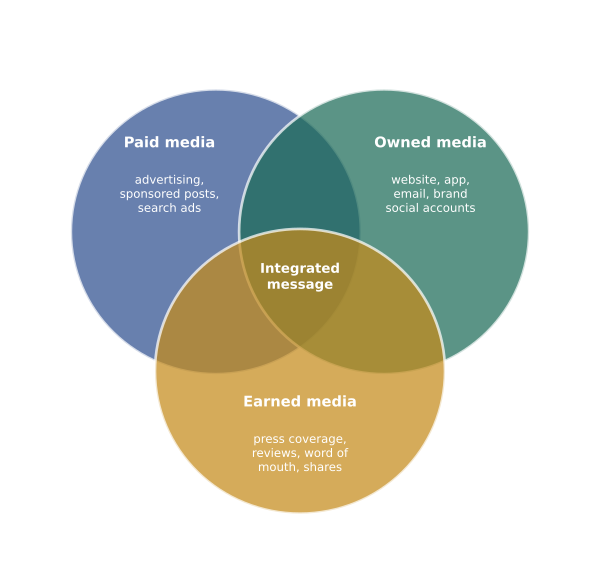
How communication works
Communication involves nine elements. The sender is the party sending the message. Encoding is putting thought into symbolic form, words and images. The message is the set of symbols the sender transmits. Media are the communication channels through which the message moves. Decoding is the process by which the receiver assigns meaning to the symbols. The receiver is the party receiving the message. Response is the receiver's reaction after exposure. Feedback is the part of the response communicated back to the sender. Noise is unplanned static or distortion, such as competing messages or distractions, that causes the receiver to get a different message from the one sent. For a message to be effective, the sender's encoding process must mesh with the receiver's decoding process; messages work best when they use words and symbols familiar to the receiver.
Developing effective communications
Developing communications involves identifying the target audience, determining the communication objectives, designing a message, choosing the media, selecting the message source and collecting feedback. The target audience heavily affects decisions on what will be said, how, when, where and by whom. Objectives depend on where the audience is in the buying process. One classic model describes buyer-readiness stages: awareness, knowledge, liking, preference, conviction and purchase. Another, AIDA, says a message should get attention, hold interest, arouse desire and obtain action. A launch campaign for a new brand might aim for awareness and knowledge; a campaign for a well-known brand might aim to move people from preference to purchase.
Message content can use three types of appeals. Rational appeals relate to the audience's self-interest and show that the product will produce desired benefits, such as quality, economy, value or performance. Emotional appeals attempt to stir up positive or negative emotions, such as love, joy, humor, fear or guilt, that can motivate purchase. Moral appeals are directed to the audience's sense of what is right and proper and are often used to urge people to support social causes. The message source matters too: messages delivered by highly credible sources, whether experts, trusted personalities or ordinary customers, are more persuasive, but a celebrity endorser who becomes involved in a scandal can damage the brand.
Setting the promotion budget
One of the hardest marketing decisions is how much to spend on promotion. Four common methods exist. The affordable method sets the budget at the level management thinks the company can afford, ignoring the effects of promotion on sales; it can lead to uncertain budgets that make long-range planning difficult. The percentage-of-sales method sets the budget at a percentage of current or forecast sales; it is simple but wrongly treats sales as the cause of promotion rather than the result, and leads to cutting spending when sales fall, exactly when more promotion might help. The competitive-parity method matches competitors' outlays; it reflects industry wisdom but assumes competitors know best. The objective-and-task method develops the budget by defining specific objectives, determining the tasks needed to achieve them and estimating the costs of those tasks. It is the most logical method, though the hardest to use, because it forces managers to spell out their assumptions about the relationship between spending and results.
Worked problem
An objective-and-task budget
A regional credit union wants to win 2,400 new members for its everyday banking account in a year. Its research suggests that, of people who become aware of its offer, 25 % will visit its website or a branch, and 20 % of those will open an account. It plans to reach target households through social video ads at a cost per thousand impressions (CPM) of $12, needing an average frequency of 8 impressions per person to create awareness in 40 % of those reached. Estimate the reach and media budget required.
Show solution
- Accounts needed = 2,400; conversion from visit to account = 20 %, so visits needed = 2,400 ÷ 0.20 = 12,000.
- Visit rate from awareness = 25 %, so aware people needed = 12,000 ÷ 0.25 = 48,000.
- Awareness reaches 40 % of those reached, so people to reach = 48,000 ÷ 0.40 = 120,000.
- Impressions = 120,000 × 8 = 960,000.
- Media cost = 960,000 ÷ 1,000 × $12 = $11,520.
- Add creative production, landing pages and a branch-staff incentive, and check the result against the lifetime value of 2,400 members.
Answer: About 960,000 impressions, costing roughly $11,500 in media, are needed. The method makes every assumption visible, so each can be tested and refined.
Advertising
Developing an advertising program involves setting objectives (to inform, persuade or remind), setting the budget, developing the strategy (message and media decisions) and evaluating campaigns. Media planners choose media on the basis of reach (the percentage of people in the target market exposed to the campaign during a given period), frequency (how many times the average person is exposed) and impact (the qualitative value of an exposure in a given medium). Gross rating points (GRPs) combine reach and frequency, and cost per thousand impressions (CPM) allows comparison of costs across media.
Worked problem
Comparing media plans
A snack brand targeting 2 million adults aged 18 to 34 compares two four-week plans. Plan A uses streaming video, reaching 45 % of the target an average of 4 times, at a cost of $216,000. Plan B uses social video, reaching 60 % an average of 5 times, at a cost of $180,000. Calculate GRPs and CPM for each plan.
Show solution
- Plan A GRPs = 45 × 4 = 180; impressions = 2,000,000 × 0.45 × 4 = 3.6 million; CPM = $216,000 ÷ 3,600 = $60.
- Plan B GRPs = 60 × 5 = 300; impressions = 2,000,000 × 0.60 × 5 = 6.0 million; CPM = $180,000 ÷ 6,000 = $30.
- Plan B delivers more reach and frequency at half the cost per thousand.
- But impact differs: if full-screen streaming ads are watched more completely and recalled better, Plan A's higher CPM may be justified. Planners often compare cost per completed view or per point of recall rather than raw impressions.
Answer: Plan B gives 300 GRPs at a $30 CPM against Plan A's 180 GRPs at $60. The final choice depends on the quality of attention each medium delivers.
Message strategy starts with identifying customer benefits that can be used as advertising appeals, and creative concepts bring the strategy to life in a distinctive and memorable way. In a cluttered, fragmented media world, advertisers increasingly blend advertising with entertainment and content, from branded videos and podcasts to sponsorships and product placements, which must be clearly identified as advertising when they are paid.
Public relations
Public relations involves press relations, product and brand publicity, public affairs (building and maintaining relationships with governments and communities), investor relations, development (fundraising) and crisis management. PR can have a strong impact on public awareness at a much lower cost than advertising, because the company does not pay for space or time in the media; it pays for a staff to develop and circulate information and manage events. If the company develops an interesting story or event, it may be picked up by many media and shared widely online. Crisis communication, responding quickly, honestly and with empathy when something goes wrong, can protect a reputation built over decades.
Sales promotion
Sales promotion consists of short-term incentives to encourage the purchase or sale of a product. Consumer promotions include samples, coupons, cash refunds (rebates), price packs, premiums, loyalty rewards, point-of-purchase displays, contests and sweepstakes. Trade promotions, aimed at retailers and wholesalers, include discounts, allowances, free goods and display support, and in many consumer packaged goods categories trade spending exceeds consumer advertising. Business promotions include trade shows and sales contests.
Contests and sweepstakes are regulated. In the United States, a promotion that combines a prize, chance and a required purchase or payment (consideration) is an illegal lottery, so sweepstakes must offer a free method of entry, often called the alternative method of entry. Official rules must disclose odds, prize values and eligibility, and some states, such as New York and Florida, require registration and bonding for large games of chance.
Worked problem
Is a coupon worth running?
A frozen pizza brand distributes 500,000 coupons worth $2 off a pizza that sells for $8.99 and earns the brand a $3.10 margin. It expects a 3 % redemption rate and pays retailers $0.12 handling per redeemed coupon; printing and distribution cost $25,000. It estimates that 60 % of redemptions are from people who would have bought anyway. What is the net effect on profit?
Show solution
- Redemptions = 500,000 × 0.03 = 15,000.
- Cost of redemptions = 15,000 × ($2.00 + $0.12) = $31,800; total cost = $31,800 + $25,000 = $56,800.
- Incremental purchases = 15,000 × 0.40 = 6,000; incremental margin = 6,000 × $3.10 = $18,600.
- Net effect = $18,600 − $56,800 = −$38,200.
- The promotion loses money in the short run unless it creates repeat buyers; if one in five incremental buyers bought four more pizzas, extra margin would be 1,200 × 4 × $3.10 = $14,880, still not enough.
Answer: The coupon loses about $38,000, mainly because most redemptions subsidize existing buyers. It would need better targeting at non-users to pay off.
Personal selling
Personal selling is the interpersonal part of the promotion mix. Salespeople serve as a critical link between a company and its customers, representing the company to customers and customers to the company. The selling process has seven steps: prospecting and qualifying (identifying qualified potential customers), preapproach (learning about the prospect and setting call objectives), approach (meeting the buyer and getting the relationship off to a good start), presentation and demonstration (telling the value story and showing how the offer solves the customer's problems), handling objections (seeking out, clarifying and overcoming objections), closing (asking for the order) and follow-up (ensuring satisfaction and repeat business). Modern selling emphasizes value selling and relationship building: listening to customers, understanding their needs and helping solve their problems rather than pushing products. Sales technology, including customer relationship management systems, video meetings and AI tools that summarize calls and suggest next steps, now supports most sales teams.
Digital and social media marketing
Digital marketing uses websites, search, social media, email, mobile apps and other online channels to engage consumers. Search marketing includes search engine optimization (SEO), improving a website's position in unpaid search results, and paid search advertising, in which advertisers bid on keywords and pay each time someone clicks their ad (cost per click, CPC). The rise of AI-generated answers in search engines and of chat assistants has begun to change search behavior, reducing clicks to some websites and pushing marketers to provide clear, authoritative information that AI systems are likely to cite.
Social media marketing ranges from organic posting on brand accounts to paid social advertising targeted by interests and behaviors, community management, customer service and social listening. Each platform has its own audience, culture and formats, and short-form video now dominates attention on many of them. Social media also gives customers a powerful voice: complaints can spread quickly, so brands need clear policies for responding.
Email marketing remains one of the highest-return digital channels because it reaches people who have chosen to hear from the brand. It must be relevant, timely and permission-based. Mobile marketing includes text messages, apps, mobile advertising and location-based offers, all of which must respect consumers' privacy and consent.
The CAN-SPAM Act allows commercial email to be sent without prior consent, but it requires accurate header and subject lines, identification of the message as an advertisement, a valid physical postal address and a working opt-out mechanism honored within 10 business days; penalties can exceed $50,000 per email. Text messages and automated calls are governed by the stricter Telephone Consumer Protection Act, which generally requires prior express written consent for marketing. BUS-210 lesson 11 sets out the details.
Digital marketers track customers through a funnel from impression to click, visit, lead or add-to-cart and purchase, and measure cost per acquisition (CPA) and return on ad spend (ROAS), revenue attributed to advertising divided by advertising cost. ROAS ignores margins, so it should be translated into profit before judging a campaign.
Worked problem
Funnel metrics and ROAS
An online home-goods store runs a paid search campaign. It buys 40,000 clicks at an average CPC of $0.85. Of the visitors, 3.5 % make a purchase, with an average order value of $72 and a gross margin of 45 %. Calculate the number of orders, CPA, ROAS and profit, and compare ROAS with break-even ROAS.
Show solution
- Ad spend = 40,000 × $0.85 = $34,000.
- Orders = 40,000 × 0.035 = 1,400.
- CPA = $34,000 ÷ 1,400 ≈ $24.29.
- Revenue = 1,400 × $72 = $100,800; ROAS = $100,800 ÷ $34,000 ≈ 2.96.
- Break-even ROAS = 1 ÷ 0.45 ≈ 2.22, so the campaign beats break-even.
- Gross margin = $100,800 × 0.45 = $45,360; profit after ad spend = $45,360 − $34,000 = $11,360.
Answer: The campaign produced 1,400 orders at a CPA of about $24, a ROAS of 2.96 against a break-even of 2.22, and about $11,400 of profit before other costs.
Influencer marketing and disclosure
Influencer marketing pays or otherwise rewards creators to feature a brand. Influencers range from celebrities with millions of followers to nano-influencers with a few thousand highly engaged followers, who often deliver better engagement per dollar. Brands should choose influencers whose audiences match the target market, check for fake followers and past controversies, agree on deliverables, usage rights and disclosure in a written contract and measure results with tracked links and codes.
In the United States, the FTC's Endorsement Guides, revised in 2023, require clear and conspicuous disclosure of any material connection between a brand and an endorser, such as payment, free products or family relationships, and both brands and influencers can be held liable. The FTC's rule on consumer reviews and testimonials, in force since October 2024, bans fake reviews, buying reviews and suppressing negative reviews, with civil penalties per violation. Disclosures should be placed where people will see them, not buried in a list of hashtags.
AI in marketing communications
Generative AI tools can draft copy, create images and video, translate and localize campaigns, personalize emails at scale and analyze performance data. Used well, they speed up production and testing. They also create new responsibilities. AI-generated claims must be checked for accuracy, because marketers remain legally responsible for every claim they publish. Images of people who do not exist, or realistic depictions of real people, can mislead if presented as real customers or endorsements. Training data and outputs raise intellectual property questions, and some platforms and jurisdictions require labeling of synthetic or AI-altered content in political and some commercial advertising. Many firms now have written policies on approved tools, human review, disclosure and data privacy.
Measuring communications
Measuring the effects of communications is hard because customers encounter many touchpoints before buying. Attribution models assign credit for a sale to touchpoints: last-click attribution gives all credit to the final click, first-click to the first, and multi-touch models spread credit across touchpoints. All are imperfect, because they measure correlation rather than causation and miss offline influences. Marketing mix modeling uses statistical analysis of sales, spending and other factors over time to estimate the contribution of each channel. Incrementality testing, running controlled experiments in which some regions or users see a campaign and others do not, gives the most reliable evidence of what advertising actually causes, using the same logic as the A/B tests in lesson 3.
Common mistakes
MistakeLetting each channel or agency send its own message.
InsteadCoordinate all touchpoints around one clear, consistent message.
MistakeSetting the budget as a fixed percentage of last year's sales.
InsteadUse the objective-and-task method and test the assumptions.
MistakeChoosing media on CPM alone.
InsteadConsider reach, frequency and the quality of attention each medium delivers.
MistakeJudging a coupon by the number redeemed.
InsteadCount only incremental purchases and include all costs.
MistakeTreating ROAS above 1 as profitable.
InsteadCompare ROAS with break-even ROAS = 1 ÷ gross margin.
MistakeFailing to disclose influencer payments or free products.
InsteadRequire clear, prominent disclosure in contracts and check posts.
MistakePublishing AI-generated content without review.
InsteadCheck every claim, image and endorsement for accuracy, rights and disclosure.
Summary and key terms
- The promotion mix includes advertising, PR, sales promotion, personal selling and direct and digital marketing.
- IMC coordinates all touchpoints around a clear, consistent message; paid, owned and earned media work together.
- Communication involves a sender, encoding, message, media, decoding, receiver, response, feedback and noise.
- Objectives follow buyer-readiness stages or AIDA; appeals can be rational, emotional or moral.
- The objective-and-task method is the most logical way to set a promotion budget.
- GRPs = reach × frequency; CPM = cost per thousand impressions.
- Sales promotions, contests and coupons must be judged on incremental results and comply with contest law.
- The selling process runs from prospecting to follow-up.
- Digital marketing uses search, social, email and mobile; CASL is opt-in, CAN-SPAM is opt-out.
- Influencer content requires disclosure of material connections; AI content needs human review.
- Attribution, marketing mix modeling and incrementality testing measure effects; experiments give the best evidence.
- Integrated marketing communications
- Coordinating all communications channels to deliver a clear, consistent message.
- Owned media
- Channels the company controls, such as its website, app and email list.
- Earned media
- Publicity, coverage, reviews and word of mouth not directly paid for.
- Noise
- Unplanned static or distortion in the communication process.
- AIDA
- Attention, interest, desire, action: a model of how messages should work.
- Objective-and-task method
- Setting the promotion budget from specific objectives, tasks and their costs.
- Gross rating points
- Reach (as a percentage) multiplied by average frequency.
- CPM
- Cost per thousand impressions.
- Return on ad spend
- Revenue attributed to advertising divided by advertising cost.
- Incrementality testing
- Experiments comparing groups that do and do not see a campaign to measure its causal effect.
Practice problems
Work each problem on paper first, then reveal the answer to check.
Classify a company blog, a newspaper article about the company and a sponsored post.
Show answer
Owned, earned and paid media.
What is noise in the communication process? Give an example.
Show answer
Distortion such as a competing ad or a distracted viewer.
Name the four budget-setting methods.
Show answer
Affordable, percentage-of-sales, competitive-parity, objective-and-task.
Reach is 50 % and frequency 6. What are the GRPs?
Show answer
300.
A plan costs $90,000 for 3 million impressions. What is the CPM?
Show answer
$30.
Why must Canadian contests that require purchase include a skill-testing question?
Show answer
To avoid being an illegal lottery under the Criminal Code.
List the seven steps of the selling process.
Show answer
Prospecting and qualifying, preapproach, approach, presentation, handling objections, closing, follow-up.
Gross margin is 40 %. What is break-even ROAS?
Show answer
2.5.
$20,000 of ads produces 800 orders at $60. What are CPA and ROAS?
Show answer
CPA $25; ROAS 2.4.
Portfolio task: audit three influencer posts in a category you follow for disclosure quality.
Show answer
Answers vary; a good answer judges clarity, placement and prominence.
Lesson quiz · 5 questions
Score 60% or more to complete this lesson.
Create a free account to save your progress, take quizzes and earn a certificate.