
BUS-220 · Lesson 1 of 12 · 36 min
What marketing is
Marketing is often mistaken for advertising, or for the slightly pushy art of persuading people to buy things they do not need. In practice it is much broader. Marketing decides which customers a business will serve, what problems it will solve for them, what it will offer, what it will charge, how the offer will reach people and how the business will talk with them. BUS-101 introduced the marketing concept and the four Ps in a single lesson. This course goes deeper, one decision area at a time, and ends with a complete marketing plan. Later, MBA-512 Marketing Management treats the same ideas at a strategic, general-management level.
This first lesson sets out the vocabulary used throughout the course: needs, wants and demand; value and exchange; the competing philosophies, or orientations, that organizations bring to markets; the marketing mix; and the idea that the real asset a business builds is a base of profitable customer relationships.
Defining marketing
The American Marketing Association defines marketing as the activity, set of institutions and processes for creating, communicating, delivering and exchanging offerings that have value for customers, clients, partners and society at large. Four verbs in that definition are worth noticing. Creating means designing products and services that people want. Communicating means telling the right people about them in a believable way. Delivering means making them available where and when customers want them. Exchanging means agreeing on terms, usually a price, that leave both sides better off. Advertising is only one part of communicating, which is only one part of marketing.
A shorter working definition is that marketing is the process of creating value for customers and capturing value from them in return. The first half, creating value, is about understanding customers well enough to serve them better than competitors. The second half, capturing value, is about earning sales, profits, loyalty and referrals. A business that creates value but cannot capture it, for example by underpricing, will not survive. A business that captures value without creating it, for example by misleading customers, may survive for a while, but it erodes trust and invites legal action.
Marketing applies well beyond consumer products. Hospitals market services to patients and referring doctors. Universities market programs to students. Charities market causes to donors. Cities market themselves to tourists and investors. Governments run public-health campaigns that use the same tools of research, segmentation and communication. Business-to-business firms, which sell to other organizations rather than to households, account for a large share of all marketing activity, and lesson 5 is devoted to them.
Needs, wants and demand
Marketing starts with human needs, which are states of felt deprivation. People need food, shelter, safety, belonging, esteem and self-expression. Marketers do not create these needs; they are part of being human. Wants are the form that needs take as they are shaped by culture and individual personality. A hungry person in Halifax may want fish and chips, while a hungry person in Vancouver may want sushi; the underlying need is the same. When wants are backed by the ability and willingness to pay, they become demand.
The distinction matters because it keeps attention on the problem the customer is trying to solve rather than on the product the company happens to make. A widely repeated line in marketing is that people do not want a quarter-inch drill; they want a quarter-inch hole. In fact they may want the shelf the hole will hold up, or the tidy room the shelf will create. A drill maker who understands this sees that competition can come from adhesive hooks and furniture with built-in storage, not just from other drill makers.
The jobs-to-be-done approach, popularized by Clayton Christensen and colleagues, formalizes this idea. It asks what job a customer is hiring a product to do, in what circumstances, and what would make them fire it. A commuter who buys a milkshake on the way to work may be hiring it to make a long, boring drive more interesting and to stave off hunger until lunch, a job for which a thick drink that lasts the whole journey is ideal. Framing the job, rather than the product, often reveals unexpected competitors and better designs.
| Concept | Meaning | Example |
|---|---|---|
| Need | A basic state of felt deprivation | Staying warm in winter |
| Want | The form a need takes, shaped by culture and personality | A down-filled parka from a particular brand |
| Demand | A want backed by ability and willingness to pay | 5,000 people in a region prepared to pay $400 for that parka |
| Job to be done | The progress a customer is trying to make in a situation | Getting through a cold commute without arriving damp or chilled |
Value and exchange
Customers choose among offers on the basis of perceived value: the benefits they expect to receive compared with the total costs they expect to bear. Benefits include functional performance, emotional satisfaction, social approval and the convenience of buying and using the product. Costs include not only the price but also time, effort, risk and the hassle of switching from what they use now. Two customers can look at the same offer and judge its value quite differently.
Customer satisfaction depends on how a product's perceived performance compares with the customer's expectations. If performance falls short, the customer is disappointed; if it matches, the customer is satisfied; if it exceeds, the customer is delighted. This creates a balancing act for marketers. Promise too little and no one will try the product; promise too much and buyers will be disappointed. Many successful firms promise only what they can reliably deliver and then deliver a little more.
Exchange is the act of obtaining something desired from someone by offering something in return. For exchange to happen there must be at least two parties, each with something the other values, each able to communicate and deliver, and each free to accept or reject the offer. Marketing aims to build exchange relationships that both sides want to repeat. A market is the set of actual and potential buyers of a product, and the marketing system includes the company, its suppliers, its competitors, intermediaries such as retailers, and the final customers, all operating in a wider environment that lesson 2 examines.
Worked problem
Comparing perceived value
A small business owner is choosing accounting software. Option A costs $40 a month, needs about 10 hours of set-up and is rated by the owner as worth 8 benefit points. Option B costs $60 a month, needs about 2 hours of set-up and is rated at 9 benefit points. The owner values their time at $50 an hour and plans to use the software for 24 months. Which offer has the higher perceived value, using total two-year cost?
Show solution
- Option A total cost = 24 × $40 + 10 × $50 = $960 + $500 = $1,460.
- Option B total cost = 24 × $60 + 2 × $50 = $1,440 + $100 = $1,540.
- Benefit per $1,000 of cost: A = 8 ÷ 1.46 ≈ 5.5; B = 9 ÷ 1.54 ≈ 5.8.
- Although B has a higher price, its lower set-up effort and higher benefits give it slightly better value for this customer.
- A customer who valued their time at only $20 an hour would find A cheaper overall ($1,160 versus $1,480) and might prefer it.
Answer: Option B offers slightly higher perceived value for this owner. Price is only one element of cost, and the same offer can win with one customer and lose with another.
Marketing orientations
Organizations bring different philosophies to the market. These are often described as a historical sequence, but all of them can still be found today, sometimes within the same company.
The production orientation holds that customers favor products that are available and affordable, so the main task is to improve production and distribution efficiency. It makes sense when demand exceeds supply or when costs must fall to open a market. The risk is that the firm focuses so tightly on its own operations that it loses sight of what customers want.
The product orientation holds that customers favor products with the best quality, performance and features. Firms with this mindset pour effort into engineering ever-better products. The trap is building a better mousetrap when customers would rather solve the mouse problem another way, such as by sealing the gaps where mice get in.
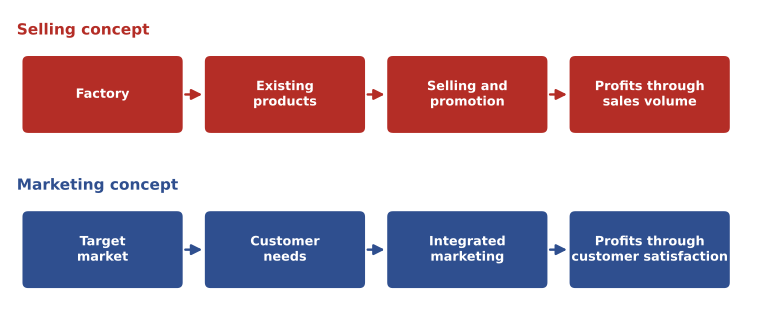
The selling orientation holds that customers will not buy enough unless the firm undertakes a large-scale selling and promotion effort. It is common for unsought goods, such as insurance or funeral plans, and for firms with excess capacity. Its danger is that it aims to sell what the company makes rather than make what the market wants, and it can damage relationships through high-pressure tactics.
The marketing orientation, or marketing concept, holds that achieving organizational goals depends on knowing the needs and wants of target markets and delivering the desired satisfactions better than competitors. It starts with the customer rather than the factory. A marketing-oriented firm gathers information about customers and competitors, shares it across departments and acts on it in a coordinated way. Research by John Narver and Stanley Slater in the 1990s linked this kind of market orientation to higher profitability.
The societal marketing orientation adds a further test: a firm should serve customers' long-run interests and society's well-being, not only their immediate wants. Fast food that is cheap and delicious may satisfy immediate wants while contributing to poor health; single-use packaging may be convenient while creating waste. Societal marketing asks firms to balance company profits, customer wants and society's interests, an idea lesson 12 develops through ethics and sustainability.
| Orientation | Starting point | Focus | Main risk |
|---|---|---|---|
| Production | Factory | Efficiency and availability | Ignoring what customers value |
| Product | Product | Quality and features | Marketing myopia; over-engineering |
| Selling | Existing products | Promotion and persuasion | Short-term sales, damaged trust |
| Marketing | Target market | Customer needs, coordinated across the firm | Can follow stated wants too literally |
| Societal | Target market and society | Customer and societal well-being | Harder to measure; trade-offs |
In 1960 Theodore Levitt warned against marketing myopia, the mistake of defining a business by its product rather than by the customer need it serves. His famous example was the American railroads, which saw themselves as being in the railroad business rather than the transportation business and so watched passengers and freight move to cars, trucks and aircraft. Modern examples include film-camera makers that defined themselves by film rather than by capturing memories. The cure is to ask what business the firm is really in from the customer's point of view.
A marketing orientation does not mean doing whatever customers say. Customers often cannot describe needs they have never experienced a solution for, and a firm that only responds to stated wants may miss bigger opportunities. Some firms practice a proactive market orientation, studying how customers actually behave and anticipating latent needs. Observing people in their homes and workplaces, a technique called ethnographic research and covered in lesson 3, is one way to find needs customers have not articulated.
The marketing mix
Once a firm has chosen whom to serve and how to position its offer, it builds a marketing program from a set of controllable tools called the marketing mix. The classic version, proposed by E. Jerome McCarthy in 1960, has four elements, known as the four Ps.
| Element | Key decisions | Lesson |
|---|---|---|
| Product | Features, quality, design, brand, packaging, product line, services that support it | 7 and 8 |
| Price | List price, discounts, payment terms, price changes, how price is displayed | 9 |
| Place | Channels, intermediaries, locations, logistics, online and in-store availability | 10 |
| Promotion | Advertising, public relations, sales promotion, personal selling, digital and social media | 11 |
Services marketers often add three more Ps: people (the employees who deliver the service and the other customers present), process (the steps a customer goes through) and physical evidence (the environment and tangible cues that signal quality). Lesson 8 uses this extended mix. Some writers prefer a customer-centered version, the four Cs: customer solution instead of product, customer cost instead of price, convenience instead of place and communication instead of promotion. The four Cs are a useful reminder that each P should be designed from the buyer's point of view.
The elements must work together. A luxury watch sold at a premium price needs high design quality, an exclusive network of retailers and refined advertising. Selling the same watch through discount stores with coupon promotions would send contradictory signals and undermine the brand. Consistency among the mix elements, and between the mix and the chosen positioning, is one of the most important tests of a marketing plan.
Customer relationships and customer equity
Modern marketing places as much emphasis on keeping customers as on winning them. Customer relationship management (CRM) is the overall process of building and maintaining profitable customer relationships by delivering superior value and satisfaction. Keeping an existing customer is usually cheaper than acquiring a new one, and loyal customers often buy more over time, cost less to serve and recommend the business to others.
Not all customers are equally valuable. Some buy a lot and stay for years; others buy once on discount and never return. Customer lifetime value (CLV) estimates the value of the future stream of profit a customer will generate. A simple version multiplies the annual profit from a customer by the number of years they are expected to stay. Lesson 6 introduces a more careful version that allows for retention rates and the time value of money.
Customer equity is the total combined lifetime value of all the company's customers. Viewed this way, the marketing budget is an investment in an asset, not just a cost. A company whose sales are growing because it is buying many low-value, disloyal customers with deep discounts may be destroying customer equity, while a company with flat sales but rising retention may be building it.
Worked problem
A simple lifetime value and the case for retention
A neighborhood fitness studio charges $70 a month. After instructor pay, rent and other variable costs, each member contributes $30 a month in margin. Members stay an average of 14 months. A referral program costing $10,000 a year is expected to raise average membership length to 18 months across the studio's 300 members. Is the program worthwhile?
Show solution
- Annual margin per member = $30 × 12 = $360.
- Current simple CLV = $30 × 14 months = $420.
- With the program, simple CLV = $30 × 18 = $540, an increase of $120 per member.
- Across 300 members, the extra lifetime margin = 300 × $120 = $36,000.
- Members turn over roughly every 14 to 18 months, so the gain is earned over a little more than one year, against a $10,000 annual cost.
- Net gain over the period ≈ $36,000 − about $15,000 of program cost ≈ $21,000.
Answer: Even on rough numbers, extending membership by four months is worth far more than the program costs, illustrating why retention is often a better investment than acquisition.
Marketing in the organization and as a career
In a small business the owner usually does all the marketing personally. In larger firms, marketing is organized by function (research, product management, communications, digital, sales), by product or brand, by geographic market or by customer type. A chief marketing officer may lead the function, but the marketing concept implies that everyone who affects the customer experience, from call-center agents to delivery drivers, is part of marketing.
Marketing careers in the United States include brand and product management, market research and analytics, digital and content marketing, sales, retail management, public relations and agency work. Professional bodies include the American Marketing Association, which offers professional certifications and publishes a statement of ethical norms, and the Insights Association for research professionals. Because the US market is large and diverse, marketers often build campaigns for specific regions and for Spanish-speaking and other multicultural audiences.
Marketing increasingly relies on data and technology. Marketers now work with customer databases, web analytics, marketing automation and, more recently, generative AI tools that draft copy and images. These tools change how work is done but not the underlying questions: who is the customer, what do they value, and how can the firm serve them better and profitably? Lesson 3 covers research and data, and lesson 11 discusses AI in marketing communications.
Worked problem
Measuring a campaign's return
A regional bakery chain spends $8,000 on a four-week social media and flyer campaign for a new line of sourdough. Sales of the line during the campaign are $36,000, compared with an estimated $12,000 that would have sold anyway. The line has a gross margin of 55 %. Calculate the incremental gross margin and the marketing return on investment (ROI).
Show solution
- Incremental sales = $36,000 − $12,000 = $24,000.
- Incremental gross margin = $24,000 × 0.55 = $13,200.
- Marketing ROI = (incremental margin − marketing cost) ÷ marketing cost = ($13,200 − $8,000) ÷ $8,000 = 0.65, or 65 %.
- Using total sales rather than incremental sales would overstate the return dramatically, giving ($19,800 − $8,000) ÷ $8,000 ≈ 148 %.
Answer: The campaign earned a 65 % return on its cost. Measuring only the sales the campaign caused, and using margin rather than revenue, gives an honest figure.
How this course is organized
The course follows the order in which a marketer typically works. Lessons 2 to 5 build understanding: the environment and strategy, research, consumer buyers and business buyers. Lesson 6 makes the core strategic choice of whom to serve and how to stand out. Lessons 7 to 11 design the marketing mix: product and brand, services and the customer experience, pricing, distribution and communications. Lesson 12 addresses ethics and sustainability and brings everything together in a marketing plan for an invented product. Throughout, you will find worked calculations, because good marketing decisions combine creativity with numbers.
Common mistakes
MistakeEquating marketing with advertising or selling.
InsteadTreat marketing as the whole process of creating, communicating, delivering and exchanging value; advertising is one tool within communication.
MistakeDefining the business by its product.
InsteadDefine it by the customer need or job it serves, which reveals real competitors and new opportunities.
MistakeAssuming the lowest price always wins.
InsteadCompare total perceived benefits with total costs, including time, effort and risk.
MistakeJudging a campaign by total sales during the campaign.
InsteadMeasure incremental sales and margin compared with what would have happened anyway.
MistakeChasing new customers while ignoring existing ones.
InsteadTrack retention and customer lifetime value; keeping good customers is often the better investment.
Summary and key terms
- Marketing is the process of creating value for customers and capturing value from them in return.
- Needs are basic deprivations; wants are needs shaped by culture; demand is wants backed by buying power.
- Customers judge perceived value as benefits relative to total costs, and satisfaction as performance relative to expectations.
- Production, product, selling, marketing and societal orientations reflect different philosophies; the marketing concept starts with the target market.
- Marketing myopia is defining a business by its product rather than the need it serves.
- The marketing mix of product, price, place and promotion must be consistent; services add people, process and physical evidence.
- Customer lifetime value and customer equity treat marketing spending as an investment in relationships.
- Marketing ROI should use incremental margin, not total sales.
- Marketing
- The process of creating value for customers and capturing value from them in return.
- Need
- A state of felt deprivation.
- Want
- The form a need takes as shaped by culture and individual personality.
- Demand
- Wants backed by ability and willingness to pay.
- Perceived value
- The customer's evaluation of the benefits of an offer relative to all its costs.
- Marketing concept
- The philosophy that success depends on meeting target customers' needs better than competitors.
- Marketing myopia
- Defining a business by its products rather than by the customer needs it serves.
- Marketing mix
- The set of controllable tools, product, price, place and promotion, used to pursue a target market.
- Customer lifetime value
- The value of the future stream of profit a customer is expected to generate.
- Customer equity
- The combined lifetime value of all of a company's customers.
Practice problems
Work each problem on paper first, then reveal the answer to check.
Distinguish a need, a want and demand, with an example.
Show answer
Need: hunger. Want: a burrito. Demand: people able and willing to pay $12 for one.
What job might a parent hire a minivan to do?
Show answer
Answers vary: transporting children and gear safely and comfortably with easy access.
A product performs below a customer's expectations. How will the customer feel?
Show answer
Dissatisfied or disappointed.
Which orientation focuses on making products available and affordable?
Show answer
The production orientation.
What is marketing myopia? Give an example.
Show answer
Defining the business by its product; for example, a printer maker thinking it sells printers rather than easy ways to share documents.
Name the four Ps and the three extra Ps for services.
Show answer
Product, price, place, promotion; people, process, physical evidence.
A customer gives $25 of monthly margin and stays 20 months. What is the simple CLV?
Show answer
$500.
A campaign costs $5,000 and produces $20,000 of incremental sales at a 40 % margin. What is the marketing ROI?
Show answer
($8,000 − $5,000) ÷ $5,000 = 60 %.
Why might a firm practice a proactive rather than responsive market orientation?
Show answer
Customers cannot always describe latent needs; observing behavior can reveal bigger opportunities.
Portfolio task: describe a business you use and identify which orientation it seems to follow.
Show answer
Answers vary; a good answer cites evidence such as how the firm communicates and what it measures.
Lesson quiz · 5 questions
Score 60% or more to complete this lesson.
Create a free account to save your progress, take quizzes and earn a certificate.