
BLR-310 · Lesson 8 of 12 · 18 min
Nozzle layout on shells and heads
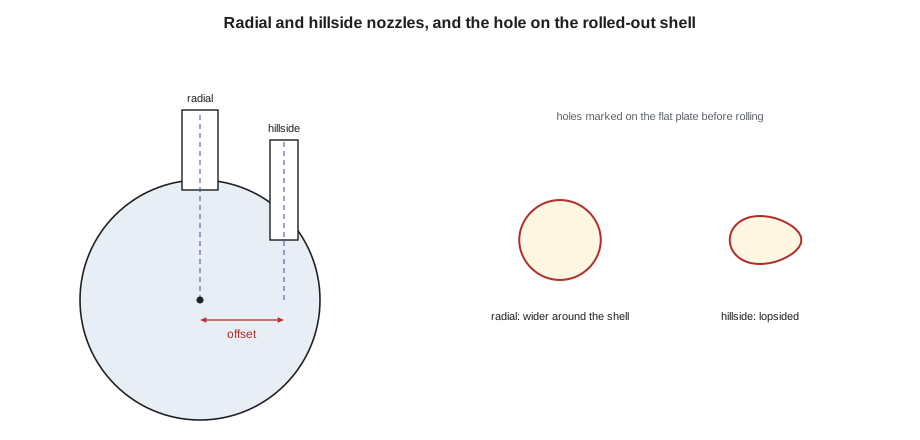
In January, the shop starts V-414, a second knockout drum built to the V-412 drawings that Kiera fitted last winter: 72 in inside diameter, 5/8 in shell, three courses, 2:1 ellipsoidal heads. This time Joanne wants the nozzle openings cut in the flat plates before rolling, rather than cut with a torch after the shell is fitted, because the CNC table cuts a cleaner hole and the bevel can be machined in one pass. That means every opening has to be laid out on the flat plate, where a round nozzle's hole is not round. "On the plate, the hole for a radial nozzle is wider around than it is along," Joanne says. "For a hillside nozzle, it's lopsided too. Get it wrong and the nozzle won't go in, or it'll go in crooked." This lesson covers radial, hillside and tangential nozzles on cylindrical shells, how their openings and neck cuts are laid out, how nozzles are oriented and located, and how nozzles on heads are laid out.
How nozzles are located
A vessel drawing locates each nozzle by three things: its orientation, the angle around the vessel from a reference line; its elevation, the distance along the vessel from a reference line such as the bottom tangent line; and its projection, the distance from the vessel's center line or outside surface to the nozzle's flange face. The orientation is shown in a plan view with the vessel's reference angles, usually 0, 90, 180 and 270 degrees, matched to north, east, south and west or to the plant's coordinate system. V-414's nozzles follow V-412's: the inlet N1 at 90 degrees on course 3, the vapor outlet on the top head, the liquid outlet on the bottom head, the level instrument nozzles N3 and N4 at 45 degrees, and the manway M1 at 210 degrees on course 2.
Before marking anything, Kiera transfers the orientation lines onto each course's flat plate. The 0 degree line is a known distance from the plate's edge, set by where the long seam falls, and every other angle is converted to an arc length on the outside of the shell: the outside radius times the angle in radians. On a rolled-out plate, the angles become straight lines across the plate, parallel to its short edges, at those arc lengths. The elevations become lines parallel to the long edges. Where a nozzle's orientation line and elevation line cross is the nozzle's center mark.
| Information | Where it comes from | How it is marked on the flat plate |
|---|---|---|
| Orientation | Plan view angle from the 0 degree line | Line across the plate at the arc length on the outside radius |
| Elevation | Distance from the bottom tangent line | Line along the plate at the distance from the course's lower edge |
| Projection | Flange face distance from the vessel center line | Sets the length of each neck line |
| Bolt hole orientation | Usually straddle the main center lines | Marked on the flange before fit-up |
Radial nozzles
A radial nozzle's axis passes through the vessel's center line. It is the simplest nozzle and the most common. On the rolled shell, its opening is a circle when seen along the nozzle's axis. On the flat plate, it is not: the points of the opening along the vessel's axis stay where they are, but the points around the vessel are measured along the curved surface, which is longer than their straight-line distance from the nozzle's axis. For a point on the nozzle's circle at sideways distance y from the nozzle's axis, the arc distance around the shell is the shell's radius times the angle whose sine is y divided by the radius.
For a small nozzle on a large shell, the arc and the straight distance are nearly equal and the hole is almost round. For a large nozzle on a small shell, the difference is clear: the hole on the flat plate is a slightly widened circle, longer around the shell than along it. The nozzle neck is also cut to the shell: its lines are longest at the sides, where the shell surface curves away, and shortest at the top and bottom, on the vessel's axis direction. That neck cut is the same saddle as a tee's branch, and lesson 6's method develops it.
Hillside and tangential nozzles
A hillside nozzle's axis is parallel to a radial line but offset from it, so the nozzle enters the shell on its sloping side, like a pipe set into a hill. Hillside nozzles are used to bring a pipe in where it lines up with the piping without a bend, or to clear another nozzle or a support. A tangential nozzle is a hillside nozzle offset so far that its axis is tangent, or nearly tangent, to the shell; it is used to make the incoming flow swirl, as in cyclones and some separators.
On the flat plate, a hillside opening is lopsided. The side of the hole toward the hill's top, farther from the radial line, is stretched more than the side toward the bottom, because the shell's surface slopes more steeply there. The neck lines are also very different on the two sides: short on the high side and long on the low side. The opening and the neck lines are found by the same method as for a radial nozzle, but with the offset added to each point's sideways distance before the arc is calculated, and the arc measured from the nozzle's own center mark.
Kiera's layout for N1 and N2
For practice, Joanne gives Kiera two nozzles from V-414's course 3: N1, an NPS 8 radial inlet, and N2, an NPS 4 hillside connection offset 20 in from its radial line, which the piping designer added to line up with a drain header. The shell's outside radius is 36 5/8 in, and both flange faces are 48 in from the vessel's center line. The code gives eight points on each opening, measured from the nozzle's center mark, and the neck length to the flange face at each point.
# Nozzle openings on a cylindrical shell, laid out on the rolled-out plate (US units)
import math
from math import gcd
MODE = "in"

def frac(x, den=16):
    sign = "-" if x < 0 else ""
    n = round(abs(x) * den); whole, rem = divmod(n, den)
    if rem == 0:
        return f"{sign}{whole} in"
    g = gcd(rem, den)
    return f"{sign}{whole} {rem // g}/{den // g} in" if whole else f"{sign}{rem // g}/{den // g} in"

def show(x):
    x = 0.0 if abs(x) < 1e-6 else x
    return f"{x:,.0f} mm" if MODE == "mm" else frac(x)
R = 36.625                       # outside radius of the shell (layout on the outside)
nozzles = [("N1 NPS 8, radial", 8.625, 0), ("N2 NPS 4, hillside", 4.5, 20)]                # name, nozzle outside diameter, offset of its axis from the radial line
H = 48                       # flange face distance from the vessel axis
n = 8
for name, d, e in nozzles:
    r = d / 2
    print(f"{name}: OD {show(d)}, offset {show(e)}")
    c = R * math.asin(e / R)   # arc position of the nozzle axis from the reference line
    for k in range(n):
        th = 2 * math.pi * k / n
        ax = r * math.cos(th)              # along the vessel axis
        lat = e + r * math.sin(th)         # sideways in plan
        arc = R * math.asin(lat / R) - c   # around the shell, from the nozzle center mark
        proj = H - math.sqrt(R * R - lat * lat)
print(f" pt {k}: axial {show(ax):>9} around {show(arc):>9} neck length {show(proj)}")N1 NPS 8, radial: OD 8 5/8 in, offset 0 in pt 0: axial 4 5/16 in around 0 in neck length 11 3/8 in pt 1: axial 3 1/16 in around 3 1/16 in neck length 11 1/2 in pt 2: axial 0 in around 4 5/16 in neck length 11 5/8 in pt 3: axial -3 1/16 in around 3 1/16 in neck length 11 1/2 in pt 4: axial -4 5/16 in around 0 in neck length 11 3/8 in pt 5: axial -3 1/16 in around -3 1/16 in neck length 11 1/2 in pt 6: axial 0 in around -4 5/16 in neck length 11 5/8 in pt 7: axial 3 1/16 in around -3 1/16 in neck length 11 1/2 in N2 NPS 4, hillside: OD 4 1/2 in, offset 20 in pt 0: axial 2 1/4 in around 0 in neck length 17 5/16 in pt 1: axial 1 9/16 in around 1 15/16 in neck length 18 7/16 in pt 2: axial 0 in around 2 3/4 in neck length 18 15/16 in pt 3: axial -1 9/16 in around 1 15/16 in neck length 18 7/16 in pt 4: axial -2 1/4 in around 0 in neck length 17 5/16 in pt 5: axial -1 9/16 in around -1 7/8 in neck length 16 5/16 in pt 6: axial 0 in around -2 5/8 in neck length 15 15/16 in pt 7: axial 1 9/16 in around -1 7/8 in neck length 16 5/16 in
N1's opening is very slightly wider around than along: 3 1/16 in at the 45 degree points against 3 1/16 in along, a difference too small to see on NPS 8 at this shell size. The neck lines tell more: they range from 11 3/8 to 11 5/8 in, so the neck's end is a shallow saddle. N2 is a different story. Its opening runs 2 3/4 in around on the high side and only 2 5/8 in on the low side, and its neck lines range from 15 15/16 to 18 15/16 in, a difference of 3 in from one side of a small nozzle to the other. A hillside nozzle cut with a square end would leave a gap of that size.
Kiera marks both openings on the flat plate with a center mark, a cross along the orientation and elevation lines, and the eight points, and joins them with a flexible batten. She writes the nozzle number, size and "cut to line" inside each hole, and the CNC programmer uses her marks to check the program before it runs.
Openings in the flat plate and the rolling allowance
Cutting an opening before rolling saves time, but it changes how the plate rolls. Near a large hole, the plate is weaker and rolls flat, so a course with a large opening tends to come out of the rolls with a flat spot. Joanne's rules: openings larger than about a quarter of the shell's diameter are cut after rolling, or cut in the flat plate with a bridge left across the hole and removed after rolling; and every course with an opening is checked carefully for roundness at the opening before it is fitted. On V-414 the manway, at 24 in, is cut after rolling; the smaller openings are cut flat.
The flange face's position is the other thing to watch. The neck length to the flange face is calculated from the drawing's projection, but the actual shell may be a few millimeters out of round at the nozzle. Kiera's practice, from Harjit, is to cut the neck long by 1/8 in, fit it, measure the actual projection with the flange held level and square, and trim to the drawing dimension before tacking the flange.
Nozzles on heads
Nozzles on heads are usually at the head's center or on a circle around it. A nozzle at the center of a 2:1 ellipsoidal or torispherical head is radial to the head, and its opening is a circle; its neck is cut square or very nearly so, because the head is flat near its center. A nozzle off-center on a head, parallel to the vessel's axis, is a hillside nozzle on a curved surface: its opening is an ellipse-like shape and its neck must be cut to the head's slope. The slope of the head at the nozzle's position decides how long the neck lines are on each side.
Head nozzles are laid out on the formed head, because a head is not developed from flat plate. Kiera marks the head's center with a center finder, scribes the 0, 90, 180 and 270 degree lines across it, measures each nozzle's radius from the center along the head's surface, or in plan with a level and a plumb bob, and marks the opening by holding the cut nozzle in place. Lesson 9 covers how to find the height and slope of the head at any radius, which tells her how to cut the neck before she offers it up.
| Nozzle | Axis | Opening on the flat plate | Neck cut |
|---|---|---|---|
| Radial on a shell | Through the vessel center line | Slightly widened circle | Shallow saddle |
| Hillside on a shell | Parallel to a radial line, offset | Lopsided | Short on the high side, long on the low side |
| Tangential | Tangent or nearly tangent | Very elongated | Very long on one side |
| Center of a head | On the vessel axis | Circle (laid out on the formed head) | Square or nearly square |
| Off-center on a head | Parallel to the vessel axis | Ellipse-like (on the formed head) | Cut to the head's slope |
Common mistakes
MistakeLaying out a round hole on the flat plate for a radial nozzle.
InsteadMeasure each point's position around the shell as an arc, not a straight distance.
MistakeMeasuring a hillside opening's arcs from the radial line.
InsteadAdd the offset to each point, then measure the arcs from the nozzle's own center mark.
MistakeCutting a large opening in a plate before rolling with no allowance.
InsteadCut large openings after rolling, or leave a bridge across the hole until rolled.
MistakeCutting the neck to the calculated length and tacking straight away.
InsteadCut long, fit, measure the actual projection, and trim before tacking.
MistakeIgnoring flange bolt hole orientation.
InsteadCheck that bolt holes straddle the center lines unless the drawing says otherwise.
Summary and key terms
- Nozzles are located by orientation, elevation and projection, transferred to the flat plate as arc lengths and distances.
- A radial nozzle's opening on the flat plate is slightly wider around than along: s = R sin⁻¹(y ÷ R).
- A hillside nozzle's opening is lopsided and its neck lines differ greatly from side to side.
- Large openings are cut after rolling or bridged, because holes make the plate roll flat.
- Necks are cut long, fitted and trimmed to the measured projection.
- Head nozzles are laid out on the formed head, with the neck cut to the head's slope.
- Orientation
- A nozzle's angle around a vessel from its reference line.
- Projection
- The distance from a vessel's center line or surface to a nozzle's flange face.
- Radial nozzle
- A nozzle whose axis passes through the vessel's center line.
- Hillside nozzle
- A nozzle whose axis is parallel to a radial line but offset from it.
- Tangential nozzle
- A nozzle whose axis is tangent or nearly tangent to the shell.
- Neck
- The pipe or rolled plate between a nozzle's flange and the shell.
Practice problems
Work each problem on paper first, then reveal the answer to check.
On the flat plate, why is a radial nozzle's opening wider around the shell than along it?
Show answer
Distances around the shell are measured along the curved surface, which is longer than the straight distance.
Why are hillside nozzle neck lines so different from side to side?
Show answer
The nozzle enters the shell on a slope, so one side meets the shell much sooner than the other.
A nozzle at 90 degrees on a shell with an outside radius of 36 5/8 in: how far around from the 0 degree line is its center mark?
Show answer
π ÷ 2 × 36.625 = 57 1/2 in.
Why does Harjit cut nozzle necks long?
Show answer
So the actual projection can be measured on the real shell and the neck trimmed to the drawing dimension.
Lesson quiz · 5 questions
Score 60% or more to complete this lesson.
Create a free account to save your progress, take quizzes and earn a certificate.