
BLR-310 · Lesson 7 of 12 · 19 min
Cone-to-cylinder intersections
The Pinecrest hopper needs one more feature before it can be cut: a round inlet on its sloping side, an NPS 10 pipe that brings back the fine dust from a second-stage cyclone. The inlet comes in horizontally, square to the hopper's axis, at 36 in above the hopper's small end, and its flange face must be 48 in out from the hopper's center line to line up with the cyclone's return leg. The cylinder is easy; the cone it meets is not, because the cone's surface is sloping and its radius changes with height. "This is the job that separates the people who learned the method from the people who learned the recipe," Joanne says. "There's no table in a book for a pipe going into the side of a cone at that height. You have to find the line of intersection yourself." This lesson covers how to find the line where a cylinder meets a cone by cutting planes, how to develop the inlet's pattern and the opening in the cone, and the special cases that make the job easier.
Why cones are harder than cylinders
When a branch meets a cylindrical header, every horizontal slice through the header is the same circle, so each branch line's meeting point depends only on its sideways offset. A cone is different: every horizontal slice is a circle of a different size. A branch line that is higher on the inlet meets a wider part of the cone, and a line that is lower meets a narrower part. The meeting point of each line depends on both its sideways offset and its height. That is why there is no simple formula like the tee's, and why the line of intersection must be found point by point.
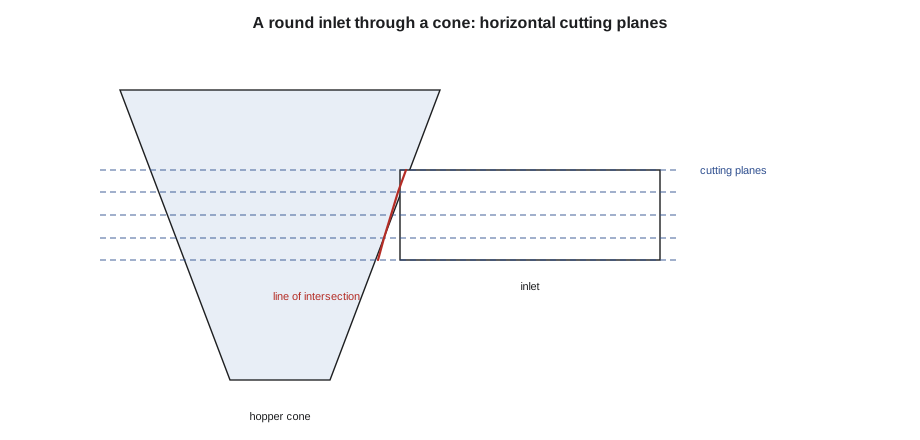
The method is cutting planes. Imagine a series of horizontal planes slicing through both the cone and the inlet. Each plane cuts the cone in a circle, whose radius is the cone's radius at that height, and cuts the horizontal inlet in two straight lines running along it, at the plane's height. Where those straight lines meet the circle are two points on the line of intersection. Repeat with enough planes, from the top of the inlet to the bottom, and the points trace out the whole curve.
Choosing the planes
The planes are chosen so that each one passes through a division line of the inlet. The inlet's circle is divided into 16 equal parts, as for a tee, starting at the top. Each division point has a height, the inlet's center line height plus the inlet radius times the cosine of its angle, and a sideways offset, the inlet radius times the sine of its angle. The plane through that point cuts the cone at the cone's radius for that height. The point on the line of intersection is where the inlet line, at that sideways offset, meets the cone's circle: its distance out from the cone's axis is the square root of the cone's radius squared minus the sideways offset squared.
Here ρ of z is the cone's radius at height z above its small end, r zero is its small-end radius and α is its half apex angle. For the Pinecrest hopper, the radius grows by 0.6 times the height: from the small mean radius of 12 3/16 in, by 36 in over 60 in of height. The length of each inlet line, from the flange face to the cone, is the flange face's distance from the axis minus x.
| Inlet line | Height on the cone | Cone radius there | Meeting point |
|---|---|---|---|
| Top (line 0) | Highest | Largest | Farthest out: shortest inlet line |
| Sides (line 4) | Inlet center line | Middle | Reduced by the sideways offset |
| Bottom (line 8) | Lowest | Smallest | Closest to the axis: longest inlet line |
Kiera's inlet pattern
Kiera runs the shop code for the inlet: the stretchout and the length of each of the 16 lines, from the top line round to the bottom. Because the inlet is symmetrical left to right, nine lines cover half the pattern.
# A round inlet through the side of a cone: points by cutting planes (US units)
import math
from math import gcd
MODE = "in"

def frac(x, den=16):
    sign = "-" if x < 0 else ""
    n = round(abs(x) * den); whole, rem = divmod(n, den)
    if rem == 0:
        return f"{sign}{whole} in"
    g = gcd(rem, den)
    return f"{sign}{whole} {rem // g}/{den // g} in" if whole else f"{sign}{rem // g}/{den // g} in"

def show(x):
    x = 0.0 if abs(x) < 1e-6 else x
    return f"{x:,.0f} mm" if MODE == "mm" else frac(x)
r0, slope = 12.1875, 0.6      # cone radius at the small end, and radius gained per unit height
z0, d = 36, 10.75             # height of the inlet centerline above the small end, inlet outside diameter
X0 = 48                      # inlet flange face, measured out from the cone axis
rn = d / 2
n = 16
print("inlet stretchout", show(math.pi * d))
lengths = []
for k in range(n // 2 + 1):
    th = 2 * math.pi * k / n
    y, z = rn * math.sin(th), z0 + rn * math.cos(th)   # point on the inlet circle
    rho = r0 + slope * z                               # cone radius at that height
    x = math.sqrt(rho * rho - y * y)                   # where that inlet line meets the cone
    lengths.append(X0 - x)
for k, L in enumerate(lengths):
    print(f"  line {k:2} ({'top' if k == 0 else 'bottom' if k == n // 2 else 'side'}) length {show(L)}")
print("longest minus shortest line:", show(max(lengths) - min(lengths)))inlet stretchout 33 3/4 in line 0 (top) length 11 in line 1 (side) length 11 5/16 in line 2 (side) length 12 1/8 in line 3 (side) length 13 5/16 in line 4 (side) length 14 5/8 in line 5 (side) length 15 13/16 in line 6 (side) length 16 3/4 in line 7 (side) length 17 1/4 in line 8 (bottom) length 17 7/16 in longest minus shortest line: 6 7/16 in
The top line is the shortest, as the table predicted, because it meets the cone where the cone is widest. The bottom line is the longest. The difference, more than 6 3/8 in, is much larger than the saddle on a tee of the same size, because the cone's slope adds to the effect of the curvature. The pattern looks like a lopsided tee template, with a deep cut at the bottom and a shallow one at the top, and that is what it is: a tee on a sloping header whose radius changes.
Kiera lays out the template on sheet metal, wraps it on a length of NPS 10 pipe and marks the cut. Before cutting, she checks two points against the drawing: the top line's length, measured from the flange face, should place the inlet's top just at the cone, and the bottom line's length should place its bottom just at the cone. Both match.
The opening in the cone
The opening in the cone must be marked on the cone's flat pattern before it is rolled, or the hole must be cut after forming with the inlet held in place. For a hopper made of three flat pieces, Joanne prefers to cut the opening flat. Each point on the line of intersection has a height on the cone and an angle around the cone's axis. On the cone's pattern, the height becomes a distance along an element from the apex, the slant distance, which is the height above the apex times the slant height divided by the vertical height; and the angle around the axis becomes an angle on the pattern, which is the angle around the axis times the sine of the half apex angle.
So each point on the opening is laid out on the flat piece by swinging an arc of its slant distance from the apex and setting off its angle on the pattern from a reference element. With 16 points, the opening's outline on the flat plate is a slightly egg-shaped curve. Kiera marks it on the second of the three pieces, where the inlet falls, and cuts it with the piece still flat. The cut is made square to the plate, and the bevel for the weld is ground after rolling, when the angle of the inlet to the cone's surface can be seen.
Worked problem
Placing the top point of the opening
The inlet's top point is 41 3/8 in above the hopper's small end, on the reference element in line with the inlet. The cone's radius grows by 0.6 times the height from 12 3/16 in at the small end. How far from the apex is the point on the flat pattern?
Show solution
- The apex is below the small end by the small radius divided by 0.6: 12.1875 ÷ 0.6 = 20 5/16 in.
- Height of the point above the apex = 41 3/8 + 20 5/16 = 61 11/16 in.
- Slant distance = height × √(1 + 0.6²) = height × 1.166 = 71 15/16 in.
- The point is on the reference element, so its pattern angle is zero.
Answer: The top point is marked 71 15/16 in from the apex along the reference element of the flat piece.
Special cases
Some cone-to-cylinder intersections are much simpler. When a cylinder meets a cone on the same axis, as when a shell course meets a cone in a vessel, the line of intersection is a circle in a plane square to the axis, and both parts are simply cut square. That is the shell-to-cone junction Kiera will fit in lessons 10 and 12. When a cylinder enters a cone along a line that passes through the cone's apex, a cylinder whose axis lies along an element of the cone, the intersection is easier to find with planes through the apex instead of horizontal planes, because each such plane cuts the cone in two straight elements. And when a cylinder meets a cone with its axis vertical and parallel to the cone's axis, as an outlet pipe hanging from a hopper might, horizontal planes cut the cylinder in circles and the work is again simple.
There is one more special case that Joanne likes to show apprentices: when a cylinder and a cone both fit around the same sphere, their line of intersection is a pair of flat curves that appear as straight lines in a side view. This is the basis of the classic layout for a cone reducer meeting an elbow, and it is why drawing offices often choose cone angles and cylinder sizes that fit around a common sphere: the cuts become straight in the side view and much easier to lay out.
| Case | Planes to use | Intersection |
|---|---|---|
| Cylinder on the cone's axis | None needed | A circle square to the axis; both parts cut square |
| Horizontal cylinder into the side of a vertical cone | Horizontal planes | Curve found point by point |
| Cylinder along an element of the cone | Planes through the apex | Curve found from straight elements |
| Cylinder and cone around a common sphere | Any | Flat curves, straight in side view |
Fitting the inlet
The inlet is fitted after the hopper is rolled, fitted and tacked, so that the cone's actual shape is known. Kiera sets the inlet in the opening with its flange face plumb and square to the hopper's center line, checks the face's distance from the hopper's axis, and checks that the flange bolt holes straddle the vertical center line, as the drawing requires. Small gaps at the top or bottom are dressed by grinding the inlet's end. The inlet is tacked in four places, rechecked, and welded with a sequence that alternates sides to keep the flange from pulling out of square.
Common mistakes
MistakeTrying to develop the inlet with the tee formula.
InsteadA cone's radius changes with height; find each point with cutting planes.
MistakeUsing a few planes and joining the points with straight lines.
InsteadUse a plane through every division line of the inlet and join the points with a smooth curve.
MistakeCutting the opening in the cone after it is rolled, without the inlet in place.
InsteadDevelop the opening onto the flat piece, or hold the inlet in place and mark around it after forming.
MistakeSetting the inlet flange by eye.
InsteadCheck plumb, square, distance from the axis, and bolt holes straddling the center line before tacking.
Summary and key terms
- A cylinder meeting a cone's side is found point by point, because the cone's radius changes with height.
- Horizontal cutting planes through each inlet division line cut the cone in circles and the inlet in straight lines.
- Each inlet line meets the cone at x = √(ρ(z)² − y²); its length is the flange distance minus x.
- The opening is laid out on the cone's flat pattern by slant distance and pattern angle.
- Coaxial cylinders and cones meet in a circle and are cut square; other special cases use planes through the apex or a common sphere.
- The inlet is fitted after the cone is formed, with its flange checked for plumb, square and position.
- Cutting plane
- An imaginary plane that slices two surfaces to find points on their line of intersection.
- Slant distance
- The distance from a cone's apex to a point, measured along an element.
- Pattern angle
- The angle on a cone's flat pattern that corresponds to an angle around its axis.
- Coaxial
- Sharing the same axis.
- Inlet
- A pipe or duct connection bringing material into a vessel or hopper.
Practice problems
Work each problem on paper first, then reveal the answer to check.
Why is the inlet's top line shorter than its bottom line?
Show answer
The top line meets the cone where the cone is widest, so it reaches the cone sooner.
A cone's radius is 12 3/16 in at its small end and grows by 0.6 times the height. What is its radius 20 in up?
Show answer
12 3/16 + 12 = 24 3/16 in.
How does a shell course meet a cone on the same axis?
Show answer
In a circle square to the axis, so both parts are cut square.
What does a cutting plane do to a horizontal inlet?
Show answer
It cuts it in two straight lines running along the inlet at the plane's height.
Lesson quiz · 5 questions
Score 60% or more to complete this lesson.
Create a free account to save your progress, take quizzes and earn a certificate.