
BLR-310 · Lesson 5 of 12 · 19 min
Triangulation: square-to-round and other transitions
The same dust collector needs a new inlet. The collector's inlet plenum has a square opening, but the duct bringing the dusty air from the mill's boiler is round. Between them goes a transition: a square-to-round, 48 in square at the plenum, 16 in round at the duct, with 36 in between the two ends, in 3/8 in plate. Kiera will lay it out as if it stood upright, with the square at the bottom and the round on top, and call the distance between the ends its height; the geometry is the same in any position. Square-to-round transitions are among the most common fabricated parts in ductwork, hoppers and chutes, and they are the classic triangulation job. "Every apprentice I've taught has laid out a square-to-round," Joanne says. "Most of them got it wrong the first time. The ones who checked their true lengths got it right the second time." This lesson covers how a transition is made up of flat triangles and partial cones, how to triangulate it, where to put the seam, and how the same method handles rectangular and offset transitions.
What a square-to-round is made of
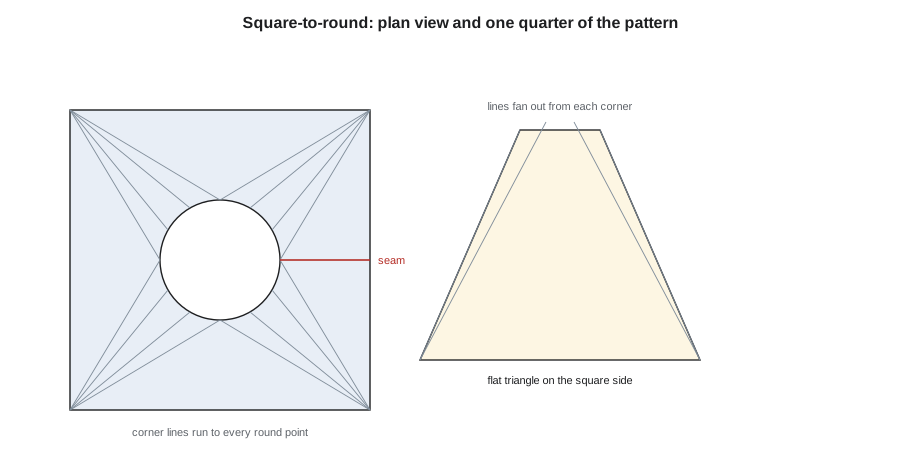
Look at a square-to-round from above. Each side of the square is joined to the round by a flat triangle: its base is the side of the square and its apex is the point on the round nearest that side. Between the flat triangles, at each corner of the square, is a part of an oblique cone: the corner of the square is its apex, and a quarter of the round is its base. So a square-to-round is four flat triangles and four quarter cones, all of which are developable, joined along straight lines. That is why it can be made from one flat plate, bent along the lines between the triangles and rolled or brake-formed in the cone parts.
The quarter cones are oblique, not right cones: the corner of the square is not over the center of the quarter round, so the lines from the corner to points on the round are all different lengths. That rules out the radial-line method with a single slant height and calls for triangulation, although each line is still swung from the corner as its center.
Dividing the round and finding true lengths
The round is divided into twelve equal parts, three in each quarter, with points on the center lines of the square's sides. In one quarter, the points are numbered 0 to 3, from the middle of one side to the middle of the next, and lines are drawn from the corner of the square to each of them. By symmetry, the other three quarters are the same, so the true lengths for one quarter serve the whole transition.
Each line from the corner to a point on the round covers three distances: across and along in plan, from the corner to the point, and up, the height of the transition. Its true length is the square root of the sum of their squares. Because the transition is concentric and square, lines 0 and 3 are the same length, and lines 1 and 2 are the same length, so only two true lengths are needed for the corner lines. One more is needed for the seam: the line from the middle of a side of the square to point 0, which lies in a vertical plane and is the true length of the seam.
| Line | From | To | Notes |
|---|---|---|---|
| Corner to 0 and corner to 3 | Corner of the square | Points on the side center lines | Edges of the flat triangles; same length |
| Corner to 1 and corner to 2 | Corner of the square | Points at 30 and 60 degrees | Inside the quarter cone; same length |
| Seam line | Middle of a side | Point 0 | Splits one flat triangle in half |
| Round chords | Point to neighboring point | - | Mean circumference divided into twelve, as chords |
Kiera's numbers
Kiera works to the mean dimensions: a 48 3/8 in square and a 16 3/8 in round, 36 in high. The code gives her the two corner true lengths, the seam length, the chord between round points and an estimate of the pattern area for the weight on the cutting list.
# Square-to-round transition by triangulation (US units)
import math
from math import gcd
MODE = "in"

def frac(x, den=16):
    sign = "-" if x < 0 else ""
    n = round(abs(x) * den); whole, rem = divmod(n, den)
    if rem == 0:
        return f"{sign}{whole} in"
    g = gcd(rem, den)
    return f"{sign}{whole} {rem // g}/{den // g} in" if whole else f"{sign}{rem // g}/{den // g} in"

def show(x):
    x = 0.0 if abs(x) < 1e-6 else x
    return f"{x:,.0f} mm" if MODE == "mm" else frac(x)
A, Dr, H = 48.375, 16.375, 36      # mean side of the square, mean diameter of the round, height
r = Dr / 2
n = 12                         # divisions of the round, 3 in each quarter
# one quarter: corner at (A/2, A/2, 0); round points 0..3 from the middle of one side to the next
corner = (A / 2, A / 2, 0)
pts = [(r * math.cos(math.radians(90 * k / 3)), r * math.sin(math.radians(90 * k / 3)), H) for k in range(4)]
print("true lengths from the corner to round points 0-3:")
for k, p in enumerate(pts):
    print(f"  corner to {k}: {show(math.dist(corner, p))}")
mid = (A / 2, 0, 0)            # seam line from the middle of the flat side to point 0
print("seam line (middle of side to point 0):", show(math.dist(mid, pts[0])))
chord = 2 * r * math.sin(math.radians(15))
print("chord between round points", show(chord), "(arc", show(math.pi * Dr / n) + ")")
# area of the developed pattern, for weight: sum of flat triangles and the triangles of the cone parts
def tri(p, q, s):
    a, b, c = math.dist(p, q), math.dist(q, s), math.dist(s, p)
    z = (a + b + c) / 2
    return math.sqrt(max(z * (z - a) * (z - b) * (z - c), 0))
quarter = sum(tri(corner, pts[k], pts[k + 1]) for k in range(3))
quarter += 2 * tri(corner, mid, pts[0])        # two half flat triangles per quarter
area = 4 * quarter
print("approximate pattern area", f"{area / 144:.2f} ft2")true lengths from the corner to round points 0-3: corner to 0: 46 1/4 in corner to 1: 44 5/8 in corner to 2: 44 5/8 in corner to 3: 46 1/4 in seam line (middle of side to point 0): 39 3/8 in chord between round points 4 1/4 in (arc 4 5/16 in) approximate pattern area 34.04 ft2
The chord is a little shorter than the arc spacing it stands for, by about 1/16 in for each of the twelve spaces. Over the whole round that would add up to more than 3/8 in, so when Kiera lays out the pattern she uses the arc spacing along the curve, bending a flexible rule through the points, rather than stepping the chord with dividers. Joanne's rule is simple: use chords to find the points, then check the curve's length against the circumference.
Laying out the pattern
The seam goes on the center line of one flat side, so the pattern starts and ends with half a flat triangle. Kiera starts with the seam line drawn at its true length. At its bottom end, point 0 on the round; at its top, the middle of the square's side. From the top, she sets off half the side of the square, square to the seam line in the drafting sense: a half triangle needs one more true length, the corner-to-0 line, swung from point 0, to cross the half-side distance swung from the middle of the side. Where they cross is the corner of the square.
From there, the quarter cone is laid out as a fan. With the corner as center, she swings arcs of the true lengths to points 1, 2 and 3; from point 0, she steps the arc spacing to cross the arc for point 1, then from point 1 to cross the arc for point 2, and so on. After point 3, the next flat triangle is laid out with the full side of the square as its base: from point 3, the corner-to-3 true length to the next corner, crossed by the side length from the previous corner. Then another fan, another flat triangle, around all four corners, finishing with the half triangle at the seam.
When the pattern is complete, the points on the round end are joined by a smooth curve, the corners of the square are joined by straight lines, and two checks are made. The curve must measure the round's mean circumference, and each straight edge must measure the side of the square. Joanne also checks that the two seam edges are the same length and that the pattern is symmetrical about a line through its middle.
Worked problem
A check on the curve
Kiera's completed pattern has a curved edge measuring 51 5/8 in. Is it right?
Show solution
- The round's mean circumference = π × 16.375 = 51 7/16 in.
- The difference is 3/16 in.
Answer: 3/16 in is more than the shop allows for a part this size, so Kiera finds the step where her arcs drifted and lays that part out again.
Forming the transition
The flat triangles stay flat. The lines between each flat triangle and its neighboring quarter cone, the corner-to-0 and corner-to-3 lines, are bend lines, marked on the plate with a center punch. The quarter cones are formed by a series of light brake bends along the lines from the corner to each round point, the lines Kiera already has, with extra lines between them for a smoother curve. A press brake operator calls these bump bends. In thin plate, the cone parts can be rolled on a slip roll instead. The plate is formed from the middle outward, the seam closed and tacked, and the square end checked for square by its diagonals and the round end checked for diameter.
Where a transition is too large for one plate, it is made in two halves or four quarters, with seams on the center lines of opposite sides or of all four sides. The seams are always on a flat triangle's center line, never in a cone part, because a seam in a cone part would have to be formed and welded at once.
Other transitions
The same method handles every transition built from flat triangles and cone parts. A rectangle-to-round has two pairs of flat triangles of different sizes, and its corner lines in each quarter are no longer symmetrical, so all four corner lines in a quarter need their own true lengths. An offset square-to-round, where the round is not centered under the square, needs true lengths for every line in every quarter, since no two quarters are alike. A transition between two rectangles of different sizes is a frustum of a pyramid, made of four flat trapezoids, each of which can be split into two triangles and developed directly.
The Riverbend fan inlet has one of those rectangle-to-rounds, from the fan's 72 by 48 in inlet box to the 48 in duct. Joanne gives it to Kiera to lay out on her own as practice, with the warning that the corner lines are no longer equal. She triangulates it with 24 divisions of the round and finds her curve within 1/16 in of the circumference on the first try.
| Transition | Pieces | True lengths needed |
|---|---|---|
| Concentric square-to-round | 4 flat triangles, 4 quarter cones | 2 corner lines and the seam line |
| Concentric rectangle-to-round | 2 pairs of flat triangles, 4 quarter cones | All corner lines in one quarter |
| Offset square-to-round | 4 flat triangles, 4 quarter cones, all different | Every line in every quarter |
| Rectangle-to-rectangle | 4 flat trapezoids | Diagonals and edges of each face |
Common mistakes
MistakeTreating the quarter cones as right cones with one slant height.
InsteadThe corner is not over the center of the quarter round; every line has its own true length.
MistakeStepping chords around the whole round and trusting the total.
InsteadUse chords to find points, then check the curve's length against the mean circumference.
MistakePutting a seam in a cone part.
InsteadPut seams on the center line of a flat triangle.
MistakeAssuming the corner lines of a rectangle-to-round are symmetrical.
InsteadOn a rectangle or offset transition, each corner line needs its own true length.
MistakeForgetting to mark bend lines before forming.
InsteadPunch the lines between the flat triangles and the cone parts, and the bump-bend lines in the cones.
Summary and key terms
- A square-to-round is four flat triangles and four quarter oblique cones, all developable.
- The round is divided into equal parts and lines are drawn from each corner to the points on its quarter.
- Each line's true length comes from its plan distances and the height.
- The pattern is laid out from the seam, alternating flat triangles and fans, and checked against the circumference and side lengths.
- Flat triangles stay flat; the cone parts are bump-bent or rolled.
- Rectangle, offset and rectangle-to-rectangle transitions use the same method with more true lengths.
- Transition
- A part joining two openings of different shape or size.
- Square-to-round
- A transition from a square opening to a round one.
- Flat triangle
- The flat part of a transition joining a side of the square to the round.
- Quarter cone
- The oblique cone part of a transition at each corner of the square.
- Bump bending
- Forming a curve on a press brake with a series of light bends.
- Bend line
- A line marked on a pattern where the plate is to be bent.
Practice problems
Work each problem on paper first, then reveal the answer to check.
How many true lengths are needed for the corner lines of a concentric square-to-round?
Show answer
Two, because lines 0 and 3 are equal and lines 1 and 2 are equal.
Where does the seam go on a square-to-round?
Show answer
On the center line of a flat triangle, usually the middle of one side.
Why are the corner lines of a rectangle-to-round not symmetrical?
Show answer
The two sides of each corner are different lengths, so the round points are at different distances from the corner.
A transition's round end has a mean diameter of 20 in. What should its curved edge measure?
Show answer
π × 20 = 62 13/16 in.
Lesson quiz · 5 questions
Score 60% or more to complete this lesson.
Create a free account to save your progress, take quizzes and earn a certificate.